
The behaviors that kill your shot at competitive specialties almost never feel dramatic. They feel small, casual, “no big deal.” They are not.
If you want even a chance at derm, ortho, plastics, ENT, urology, ophtho, or a competitive IM program, you cannot afford to ignore how you show up on clerkships. Not grades on paper. Behaviors. The stuff people quietly warn each other about when your name comes up at ranking meetings.
Let me walk you through the landmines.
1. Acting Like Non-Core Rotations Don’t “Count”
This one ends students every year.
You think: “I’m going into ortho. Family med and psych don’t matter.”
The faculty think: “This student is disrespectful, narrow, and risky to recommend.”
You will never see the email that says, “I wouldn’t take this student for our specialty.” But it gets sent.
Common ways this shows up:
- Doing the bare minimum on “non-relevant” rotations
- Constantly saying “I’m not interested in this, I’m going into X”
- Skipping teaching because “I had to study for Step 2”
- Rolling your eyes at consults from services you “don’t care about”
Here’s the nasty part: attendings talk across departments. The psych attending whose lecture you blew off plays tennis with the program director in anesthesia. The FM doc whose patients you ignored has a spouse on the derm faculty. You never see the connections. They absolutely see you.
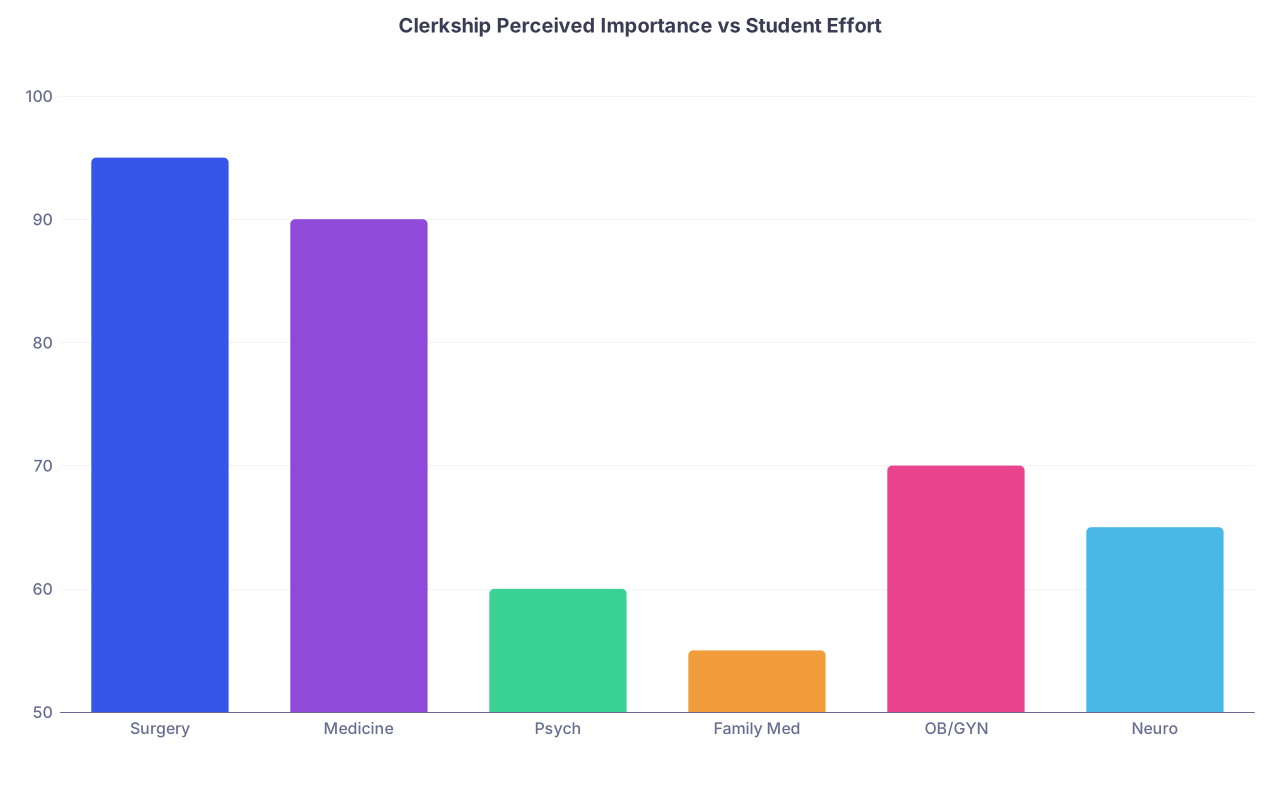
| Category | Value |
|---|---|
| Surgery | 95 |
| Medicine | 90 |
| Psych | 60 |
| Family Med | 55 |
| OB/GYN | 70 |
| Neuro | 65 |
Do not make these mistakes:
- Treating some rotations as “vacation” blocks
- Studying only for your desired field during other clerkships
- Saying out loud, “This isn’t really my thing, so I’m just here to pass”
Better rule:
Every rotation is either (a) a letter of recommendation opportunity, or (b) a future colleague’s memory of you. Both matter.
You want attendings saying, “Not my field, but this student would do great in ____.” That’s the quiet endorsement that opens doors.
2. Being the “Score Chaser” Who Forgets They’re a Teammate
Competitive fields do care about Step scores and class rank. But programs don’t want robots who annihilate exams and drain the team.
I’ve seen this pattern too often:
- Student crushes pre-clinical exams
- Hits 250+ on Step 2
- Shows up on wards acting like the rotation is an annoying obstacle to their study schedule
Outcome?
Evaluations full of: “technically strong, but not a team player,” “seems uninterested in patient care,” “prioritizes own schedule over service needs.”
In competitive specialties, that reads as: risk. They picture you as a resident who disappears before sign-out because you “have to study.”
Typical self-sabotaging behaviors:
- Constantly asking to leave early “to study” when the team’s still working
- Refusing small tasks (calling a lab, finding old records) because “that’s scut”
- Never checking on patients unless specifically told
- Not offering to help co-students; acting like everyone else is competition

What attendings and residents remember:
- Who volunteered to handle hard family conversations
- Who stayed late once without complaining when things got busy
- Who checked back on a sick patient without being asked twice
You don’t need to martyr yourself or live at the hospital. You do need to look like someone they’d want on call at 3 a.m. That’s what gets you the line: “I’d rank this student highly.”
Blunt rule:
If you’re always calculating “what’s the least I can do and still get Honors,” people can smell it. Competitive fields do not reward that.
3. Clocking Out Mentally Once the Day “Should” Be Over
Residents notice the student who disappears at 4:59 p.m. every day like it’s a shift at Starbucks. Some services are chill. Some really do say, “Go home, read.” Fine. Then go home.
But students quietly close doors when they:
- Start packing up 15 minutes before the expected end of the day
- Stand at the door with their backpack on while sign-out is still happening
- Say, “I have to get to the gym/appointment/dinner,” every other day at 5 on the dot
You might think, “I’m just following orders. They said we usually leave at 4.”
That’s not how they’re reading it.
They’re thinking:
- “Will this person bounce the second things get hard as a resident?”
- “Do they care about the team’s rhythm or just their own schedule?”

| Step | Description |
|---|---|
| Step 1 | Busy late afternoon |
| Step 2 | Offer to help with 1-2 concrete tasks |
| Step 3 | Ask if its ok to head out |
| Step 4 | Resident notices reliability |
| Step 5 | Neutral impression |
| Step 6 | Student packs up early |
| Step 7 | Resident notes poor commitment |
| Step 8 | Tasks pending at 4:30? |
Better script at 4:30–5:00:
- “What can I help with before I head out?”
- “Anything I can finish up while you guys work on notes?”
- “If nothing else is needed, is it ok if I read for tomorrow?”
Ten seconds of that language changes the entire evaluation.
Do not make the mistake of always being the first one to leave. People notice patterns, not isolated days.
4. Using “I Want X Specialty” as a Personality, Not a Goal
Here’s a brutal truth: telling everyone “I want derm/ortho/plastics” does nothing for you if your behavior doesn’t match the competitiveness of that field. In fact, it backfires.
I’ve sat in meetings where someone says, “He’s very vocal about wanting ENT, but…” and then everyone else fills in the “but” with stories:
- But he was late all the time
- But he complained nonstop on medicine
- But he was disorganized on OB and missed key follow-ups
- But nursing hated working with him
That “but” kills your future faster than a mid-range Step score.
Red-flag behaviors:
- Introducing yourself with: “Hi, I’m Alex, I want derm!” to every attending on day 1
- Making jokes about other fields being “less competitive” or “backup plans”
- Acting like you’re above “non-procedural” tasks because you’re a future surgeon
- Only turning on effort when in front of someone you think can write your letter

You want faculty to discover that you’re aiming high after they’ve already noticed you:
- Showing up prepared every day
- Being kind to staff
- Owning your mistakes without drama
- Doing solid H&Ps and follow-up
Then when you say, “I’m interested in ortho,” they think, “That tracks. They’re reliable.”
Wrong order → you announce a big dream before building credibility.
Right order → you prove you’re serious, then share your goal.
5. Underestimating How Much Nurses and Staff Control Your Reputation
If you blow off one thing from this article, do not let it be this.
Nurses, MAs, unit secretaries, techs, and scrub nurses can quietly destroy your chances at a field. Not because they’re malicious. Because attendings ask them simple questions:
- “How’s the student?”
- “Do they help or just stand around?”
- “Would you want to work with them again?”
And then they answer honestly.
Common self-inflicted damage:
- Ignoring nurses’ pages or taking forever to respond
- Acting defensive when a nurse points out something you missed
- Standing with arms crossed in the OR instead of offering to help turn, position, or move the patient
- Treating ancillary staff like obstacles instead of teammates
| Behavior | How Staff Interprets It |
|---|---|
| Quickly answering pages | Reliable, respectful |
| Arguing over small requests | Difficult, ego-driven |
| Offering to help with simple tasks | Team player, hardworking |
| Constant phone use at nurses' station | Disengaged, disrespectful |
| Thanking staff after cases/shifts | Professional, memorable |
I’ve heard scrub nurses tell surgeons:
- “Take the other student. This one never helps.”
- “She’s great in the OR. Always ready, never complains.”
Guess which one gets an away rotation spot or a quiet call to the program director.
Do not make the mistake of thinking only attendings matter. Staff can’t write you letters, but they absolutely shape them.
6. Confusing “Laid-Back” With “Unreliable”
Some students, trying to be “chill,” come across as uninterested. Or worse, lazy. On an easy service, this might just cost you Honors. On a competitive-subject-facing rotation, it can label you as unfit for high-intensity fields.
Patterns that send the wrong message:
- Strolling in just on time, never early, never prepared
- Never volunteering for anything unless directly asked
- Responding with one-word answers on rounds
- Standing at the back, never close to the action
Residents don’t say, “This student is laid-back.”
They say, “I can’t tell if they even want to be here.”
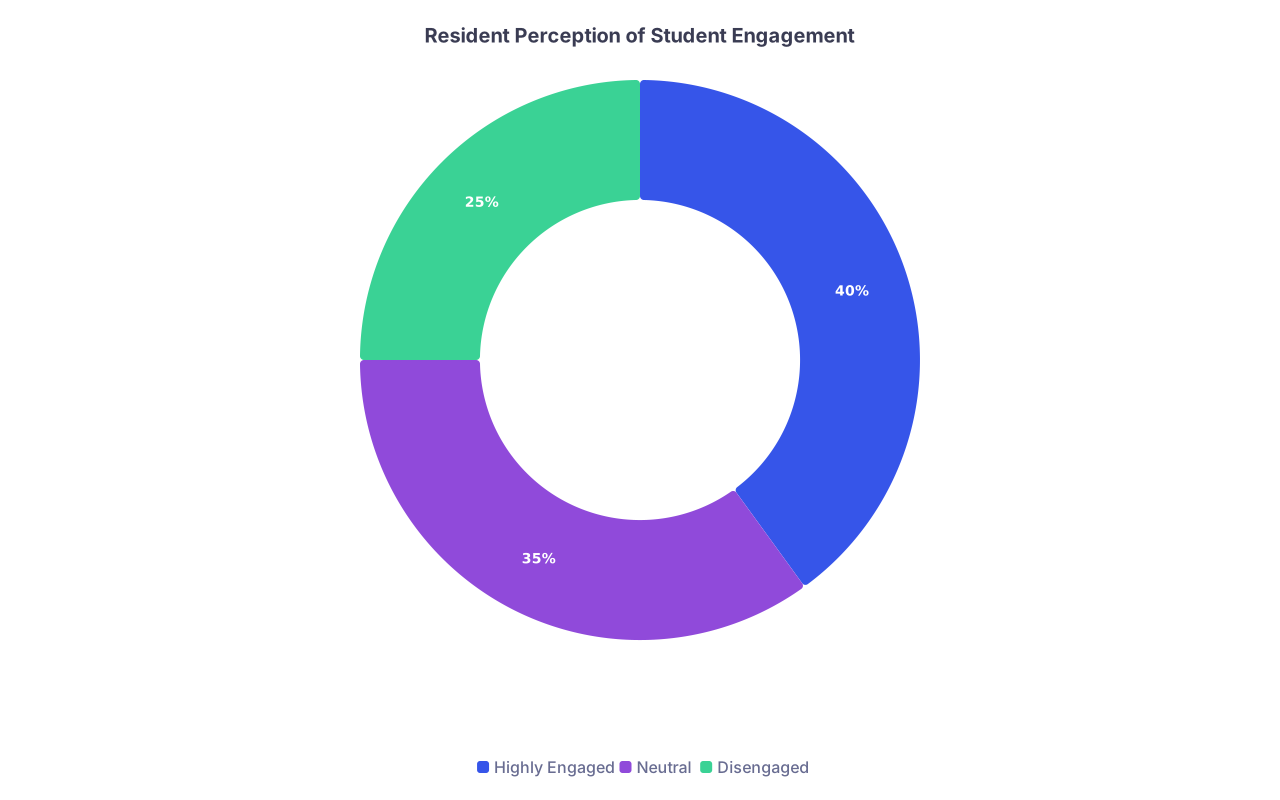
| Category | Value |
|---|---|
| Highly Engaged | 40 |
| Neutral | 35 |
| Disengaged | 25 |
If you’re naturally quiet, you don’t need to fake extroversion. But you do have to show intent:
- Ask 1–2 specific questions per day
- Volunteer for at least one concrete task per patient you follow
- Keep a running list of follow-ups to present on rounds without prompting
Don’t hide at the edges and assume your “good attitude” is obvious. It isn’t.
Competitive specialties especially want people who take initiative. Not chaos-makers. Quietly proactive.
7. Treating Feedback as a Personal Attack
I’ve watched otherwise strong students take themselves out of contention for competitive programs because they couldn’t handle feedback like adults.
Patterns that scare evaluators:
- Getting visibly defensive when corrected
- Arguing about minor points on presentations or notes
- Shutting down after one piece of criticism
- Saying, “But that’s not what the last attending wanted” in a combative way
Here’s the hidden test: attendings are asking, “Can this person take feedback at 2 a.m. when a patient is crashing and not melt down or fight me?”
They are absolutely projecting student behavior into residency-level situations.

Better way to respond to feedback:
- “Thank you for pointing that out.”
- “Got it. I’ll adjust how I present tomorrow.”
- “That makes sense. I hadn’t thought about it that way.”
Then actually change your behavior. Fast.
You don’t have to agree with every nuance of every attending’s style. You do have to prove you can adapt without drama. That’s what makes someone vouch for you in tight specialty circles.
8. Being Unreachable or Sloppy With Communication
You want a quick way to freak out a potential letter writer in a surgical or procedural field? Be the student who:
- Doesn’t answer pages or texts for 30+ minutes
- Doesn’t check their email for important schedule updates
- Consistently miscommunicates lab results or orders
- “Forgets” to follow up on critical tasks
Competitive specialties assume high acuity, rapid decisions, and limited tolerance for communication screwups. If you’re loose with messages as a student when the stakes are lower, no one trusts you with higher stakes.
Simple rules that protect you:
- Keep your phone on vibrate and somewhere you can actually feel it
- If you miss a page, apologize once and improve your responsiveness
- When giving updates, be structured: “Mr. Smith: vitals, labs, changes, plan”
- Never “wing” information. Check the chart before you speak.
This might sound basic. It is. That’s why it’s unforgivable when people mess it up repeatedly.
9. Ignoring the “Small Stuff” That Screams Unprofessional
No one fails a rotation because they wore slightly off-shade shoes once. But unprofessional patterns add up and quietly push you out of consideration for hyper-competitive paths.
Red flags people actually write on evals:
- “Chronically late by 5–10 minutes”
- “Frequently on phone during rounds”
- “Inappropriate jokes in front of patients/staff”
- “Discusses other students/residents negatively”

| Step | Description |
|---|---|
| Step 1 | Minor lapse: late once |
| Step 2 | Pattern develops |
| Step 3 | Residents mention it to attending |
| Step 4 | Negative comment on eval |
| Step 5 | PD sees pattern across rotations |
| Step 6 | Hesitation to recommend for competitive fields |
You might think, “Everyone checks their phone sometimes.” Sure. But if the nurse catches you scrolling while a patient is crying in the next room, that’s what gets remembered. Not your question about beta-blockers.
You do not need to be perfect. You do need to decide which habits you’re willing to let cost you future options. Because they will.
10. Failing to Build Even One Strong Advocate
Final big mistake: drifting through clerkships without intentionally cultivating at least 1–2 genuine advocates in your home institution. Competitive specialties are small. They run on trust and backchannel conversations.
What hurts you:
- Rotating on a field you “might like” and never once asking for feedback or guidance
- Leaving without a single attending who knows you well enough to write more than “hard-working, pleasant student”
- Waiting until ERAS season to email faculty you barely interacted with: “Can you write me a strong letter?”
By then, it’s already too late.
You want someone to say:
“I worked with this student closely. They kept showing up early, took responsibility, improved quickly with feedback, and I’d be happy to have them in my specialty.”
That requires:
- Identifying attendings you click with reasonably well
- Telling them early: “I’m interested in potentially pursuing ____”
- Asking, “What would it take for you to feel comfortable writing me a strong letter?”
- Then actually doing those things
It’s not manipulative. It’s called being intentional.
FAQs
1. If I’ve already made some of these mistakes, is my shot at a competitive specialty gone?
No, not automatically. Faculty care more about patterns than isolated bad days. What you must do is change the pattern visibly: improve your responsiveness, show up prepared, explicitly ask for feedback, and demonstrate growth. Then, on future rotations, you can ask attendings to comment on your improvement. A narrative of “early missteps, clear upward trajectory” is salvageable. A narrative of “kept doing the same stuff all year” is not.
2. Do I really need Honors on every clerkship for competitive specialties?
You don’t need perfection, but you also can’t tank multiple core rotations and expect people to ignore it. Honors in medicine/surgery and strong comments across the board matter. What kills you more than a single Pass is a pattern of mediocre evaluations with lukewarm language. Programs read between the lines. Focus less on the label and more on behavioral comments that scream reliability, initiative, and teachability.
3. How early do I have to start acting “competitive-specialty serious”?
From your first clerkship. You won’t know for sure what you want until later, but every rotation is either keeping doors open or quietly closing them. If you end up deciding on a less-competitive field, great—no harm. But if you wait until fourth year to “turn it on,” you’ve already lost some of the best chances to build a track record that convinces selective programs to take a risk on you.
4. What’s the single fastest behavior change that improves how I’m perceived?
Stop being passive. Starting tomorrow: show up 10–15 minutes early, volunteer for at least one specific task per patient you follow, respond to pages quickly, and ask one thoughtful question per day that shows you prepared. Those four behaviors alone flip you from “background student” to “someone we notice”—and in competitive specialties, being positively memorable is half the battle.
Remember:
- Small daily behaviors on clerkship are quietly voting for or against your future options.
- Competitive specialties don’t just want smart; they want reliable, teachable colleagues staff actually like working with.
Act accordingly now, so you’re not begging doors to reopen later.