
The shadowing you’re doing right now is probably lying to you about what that specialty is really like.
Not because anyone’s malicious. Because shadowing is structurally biased. It shows you the tip of the iceberg and hides the 90% that will dictate your happiness, burnout risk, and career satisfaction.
If you treat shadowing as a realistic preview of a specialty, you’re setting yourself up for one of the most preventable mistakes in medical training: choosing a field based on a curated, misleading highlight reel.
Let me walk you through the traps I’ve seen students fall into over and over—and how to protect yourself.
1. The “Perfect Day” Trap: Confusing Showcase Days With Real Work
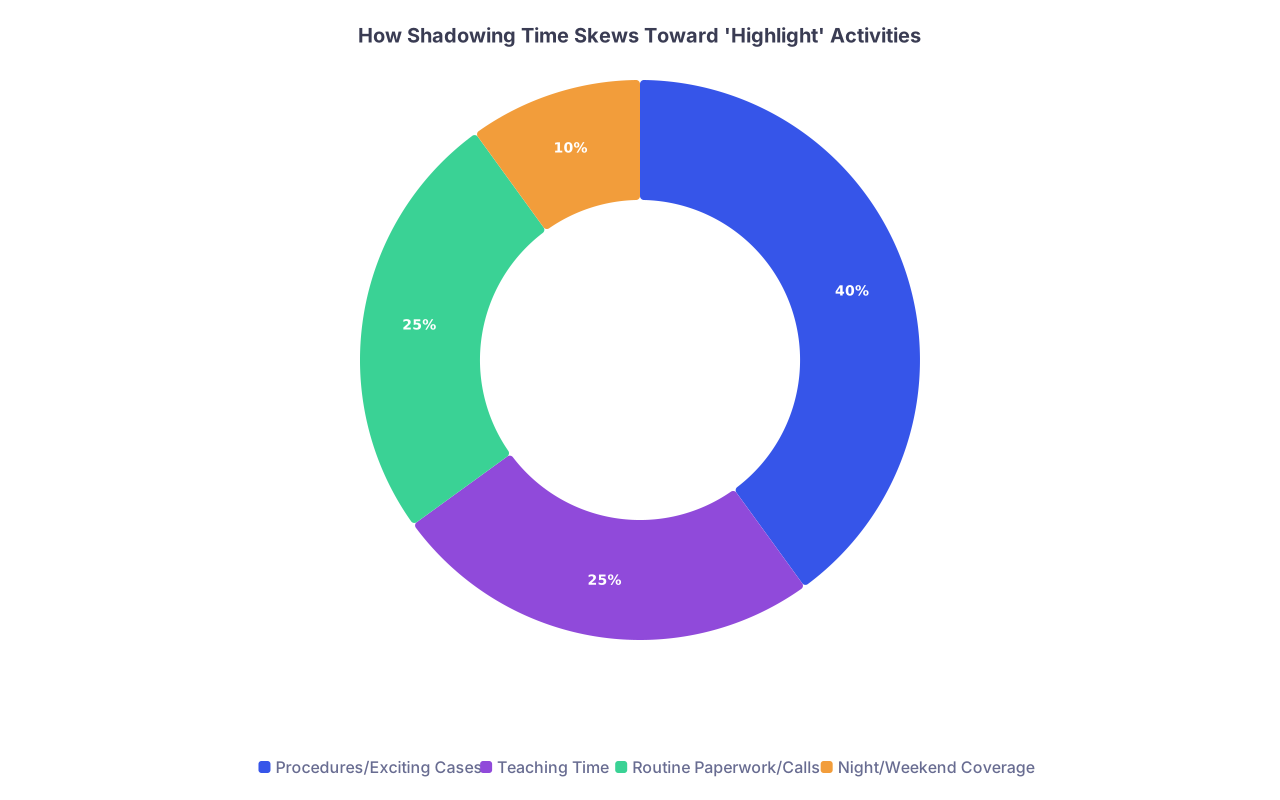
| Category | Value |
|---|---|
| Procedures/Exciting Cases | 40 |
| Teaching Time | 25 |
| Routine Paperwork/Calls | 25 |
| Night/Weekend Coverage | 10 |
Shadowing days are often the best-behaved days of a physician’s week. That alone should make you suspicious.
Attendings unconsciously (or very consciously) adjust the schedule when a student is coming:
- They cluster “interesting” cases.
- They move routine admin work to another day.
- They’re on their best behavior with staff and patients.
- They have more patience than usual.
You see:
- Cool procedures.
- Satisfying diagnoses.
- Charming bedside manners.
- A peaceful, “manageable” workload.
You don’t see:
- The 30 insurance calls they did yesterday.
- The soul-sucking EMR messages at 10 p.m.
- The combative family meeting that derailed their entire afternoon.
- The fifth weekend call in a row.
The result? You walk away thinking, “Wow, this specialty is so balanced and interesting,” based on a day that is not representative.
How to avoid this mistake
Ask directly:
“Is today a typical day for you? If not, what’s different?”
Then shut up and really listen.Shadow on multiple days of the week (including a Monday or Friday) and, if possible, different times (early morning, late afternoon).
Get specific:
- “On an average day, how many hours are truly clinical vs. charting/admin?”
- “What parts of your job do I not get to see today?”
If the physician laughs and says, “You’re seeing the fun 10%,” believe them. That’s not modesty. That’s the warning label.
2. The Personality Mirage: Mistaking One Doctor for an Entire Specialty

Another consistent error: you fall in love (or out of love) with a person, not a field—then your brain quietly merges the two.
You like:
- Their teaching style.
- Their humor.
- How respected they are.
- How efficiently they move.
So you conclude: “This is what [insert specialty] people are like.”
Dangerous assumption.
Every specialty contains:
- Warm, humble clinicians.
- Arrogant, performative jerks.
- Brilliant but disorganized chaos agents.
- Quiet, steady workhorses.
I’ve seen students say:
- “I can’t do surgery, surgeons are too intense” after shadowing one malignant attending.
- “Dermatology is so chill” after shadowing one part-time academic dermatologist with no kids and massive support staff.
- “Emergency medicine is all adrenaline and action” after one night in a well-staffed, well-run ED during a quiet shift.
You are building your mental model of an entire career off one or two people who you happened to meet in a single institution. That’s like judging all restaurants by one Saturday brunch.
How to avoid this mistake
Do not stop at one physician. Minimum:
- Shadow at least 3–5 different attendings in a specialty.
- Aim for different practice types:
- Academic vs community
- Hospital-employed vs private practice
- Urban vs suburban vs rural
And then literally ask:
- “How typical do you think your practice is compared to others in your field?”
- “What are colleagues in very different practice settings dealing with that you don’t?”
You’re not choosing Dr. Smith’s life. You’re choosing a range of possible lives within that specialty. You need to see that range.
3. The Clinic–Hospital Illusion: Missing Half the Job

| Step | Description |
|---|---|
| Step 1 | Shadowing Day |
| Step 2 | Clinic |
| Step 3 | OR / Procedures |
| Step 4 | Rounds |
| Step 5 | After-hours calls |
| Step 6 | Post-op issues |
| Step 7 | Discharge planning |
| Step 8 | Chronic patient management |
Most shadowing is built around visible, tidy blocks:
- Clinic sessions
- OR block
- Rounds
What you rarely see:
- 7 p.m. phone calls about lab results.
- Weekend messages piling up.
- Prior auth battles with insurance.
- “Can you quickly review this?” emails that are never quick.
- The emotional weight that goes home with them. Every day.
This creates a skewed perception of time and effort. You see a pulmonologist in clinic from 8–4 and think, “Nice, that’s not bad.” You don’t see them charting 4–6 p.m. and fielding calls 8–9 p.m.
Or you watch an anesthesiologist do four neat, efficient cases. You don’t experience:
- The 5:30 a.m. start times.
- The case that went sideways yesterday.
- The Q3 call.
How to avoid this mistake
Ask about the invisible hours:
- “On a typical week, how many hours do you spend not physically in the hospital/clinic but still working?”
- “How often do you get called after hours? What kind of problems come up?”
- “What parts of your job are the most draining that I can’t see today?”
Then pay attention to body language:
- Do they sigh before answering?
- Do they crack a “that’s the real job” joke?
- Do they hesitate when you ask about weekends or call?
Those are not random. That’s your glimpse behind the curtain.
4. The “Cool Case” Bias: Overvaluing Rare, Glamorous Moments

Students love highly visual, dramatic medicine. It’s natural.
So your memory logs:
- The massive trauma resuscitation in the ED.
- The brain tumor resection with perfect navigation.
- The cardiac cath that saved someone’s life in minutes.
And mostly ignores:
- The 27 stable chest pain rule-outs.
- The 15 routine follow-up visits.
- The “nothing to do but manage expectations” conversations.
The rare, glamorous cases hijack your brain. You overestimate how common they are and underestimate how much of the specialty is pattern recognition and repetition.
You end up thinking:
- “Neurosurgery is all epic tumor and aneurysm cases.”
- “Emergency medicine is constant resuscitation and procedures.”
- “GI is all endoscopy and satisfying polyp removals.”
Reality in most fields:
- A small percentage is dramatic, career-highlight stuff.
- The majority is routine, chronic disease and follow-up.
If you choose a specialty because of the big, cinematic moments, you’re choosing based on fantasy frequency, not actual frequency.
How to avoid this mistake
When you see a cool case, mentally tag it as “rare dopamine spike,” not “typical day.”
Then ask:
- “Out of 100 patients, how many are like this vs routine?”
- “What does the most common patient look like in your practice?”
- “What’s the most frequent thing you see that bores you?”
You need to know whether you can tolerate the 70–80% of routine to earn the 10–20% of excitement.
5. The Training vs. Career Confusion: Shadowing Residents and Misreading the Job
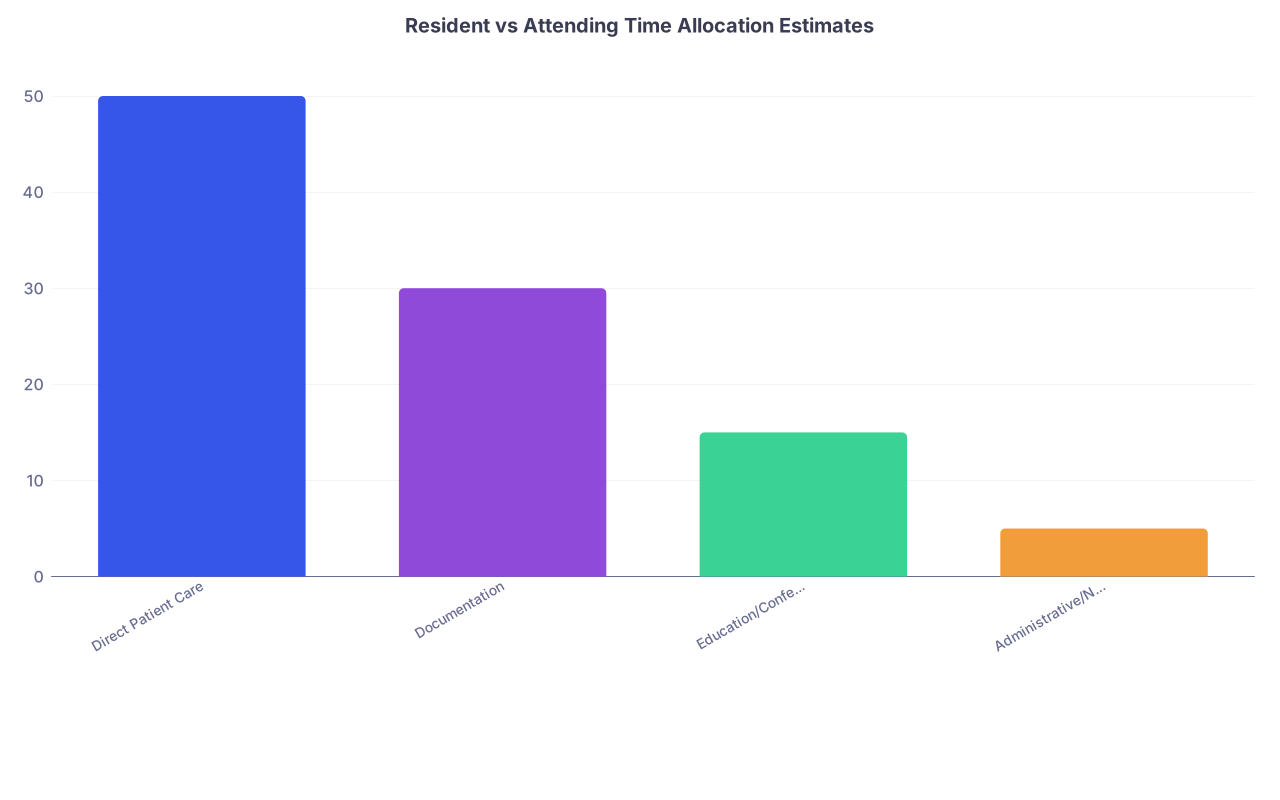
| Category | Value |
|---|---|
| Direct Patient Care | 50 |
| Documentation | 30 |
| Education/Conferences | 15 |
| Administrative/Nonclinical | 5 |
Shadowing during med school often happens in academic hospitals, where your main contact is residents. Great people to talk to. But here’s the catch:
You’re seeing:
- A training environment with built-in inefficiencies.
- Scut that disappears (or at least shrinks) after residency.
- Service-heavy rotations that aren’t sustainable long-term.
Residents are:
- Overworked.
- Under-autonomous.
- Stuck in someone else’s schedule, often in the least efficient system.
If you hate the lifestyle you see on a brutal inpatient month, you might incorrectly write off the entire specialty.
Examples I’ve seen:
- Student shadows internal medicine on a Q4 call gen med month, decides “IM is misery.” That same resident later practices outpatient IM 8–5, no weekends.
- Student sees OB/GYN residents drowning in triage and pages, decides “OBs are always exhausted.” Then meets private practice OBs who are actually content with their call group and outpatient mix.
The reverse also happens: students see chill attending life in academic settings and don’t appreciate how rough certain private or community jobs can be.
How to avoid this mistake
You must separate:
- “What residency looks like”
vs - “What the average attending job in this specialty looks like”
Ask both residents and attendings:
- “How does your day now compare to a typical day in your first 5 years out of training?”
- “If someone hates residency in this field, do they usually still like the attending life, or not?”
- “What parts of this that are miserable for you now will actually improve after training—and what won’t?”
If no one in the specialty is willing to say “Things get better after residency,” that’s a separate red flag.
6. The Single-Setting Fallacy: Assuming All Jobs Look Like the Academic Center
| Setting | Common Features |
|---|---|
| Academic | Teaching, research, complex cases |
| Community | High volume, less teaching |
| Private Practice | Business pressures, autonomy varies |
| Rural | Broad scope, fewer resources |
| Urban Safety-Net | Underserved, high social complexity |
Most med schools are attached to large academic centers. Most structured shadowing is there. That breeds a nasty bias: you think “this hospital” = “this specialty.”
It doesn’t.
Cardiology in:
- A quaternary care center = complex referrals, subspecialty teams, academic meetings.
- A small community hospital = chest pain, heart failure, bread-and-butter, fewer bells and whistles.
General surgery in:
- Rural hospital = broad scope, fewer subspecialists, more independence.
- Big academic center = narrow niche, lots of trainees, big hierarchy.
Psychiatry in:
- Urban safety-net = high acuity, severe mental illness, social complexity.
- Suburban private practice = med management, therapy interface, more stable follow-up.
If you only ever see one version of a specialty, you may reject or embrace it based on a practice pattern you never actually plan to live in.
How to avoid this mistake
You don’t need to physically rotate through all settings (though that helps). But you do need to talk to people in each.
Questions to ask attendings:
- “If you were doing this in a community (or rural / private practice) setting, how would your day be different?”
- “What are common job options for your graduates? What do their lives look like?”
- “What parts of your work are unique to an academic center?”
And then you need to decide:
- Do you picture yourself in academia long-term?
- Or does a different setting fit your personality/life goals better?
If your vision and your shadowing setting don’t match, adjust your interpretation accordingly.
7. The Silent Red Flags: Ignoring Culture, Burnout, and How People Talk

Most students focus on:
- Procedures
- Pathology
- Intellectual content
They forget to watch the humans around them.
If everyone in the department:
- Looks exhausted.
- Makes dark jokes about regret.
- Warns you about burnout unprompted.
Believe that. Do not romanticize it away.
Red flags I’ve heard with my own ears:
- “I tell all my kids not to go into medicine.”
- “If I could go back, I’d pick literally anything else.”
- “It’s a great field… was a great field, before [insert systemic change].”
- “The work is fine, the system is broken.”
If you hear these once from a clearly bitter outlier, fine. If you hear them from three different people in the same week? That’s cultural smoke. And where there’s smoke…
How to avoid this mistake
Pay attention to:
- How staff talk to each other.
- How attendings talk about patients (respect vs contempt).
- How much people interrupt themselves with “sorry, I’m just tired.”
Then ask blunt questions:
- “If your kid wanted to enter this specialty, what would you say?”
- “What do you complain about most with your colleagues?”
- “Do you see yourself still doing this at 60?”
You are not just choosing a body system. You’re choosing a culture to live in for decades.
8. How to Make Shadowing Actually Useful (Without Getting Fooled)
You don’t need to throw out shadowing entirely. You just need to stop treating it like a trailer for the movie. It’s behind-the-scenes footage, heavily edited. Your job is to un-edit it.
Here’s how to use it wisely:
Shadow broadly before you shadow deeply.
Quick exposure to many fields > long exposure to just one at the start. You’re trying to rule out obvious “no way” specialties first.Pair every shadowing block with explicit questioning.
Build a habit of asking:- “What’s the worst part of your job?”
- “What do people outside this specialty misunderstand about it?”
- “What would surprise me most if I followed you for a whole month?”
Collect data, not just vibes.
For each specialty you’re considering, write down:- Clinic hours vs total work hours.
- Call frequency and type.
- Typical patient mix.
- Admin/EMR burden. Do not trust your memory alone; it will prioritize the exciting parts.
Cross-check with residents, mid-career attendings, and near-retirees.
Each stage sees the field differently. If senior people are all saying, “This job used to be great, but not anymore,” take that seriously.Notice your own energy.
After shadowing days, jot this down:- Did you feel drained or stimulated?
- Did you dread going, or did the time pass quickly?
- Did you find yourself curious or counting the minutes?
Your body often knows before your brain admits it.
FAQ (Exactly 5 Questions)
1. How many hours of shadowing in a specialty are enough to form a real opinion?
Enough that you’ve seen multiple physicians in multiple contexts. That usually means at least 15–20 hours per specialty you’re seriously considering, spread over different days and including at least one busy or “bad” day. Ten perfect clinic mornings with the same charismatic attending are not enough.
2. Should I avoid a specialty if the residents all seem miserable?
No, but you should not ignore it either. Resident misery might be a program-specific issue, or it might reflect deeper problems in the field. That’s why you talk to attendings outside that program, ideally in different practice settings, and ask whether things realistically improve after training.
3. What if I loved shadowing a specialty, but everyone warns me about burnout?
Do not dismiss their warnings because you “felt different.” Instead, investigate them. Ask what specifically causes burnout (hours, call, EMR, patient population, bureaucracy). Then decide if those are things you can realistically tolerate long-term, not just for a couple of fun shadowing days.
4. Is procedure-heavy shadowing making me overvalue procedural specialties?
Probably. Procedures are inherently more exciting to watch than chronic disease management. Balance it by deliberately shadowing outpatient, longitudinal care as well, and ask yourself honestly if you can tolerate the routine, not just chase the adrenaline of procedures.
5. How do I correct for academic-center bias if I can’t easily access community physicians?
If you can’t physically shadow, you can still email or call community docs, rural docs, and private practitioners. Ask them about their typical day, hours, call, and biggest frustrations. It’s not as vivid as in-person shadowing, but those conversations will still puncture the idea that “my med school hospital = the entire specialty.”
Key points to remember:
- Shadowing shows you a curated, distorted slice of a specialty—never the whole picture.
- Do not generalize from one person, one setting, or one “perfect day” to an entire career.
- Use shadowing as a starting point, then aggressively question, cross-check, and reality-test before you let it steer your specialty choice.