
It’s late afternoon on your medicine clerkship. You’re in that cramped workroom with the broken chair and the ancient desktop. The attending is wrapping up feedback and glances at your evaluation form.
“So, what are you thinking for specialty?”
You freeze. Because the real answer is: you have no idea. You like a bunch of things. You hate that everyone else seems to have a crisp answer. So you say the line you’ve been practicing:
“I’m…still undecided. Just trying to keep an open mind.”
The attending nods, smiles politely, and says, “That’s totally fine.”
Let me tell you what actually goes through their head.
They’re not just hearing your words. They’re categorizing you. They’re making decisions about what to write in your eval. They’re deciding whether you’re someone to sponsor, someone to rank as “average,” or someone to quietly forget.
And that all happens in the two seconds after you say “undecided.”
You deserve to know how this game actually works.
The Six Unspoken Categories of “Undecided” Students
Nobody will tell you this explicitly, but faculty mentally sort “undecided” students into buckets. Not on paper. In their head. And those buckets absolutely color how they evaluate you.
Here’s the rough breakdown most experienced attendings and clerkship directors are running in the background.
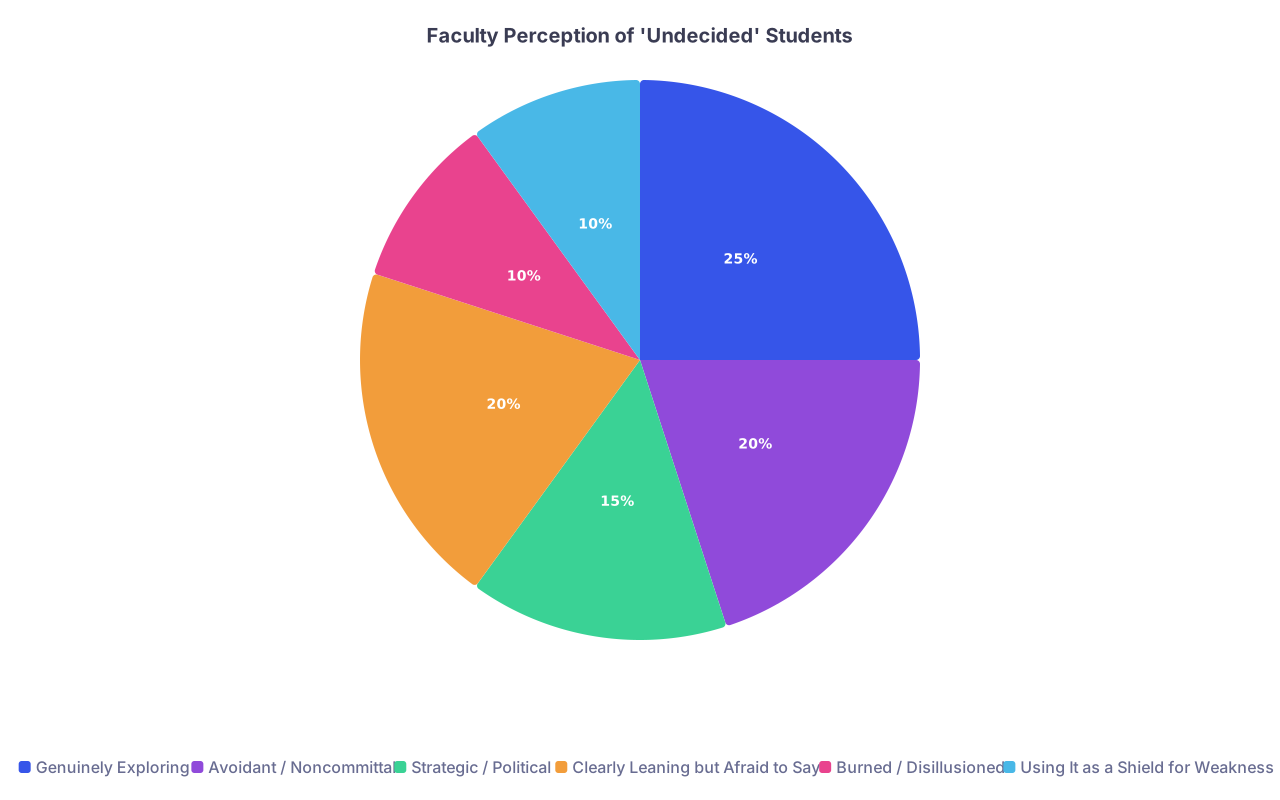
| Category | Value |
|---|---|
| Genuinely Exploring | 25 |
| Avoidant / Noncommittal | 20 |
| Strategic / Political | 15 |
| Clearly Leaning but Afraid to Say | 20 |
| Burned / Disillusioned | 10 |
| Using It as a Shield for Weakness | 10 |
1. The genuinely exploring group
These are the students who are actually open-minded and curious. They show up engaged on every rotation, ask good questions, and seem legitimately willing to consider different paths.
Faculty love this type. They’re easy to support, easy to write about, and they usually do well in letters: “Although undecided about specialty, they have the intellectual curiosity and work ethic to do well in any field.”
2. The avoidant / noncommittal group
You’ve seen them. Vibe is: “I’ll think about it later.” They haven’t read about any field in depth, don’t seek out mentors, and treat specialty choice like some mystical revelation that will appear in M4 fall.
Faculty are wary of this group. These are the people who end up panic-applying to 60 IM programs with a personal statement that reads like ChatGPT circa 2021.
3. The strategic / political group
These are the students who know exactly what they want but think saying it out loud might hurt them.
Example: You’re on peds but really want ortho, and you’re convinced the peds attending will write you off if you say “ortho,” so you default to “undecided.” You’re not wrong; some faculty are petty and specialty-tribal. Others aren’t.
Faculty can usually smell this, by the way. You talk about research in one narrow field, your Step 2 is aligned with a competitive specialty, all your extracurriculars scream “derm,” but you’re “totally open.” People notice that.
4. The clearly leaning but afraid to commit group
You have a strong lean—say EM or anesthesia—but you worry about “closing doors.” So you stay in the comfort zone of “I’m not sure yet.”
Faculty see this as a confidence and decisiveness issue more than a career-planning issue. This doesn’t kill you, but it makes you come across as less mature than your more decisive classmates.
5. The burned / disillusioned group
These are students who thought they were going into one specialty—gunned hard for it—and something blew up. Bad rotation. Horrible attending. Step scores didn’t line up. Now they’re adrift.
They often say “undecided” with a flat affect and dead eyes. Faculty either feel protective or quietly label them as “unstable right now.” What happens next depends heavily on how you talk about it.
6. The “shield for weakness” group
Some students say “undecided” to hide the real issue: poor performance, low scores, or no meaningful mentorship in any field. The subtext isn’t “I could do anything.” It’s “I don’t really have obvious options.”
Faculty pick up on this quickly when the rest of the application looks scattered and weak.
Here’s the uncomfortable truth: when you say “undecided,” faculty are looking for which bucket to put you in.
Your job is to control which one they choose.
What Faculty Are Actually Evaluating When You Say “Undecided”
They’re not mainly judging the content of your answer. They’re judging how you answer and what it reveals.
Let me walk you through what’s happening in an attending’s head when you drop the “undecided” line.
1. Are you doing your homework on yourself?
A generic “I like everything” is a red flag. Faculty hear that constantly. It usually means: “I haven’t thought hard enough yet.”
What they want to see instead is evidence of work: that you’re actually analyzing your own fit.
On the inside, they’re asking themselves:
- Have you clearly reflected on what you value in a career?
- Can you name what you like and don’t like about the rotations you’ve already done?
- Are you aware of the trade-offs between fields, or are you still at the “I like procedures and clinic and inpatients and outpatients and lifestyle and acuity” fantasy stage?
Students who impress faculty aren’t the ones with a declared specialty. They’re the ones with a declared thought process.
2. Are you serious about something?
“Undecided” becomes a problem when it blends into “uncommitted.”
Faculty are scanning your behavior:
- Do you show up early?
- Do you follow through on reading?
- Do you seem to care about being good at the fundamentals, even if this isn’t your dream field?
They want to know: even if you don’t know the final destination, are you serious about becoming a good physician? Or are you just floating through rotations?
The brutal internal translation is: Will I regret writing a strong letter for this person?
3. Are you playing the political game or being honest?
Attendings see a lot of strategic nonsense:
- On surgery: “I’m really thinking about surgery or maybe EM or maybe anesthesia.”
- On peds: “I really love working with kids, so maybe peds or family or Med-Peds.”
- On psych: “I find psych really fascinating, so maybe psych or neurology.”
Same student. Different tailored answer. They remember.
What actually earns respect is not the desperate attempt to please everyone, but thoughtful honesty delivered with respect:
- “I’m leaning toward EM, but I’m very aware that I need a strong medicine foundation regardless, which is why I care about doing well here.”
That line? I’ve heard versions of it. Faculty like it. It’s honest, it validates their field, and it signals maturity.
4. Do you understand the competitiveness landscape?
Here’s a harsh one: if you say you’re “undecided,” and your CV already screams a crazy mismatch—like weak scores + no research but you’re whispering derm or plastics to residents in the hallway—faculty clock that.
They’re asking: Is this student realistic yet? Or are they still in fantasy mode?
If your answer reveals that you’ve at least started to understand what different fields actually demand, you get bumped into the “mature” category fast.
How Different Faculty Types React to “Undecided”
Not all faculty want the same thing. You’re not dealing with a monolith; you’re dealing with personalities and agendas.
The Specialty Evangelist
This is the attending who thinks their field is the center of the universe. The cardiologist who can’t imagine doing anything else. The trauma surgeon who sneers at clinic.
If you say “undecided” to them, they will either:
- Try to recruit you aggressively, or
- Write you off as “lacks passion for my specialty.”
With these people, the smartest move is not to pretend you’re joining their cult. Instead, show engaged curiosity. Something like:
“I’m still figuring it out, but this rotation has really opened my eyes to how much I enjoy X. I’m trying to pay attention to what actually energizes me day to day, and I’ve been surprised how much I like [something concrete from their field].”
You’re not promising allegiance. You’re showing you’re awake.
The Realist Mentor
These are the gold-standard attendings. They care more about fit and your long-term wellbeing than about recruiting you to their specialty.
They’re listening for:
- Do you know yourself at all yet?
- Do you ask the right questions?
- Are you thinking about the lifestyle + personality + values intersection, not just prestige?
With them, you can be more nakedly honest:
“I used to think I was definitely going into X, but the more rotations I do, the more I see that I need to factor in lifestyle and the kind of team I enjoy. So right now I’m genuinely undecided, but I’m paying attention to what environments bring out my best.”
This is the type of answer that gets them invested in mentoring you long-term.
The Evaluator-Only Attending
Some faculty just want to complete your eval and move on with their life. To them, your specialty choice is mainly a checkbox that shapes their narrative.
They’re listening for enough structure to write that obligatory line: “They plan to pursue [field] and will excel there.”
If you give them a mushy nothing answer, you force them into generic filler. If you give them at least a direction, they can anchor your strengths to something.
Even if you’re not sure, giving them a working hypothesis helps:
“Right now, I’m between internal medicine and neurology, but I’m still early in the process. I’m trying to see where I click in terms of patient population and pace.”
Now they can write: “Although still choosing between internal medicine and neurology, they have shown the analytical thinking and bedside communication to thrive in a cognitive specialty.”
That’s usable. That matters.
How to Say “Undecided” Without Sounding Lost or Weak
The words “I’m undecided” are not the problem. The silence afterward is.
Faculty are listening for three things: signal of reflection, hint of direction, and evidence you’re doing something about it.
So you need a template that hits all three but leaves you room to be honest.
The structure that actually works
You want your answer to loosely follow this pattern:
- Acknowledge you’re still deciding
- Name 1–2 things you’ve noticed you like or value
- Offer a current lean or shortlist
- Show that you’re actively exploring, not passively drifting
Something like:
“I’d say I’m still deciding, but I’ve noticed I really enjoy [X: acuity, continuity, procedures, complex puzzle-solving]. So right now I’m most interested in [1–2 fields that match], but I’m using these clerkships to pay attention to what kind of day-to-day work actually fits me.”
That’s a grown-up answer. It signals: “I’m not locked in, but I’m paying attention and I have a brain.”
Or, if you’re earlier:
“I’m honestly still pretty open, but I’ve realized I care a lot about [patient population / work style / team dynamic]. So I’m talking to people in [a couple of specialties] and trying to shadow a bit more before I commit. I want to be intentional about it.”
Faculty hear that and think: “Okay. Not naive. Not avoidant. Just early.”
What Your “Undecided” Signal Does to Your Evaluations and Letters
Here’s the part students underestimate: what you say about your specialty plans shapes what ends up in your letters and clerkship comments.
And that follows you into ERAS whether you like it or not.
When “undecided” helps you
It helps when:
- You’re early M3 and clearly engaged and curious
- Your narrative is: “I could see myself happy in multiple directions and I’m being thoughtful”
- Faculty can honestly write: “They will excel in any field they choose”
Program directors read that as: high-ceiling candidate, not boxed in, probably easy to work with.
It also helps when your scores or CV don’t obviously point you to a super competitive field. “Undecided” here gives you room to pivot without looking like you failed a single all-or-nothing bet.
When “undecided” hurts you
It hurts when it’s paired with:
- Weak engagement in rotations (“pleasant but passive”)
- No clear strengths that are being developed
- A generic story: nothing in your application shows traction in any direction
Then “undecided” reads as: unfocused, maybe unmotivated, no one really sponsoring this person.
The harsh reality: programs will always favor the student whose letters say “This person is made for X and will be a leader in our field” over the student whose letters basically say “Nice kid, could do anything, not sure what.”
If you stay “undecided” too long without building a coherent story, you become forgettable.
Using “Undecided” as a Strategic Tool (Not a Confession)
Here’s the twist: “Undecided” can actually be powerful if you know how to use it.
You can deploy it to:
- Get honest career advice (when you’re not locked into defending a choice)
- Avoid being prematurely boxed into a field that doesn’t fit
- Build mentors in multiple specialties before you commit to one
The key is timing and framing.
M1–early M2
You’re allowed to be very openly undecided here. Nobody cares. You should actually try on identities here: talk to surgeons, psychiatrists, radiologists, EM docs. Listen more than you talk.
Your “undecided” here should sound exploratory:
“I’m really early, so I’m trying to shadow a bunch of fields and see what resonates.”
Totally fine.
Late M2–early M3
Now “undecided” needs more structure. You should have at least:
- A sense of whether you like inpatient vs outpatient
- Some idea about procedures vs cognitive-heavy work
- A starting sense of patient populations you enjoy or dislike
Your “undecided” answer should reflect a narrowing:
“I’ve realized I like [acute vs longitudinal] care and [hands-on vs thinking-heavy] work, so I’m mostly considering [2–3 aligned fields], but still trying to see what fits best day to day.”
Late M3–early M4
By now, “undecided” needs to be very controlled. Publicly, to letter writers and advisors, you want to present a coherent primary choice—even if you keep a backup in your head.
The hidden truth: by the time you’re asking for letters, most faculty expect you to at least have a top choice. If you’re still broadly undecided, they start to wonder what went wrong.
This doesn’t mean you need to announce it to every attending on every rotation. But your core mentors should hear a decisive version:
“I’ve decided to pursue [field], and I’d really value your honest input about my fit and how to strengthen my application.”
You can still use “undecided” language with faculty outside your chosen field if you don’t want to alienate anyone, but your behavior and CV should be converging.
A Quick Reality Check: What Faculty Remember About You
One last behind-the-scenes truth: most attendings don’t remember your exact words.
They remember your tone, your engagement, and a couple of standout moments.
What lingers with them is something like:
- “She was reflective and seemed genuinely curious about where she fit.”
- “He said he was undecided but clearly leaned toward EM and worked hard on medicine because he knew it mattered.”
- “They had no idea what they wanted and didn’t seem to be thinking very hard about it.”
Your job isn’t to deliver the perfect speech. It’s to consistently project: “I’m taking my career seriously. I’m thinking. I’m not passive.”
Do that, and “undecided” stops being a liability and starts being an honest, respectable phase of your development.

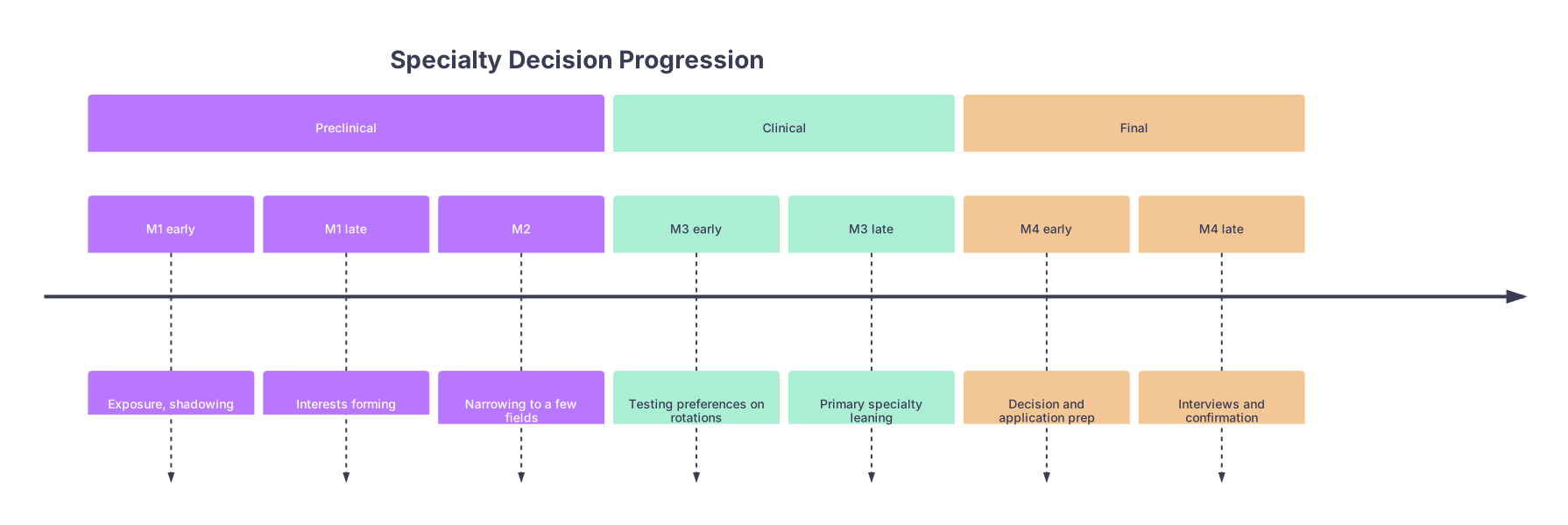
| Period | Event |
|---|---|
| Preclinical - M1 early | Exposure, shadowing |
| Preclinical - M1 late | Interests forming |
| Preclinical - M2 | Narrowing to a few fields |
| Clinical - M3 early | Testing preferences on rotations |
| Clinical - M3 late | Primary specialty leaning |
| Final - M4 early | Decision and application prep |
| Final - M4 late | Interviews and confirmation |

Boiled down
Three things to walk away with:
- When you say “undecided,” faculty are judging your process, not just your answer. Show reflection, direction, and action.
- Being undecided is fine; being passive is not. Your job is to look like someone actively working toward a good fit, not waiting for a sign from the universe.
- By late M3, “undecided” has to evolve into a coherent story. Even if you’re still juggling options in your head, your mentors and letters need to see a real, believable direction.