

It’s late on a Wednesday night. You’re in the lab, finishing Western blot #27 for a cardiology project you never really loved. Your name is on one abstract, maybe a manuscript in review. The PI knows you. The residents know you. On paper, you’re “the cards research person.”
Except…you’re pretty sure you want to go into psychiatry. Or EM. Or maybe ortho. Just not this.
And now the voice in your head is loud: “Did I just waste the last year? Will programs think I’m unfocused? Do I have to keep faking interest in this field to not burn bridges?”
This is exactly the situation: you’re already invested in one specialty’s research but want to switch fields. You’re not the first, and you will not be the last. Let’s walk through what actually matters and what you should do next.
Step 1: Get Clear on Your Real Problem (It’s Not “I Wasted My Research”)
Most students in your spot think the problem is: “My research is in the wrong field.”
That’s not the actual problem.
The real problems are usually one or more of these:
- You’re scared programs in the new specialty will think you’re not serious because your CV screams a different field.
- You feel guilty or anxious about “abandoning” your current PI/mentor who invested in you.
- You worry about timeline: “Do I have enough time to pivot and still be competitive?”
- You’re confused how to explain the story without sounding flaky in your personal statement and interviews.
All solvable. And no, your past research is not “wasted.” It’s just data and skills you’ll frame differently.
Let me be blunt: residents match every year into specialties where none of their research aligns perfectly. I’ve seen people with three years of neurosurgery research match psychiatry, people with cardiology meta-analyses end up in EM, and people with zero research match into solid IM programs.
You’re not doomed. But you do need to handle this strategically.
Step 2: Decide if You’re Truly Switching or Just “Curious”
Before you torch any bridges or mentally rebrand yourself overnight, test whether this is a real pivot or just mid-rotation whiplash.
Ask yourself three concrete questions:
- Have I actually spent at least a few solid weeks on clinical exposure in the new specialty? Not one interesting patient, not one charismatic attending. Real exposure.
- Could I reasonably imagine doing the day-to-day work of this specialty at 2 a.m. when everyone is cranky and caffeinated, not just during the “cool case” parts?
- If I had to apply this upcoming cycle with my current CV, and I could only pick one specialty, which one would I feel more regret about not trying?
If you cannot answer those honestly, your next step is not “fix the research problem.” Your next step is “get more exposure now.”
You do that with:
- A focused elective/rotation in the new field as soon as scheduling allows.
- Shadowing on evenings/weekends if your school is rigid.
- Asking residents in the new specialty for 10–15 minute honest conversations: “What do you hate about your field?”
Once you’re pretty sure the switch is real, then we address the research situation.
Step 3: Stop Thinking of Research as “Wrong Specialty / Right Specialty”
Programs care about three main things with research:
- Can you follow through and complete projects?
- Do you understand the basics of scientific thinking and methods?
- Does your story show curiosity, persistence, and growth?
The specific topic matters less than students think, except in ultra-competitive fields (derm, plastics, ortho, neurosurg, ENT). Even there, the “perfect” alignment is helpful but not mandatory if the rest of your app is strong.
Your cardiology QI project still shows:
- Experience in data collection, IRB, maybe statistics.
- Ability to work on a team.
- That someone trusted you enough to include you.
You don’t throw that away. You reframe it.
Example reframing for a student who did nephrology research but now wants EM:
“Most of my early research was in nephrology, looking at outcomes in patients with AKI. That work actually pushed me toward EM, because I realized I was most engaged when we were dealing with these patients upstream—acutely in the ED—rather than managing the chronic complications. The research taught me how to think in terms of outcomes and systems, which I now bring to questions I’m exploring in emergency medicine.”
That’s not fake. That’s just connecting the dots like an adult rather than apologizing for your own CV.
Step 4: How Much Do You “Owe” Your Current PI or Specialty?
This is where people get stuck and stay stuck for a year too long.
You might be thinking:
- “My PI invested a lot in me; I can’t just leave.”
- “They’re counting on me to finish this project.”
- “If I tell them I’m switching, they’ll be mad and tank my letter.”
Reality check:
Most decent PIs understand that medical students change their minds. They’ve seen it a hundred times.
What they actually care about is:
- You finishing what you reasonably can.
- You not ghosting them or leaving a mess.
- You not lying.
Here’s how to handle it like a professional.
Script for talking to your current PI
You do this in person or on Zoom, not by email if at all possible.
“Dr. X, I wanted to update you on my plans. Over the past year, I’ve gotten more exposure to [new specialty], and I’ve realized that’s the direction I’m most likely to pursue for residency. I’m very grateful for the opportunities I’ve had in your lab and I’ve learned a lot about [methods/analysis/topic].
I want to make sure I transition my responsibilities well. Right now I’m working on [brief list of active tasks]. I think I can realistically finish [A, B] by [timeframe]. For [C], it might make more sense to hand that off to another student, but I’m happy to help with a transition and documentation. Does that seem reasonable, or is there another way I can be most helpful as I shift my time?”
You’re not asking permission to change specialties. You’re informing them of your plans and offering to tie up loose ends.
If your PI is mature, they’ll respect that. If they act hurt or manipulative (“After all I’ve done for you…”), that’s data about them, not you.
Still, do what you said you’ll do. Finish what’s realistic. Don’t promise what you cannot deliver.
Step 5: Get Some Connection to the New Specialty (Without Starting from Zero)
You do not need three years of perfectly aligned research in your new field to be taken seriously. But you do need something that shows you didn't decide last Tuesday because of one cool attending.
Here are realistic options depending on your timeline.

If you’re early M2 or earlier
You have time. Ideal moves:
- Keep helping your original PI until current projects reach a natural breakpoint (abstract submitted, paper drafted, data collection complete).
- In parallel, intentionally seek out a mentor in your new field. Not by mass emailing “Any research?” but by:
- Asking residents/fellows who seem reasonable: “Who works with med students and actually gets things finished?”
- Attending a divisional conference and seeing who engages students.
- Asking your dean/office of student research for names.
When you meet them:
“I’ve done [X] type of research in [old field] and want to explore [new specialty] more seriously. I’d love to get involved in a project where I can be genuinely useful and ideally see it through to presentation or publication. Do you have anything suitable for a student with [skills you actually have] and [Y] hours per week?”
Be specific about time. Don’t say “whatever you need.” That’s how you drown.
If you’re mid M3 or early M4, pre-ERAS
You don’t have time for a 3-year bench project. You need fast(er)-moving, clinical or retrospective work.
Look for:
- Case reports or case series.
- Chart-review projects where the IRB is already approved.
- QI projects in the new department with clear milestones.
- Help on an almost-finished manuscript (editing, references, tables).
Be honest with the mentor:
“I’m planning to apply to [new specialty] this upcoming cycle, so I’m looking for something that’s already underway where I can meaningfully contribute over the next [X] months. Even if it doesn’t result in a publication before ERAS, I’d like to be able to describe concrete work and potentially get a letter.”
If nothing pans out, still do this: attend the specialty’s conferences, join the interest group, and get at least one clinical mentor who knows you well enough to write a letter. Research is not the only currency.
If you’re extremely late (ERAS is basically now)
Then your priority is not “get research at any cost.”
Your priority is:
- Securing strong clinical letters in the new specialty.
- Making sure your application clearly explains the pivot.
- Getting any small project or involvement that shows you didn’t switch on a whim, even if it’s just:
- Helping with a review paper.
- Assisting a resident with data cleaning on their project.
- Doing a quick QI measure during a sub-I.
Step 6: How to Explain Your Research Story on Paper and in Person
You will get asked about this. Personal statements. Interviews. Maybe even by letter writers.
Here’s the rule: you’re not apologizing; you’re narrating growth.
Personal statement structure
Rough outline that works:
- Start with why the new specialty fits you now (clinical experiences, the work itself).
- Briefly acknowledge your earlier focus:
- “Early in medical school, I was drawn to [initial specialty] and pursued research in [describe].”
- Show the turning point:
- “During clerkships, I realized I was consistently most engaged when…”
- Connect the dots:
- “The research skills I gained—[list 2–3 concrete skills]—now inform how I think about questions in [new specialty].”
- Land firmly in the new field:
- “At this point, I’m committed to a career in [new specialty] because…”
Do not waste half the statement justifying why you switched. Two short paragraphs is plenty.
Interview answers
You’ll get some version of: “I see you did a lot of [old specialty] research. What led you to [new specialty]?”
A clean answer:
“Early on I thought I’d go into [old specialty], and that’s why most of my research is in that area. I learned a lot about [methods, team science, topic].
Once I started clinical rotations, I noticed that the parts of the day that energized me most were in [new specialty]—[give 1–2 specific examples]. Over time, that pattern was consistent, and mentors in [new specialty] encouraged me to take it seriously.
So now I bring that research background into a different context. For example, in my current project in [new specialty], I’m using the same skills in data analysis and study design, but applied to [briefly describe project]. I’m confident [new specialty] is the right fit for me going forward.”
No drama. No over-sharing about hating the old field. Just evolution.
Step 7: Strategically Using Your “Old” Research on Your CV
You absolutely keep your prior research on your CV. You just present it in a way that supports your current goals.
Some tactics:
- Emphasize transferable skills in your descriptions:
- “Developed a REDCap database and performed multivariable logistic regression analysis on a cohort of 500 patients.”
- Group projects so the list doesn’t scream “I was going to be a cardiologist”:
- Use headings like “Peer-Reviewed Publications,” “Abstracts,” “Presentations” instead of “Cardiology Research.”
- In your ERAS experiences descriptions, you can add a line:
- “Initially pursued this work while considering a career in [old specialty]; the experience ultimately helped clarify my interest in [new specialty] through [how].”
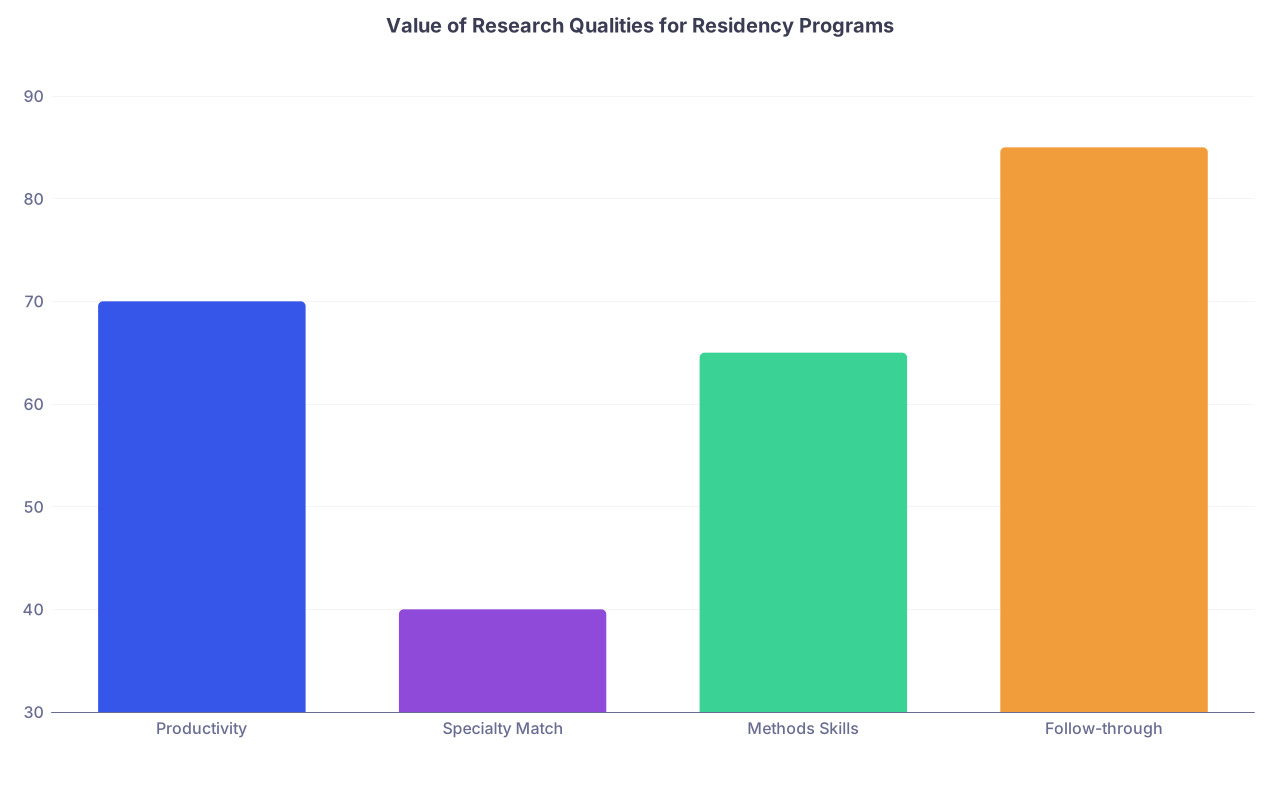
| Category | Value |
|---|---|
| Productivity | 70 |
| Specialty Match | 40 |
| Methods Skills | 65 |
| Follow-through | 85 |
If you’re aiming for a competitive specialty now (ortho, derm, neurosurg, plastics), you’ll want at least some new-field research eventually. But your old work is still evidence you can produce.
Step 8: Specialty-Specific Reality Checks
Different fields care about this switch in different ways.
| Specialty Type | Field Examples | Alignment Importance | Comment |
|---|---|---|---|
| Ultra-competitive | Derm, Plastics, Ortho, NSG | High | Get at least some aligned work |
| Moderately competitive | EM, Anesth, Rad, Psych | Moderate | Helpful but not mandatory |
| Broad / less research-heavy | FM, Peds, many IM | Low–Moderate | Any research is a plus |
If you’re moving into an ultra-competitive field
You need to hustle, not panic. Priority list:
- Strong Step/COMLEX scores and clinical grades (honors where possible).
- At least one solid home rotation/sub-I in the field with a strong letter.
- Some aligned research, ideally with your name on something tangible (poster, abstract, in-press paper).
You might consider:
- Taking a research year if your metrics are marginal and you really want that field.
- Being realistic about backup specialties if your numbers and timing don’t support the pivot.
If you’re moving out of an ultra-competitive field
Good. You probably just saved yourself some pain if your heart wasn't in it.
Programs in less competitive fields are often happy to see:
- That you tried something intense, did real work, and then made a thoughtful choice.
- That you’re not just applying to them as a backup last-minute.
But you must clearly commit in your application story. No “I love ortho and FM equally” nonsense.
Step 9: Emotional Crap No One Talks About (But You’re Feeling)
You will probably feel:
- Embarrassed telling people you “changed your mind.”
- Like you wasted time.
- Behind compared to classmates who “always knew.”
Let me cut through it: changing your mind after getting more data is what grown-ups are supposed to do. Digging in just to stay consistent is how people end up miserable at 2 a.m. hating their lives.
And no, your time wasn’t wasted.
You likely got:
- A letter writer who can still comment on your work ethic and reliability.
- Data analysis or writing skills you can reuse.
- A clearer sense of what you don’t want—which is just as important.
You’re not behind. You’re just rewriting the story with a slightly messier first draft than the “always wanted to be a pediatrician since age 5” crowd. Program directors know those stories are often fiction anyway.
Step 10: Concrete To-Do List for the Next 4 Weeks
Stop hand-wringing. Here’s what you do in real life.

| Step | Description |
|---|---|
| Step 1 | Week 1: Confirm switch |
| Step 2 | Week 1-2: Talk to current PI |
| Step 3 | Week 2: Identify new mentors |
| Step 4 | Week 2-3: Join a small project |
| Step 5 | Week 3-4: Update CV and draft explanation |
| Step 6 | Week 4: Plan rotations & letters |
Week 1
- Get at least one more meaningful exposure to the new specialty (shadowing, clinic, call shift).
- Decide: Yes, I’m truly switching. Commit.
Week 1–2
- Schedule a meeting with your current PI. Use the script. Clarify what you’ll finish and by when.
- Start documenting your current tasks so they’re handoff-ready if needed.
Week 2
- Ask residents/fellows in the new specialty for 1–2 recommended mentors.
- Email those mentors with a short, specific ask (who you are, prior research, interest in their field, realistic time availability).
Week 2–3
- Join one small or ongoing project in the new field if possible. Not 5. One or two you can actually complete.
- Start attending their departmental conferences/meetings regularly.
Week 3–4
- Update your CV with all current research, emphasizing skills and outcomes.
- Draft 2–3 sentences you’ll use in emails, personal statements, and interviews to explain the switch cleanly.
- Identify at least one potential letter writer in the new specialty and start actually working with them clinically or academically.

FAQ (Exactly 3 Questions)
1. Should I hide my old specialty interest or not mention it at all?
No. Trying to erase your past usually backfires because your CV will still show the research, mentors, and maybe interest group roles. Instead, acknowledge it briefly and position it as part of your exploration: you thought X, you learned Y, now you know Z is a better fit. One or two sentences in your personal statement and a clear, confident explanation in interviews are more credible than pretending it never happened.
2. Can I still ask my old PI for a letter if I’m switching specialties?
Yes, if they know you well and will say good things about your work ethic, reliability, and intellect. Letters do not have to be in the same specialty to be valuable, especially for less hyper-competitive fields. Just don’t make your only strong letter from someone who thinks you’re still going into their field. When you ask, be transparent: tell them what you’re applying to now and why, so they’re not blindsided.
3. What if I can’t find any research in my new specialty before I apply?
Then you lean on what you do have: your prior research (framed in terms of skills), strong clinical performance, and clear commitment through rotations, sub-Is, and letters in the new field. You can still mention ongoing or planned projects in your new specialty in your ERAS experiences, even if they’re not published yet. Many programs care far more about how you’ve performed with real patients and teams than about perfect research alignment.
Open the document where you list your current research and activities. Right now, next to each “old specialty” project, add one sentence about what skill you gained from it that helps you in your new specialty interest. That’s your starting point for reframing your story—and for your next email to a potential mentor.


