
You can absolutely ruin a great medical career by picking the right specialty for the wrong reasons.
Not an exaggeration. I’ve watched smart, capable students trap themselves in fields they quietly hate because they chased prestige, followed a partner, or believed a fantasy version of the work. Five years later they’re burned out, resentful, and stuck explaining to a co-resident, “I don’t even like this, but changing now would be a disaster.”
Let’s make sure that’s not you.
This isn’t about “follow your passion” fluff. It’s about spotting the warning signs that your specialty choice is being driven by ego, fear, pressure, or bad data instead of reality.
1. You Talk More About Status Than About the Work
If your eyes light up when you say “derm,” “ortho,” “neurosurgery,” or “rad onc” but go flat when someone asks, “So what do you actually like about the day-to-day?”—that’s a huge red flag.
The wrong reasons sound like this:
- “It’s super competitive, so I want to prove I can do it.”
- “People say it’s one of the top-paying fields.”
- “It’s basically the ‘best’ specialty if you can get in.”
- “I want to be the type of doctor everyone respects.”
Notice the pattern? All external. Nothing about patients. Nothing about the work, the cases, the lifestyle reality, or how you felt on the rotation.
I’ve seen students chase “name-brand specialties” the same way pre-meds chase “name-brand med schools.” They’re imagining their LinkedIn headline, not their actual life.
Here’s the trap: prestige stops mattering about 6 months into residency when you’re exhausted, on call, and dealing with real humans and real complications. At 3 a.m., you don’t care that orthopedics is “elite.” You care that you genuinely like fixing fractures and being in the OR. Or you don’t.
If your internal monologue sounds like, “Everyone will be impressed if I match this,” stop. You’re optimizing for the wrong audience.
2. Your Exposure to the Specialty Is Basically Instagram-Level
Picking a specialty based mostly on:
- TikToks of “Day in the life of a dermatologist”
- YouTube “Lifestyle specialty rankings”
- A single shadowing experience from M1
- One attending who seemed really happy
…is a mistake.
Those polished “lifestyle” videos? They never show:
- The paperwork
- The nightmare patients
- The grinding call schedule as a resident
- The RVU pressure in private practice
- The days all your cases cancel and your income tanks
If your “research” into a specialty is mostly vibes, social media, or a single glowing anecdote from a charismatic attending, you’re building on fantasy.
I remember an M3 who loved an outpatient GI practice: “They make bank, endoscopy seems chill, they’re done by 4 p.m.” She hadn’t seen call weeks. Or inpatient consult hell. Or the emotional toll of recurrent cancer diagnoses. After a month on GI inpatient as a sub-I she told me, “If I’d matched in this, I’d be miserable.”
You must see the ugly parts on purpose. If you’re avoiding that because you’re afraid it will kill the dream, that’s your red flag.
3. You’re Letting One Rotation (or One Attending) Decide Everything
Falling in love with a rotation is fine. Letting one rotation override everything else without scrutiny is not.
Here’s a classic mistake pattern:
- You get an amazing team on one service.
- Residents are kind, attending teaches, nurses like you, you actually get to do stuff.
- You feel seen and respected.
- You decide, “This is my specialty.”
But what you actually liked was:
- Being treated like a human.
- Feeling competent.
- Having residents who weren’t burnt out.
Those are culture factors, not specialty features.
Flip side: you hate a rotation because the residents are bitter, the attending is toxic, or you had a rough call stretch. Then you permanently cross off that specialty. I’ve watched people avoid EM, surgery, or psych forever because they got a malignant team once.
If your reasoning is mostly, “I liked the people on that rotation” or “I hated the people,” you’re judging a specialty by a sample size of 1. That’s statistically garbage.
You need to ask yourself:
- Did I enjoy the patient population?
- Did I enjoy the cognitive vs. procedural mix?
- Did I mind the pace? The chaos? The repetition?
- Would I still enjoy this with an average (or even annoying) team?
If your answer collapses when you strip away “the people were great,” you might be confusing a good environment with a good field.
4. Your Primary Motivation Is Fear of Not Matching
There’s a quiet panic that hits late M3: “What if I don’t match?” You go on Reddit, see horror stories, and suddenly your thinking shrinks:
“I’d rather do anything than not match. I’ll just pick something ‘safe.’”
I’ve heard this too many times. Students with decent stats panic-apply to specialties they don’t like because someone told them, “Family med is the backup,” or “Internal med is the safe catch-all.”
They never ask: “Can I see myself actually doing this for 30 years?”
Here’s the dangerous mindset:
- “I’ll get into something and figure it out later.”
- “I’ll just do IM and subspecialize, I don’t need to know now.”
- “Worst case, I’ll switch specialties.”
Switching is not the safety hatch you think it is. It’s possible, but:
- You’ll need new letters, new research, and new away rotations.
- You might lose PGY-1 credit.
- You’ll carry the stress and stigma of leaving a program.
- You’re doing this while already exhausted.
Fear-based decisions produce short-term relief and long-term regret. If your “Plan A” specialty feels like a compromise you’d never choose if match risk didn’t exist, pause. You might be preemptively surrendering your career to anxiety.
Do you need to be realistic about competitiveness and your scores? Yes. But selling your future for emotional safety in M3 is too high a price.
5. You’re Ignoring What You Actually Enjoy on the Wards
This one’s sneaky, because it often shows up as subtle self-gaslighting.
On your rotations, your body and brain are constantly giving you data:
- Which days fly by vs. drag.
- Which tasks you volunteer for vs. avoid.
- Which patients you think about at home vs. which you forget immediately.
- Which notes you tolerate vs. which you loathe.
Red flag: you consistently enjoy one kind of work but are choosing a specialty that rarely does that work.
Example patterns I’ve seen:
- You light up in the OR, love procedures, hate sitting in a dark room… but you’re convincing yourself to go into radiology because “life is better, money is good.”
- You love long patient conversations, mental health aspects, and dislike procedures… but you’re chasing a surgical specialty because your school valorizes “cutters.”
- You enjoy acute, adrenaline-soaked problems and quick decisions… but you’re picking outpatient primary care because “it’s more stable.”
Your daily enjoyment patterns are not random. Ignoring them because they don’t match your mental image of a “good career” is self-sabotage.
Pay attention to:
- What pages you secretly like answering.
- Which consults you hope to get.
- Which days you dread (clinic vs. OR vs. wards vs. ED).
If your planned specialty has you spending most of your time doing things you already know you don’t enjoy, that’s not discipline. It’s denial.
6. Money Is Driving the Bus (Even If You Won’t Admit It)
Anyone who says money doesn’t matter is lying or already rich. Debt is real. Family obligations are real. Wanting a comfortable life is reasonable.
Where this goes wrong is when compensation becomes the main driver and you start rationalizing everything else.
I’ve heard:
- “I could never do pediatrics, they don’t make anything.”
- “Derm makes the most per hour, that’s just smart.”
- “Why would I do psych if ortho is an option?”
Here’s the problem. Within medicine, once you’re out of training, you’re almost certainly in the top few percent of income in the general population. The differences between specialties are big on paper, but they don’t fix misery.
A miserable orthopedic surgeon making $800k is not living “better” than a content peds hospitalist making $230k. Ask any burned-out doc who’s seen their marriage collapse, their health tank, or their kids barely know them. The extra money stops mattering fast when you hate your life.
Watch for these red flags:
- You keep saying, “I like X, but Y makes more,” and Y is nothing like what you’ve actually enjoyed.
- You’ve never seriously shadowed or rotated in your “high-paying” choice.
- You keep a mental “dollars per hour” scoreboard as your main comparison.
Money should be a tie-breaker, not the foundation. If it’s your primary justification, you’re building on sand.
7. You’re Outsourcing the Decision to Other People
I’ve seen students walk into advising sessions basically asking, “Given my scores and CV, what should I do?” As if this is a sort of human version of a specialty-sorting algorithm.
Big red flag: your reasoning includes more “they said” than “I noticed.”
Common external drivers:
- Parents who push you toward “real doctors”: surgery, cards, GI, etc.
- Partners planning their own careers and needing you in a certain location/lifestyle.
- Advisors saying, “With your Step score, you should go into ______, it’d be a waste not to.”
- Friends all aiming for one specialty, so you just join the stampede.
That last one is real. I watched a whole friend group get swept into ENT/ortho/uro because “that’s what our class gunner group is doing.” One of them quietly hated the OR but didn’t want to be “the one who downgraded to IM.”
Here’s the truth: no one else is going to live your day-to-day. Your parents won’t be in clinic with you. Your PD won’t be there when your pager keeps going off post-call. Your advisor won’t be sitting across from a patient you secretly don’t like treating.
If the main defense of your choice is, “My mentor thinks I’d be good at it,” you’re being lazy with your life. Input from others is data, not destiny. Use it, but do not hand them the steering wheel.
8. You Haven’t Stress-Tested the Lifestyle—Only Daydreamed It
You’d be shocked how many students choose specialties based on heavily edited fantasies.
The surgery fantasy: glamorous ORs, epic saves, satisfied families, respect everywhere. Reality? Non-stop pages, endless consults, early rounds, late cases, and your back hurting by 35.
The EM fantasy: exciting cases, flexible shifts, lots of days off. Reality? Circadian rhythm destroyed, endless low-acuity “I’ve been coughing for 3 months,” boarding crisis, and constant interruptions.
The radiology fantasy: sitting in a comfy dark room, no patients, high pay. Reality? Isolation, pressure to read fast, constant “wet read ASAP” messages, and less physical action.
Red flag: you’ve done no targeted “anti-romance” work. You haven’t deliberately asked attendings, “What sucks about your job?” or “What would make someone hate this field?” You’re clinging to the brochure version.
Do this instead: identify the 3 worst things about a specialty and ask yourself honestly if you can tolerate those. Don’t fantasize about the best 10%. Grind reality is where careers are lived.
To make this very concrete, here’s how mismatches often show up:
| You Actually Enjoy | But You’re Choosing | Likely Problem |
|---|---|---|
| Talking, counseling, longitudinal care | OR-heavy surgery | You’ll hate OR marathons and miss real conversations |
| Fast decisions, acute care, procedures | Outpatient primary care | You’ll be bored, suffocated by chronic disease management |
| Detailed thinking, long workups, complexity | Shift-based EM | You’ll resent fast in–fast out, limited follow-up |
| Hands-on procedures, immediate results | Radiology/Pathology | You’ll miss touching patients and doing things |
If your “dream” specialty lands in a column that directly opposes what you naturally enjoy, take that seriously.
9. You’re Ignoring Your Own Personality and Energy Patterns
Some people truly like chaos. Some don’t. Some can handle constant interruptions. Others need deep-focus time or they mentally fall apart. You already know which kind you are.
Ignoring that is a self-inflicted wound.
Obvious-but-ignored mismatches:
- You’re introverted, hate conflict, and get drained by constant patient interaction… but you’re pushing yourself into outpatient-heavy fields because you think that’s “real medicine.”
- You’re extroverted, get energy from talking, and hate sitting alone for hours… but you’re forcing yourself toward radiology or pathology because “call is better” or “it’s more chill.”
- You hate waking up early and your brain doesn’t function before 9 a.m.… but you’re committing to a field where rounds start at 5:30.
No, you can’t design a perfect schedule. But pretending you can override your basic wiring for an entire career is delusional.
Ask yourself:
- Do I like predictable routines or variety?
- Do I like teams or mostly solo work?
- Do interruptions annoy or energize me?
- Do I like intensity in sprints or steady, moderate demands?
If your planned specialty fights your natural tendencies at every level, that “discipline” will one day be called “burnout.”
10. You Haven’t Done Any Real Data-Driven Self-Reflection
Most students spend more hours researching which iPad to buy than analyzing what kind of work they’re actually suited for.
Red flag: your “reflection” is just vibes and vague feelings. No notes, no comparison, no patterns tracked.
Start doing the unglamorous work:
- After each rotation, write down what you liked, hated, tolerated.
- List the types of tasks: procedures, notes, family meetings, rounding, consults, etc.
- Track how you felt waking up for each rotation: dread, neutral, excited.
Over a year, that data is gold. Without it, you’ll do what many do: remember the last 2–3 rotations most vividly and overweight them.
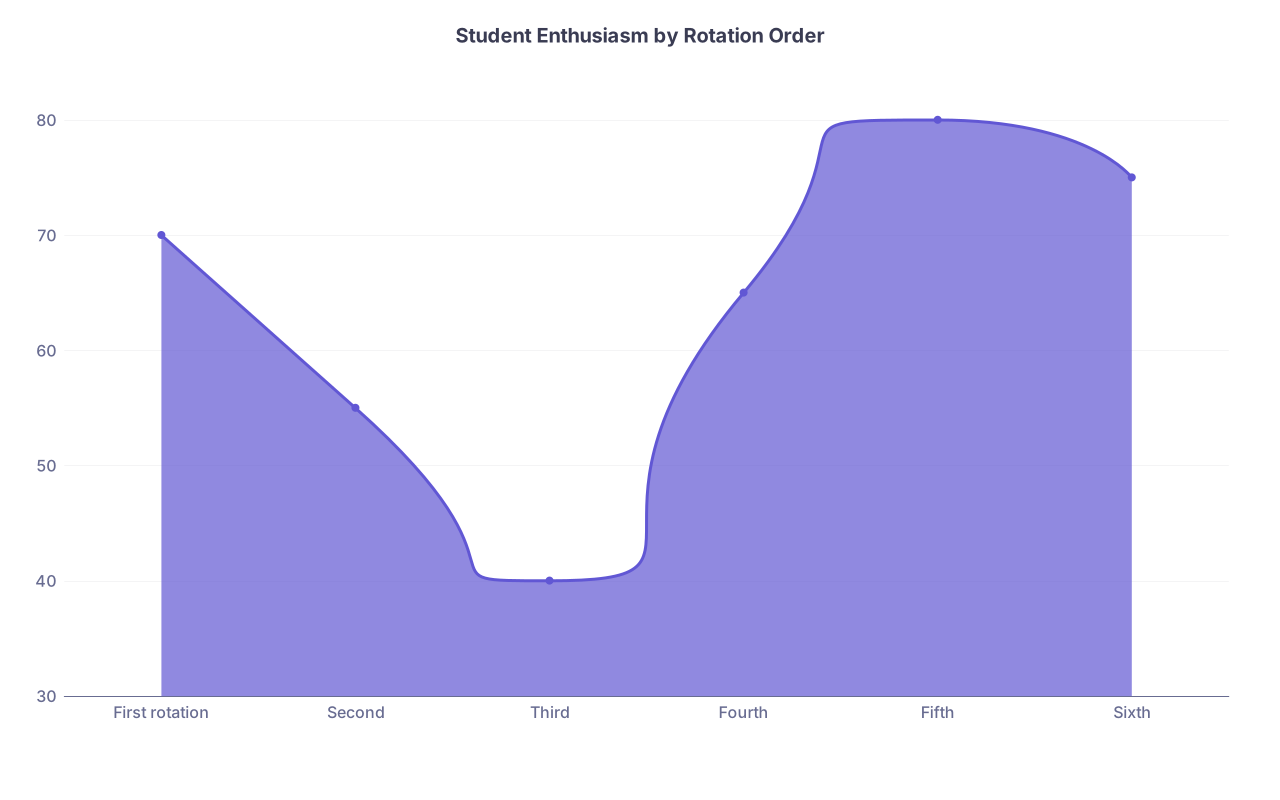
To visualize what often happens emotionally:
| Category | Value |
|---|---|
| First rotation | 70 |
| Second | 55 |
| Third | 40 |
| Fourth | 65 |
| Fifth | 80 |
| Sixth | 75 |
Students tend to overvalue their enthusiasm in the last few rotations and retroactively justify it as “finding their calling,” when really it’s recency bias plus finally feeling competent.
If your specialty choice came together in two weeks at the end of M3 with zero written reflection beforehand, that’s not insight. That’s panic dressed up as clarity.
11. You Have No Tolerance Plan for the Worst Parts
Every specialty has at least one awful feature:
- FM/IM: paperwork, chronic noncompliance, admin nonsense.
- Surgery: OR delays, brutal calls, long training, physical wear.
- EM: night shifts, boarding, constant interruptions.
- Psych: limited tools, system failures, occasional safety concerns.
- OB/GYN: high risk, litigation fears, unpredictable hours.
- Derm: demanding patients, cosmetic pressures, monotonous rashes.
Red flag: you can’t clearly articulate the top 3 worst parts of your chosen specialty and how you’ll cope with them.
If your answer to “What’s the worst part of this field?” is, “Honestly, I don’t really see any major downsides,” then either:
- You’ve not looked hard enough.
- You’re willfully ignoring red flags because you need the dream.
To change that, do this ruthlessly:

| Step | Description |
|---|---|
| Step 1 | Identify Target Specialty |
| Step 2 | Ask 5+ Attendings What They Hate Most |
| Step 3 | Shadow/Rotate During Worst-Shift Types |
| Step 4 | Reconsider Specialty |
| Step 5 | Proceed With Application |
| Step 6 | Still Acceptable? |
If you’re not willing to experience the worst version of the specialty before committing, you’re walking in blind.
12. You’re Comparing Yourself to a Hypothetical Future You That Doesn’t Exist
There’s this fantasy version of yourself:
- Always energetic
- Always disciplined
- Always patient
- Always fine with whatever schedule
- Never burned out
Red flag: you’re choosing a specialty for that version of you, not the real one.
You say things like:
- “Yeah, I hate being up all night now, but I’ll adjust.”
- “Sure, I get bored in clinic, but it’s different when they’re your patients.”
- “I know I don’t like high-stress environments, but I’ll toughen up.”
Maybe. Or maybe you won’t.
Here’s what I’ve actually seen:
- The student who hated nights still hates nights as a PGY-3. Just more tired.
- The person who gets overwhelmed by chaos still gets overwhelmed. Now with more responsibility.
- The one who resented paperwork still resents it. But now it’s attached to their name and license.
If your specialty choice depends on you becoming a completely different personality under more stress and less sleep, that’s magical thinking.
Choose for the you that drags themselves into the hospital post-call, not the best-rested, hypothetical “ideal” version of you.
13. The Numbers Don’t Match the Narrative You’re Telling Yourself
Last point, and it’s blunt.
Sometimes students build a fantasy so strong that they ignore hard realities:
- Your CV doesn’t align at all with your supposed “dream field.”
- You haven’t done any research or away rotations in it.
- Your evaluations in that field are mediocre, but stellar in another.
And yet you tell yourself, “This is my calling.”
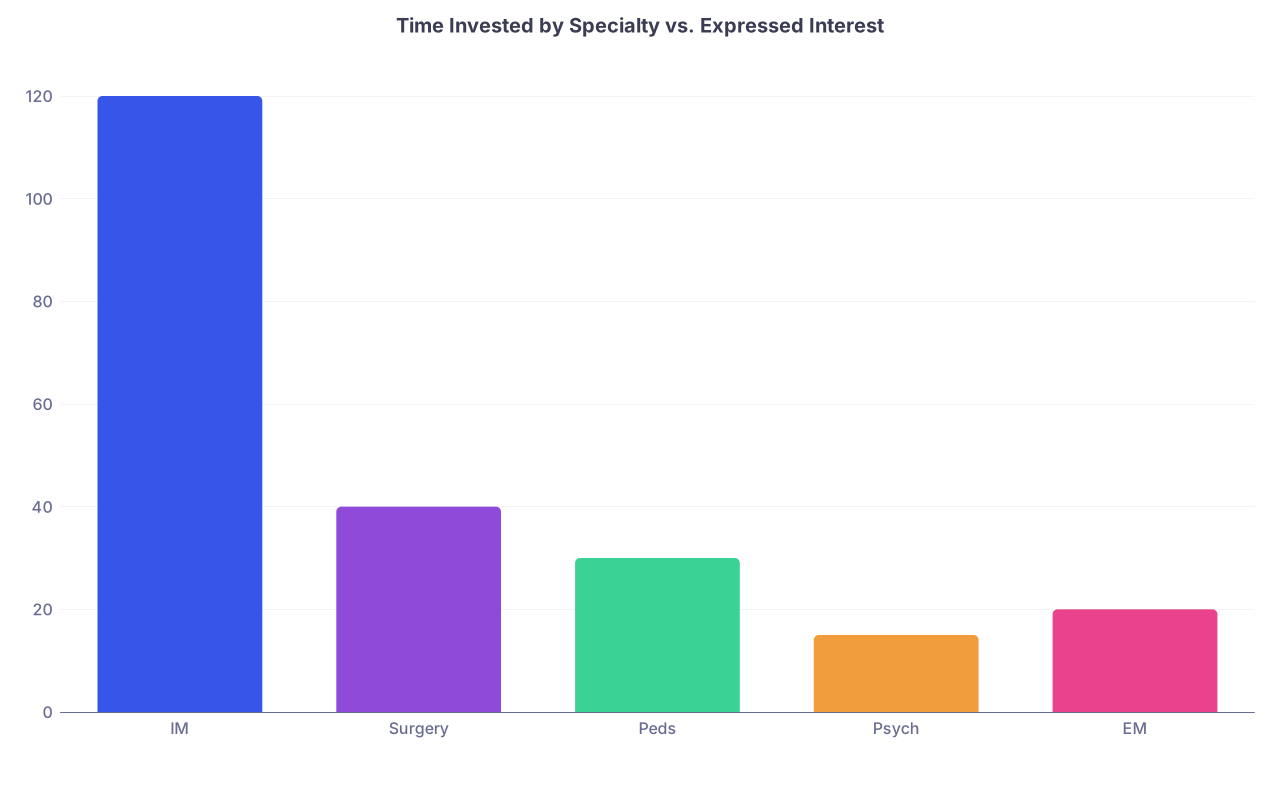
Look at your own behavior data. It often tells you what you actually like:
| Category | Value |
|---|---|
| IM | 120 |
| Surgery | 40 |
| Peds | 30 |
| Psych | 15 |
| EM | 20 |
If you say you “love surgery” but spent triple the time voluntarily on IM electives, research, and reading, something doesn’t add up.
Also pay attention to where attendings and residents naturally say, “You’d be good at this.” Not because they know your soul, but because they’re picking up on how you behave when you think no one’s watching.
If everyone in one field is telling you, “You fit here,” and no one in your chosen field is saying that, you don’t have to obey them—but you should at least consider that your self-story might be off.
14. What To Do If These Red Flags Sound Uncomfortably Familiar
If you’re reading this thinking, “That’s me on like half these points,” don’t panic. It’s fixable—if you stop pretending it’s not a problem.
Basic damage control:
List your real reasons.
Write down: “I’m choosing ______ because…” No censoring, no trying to impress your advisor. If the list is prestige, fear, money, and “it seems smart,” you’ve got work to do.Go hunt the worst days.
Ask residents: “What’s your worst day like?” Then see if you can shadow on something close to that. If you can’t stand watching it, you won’t survive doing it.Talk to people who left—or almost did.
Ask them why. Patterns matter. The reasons people regret a specialty are often more instructive than the reasons they picked it.Be willing to be “average” on paper to be fulfilled in real life.
It might mean choosing a less competitive specialty. Or ignoring your school’s prestige hierarchy. That’s not failure. That’s adulthood.Use a structured reflection tool, not just vibes.
Rating your rotations, tasks, and energy across time isn’t glamorous. But that boring spreadsheet will be more honest than your anxiety-soaked brain at 2 a.m.
Quick Reality Check: Three Things to Remember
If your main motivations are prestige, money, fear of not matching, or other people’s expectations, you’re setting yourself up for long-term regret, no matter how “impressive” the specialty looks on paper.
The best predictor of a good fit isn’t your board score—it’s what you actually enjoyed and tolerated on rotations, especially on the bad days, with average teams.
You’re the one who has to live your future call nights, clinics, and OR marathons. Choose a specialty your real, imperfect, occasionally exhausted self can stand—don’t gamble your career on a fantasy version of you.