
The way most students “sample” specialties is broken. Random shadowing, scattered electives, and a few polite clinic days will not tell you what it actually feels like to live a specialty for 30 years.
You need a specialty test drive. A deliberately engineered month where you simulate real life in a field as closely as a student can. Not vibes. Not prestige. Workflow, patient mix, cognitive load, lifestyle reality.
Here is how to build that month step by step and extract real signal from it.
Step 1: Decide What You Are Actually Testing
“Choosing a specialty” is too big and too vague. A test drive month should answer a much narrower question:
- “Could I see myself as a hospital-based internist?”
- “Do I want an OR-centered career?”
- “Is outpatient, relationship-based care actually satisfying or just what I think I should like?”
Pick one or two focused hypotheses you want to test, not five.
Examples:
- Medicine vs surgery: “Do I prefer procedure-heavy, time-pressured decisions or longitudinal diagnostic puzzles?”
- Cognitive vs procedural within one area: “Neurology vs interventional radiology-like fields.”
- Inpatient vs outpatient heavy: “Hospitalist life vs ambulatory-focused specialties.”
Write down 2–3 questions you want this month to answer. Literally on paper or in your notes app:
- “How do I feel after a full day in this environment?”
- “Do I enjoy the bread-and-butter cases or only the rare ‘sexy’ ones?”
- “Can I tolerate the documentation, phone calls, and follow-ups that fill in the gaps?”
If you cannot articulate the question, your month will turn into tourism instead of testing.
Step 2: Map Your School’s Real Options (Not the Ideal Fantasy)
Most students make the same mistake: they design an “ideal” month that their school cannot possibly deliver. Then they blame the system.
Start by doing a hard inventory of what is actually available to you in the next 6–12 months.
You need:
- The electives list (with course numbers and rotation directors)
- A sense of what clinics exist: continuity clinics, subspecialty clinics, procedure clinics, student-run clinics
- School policies:
- Max number of weeks of electives per block
- Required vs free-choice rotations
- Deadlines to request schedule changes
Email your dean’s office or clerkship coordinator once, with a focused ask:
“I am trying to build one month to compare [Specialty A] and [Specialty B] in a structured way. Could you please send me the list of electives and clinics in these areas and any policies about splitting a month between two services?”
Then build a quick comparison snapshot so you can plan. Something like this:
| Option | Setting | Weeks | Focus |
|---|---|---|---|
| Inpatient Internal Medicine | Inpatient | 2–4 | Acute, ward work |
| General Surgery Service | OR + Inpatient | 2–4 | OR + consults |
| Subspecialty Clinic | Outpatient | 1–2 | Focused disease |
| Continuity Primary Care | Outpatient | 2–4 | Longitudinal care |
| Emergency Medicine | ED | 2–4 | Acute undiff. |
You are not trying to cover everything. You are choosing the 2–3 experiences that will give you the clearest contrast on the questions you wrote earlier.
Step 3: Choose the Core Structure of Your “Test Drive” Month
You have three main structural options. I have seen each work well if done intentionally.
Model 1: Single-Specialty Deep Dive
Use the entire month to live inside one specialty with varied settings.
Example: “Test driving internal medicine”
- 2 weeks: Inpatient general medicine service
- 1 week: Subspecialty clinic (e.g., cardiology or GI)
- 1 week: Primary care or resident continuity clinic
Who this works for:
- You already suspect this may be “your” field.
- You want to confirm depth and breadth, not just peek.
Model 2: Direct A/B Comparison
Split the month between two specialties you are actually torn between.
Example: “Medicine vs surgery”
- 2 weeks: General surgery (mixed OR and floor)
- 2 weeks: Hospital-based internal medicine
Or:
- 2 weeks: Emergency medicine
- 2 weeks: ICU/critical care anesthesia
The key is keeping them adjacent in time. Back-to-back. No 3-month gap that you will conveniently misremember.
Model 3: Thematic Month (Inpatient vs Outpatient, Cognitive vs Procedural)
Sometimes you are less torn between named specialties and more between modes of practice.
Design a theme. Then pick rotations that create contrast inside that theme.
Example: “Outpatient life vs inpatient life”
- 2 weeks: Outpatient clinics (e.g., family medicine + subspecialty clinic)
- 2 weeks: Inpatient (hospitalist or ICU)
Example: “Procedural vs non-procedural”
- 2 weeks: Interventional radiology, GI, or cath lab-based exposure
- 2 weeks: Cognitive consult service (ID, nephrology, or general neurology)
Do not try to run three models at once. Choose.
Step 4: Lock In the Right Mix of Electives and Clinics
Now you know the structure. Time to slot in real experiences. Think in terms of:
- Setting (inpatient vs outpatient)
- Role (observer vs active team member)
- Visit volume and responsibility
- Time of day (are you seeing 7 am pre-rounds or 5 pm discharge crunch?)
You want:
- At least one “full responsibility” environment where you are treated like a sub-I or core student, not a visiting dignitary.
- At least one high-throughput clinic or OR experience to see the grind, not just the highlights.
Common patterns that work:
For medicine-focused fields (IM, peds, neuro, psych):
- 2 weeks inpatient (wards/consult)
- 1 week general clinic
- 1 week subspecialty clinic or continuity clinic
For surgical/procedural fields (surgery, EM, OB/GYN, anesthesia):
- 2 weeks core service (OR-heavy or ED-heavy)
- 1 week clinic (pre-op/post-op or specialty clinic)
- 1 week concentrated procedure time (endoscopy, cath lab, L&D)
Visualizing the Month Structure
Here’s a simple flow-type view of how you might build a 4-week test drive month:

| Step | Description |
|---|---|
| Step 1 | Define Questions |
| Step 2 | Choose Model (Deep Dive / A-B / Thematic) |
| Step 3 | Select Inpatient Component |
| Step 4 | Select Outpatient/Clinic Component |
| Step 5 | Confirm Electives with Coordinator |
| Step 6 | Layer in Shadowing/Extra Clinics |
| Step 7 | Daily Reflection & End-of-Week Review |
Step 5: Negotiate and Customize Within the Rotation
The syllabus is the starting point, not the ceiling. Good attendings are almost always willing to tweak your experience if you come in with a clear, respectful ask.
On day one, tell your attending or preceptor:
“I am using this month as a structured ‘test drive’ between [X and Y]. I want to understand what your day actually feels like from start to finish, including the less glamorous parts—charting, phone calls, scheduling issues. Could I [join you for a full day/see some of your inpatient work/observe how you manage results and follow-ups] at least once or twice this week?”
Be specific about what you want more of:
- More procedures? Ask if you can:
- Scrub early and help with room setup.
- Come in on an extra half-day when they are scheduled for endoscopy/cath/blocks.
- More continuity? Ask:
- “Is there a panel of patients I can follow across visits or across settings?”
- More night/weekend reality?
- “Is it possible to tag along for one evening or weekend call shift to see what nights look like in this field?”
Most will say yes if you are clearly serious and not just trying to impress them for letters.
Step 6: Add “Shadow Blocks” Without Wrecking Yourself
The regular schedule will not show you certain things:
- How often residents actually stay late
- How emergencies derail clinic
- Interactions with other services and nursing staff during off-hours
Build in 3–5 “shadow blocks” over the month:
- 2–3 evening or night shifts
- 1–2 early-morning pre-rounds or sign-out sessions
Rules so you do not self-destruct:
- Never shadow at night the day before a major exam, OSCE, or mandatory session.
- Cap yourself at one late evening per week if you are also on demanding days.
- Tell the team honestly:
- “I am here voluntarily. If you do not need me, I am happy to observe or step out.”
Use these blocks to watch:
- How attendings and residents respond when tired and behind schedule.
- The tone of the team at 6 pm vs 9 am.
- Whether the chaos energizes or drains you.
If you are dreading every shadow block, pay attention to that. That is data.
Step 7: Use a Simple, Ruthless Daily Scoring System
Your memories of the month will be fuzzy and biased by the last few days. Fix that by scoring your days in real time.
End of each day, take 5 minutes. No more. Answer these same questions:
- Energy check:
- “0–10: How mentally and physically drained am I right now?”
- Enjoyment:
- “0–10: How much did I enjoy the core work of today?”
- Interest:
- “0–10: How curious was I about the bread-and-butter cases?”
- People fit:
- “0–10: How much did I like the team dynamics and culture?”
- Lifestyle gut check:
- “0–10: Could I accept a life where many days feel like today?”
You can keep this in a simple table:
| Day | Setting | Energy (0–10) | Enjoyment (0–10) | Curiosity (0–10) | People Fit (0–10) |
|---|---|---|---|---|---|
| 1 | Inpatient | 5 | 7 | 8 | 6 |
| 2 | Clinic | 3 | 4 | 5 | 7 |
| 3 | OR | 7 | 9 | 9 | 8 |
| 4 | Night Shift | 2 | 3 | 4 | 5 |
Do not overthink the numbers. You are looking for patterns, not precision.
After each week, average each column for that block (inpatient vs clinic vs OR).
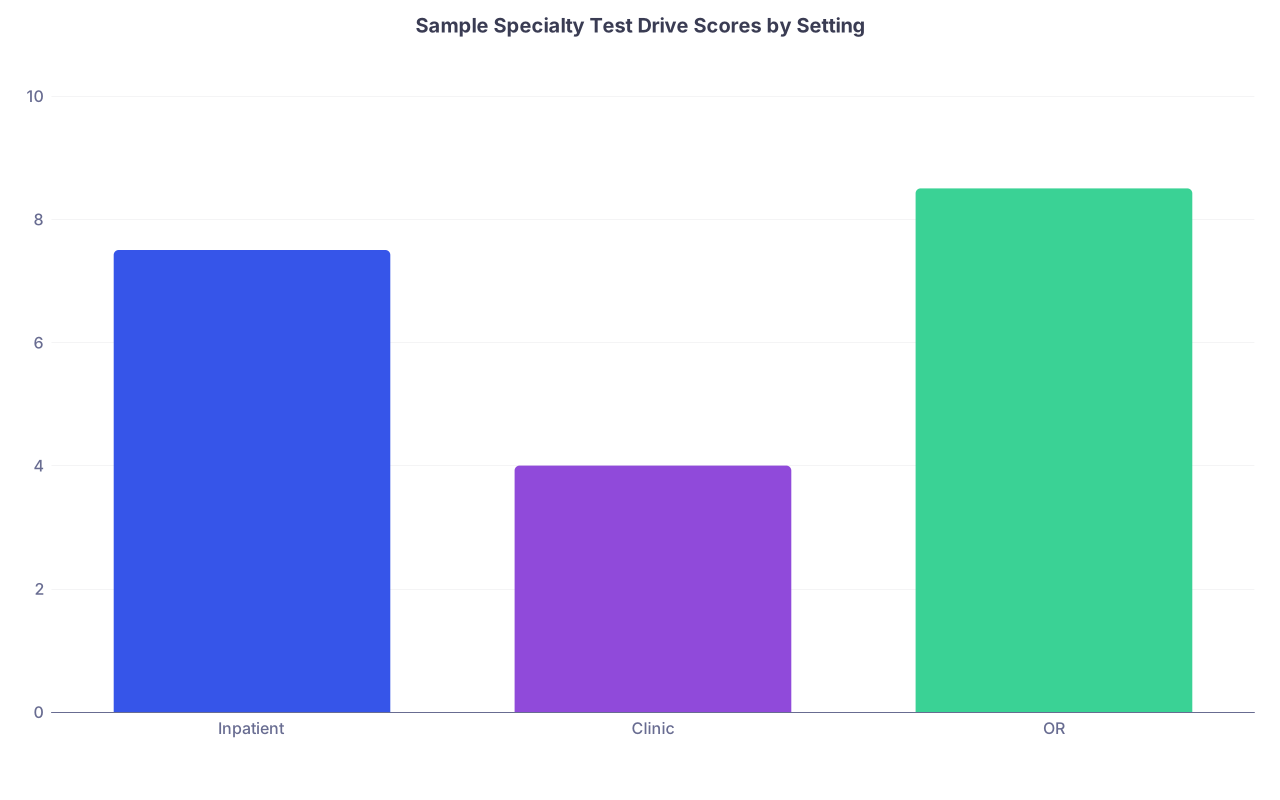
To make it visual, plot a simple graph of how your enjoyment and energy vary by setting during the month:
| Category | Value |
|---|---|
| Inpatient | 7.5 |
| Clinic | 4 |
| OR | 8.5 |
If clinic is consistently a 3–4 enjoyment and OR is an 8–9, that is not an accident. That is your brain telling you something.
Step 8: Ask the Right Questions of Residents and Attendings
You are not just test-driving the work. You are test-driving the future. So stop asking fluff questions and start asking the ones that predict regret.
Ask attendings (privately, not in front of the whole team):
- “What part of your job do you like the least but tolerate?”
- “If your child were considering this specialty, what would you tell them to watch out for?”
- “Compared to when you started, what has gotten better and what has gotten worse?”
- “What personality traits do poorly in this field?”
Ask residents:
- “What surprised you about the day-to-day reality of this specialty?”
- “On your worst day, what makes you think about quitting?”
- “If you had to switch specialties tomorrow, what would you pick and why?”
- “How many weekends or nights do you actually work in a typical month?”
Write down the answers that make you uncomfortable. The discomfort is useful.
Step 9: Track the Objective Lifestyle Clues
You are not going to get perfect lifestyle data as a student. But you can get decent proxies if you pay attention.
Over the month, keep quick tallies:
- How often do attendings stay:
- Past 6 pm?
- Past 8 pm?
- How often do residents:
- Miss lunch?
- Complain about documentation, admin, or call?
- How many:
- Weekend days does the team work?
- “Never again” comments do you hear about night float, ICU months, or consult seasons?
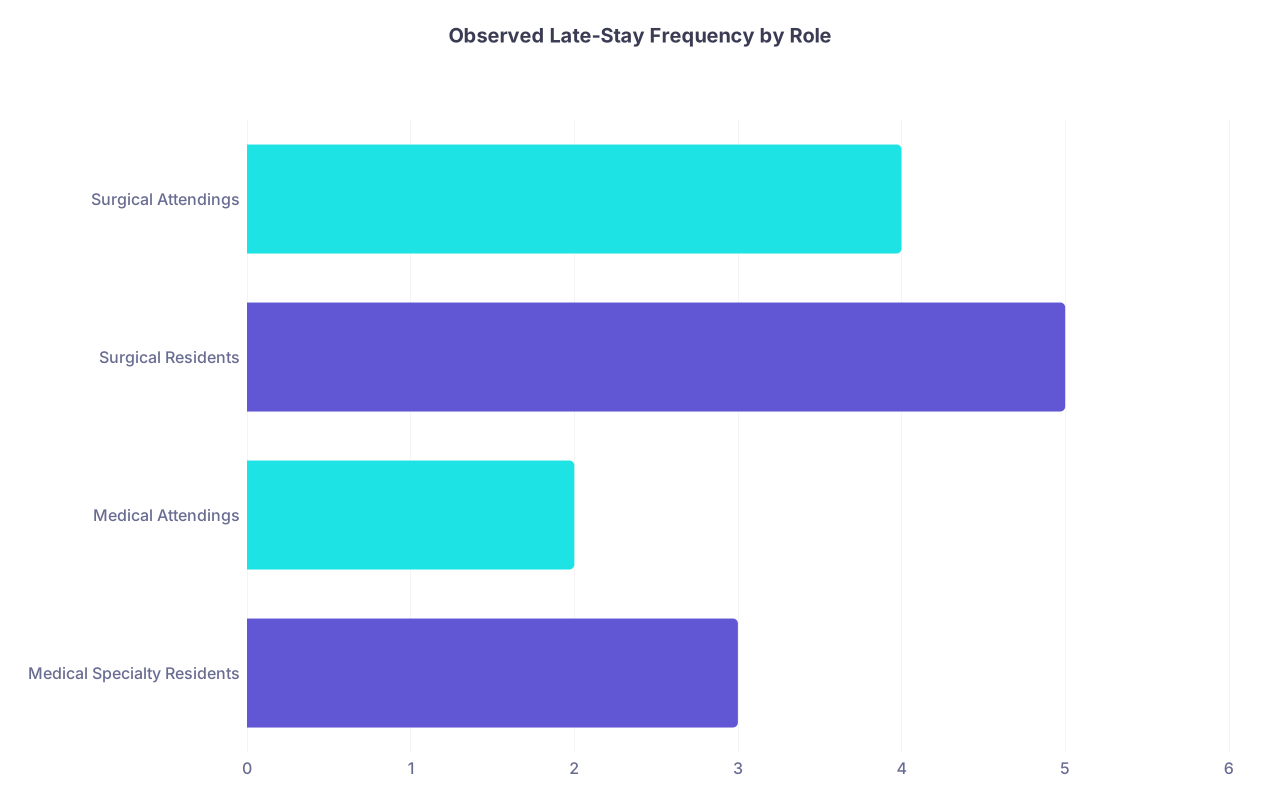
If you like structure, you can jot this down once per week. Turn it into a rough bar chart in your mind:
| Category | Value |
|---|---|
| Medical Specialty Residents | 3 |
| Medical Attendings | 2 |
| Surgical Residents | 5 |
| Surgical Attendings | 4 |
(Values here represent approximate late evenings per week. Replace with your actual observations.)
Do not chase a “chill” specialty based on one mellow attending. Look at the pattern.
Step 10: Formal Reflection at the End of the Month
You spent a month collecting data. If you just “go with your gut” now, you have wasted it.
Block 1–2 hours within a few days of finishing. No phone. No pager. Just you, your logs, and a blank document.
Work through these prompts:
- How did my energy trend across the month?
- Which settings left me drained vs charged?
- Which tasks did I look forward to vs dread?
- Examples: new consults, pre-op visits, family meetings, procedures, documentation.
- What did I miss when I was not doing it?
- When you were in clinic, did you miss the wards? Or vice versa?
- What “this is not me” moments showed up?
- Think of specific days when you thought: “I would not tolerate this for 10+ years.”
- What “I could do this for 20 years” moments showed up?
- Not the rare heroic save. The ordinary day that still felt right.
Then force yourself to write a one-page argument for and a one-page argument against each specialty you are considering. No fluff. Concrete evidence from the month.
If you like visuals, sketch a quick mindmap of what you learned:

If the “against” page for a field is full of lifestyle, personality, and values conflicts, stop trying to talk yourself into it because you liked one attending.
Step 11: Turn the Month into a Signal for Advisors and PDs
Your test drive month is not just for you. Used properly, it becomes:
- Material for personal statements
- Talking points in interviews
- Evidence when advisors doubt your choice
Condense your month into a 2–3 sentence “specialty story” you can use later:
- “I designed a four-week test drive between internal medicine and emergency medicine—two weeks on the wards, two in the ED. I tracked my daily energy and interest and realized I consistently felt most engaged with undifferentiated acute problems and rapid decision-making. That is why I am applying to EM.”
Or:
- “I spent an entire month living inside outpatient care and inpatient medicine. I found that while I respect the inpatient complexity, I missed seeing patients repeatedly and watching them improve over time. The test drive made it clear I belong in a clinic-heavy specialty.”
That kind of narrative sounds intentional because it is.
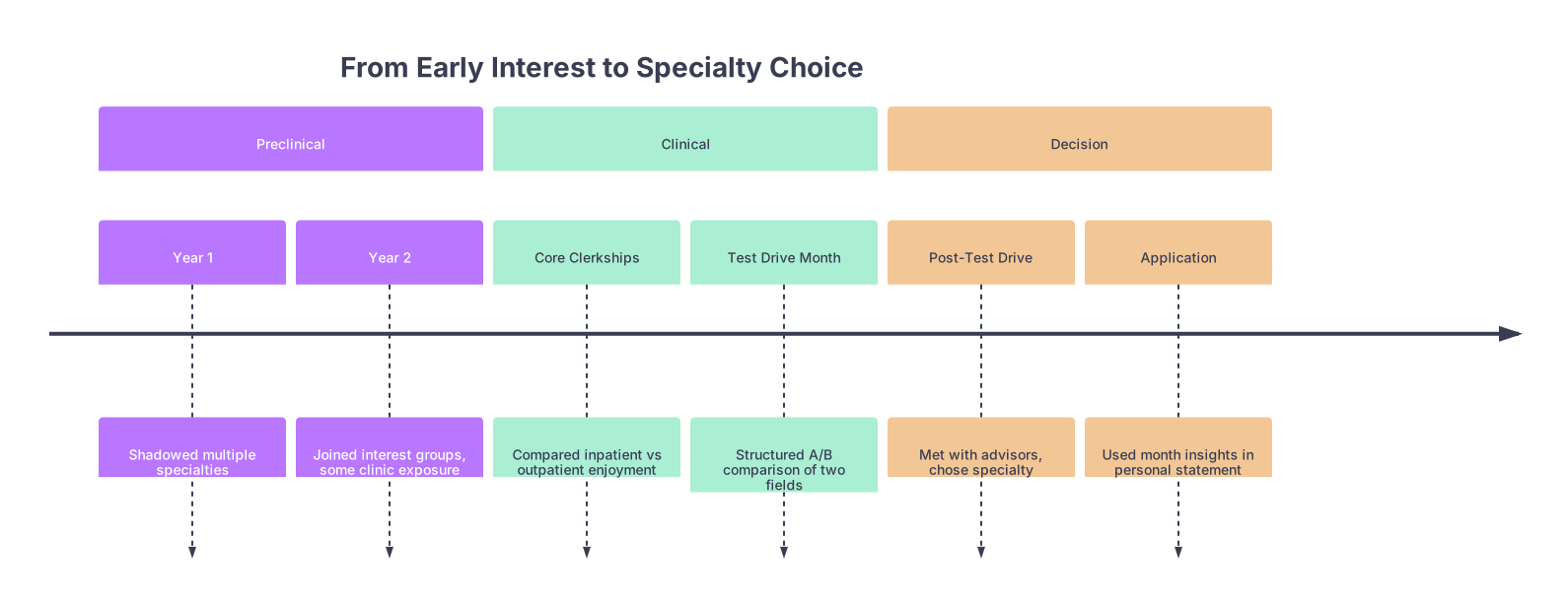
If you want to be even more explicit, build a short timeline of how this month fits into your broader specialty exploration:
| Period | Event |
|---|---|
| Preclinical - Year 1 | Shadowed multiple specialties |
| Preclinical - Year 2 | Joined interest groups, some clinic exposure |
| Clinical - Core Clerkships | Compared inpatient vs outpatient enjoyment |
| Clinical - Test Drive Month | Structured A/B comparison of two fields |
| Decision - Post-Test Drive | Met with advisors, chose specialty |
| Decision - Application | Used month insights in personal statement |
That looks a lot better than “I liked the rotation.”
Step 12: Common Pitfalls and How to Fix Them
You are going to run into friction. Here is how to handle the predictable problems.
Pitfall 1: “I cannot get the electives I want”
Fix:
- Ask for waitlist and backup options.
- Consider:
- Doing 2 weeks now, 2 weeks later in the year.
- Using evenings/weekends with a willing attending in the field you cannot formally rotate in yet.
- Use related fields as proxies:
- No critical care month? Try pulmonary + nights on medicine.
- No EM elective yet? Use night float or admit shifts on medicine to mimic flow.
Pitfall 2: “My attending is too hands-off”
Fix:
- Be explicit:
- “I am hoping to get more hands-on experience with [X]. Could I present more patients / help with [procedures] / follow a couple of patients more longitudinally this week?”
- If they remain disengaged:
- Focus your learning on setting and systems rather than individual teaching.
- Use residents, fellows, and nurses as reality sources.
Pitfall 3: “I loved both fields more after the month”
Good. You at least tested properly. Now you have to make an adult choice.
Fix:
- Go back to values:
- Nights, weekends, length of training, board competitiveness, geographic flexibility.
- List dealbreakers:
- “I will not tolerate >6 nights per month long-term.”
- “I need my practice to allow [family plans, geographic constraint, academic vs community preference].”
- Then choose the field that better matches your non-negotiables, not just the one with the flashiest cases.
Step 13: When to Time Your Test Drive Month
Do not burn this in M3 month one if you have no context. But do not wait until the last possible second either.
Reasonable timing windows:
- Late M3 to early M4:
- You have seen enough core rotations to compare.
- You still have time to pivot if the month flips your preference.
- Before away rotations:
- Use this month to confirm you actually like a field before you spend time and money on aways.
If you are very undecided, you can even do two smaller test drives six months apart (e.g., one month end of M3, one month early M4) and compare notes.
Final Tight Summary
Treat specialty choice like a serious experiment. Define specific questions, build a deliberate 4-week structure (deep dive, A/B comparison, or thematic), and lock in a realistic mix of inpatient, outpatient, and procedural exposure.
Collect real data, not just feelings. Use daily 0–10 scoring, targeted shadow blocks, and blunt questions for residents and attendings to capture what the work and lifestyle actually look like when the brochure smiles are gone.
Force a structured reflection and convert it into a clear narrative. Use your month to argue for and against each field on paper, then use those insights to guide your decision, craft your application story, and push back against noise and pressure from others.