
Most medical students stuck between two specialties are asking the wrong questions.
They obsess over “interest” and “prestige” and “lifestyle,” but they do not run a disciplined, stepwise process. They dabble. They poll random residents. They scroll Reddit. And then they are somehow surprised when February of fourth year feels like a panic attack.
You can do better than that.
What you need is not more opinions. You need a clear framework and a timeline you can actually execute, starting this week.
Below is a practical, no-norship, stepwise system I use with students who are torn between two specialties (IM vs EM, surgery vs OB, peds vs psych, etc.). The goal is simple: give you a structured way to break the tie early enough to protect your applications, your sanity, and frankly, your future happiness.
Step 0: Set the Rules of the Game (Timeline + Constraints)
Before you get lost in introspection, you need constraints. Otherwise this decision will expand to fill every available mental space.
Non‑negotiable reality checks:
You must decide what you are applying in by:
- ERAS opening: late summer/early fall of your application year.
- Practically: you need to be 90% decided 3–4 months before that so you can:
- Line up letters
- Target away rotations
- Tune your personal statement and activities list
Dual applying (e.g., IM + Neuro, EM + FM) is not a magic escape hatch. It solves one problem and creates three more:
- Twice the secondaries, letters, interviews, and emotional load.
- Risk of looking unfocused if not executed carefully.
- Funding and travel strain.
So the working assumption of this framework: you will pick one primary specialty intentionally, and only consider dual applying if you fail to reach reasonable confidence by a specific deadline you set now.
Set your deadlines on paper:
- “By [DATE]: I will have done structured reflection and value clarification.”
- “By [DATE]: I will have completed targeted clinical exposure in both fields.”
- “By [DATE]: I will have met with at least two mentors in each specialty.”
- “By [DATE]: I will commit to a primary specialty or plan a tightly scoped dual-apply.”
Write those down. Put them in your calendar. This is now a project, not a vibe.
Step 1: Clarify What Actually Matters to You (Not To Instagram)
Most students try to compare specialties using vague labels: “lifestyle,” “procedural,” “intellectual.” Those are useless if you do not break them down into concrete, daily realities.
You need a personal decision criteria sheet.
1.1 Build your criteria list
Sit down with a blank page (or spreadsheet) and list out domains that actually drive happiness and burnout in residency and beyond. Here is a starting structure:
Clinical work style
- Continuous vs episodic care (clinic panels vs ED encounters vs operative episodes)
- Inpatient vs outpatient balance
- Cognitive vs procedural vs mixed
- Typical case complexity and ambiguity tolerance
Schedule & lifestyle
- Nights/weekends/holidays frequency
- Shift work vs “whenever the work is done” vs defined clinic schedule
- Predictability vs flexibility
Training path / length
- Years of residency + fellowship norms
- Intensity of those years (e.g., surgical intern year vs psych)
Emotional fit
- Exposure to death, trauma, chronic suffering, acute crises
- Typical patient population (peds, elderly, underserved, ICU-level sick)
- Your response to conflict, demanding families, high stakes decisions
Career flexibility
- Geography options
- Ability to do academic vs community vs telehealth vs locums
- Non-clinical paths (admin, QI, informatics, industry)
Compensation and job market
- Not the only factor—but pretending it does not matter is dishonest.
Now force-rank these domains for yourself:
- Mark each as:
- 3 = critical
- 2 = important
- 1 = nice but negotiable
This gives weight to your later comparisons.
1.2 Turn the two specialties into real options, not stereotypes
Now you build a simple comparison table. Nothing fancy, just honest.
| Factor | Specialty A (e.g., IM) | Specialty B (e.g., EM) |
|---|---|---|
| Work style | ||
| Schedule predictability | ||
| Nights/weekends | ||
| Length of training | ||
| Emotional load type | ||
| Career flexibility | ||
| Job market |
You will fill this in better after the next few steps, but start now with your current beliefs. Make your assumptions explicit so you can test them.
Step 2: Do Structured Clinical “A/B Testing”, Not Random Rotations
The biggest mistake I see: students think “I did my core rotation in both, I know what they are like.” No, you saw a thin, often distorted slice under a specific team, at a specific hospital, with students treated like extra paperwork.
You need purpose-built exposure.
2.1 Design your test rotations
You want at least 2–4 weeks of intentional, higher-responsibility exposure in each specialty you are considering, ideally:
- One sub-I / acting internship (if available) in each
- Or at least:
- A high-quality elective in Specialty A
- A high-quality elective in Specialty B
While planning:
- Avoid purely “shadowing.” You need to write notes, see patients, present, feel some real pressure.
- Prioritize sites with good teaching reputations. Ask upperclassmen who actually learned and were allowed to do something.
2.2 Go in with a structured observation checklist
During those focused weeks, you are not just “feeling it out.” You are collecting data. Create a one-page sheet (or note on your phone) with daily prompts:
For each day in Specialty A or B, jot down:
- Energy check at:
- Start of day (0–10)
- Midday (0–10)
- End of day (0–10)
- 1–2 moments when:
- You felt alive / engaged
- You felt drained / annoyed / bored
- Rate from 1–5:
- Enjoyment of common tasks (notes, procedures, family meetings, interdisciplinary rounds, consults)
- Tolerance for pace (too slow / just right / too chaotic)
- Sense of “I could see myself doing this for 20 years”
Do this every day for both specialties.
At the end of each week, write a blunt paragraph:
“If I had to repeat this exact week 40 times a year for the next 10 years, my honest reaction is: ___”
After 2–4 weeks in each, you will have something far more powerful than vague impressions. You will have a pattern.
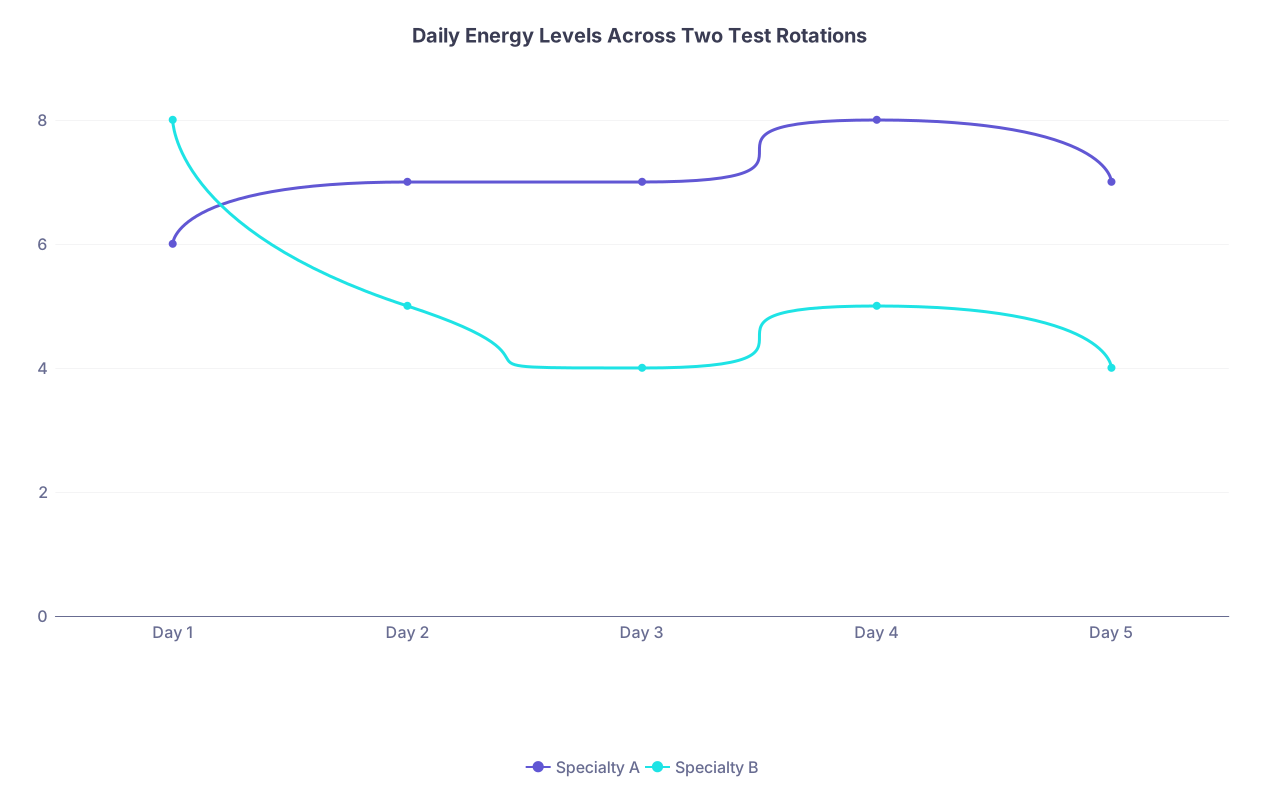
| Category | Specialty A | Specialty B |
|---|---|---|
| Day 1 | 6 | 8 |
| Day 2 | 7 | 5 |
| Day 3 | 7 | 4 |
| Day 4 | 8 | 5 |
| Day 5 | 7 | 4 |
Step 3: Filter Advice Ruthlessly – Build a Micro‑Mentor Panel
Random hallway comment from a burned-out PGY-3 should not decide your life. But you do need perspectives beyond your own.
The fix: construct a deliberate micro‑mentor panel for each specialty.
3.1 Who you actually need to talk to
For each of the two specialties, find:
- 1 junior resident (PGY-1 or 2)
- 1 senior resident or fellow
- 1 attending (ideally one who has been out >5 years)
You can do this through:
- Program interest groups
- Clerkship directors
- Email introductions from faculty you know
- Former residents from your school now in training elsewhere
Avoid only talking to “rockstar” academic attendings. They are survivorship bias in human form.
3.2 Use the right questions, not “Do you like your specialty?”
You want decision-relevant data. Ask:
- “Walk me through a typical week for you—what are the best and worst parts?”
- “When do people in your field burn out? What type of personality tends to regret choosing this?”
- “If you had to pick again today, would you choose this specialty? Why or why not?”
- “What are the hidden downsides med students almost never see on rotations?”
- “What are the realistic career paths 5–10 years out besides the obvious clinic/hospital role?”
And the big one:
“Given what you know of me from this rotation / this conversation, is there anything about my personality, values, or energy that you think does not fit well with this field?”
Write down their answers. Do not romanticize or catastrophize; just collect.
Then synthesize: patterns that come up repeatedly across people are probably real. One-off complaints, less so.

Step 4: Run a Hard-Nosed Lifestyle and Training Analysis
You cannot “vibe check” your way through residency workload differences. Some fields are simply more punishing in certain ways. Denying that is how people end up miserable by PGY-2.
You do not need perfect accuracy, but you do need a ballpark, side-by-side reality check.
4.1 Build a simple residency comparison
Put your two target specialties into a basic comparison like this (customize for your target programs):
| Factor | Specialty A | Specialty B |
|---|---|---|
| Typical residency length (yrs) | ||
| Average weekly hours (PGY-1) | ||
| Nights per month (PGY-1) | ||
| Weekend frequency | ||
| Typical call structure | ||
| Common fellowships (yrs) |
Fill this using:
- Program websites (with skepticism, they understate hours)
- Direct questions to residents (“What are your real hours?”)
- Your own experience during rotations
You are not trying to match every detail. The question is: Can I reasonably see myself surviving and growing in this environment?
4.2 Look beyond residency: the “Day-in-the-Life” test
Many students imagine the attending life of each specialty as a cartoon. Fix that.
Aim to have at least 3 clear “day-in-the-life” examples for each field:
- Academic attending
- Community attending
- One “alternative” path (part-time, admin-heavy, telemed, etc.)
Ask your mentors:
- “If you fast-forwarded me 8–10 years, what are 2–3 likely jobs I might have in this specialty? What would a typical day look like for each?”
Write down those scenarios.
Now run the test:
For each specialty, ask yourself:
“If someone told me I was guaranteed to end up in the average job in this field, not a unicorn job, how would I feel?”
If your answer for one field is “That sounds fine or good,” and for the other is “I would be furious or depressed,” you already have your answer.
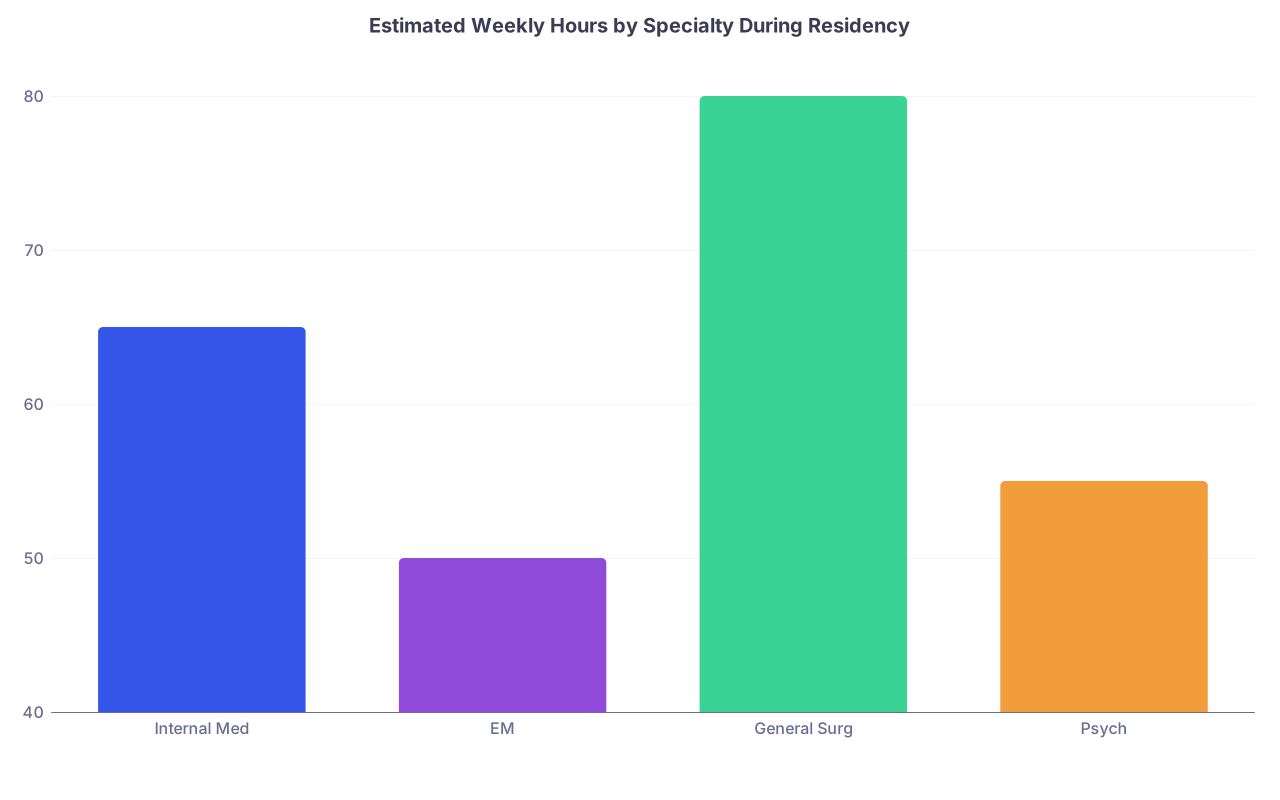
| Category | Value |
|---|---|
| Internal Med | 65 |
| EM | 50 |
| General Surg | 80 |
| Psych | 55 |
Step 5: Use a Structured Scoring System (Then Listen to the Part of You That Hates It)
At this point you have:
- Values and criteria with weights
- Real rotation experience in both fields
- Mentor input across levels
- A training and lifestyle snapshot
Time to translate all that into something that does not change with your mood.
5.1 Build a weighted decision matrix
Take your earlier criteria list and construct this framework:
- List each criterion (e.g., longitudinal relationships, schedule predictability, procedural volume).
- Assign each a weight from 1–3 based on how critical it is to you.
- For each specialty, rate how well it meets that criterion on a 1–5 scale.
- Multiply and sum.
Example (simplified):
| Criterion | Weight (1–3) | Specialty A Score (1–5) | Specialty B Score (1–5) |
|---|---|---|---|
| Long-term relationships | 3 | 5 | 2 |
| Shift-based schedule | 2 | 2 | 5 |
| Procedural intensity | 2 | 3 | 4 |
| Emotional exposure type | 3 | 4 | 3 |
Total scores:
- Specialty A: (5×3) + (2×2) + (3×2) + (4×3) = 15 + 4 + 6 + 12 = 37
- Specialty B: (2×3) + (5×2) + (4×2) + (3×3) = 6 + 10 + 8 + 9 = 33
This is not a math exam. It is a structured gut-check. The point is:
- Make your tradeoffs explicit.
- Reduce emotional whiplash from day to day.
5.2 The coin-flip test (seriously)
Once you have a “numerical winner,” do the coin trick. Tell yourself:
“Heads = Specialty A, Tails = Specialty B.”
Flip it. Look at your immediate reaction when it lands.
- If you feel relief: your subconscious probably already chose that one.
- If you feel dread or an urge to “best two out of three”: that is data. It means the other specialty has a stronger emotional claim, even if your numbers said otherwise.
When the score and your gut both point the same way, you have your answer. When they diverge, you need to explore why. Often you will find:
- The score is driven by criteria you think you should care about (income, prestige) more than you actually do day-to-day.
- Or your gut is reacting to fear (of difficulty, of matching, of telling your family) rather than attraction.
Be honest about which it is.

| Step | Description |
|---|---|
| Step 1 | Clarify values & criteria |
| Step 2 | Targeted rotations in both fields |
| Step 3 | Micro-mentor panel talks |
| Step 4 | Residency & lifestyle comparison |
| Step 5 | Weighted decision matrix |
| Step 6 | Commit to primary specialty |
| Step 7 | Clarify conflict & repeat focused steps |
| Step 8 | Scores + gut aligned? |
Step 6: Reality-Check Competitiveness Without Letting It Run the Show
Yes, competitiveness matters. No, it should not be the first filter. But ignoring it until September of M4 is reckless.
You need a sober view of your match odds in each specialty at the types of programs you would actually attend.
6.1 Quick competitiveness snapshot
Look at:
- Your Step 2 CK (or equivalent) score
- Class rank, AOA status (if applicable)
- Research output related to each field
- Clinical evals / honors in relevant rotations
Then compare this against recent match data for each specialty you are considering. Do not obsess over the top 10 programs unless you are actually competitive there.
A simple way to visualize fit:
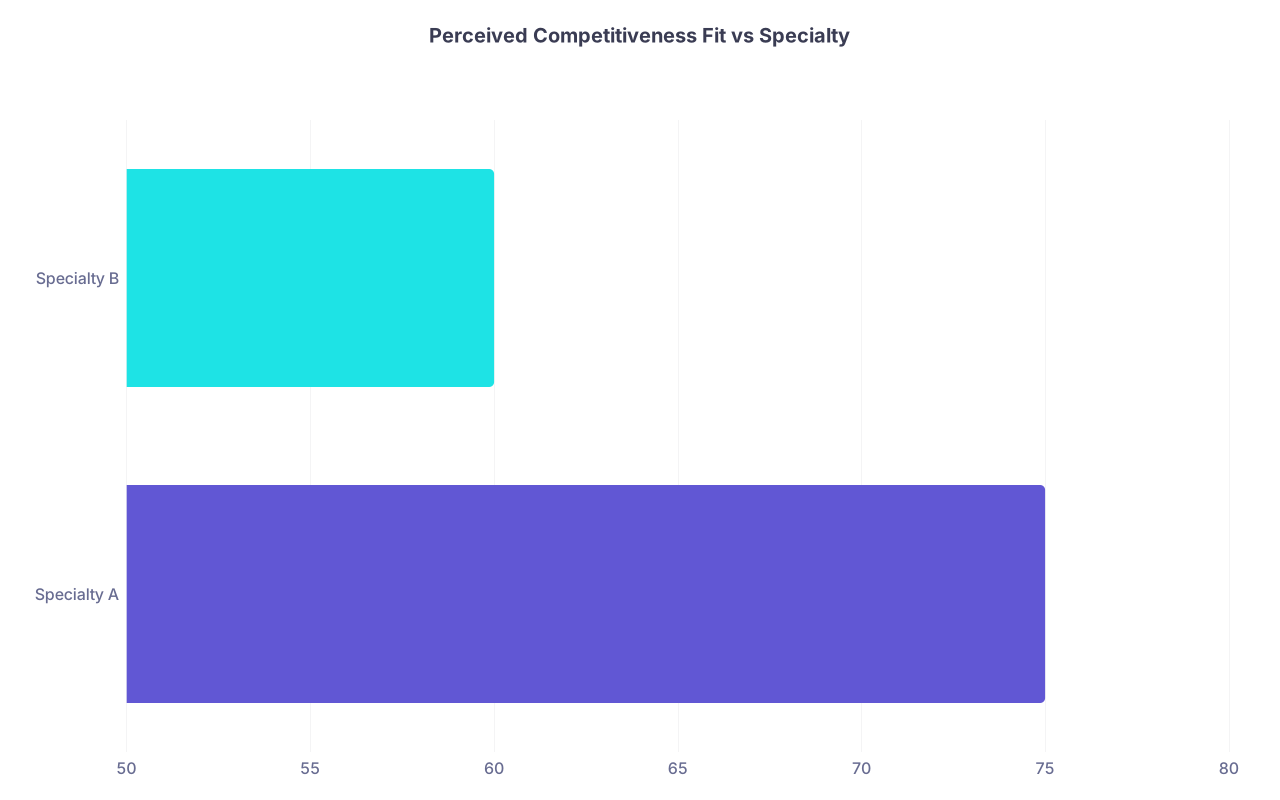
| Category | Value |
|---|---|
| Specialty A | 75 |
| Specialty B | 60 |
Think of these as fit scores, not your worth as a human.
6.2 Avoid the “I better pick the easier match” trap
Moving to a “less competitive” specialty just because you are anxious is a fast track to regret. Here is how to keep it in check:
- Ask: “If both were equally competitive for me, which would I choose?”
- If the answer is crystal-clear, that is your true preference.
- Only then layer on competitiveness:
- “Given that preference, what strategy (research, aways, broad application) do I need to get a realistic shot?”
- “Is the risk tolerable, or do I need a smart dual-apply strategy?”
Sometimes you truly fall in love with a hyper-competitive field (e.g., derm, ortho) and your current application is weak. Fine. Then you:
- Apply broadly within that field
- Consider a rational dual apply (e.g., IM with a derm interest)
- Have a plan for what you will do if you do not match (reapply vs shift fields)
But you do that with open eyes, not as a last-second fire drill.
Step 7: Decide Like a Professional and Commit to the Path
At some point, “I am keeping an open mind” becomes procrastination. Decisions are costly, but not deciding is usually worse.
You want to reach the point where you can say:
“Given the data I have, the time available, and who I am right now, I am choosing Specialty X. I understand what I am gaining and what I am giving up.”
Once you are there, you execute.
7.1 Practical commit steps
Once you choose a primary specialty:
- Notify key mentors
- “I have decided to apply in [Specialty]. I would be grateful for your guidance on next steps and letters.”
- Lock in letters early
- Aim for at least 2 strong letters from your chosen field, more if it is competitive.
- Target your remaining electives
- Use them to strengthen depth in your chosen field, not to “sample everything” indefinitely.
- Align your application story
- Frame your activities, research, and personal statement around a coherent narrative pointing to this specialty.
- Set a firm “no more reconsidering” date
- After that date, you do not reopen the question unless something dramatic changes (catastrophic eval, total change in life circumstances, etc.).
7.2 If you still feel torn by your deadline
Fine. Then you switch from “pure choice” to risk management:
- Pick a primary specialty based on:
- Your values and experiences (not just score)
- Where you feel even 10–20% more drawn
- Design a limited, strategic dual-apply if needed:
- One main specialty (e.g., EM) with full court press
- One backup (e.g., IM) that you would genuinely accept, not hate
- A clear internal rule:
- “If I get X interviews in my primary field by Y date, I will cancel the others and commit.”
- Do not try to fully pursue two unrelated ultra-competitive specialties simultaneously. You will do a mediocre job in both.
Common Pitfalls That Keep Students Stuck
Let me be direct about the patterns I have seen derail people:
Chasing prestige over fit
- Radiology, derm, ortho, neurosurg are not trophies. They are jobs. Very hard ones. If your core motivation is status, you will run out of gas.
Confusing liking a rotation with liking the specialty
- You liked the residents. The schedule was lighter. The attending was kind. That does not automatically mean you love the field.
Overweighting one off-day or one bad attending
- Every specialty has malignant people and rough weeks. One terrible call night should not torpedo an otherwise good fit.
Paralysis from fear of regret
- You will give something up no matter what you choose. That is how decisions work. The goal is not zero regret. The goal is a life you can look at and say, “That makes sense for who I am.”
Assuming you are locked in forever
- People do switch specialties. Usually early, sometimes later. It is not easy, but it happens. The decision matters, but it is not a legal sentence.
A Simple Weekly Protocol to Move You Forward
If you want to stop spinning and start making concrete progress, follow this 4-week protocol:
Week 1: Values + Data Prep
- Build your personal criteria list and weighted matrix template.
- Write your current assumptions about both specialties.
- Schedule at least 2 mentor conversations for each field.
Week 2–3: Focused Exposure and Conversations
- Do at least 1 week in each specialty with your daily observation checklist.
- Complete your mentor conversations using the targeted questions.
- Build your residency and attending day-in-the-life snapshots.
Week 4: Synthesis and Decision
- Fill in your weighted decision matrix with real data.
- Do the coin-flip test.
- Draft a one-page “Why I am choosing Specialty X over Y” memo to yourself.
- Share your thinking with 1–2 trusted mentors and adjust if needed.
- Set your commit date and, when it hits, stop revisiting.
Follow that and you will not be the M4 in October still whispering, “I am between three things.” You will be the one with a coherent application and a cleaner mind.
Your Next Step (Do This Today)
Open a blank page and write two headings: Specialty A and Specialty B.
Under each, write:
- “What I think I like about this field.”
- “What scares me about this field.”
- “What I am assuming about lifestyle and training.”
Then mark a date—four weeks from today—in your calendar labeled:
“Decision Checkpoint: Primary Specialty Choice.”
That one small move turns this from a vague anxiety into a problem with a plan.