
Keeping 2–3 specialties realistically open for a full year is a strategy problem, not a passion problem.
Most students screw this up because they “follow their interests” and hope it works out. Then discover in March of M3 that their backup specialty requires an away rotation, 4 letters, and a Step 2 they never planned to take early.
You are not doing that.
You are going to run a one-year experiment with 2–3 specialties and come out with:
- A clear rank order (1st choice, 2nd choice, emergency backup).
- Enough exposure and letters to apply credibly to at least 2 specialties.
- No fatal omissions (missing away, missing letter, missing exam score).
Here is how to build that one-year plan.
Step 1: Pick 2–3 Specialties Intelligently (Not Emotionally)
You cannot keep 6 doors open. Two or three, yes. Six, no. The math on time, letters, and away rotations just does not work.
1.1 Define your “portfolio” of specialties
You want a mix that is:
- Realistic with your current metrics.
- Cross-compatible in terms of letters and experiences.
- Diverse enough that if one door slams, you still match.
There are three common “portfolio” patterns:
Adjacent specialties (share letters/rotations well)
Examples:- Internal Medicine ↔ Neurology
- General Surgery ↔ Surgical subspecialty (ENT, Ortho, Urology)
- Pediatrics ↔ Med-Peds
Lifestyle + procedure mix
Examples:- Emergency Medicine + IM
- Anesthesiology + IM
- OB/GYN + Family Medicine
Competitive + safer backup
Examples:- Dermatology + IM
- Ortho + General Surgery
- ENT + General Surgery
- Radiology + IM
Pick one primary pattern. Do not get cute and try to chase 3 ultra-competitive fields at once.

1.2 Use cold numbers, not vibes
You need to align with competitiveness and your current profile.
Rough competitiveness snapshot (very simplified):
| Tier | Examples | Typical Step 2 CK Target |
|---|---|---|
| Ultra-competitive | Derm, Ortho, ENT, Plastics | 250+ |
| Competitive | EM, Anesthesia, Radiology, OB/GYN | 240+ |
| Moderate | IM, Peds, Gen Surg, Psych | 230+ |
| Less competitive | FM, PM&R, Neuro (many programs) | 225+ |
If your Step 1 and practice Step 2 CK scores do not live in the neighborhood for a specialty, you can still apply. But it should not be the only door you keep open.
1.3 Reality check with quick constraints
Before you lock in your 2–3 specialties, answer:
- Do they require different away rotations?
- Do they require different types of letters (e.g., EM SLOEs vs IM letters)?
- Does your school’s schedule even allow the away timing needed?
If the logistics clash (for example, ENT + EM + Derm as a trio), narrow to 2 and build a serious backup within one of them (e.g., ENT + Gen Surg).
Step 2: Map the Actual Year, Month by Month
Vague intentions die. Calendar-based plans survive.
You are building a 12-month plan that usually runs from early M3 through early M4 (or equivalent at your school).
2.1 Know the critical timelines
There are four big anchors:
- Core rotations – usually most of M3.
- Step 2 CK – needs to be taken early enough for programs to see the score.
- Sub-I / Acting Internship – for your main specialty (and maybe your backup).
- Away rotations – for fields that expect them (surgical subspecialties, EM, some IM subs).
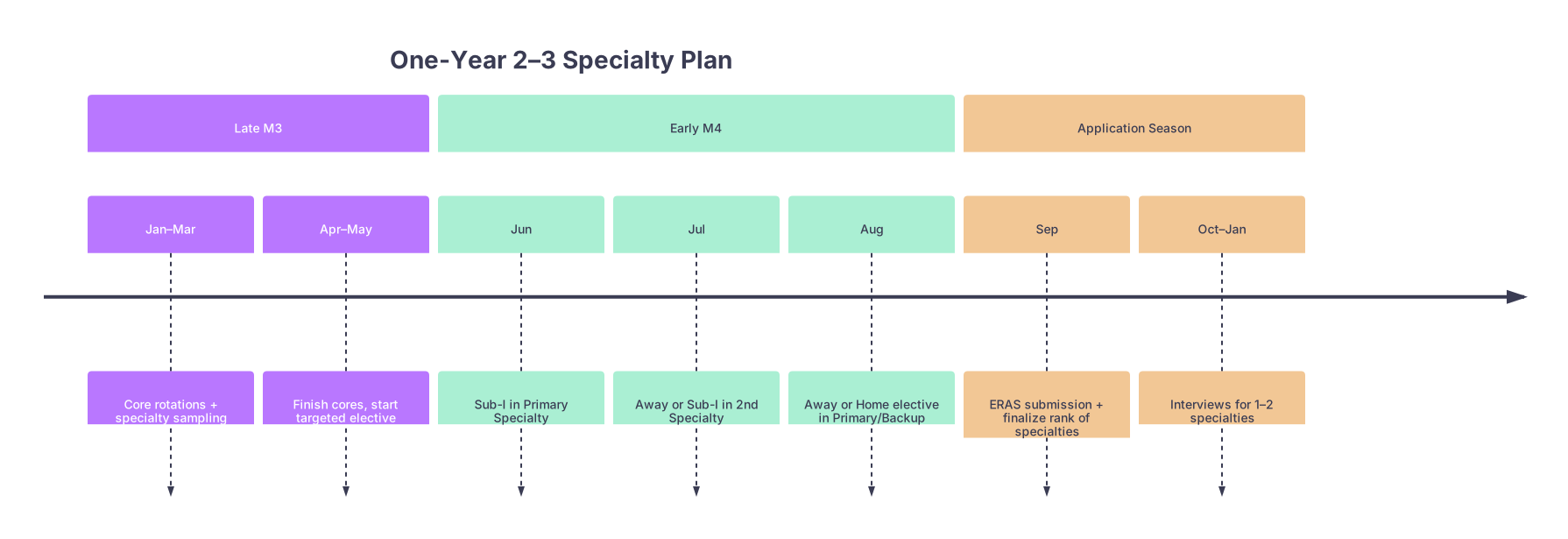
Here is a stripped-down timeline example for someone finishing M3 in May and applying in September:
| Period | Event |
|---|---|
| Late M3 - Jan–Mar | Core rotations + specialty sampling |
| Late M3 - Apr–May | Finish cores, start targeted elective |
| Early M4 - Jun | Sub-I in Primary Specialty |
| Early M4 - Jul | Away or Sub-I in 2nd Specialty |
| Early M4 - Aug | Away or Home elective in Primary/Backup |
| Application Season - Sep | ERAS submission + finalize rank of specialties |
| Application Season - Oct–Jan | Interviews for 1–2 specialties |
2.2 Assign rotations to specialties, not the other way around
You have limited “high-yield” rotation slots before ERAS opens:
- 1–2 Sub-Is (often internal medicine, surgery, or in your chosen field)
- 1–2 away rotations (if needed)
- 2–3 electives you fully control
Allocate them deliberately:
- Primary specialty: 1 Sub-I (home), 1 away or strong elective.
- Secondary specialty: 1 rotation that will impress (home or away).
- Backup “safety” within IM/FM/Peds often shares letters/experiences with others.
If you are serious about 3 specialties, the third needs to be something that can piggyback off letters or rotations. For example:
- IM + Cards interest + EM: IM letters can still support EM, but you need at least 1 EM rotation for SLOEs.
Step 3: Build a Letter Strategy That Covers 2–3 Paths
This is where students accidentally burn bridges. They chase a rotation “for exposure” but never think about whom they need letters from and by when.
3.1 Understand what each specialty actually expects
Quick and dirty letter expectations:
| Specialty | Common Letter Expectation |
|---|---|
| IM | 2–3 IM faculty (often 1 from Sub-I) |
| Gen Surg | 2+ surgery faculty, often 1 from Sub-I |
| EM | 2 SLOEs from EM rotations |
| OB/GYN | 1–2 OB/GYN, 1 other (IM/FM) |
| Psych | 1–2 Psych, 1 other (IM/FM) |
You must know this early, not in July.
3.2 Design your “letter grid”
For each specialty, list:
- Required number of specialty letters.
- Acceptable “other” letters.
- Best rotations to obtain them.
Then cross-match.
Example: You are considering IM, EM, and Psych.
- IM: 2 IM letters + maybe 1 EM or Psych.
- EM: 2 EM SLOEs (from home and away).
- Psych: 1–2 Psych letters + 1 “medical/surgical” (IM is ideal).
You might plan:
- M3 IM core → potential IM letter.
- M3 Psych core → potential Psych letter.
- Late M3/early M4 EM elective (home) → first EM SLOE.
- Early M4 EM away → second EM SLOE.
- IM Sub-I early M4 → strong IM letter.
This way:
- You can apply strong to EM (2 SLOEs).
- You have enough for IM (Sub-I + core).
- You can apply to Psych with at least 1 Psych + 1 IM.
3.3 Script the ask and the follow-up
You want “strong” letters, not “polite” ones. That means:
Show up consistently on the rotation: punctual, prepared, not a ghost.
Mid-rotation, tell the attending:
“I am seriously considering [Specialty A] and [Specialty B]. I am trying to keep my options open realistically. If my performance continues at this level, would you feel comfortable writing me a strong letter for at least [one of them]?”End of rotation:
- Ask again directly.
- Give them your CV, personal statement draft (even if it is version 0.1), and concrete bullet points on what you did.
Set a deadline. Track responses. Do not end August with “a bunch of people who said maybe.”
Step 4: Use Each Rotation as a Real Experiment, Not a Vibe Check
You need a structured way to test specialties. Not “I liked clinic and the residents were nice.”
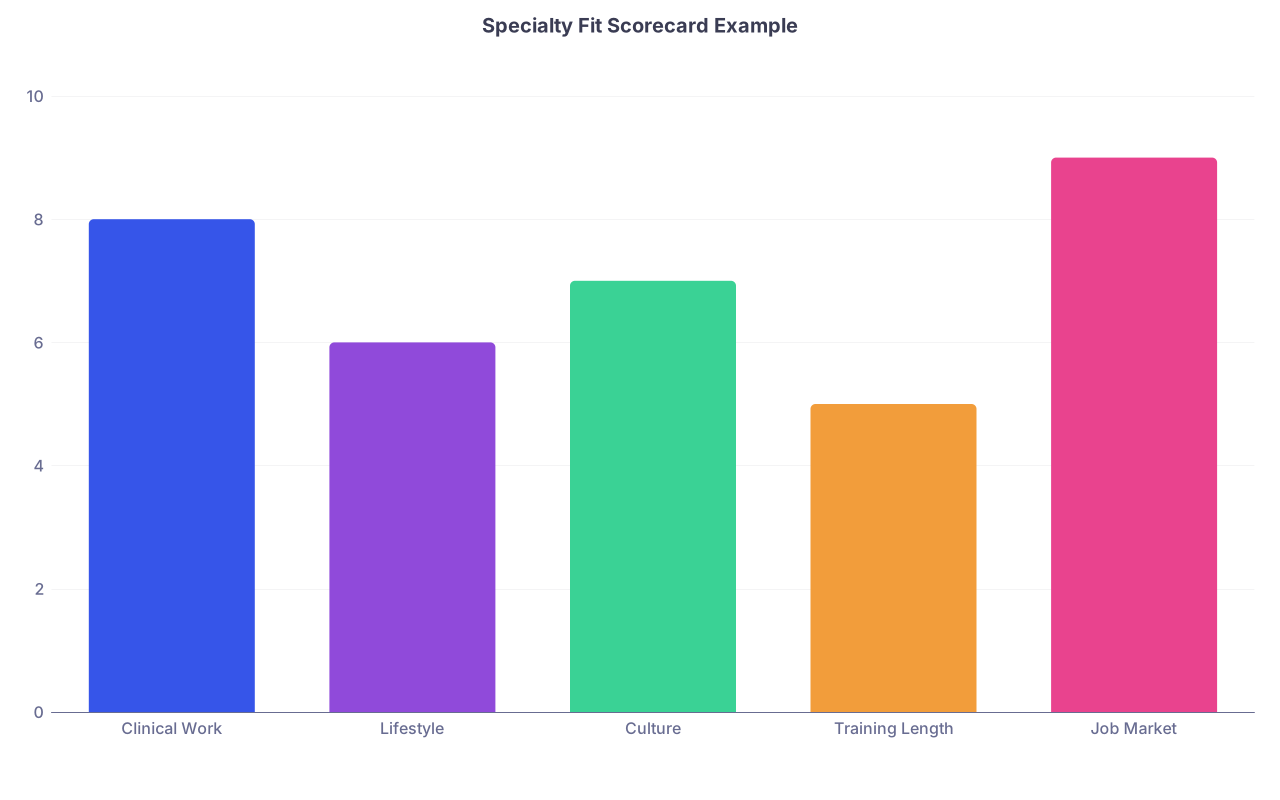
Here is a simple 5-factor scorecard to use on every specialty you are seriously considering.
| Category | Value |
|---|---|
| Clinical Work | 8 |
| Lifestyle | 6 |
| Culture | 7 |
| Training Length | 5 |
| Job Market | 9 |
Rate each 1–10 after each substantial exposure:
- Clinical work enjoyment (day-to-day tasks).
- Lifestyle (call, hours, nights, weekends).
- Culture and people (residents, attendings, nurses).
- Training length and intensity.
- Job market and flexibility (where you want to live, academic vs community).
Then add three gut check questions:
- After a brutal call night, could I still see myself doing this for 10–20 years?
- Do I like the problems this specialty solves?
- Would I be proud, long term, to put this specialty name under mine on a hospital badge?
Write your answers down immediately after the rotation. Not three months later when nostalgia kicks in.

Step 5: Schedule Step 2 CK and Exams to Support All Options
Some specialties care a lot about Step 2 CK timing and score (e.g., IM, EM, surgery, competitive fields). Others still care, just less loudly.
5.1 Decide on Step 2 CK timing up front
Typical options:
- Early summer before M4 (June/July) – Most common if you want the score in before ERAS.
- Late M3 – Aggressive but powerful if Step 1 was weak and you need redemption.
- Later in M4 – Risky if you are betting on competitive fields.
If any of your 2–3 specialties are even mildly competitive, plan to have Step 2 CK back by August.
That means:
- Test latest by mid-July.
- Protect 4–6 weeks before the test with lighter rotations (research, lighter elective, or shorter hours).
5.2 Protect your study time from rotation chaos
This is where students lose the plot. They do surgery Sub-I + EM away + Step 2 in the same 3 months. Disaster.
Build guardrails:
- Never pair a heavy Sub-I with Step 2 study push.
- Never schedule an away rotation during the 4 weeks before Step 2.
- Use lighter rotations strategically:
- Outpatient subspecialty.
- Research.
- Electives with predictable hours.
You are not “weak” for scheduling strategically. You are smart.
Step 6: Decide When to Close a Door (On Purpose)
Keeping 2–3 specialties “open” does not mean you commit to indecision until ERAS lock. At some point, you close a door. That is how you avoid a fragmented application.
6.1 Set decision checkpoints
Plan 3 specific checkpoints:
- End of core rotations – “Which 2–3 are still serious contenders?”
- After first Sub-I or key elective – “Is my primary specialty still #1?”
- By early August – “What is my final rank order, and how am I dividing applications?”
Put these on your calendar. Treat them like exams.
At each checkpoint, ask:
- Am I collecting enough letters for each option?
- How does my Step 2 CK (and transcript) realistically position me?
- Do I have sufficient rotations completed in each specialty?
6.2 Use hard criteria, not mood
Here is an actual decision framework I have seen work for students:
If one specialty:
- Has better letter strength,
- Better score alignment,
- And you enjoyed it at least as much as the others,
→ It becomes primary.
A specialty becomes “backup only” when:
- You have 1–2 letters, but not as strong as the other path.
- Your exposure is limited, but the field is less competitive.
- You can still write a coherent, honest personal statement for it.
A specialty is closed when:
- You have no realistic way to get required letters before ERAS.
- Your scores clearly undercut you for most programs there.
- Your personal enjoyment scorecard is significantly worse than the others.
Write this down. Discussion with your advisor, not just in your head.
Step 7: Construct a Dual (or Triple) Application Strategy That Does Not Look Chaotic
Here is where students panic: “If I apply to two specialties, will programs think I am not committed?”
If you do it sloppily, yes. If you are methodical, no.
7.1 Separate personal statements and narratives
You will need:
- A primary personal statement tailored to Specialty A.
- A separate personal statement for Specialty B.
- Optionally, a variant for “generalist backup” (IM or FM) if both A and B are niche.
The key: Do not try to write one vague personal statement to cover everything. That is how you sound uncommitted to everyone.
For each specialty, answer:
- Why this field specifically?
- What experiences proved that to you?
- What kind of resident do you want to be in this field?
If you have overlapping experiences (e.g., ICU rotation relevant to EM and IM), you frame them differently in each essay.
7.2 Allocate programs rationally
You decide ahead of time:
- How many programs for each specialty.
- Which regions you are willing to interview for each.
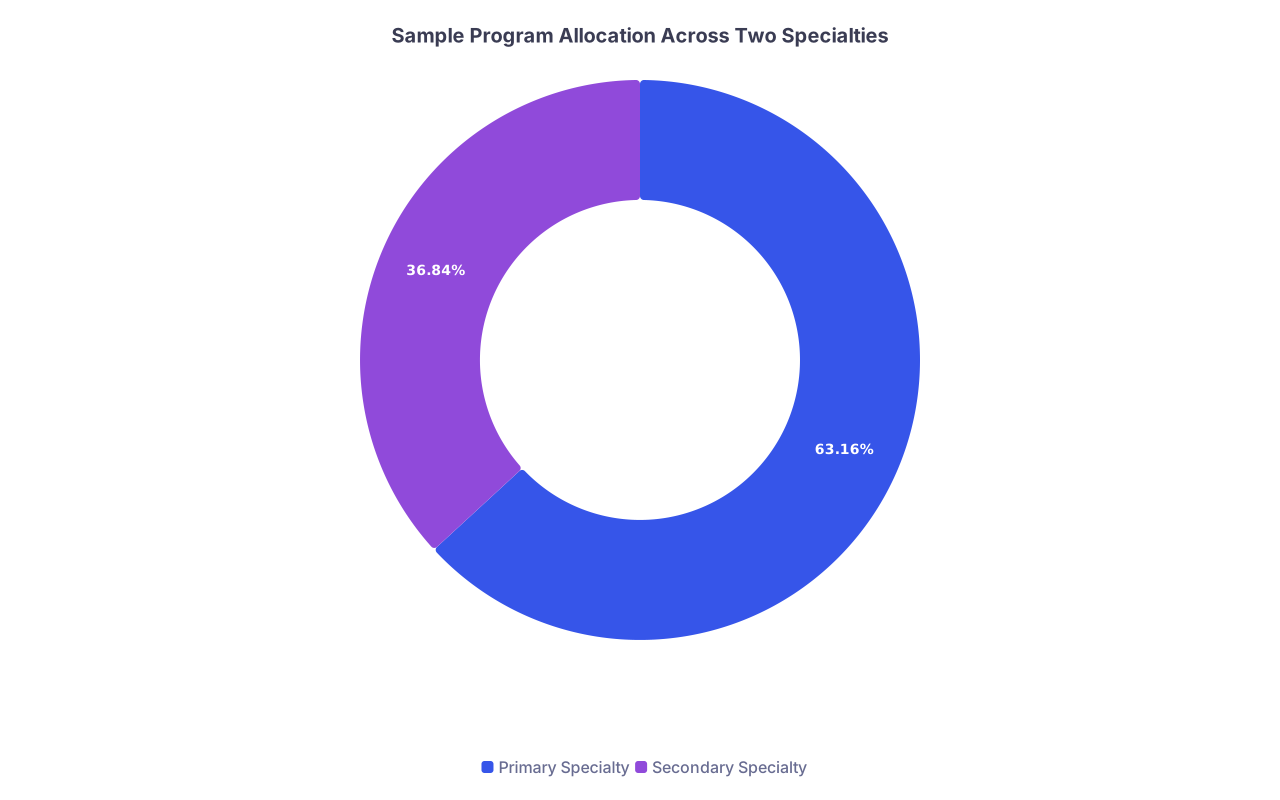
Rough rule of thumb if you are solid but not superstar:
Competitive primary + moderate backup:
- 40–60 in primary.
- 25–40 in backup.
Two moderate specialties:
- 25–40 in each, depending on geography preference and application strength.
You are not chasing 80 programs in each of three specialties. That is how you burn time, money, and sanity.
| Category | Value |
|---|---|
| Primary Specialty | 60 |
| Secondary Specialty | 35 |
7.3 Plan the interview season with two specialties in mind
You need rules before invites hit:
- Minimum number of interviews you will attend for each specialty.
- When you will start declining one specialty to protect the other.
For example:
- “If I get >14 interviews in IM and <8 in EM, I will accept all EM interviews and cap IM at 16.”
- “If by December 1 I have <8 interviews total in my primary, I will more aggressively accept backup interviews.”
Write these rules down now. Future you, drowning in emails, will be biased and confused.
Step 8: Use Advising and Mentorship Strategically (Not Randomly)
Random ad hoc advice from whoever is on call that day will confuse you. You want a small advisory board, not a crowd.
8.1 Build a 3-person “specialty board”
Aim for:
- One faculty in your primary specialty.
- One faculty in your secondary/backup specialty.
- One generalist advisor (Dean’s office, career advisor, or IM/FM faculty).
You are not asking them to decide for you. You are asking them to:
- Reality check your competitiveness.
- Review your rotation sequence.
- Advise on letters and where to apply.
8.2 Have one focused meeting per advisor
Do not show up and say, “I am lost. Help.”
Instead, walk in with:
- Your draft 12-month rotation/calendar plan.
- List of 2–3 specialties you are considering and why.
- Your current Step scores and class performance.
- Specific questions:
- “Is this enough exposure/letters to be credible for your field?”
- “What is missing?”
- “Am I overestimating or underestimating my chances here?”
Take notes. Adjust your plan. Then stop bouncing the same questions off 10 more people. Analysis paralysis is real.

A Concrete Example: One-Year Plan Template
Let’s build a quick example for a student considering: Internal Medicine (primary), Emergency Medicine (secondary), and Psych (soft backup).
M3 finishes end of May. Step 2 CK target: July.
June (late M3):
- Light elective + start Step 2 study in earnest.
- Meet IM mentor, confirm IM + EM plan.
July:
- Dedicated Step 2 CK study + exam by mid-late July.
- No heavy rotations.
August:
- IM Sub-I at home.
- Prioritize working closely with 1–2 attendings for letters.
- Confirm at least one strong IM letter commitment by end.
September:
- EM rotation at home (first SLOE).
- Draft IM and EM personal statements.
- Ask EM faculty about strength of potential SLOE.
October:
- EM away rotation (second SLOE).
- ERAS submitted only after letters + score are in (or as they come).
- Start receiving interview invites.
November:
- Psych elective (honest backup interest + potential Psych letter).
- Attend early IM/EM interviews.
December–January:
- Interviews continue.
- If EM interviews <8 and IM >15, gradually lean IM-heavy in attending invites.
- Finalize rank list with clear order: IM > EM > Psych-attached programs (if any).
This is not theoretical. I have seen this type of plan work repeatedly.
Common Failure Patterns (And How Your Plan Avoids Them)
Just to be blunt, here are the classic ways students blow this:
No early decision on 2–3 specialties
- They flirt with 5–6 fields, never commit, and end up thin everywhere.
Your fix: Commit up front to a 2–3 specialty portfolio.
- They flirt with 5–6 fields, never commit, and end up thin everywhere.
Letters are an afterthought
- They finish core rotations with “good impressions” but no strong commitments for letters.
Your fix: Letter grid + explicit asks mid-rotation.
- They finish core rotations with “good impressions” but no strong commitments for letters.
Step 2 timing is chaos
- They schedule Step 2 during a Sub-I, then wonder why scores are mediocre.
Your fix: Dedicated study block + no heavy rotations before exam.
- They schedule Step 2 during a Sub-I, then wonder why scores are mediocre.
No checkpoints to close doors
- They keep telling everyone “I am open to anything” until September.
Your fix: Defined checkpoints with criteria for closing or demoting specialties.
- They keep telling everyone “I am open to anything” until September.
Dual applications look incoherent
- One generic personal statement, random program list, conflicting narratives on interview day.
Your fix: Separate narratives, rational program counts, clear story per field.
- One generic personal statement, random program list, conflicting narratives on interview day.
Quick Summary
Two or three specialties can stay genuinely open for a year if you treat it as a structured experiment, not emotional drifting. The essentials:
- Pick 2–3 specialties on purpose using your scores, competitiveness tiers, and logistical fit, then map them onto your actual calendar.
- Design rotations, letters, and Step 2 timing around those specialties so you can apply credibly to at least two of them without killing yourself.
- Set hard decision checkpoints and build clear, separate application narratives so you look committed to each specialty you apply to, not scattered.
Do that, and you will not just “see what happens.” You will walk into application season with leverage, options, and a coherent story for each path.