
Your core clerkship comments are your real personal statement. Program directors read those before they care what you say you want to be.
Let me tell you how this actually works behind closed doors. Because the way students talk about “declaring a specialty” is almost completely disconnected from how residency faculty judge you.
You’re obsessing over your “I’m interested in…” line on your CV and your elevator pitch on rounds. We’re obsessing over what your medicine attending wrote in a sleepy online form at 11:30 p.m. three months ago. That’s what follows you. Not the cute spiel about being “passionate about XYZ.”
How Program Directors Really Look at Your File
Most students imagine some thoughtful holistic committee, sipping coffee and reading every line of your personal statement. Reality is uglier and more mechanical.
Here’s a fairly standard sequence I’ve watched in PD offices for years:
- Coordinator opens ERAS or VSLO.
- Filters by Step 2 score or “pass all exams” checkboxes.
- PD or associate PD pulls up your application.
- Their eyes go to three places in about 30 seconds:
- Red flags / failures
- Class rank / quartile / MSPE summary
- Core clerkship narrative comments
Your “stated interest in…” line? Often buried. Or skimmed as background noise.
Program directors will tell you this openly if you catch them off the record: “I don’t really care what they say they want to be. I care what their medicine attending said at 2 a.m. in the EHR feedback window.”
Why? Because one is marketing. The other is surveillance footage.
The unspoken hierarchy of information
Here’s the rough weight of things in most academic programs, whether they admit it or not:
| Component | Relative Weight in Decisions |
|---|---|
| Core clerkship narratives | Very High |
| Grades in core clerkships | High |
| Step 2 / COMLEX 2 | High |
| Letters from core faculty | High |
| Personal statement | Low–Moderate |
| “Stated specialty interest” line | Low |
They know your “interest” can change on a dime based on one rotation, one mentor, or one bad call night. But your pattern of behavior across six to eight core rotations? That screams who you actually are.
And they all zoom in on one thing first: internal medicine, surgery, OB/GYN, peds, family, psych. Those core experiences where you were watched day after day.
Why Core Clerkship Comments Hit So Hard
Clerkship comments matter because they do what no other piece of your application does: they show you when no one thought you were being evaluated for that specialty.
On your chosen specialty rotation, you’re on performance-enhancing alert. You read constantly, you show up absurdly early, you treat every attending like a potential letter writer. They know that. They discount some of that.
But on your third week of family medicine, post-call from a Saturday night, pre-rounding on six patients you barely remember? That’s when your residents see your default settings.
Faculty know this instinctively. So they use core clerkship narratives like a baseline personality test.
Here’s what they read between the lines that you probably don’t realize you’re broadcasting:
Consistency vs. performance spikes
If your comments in medicine and surgery both say “hardworking, reliable, great with patients,” and your neurology elective says “absolute rock star,” programs think: the neurology one is real, but it’s sitting on a solid foundation.
If only your chosen specialty rotation glows and everything else is “quiet,” “appropriate,” “did what was asked” with no enthusiasm? They smell performative interest.How you treat people who can’t help you
Residents talk. A lot. If you were great when the PD was around but short with nurses, techs, or “non-competitive” patients, that shows up in comments as “needs to improve communication with team” or “can be blunt at times.” That’s code. And they all speak the code.Emotional regulation when you’re tired and stressed
Core clerkships—inpatient especially—are stress tests. Your evaluations tell PDs how you behave at 4 p.m. on post-call days, not just in the conference room at 9 a.m. with coffee in hand.Your floor, not your ceiling
Electives show your ceiling when you’re hyped, interested, and over-prepared. Core comments show your floor when you’re just functioning week to week. Programs hire your floor.
The MSPE is basically a clerkship comment anthology
For many PDs, the MSPE (Dean’s Letter) is your autobiography, and the plot is your core clerkship narratives.
They scroll past the Dean’s generic opening letterhead. They go straight down to the tables with each core: IM, surgery, peds, OB, family, psych, neuro, EM depending on your school.
Then they read the text lines. Slowly.
They’re looking for patterns:
- Does every supervisor call you “hard-working, thoughtful, strong team member”?
- Or does one clerkship quietly say “required more direction than peers”?
- Or the worst one: “improved over the course of the rotation.”
You think “improved over the course” sounds positive. Faculty know it means “we were worried the first half.”
What Certain Phrases Actually Mean (The Hidden Code)
Let me decode some of the language attendings and residents use. Because a lot of students read their evaluations and think, “Looks fine.” It isn’t always fine.
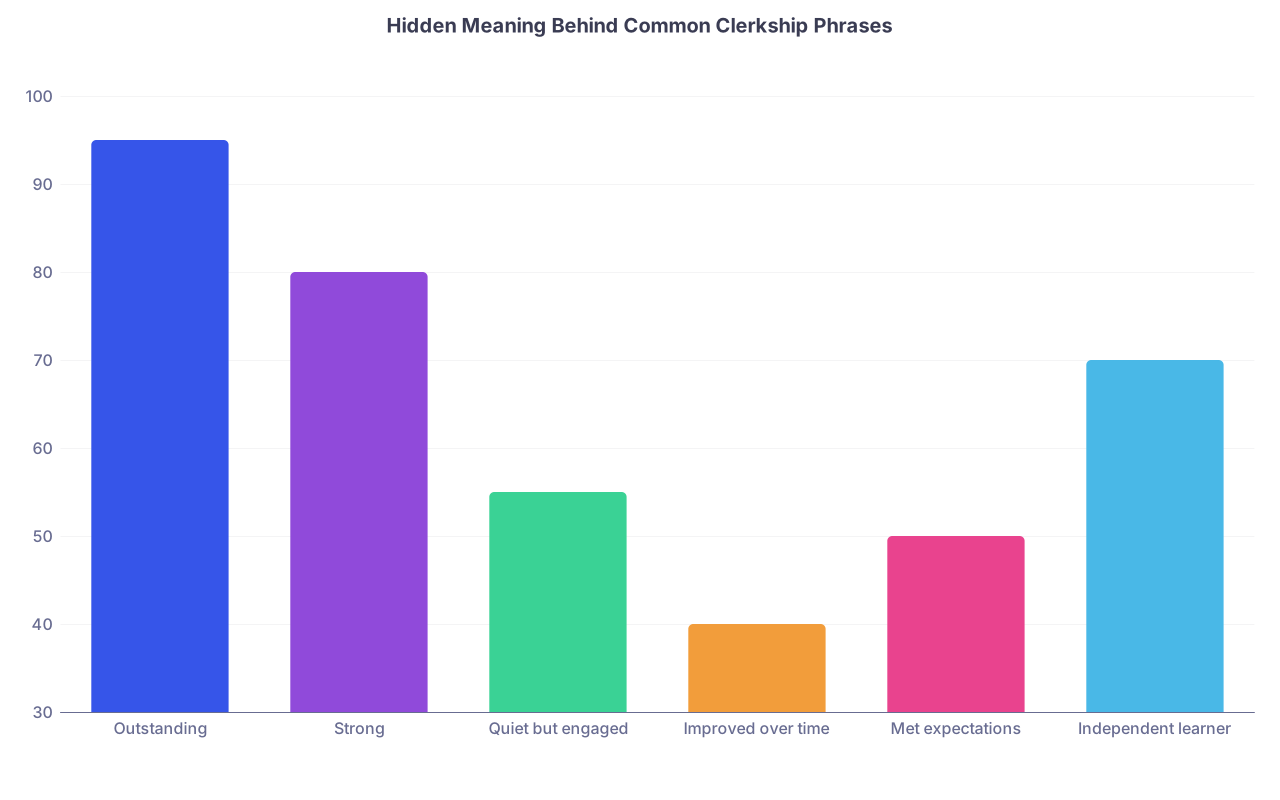
| Category | Value |
|---|---|
| Outstanding | 95 |
| Strong | 80 |
| Quiet but engaged | 55 |
| Improved over time | 40 |
| Met expectations | 50 |
| Independent learner | 70 |
Ignore the exact numbers here; think of it as rough “how PDs feel” scores.
Here’s the translation you never get in med school orientation:
“Outstanding medical student” / “one of the best students we’ve had”
Gold. Programs trust these words. When I see that across more than one core clerkship, I assume you’re a top 10–15% student, regardless of your Step score. People do not throw this around lightly; it implies they’d be happy to work with you again as a resident.“Strong student who will make an excellent resident”
Very good. This is often top quartile for that service. If repeated across your cores, you’re in great shape.“Quiet but engaged” / “quiet but thoughtful”
This one makes PDs pause. Sometimes it means “introverted but solid.” Other times it’s a nice way of saying you did not integrate with the team, did not speak up, and they’re being kind. Whether it worries them depends on your chosen specialty.“Met expectations for level of training”
Neutral on paper. But not great if you’re aiming high-competitive. That means “fine, but didn’t stand out.” For family med, this is okay if consistent. For ortho or derm? That line repeated is a problem.“Improved throughout the rotation” / “improved with feedback”
This is faculty-speak for: “We had concerns early. They got better with work.” It’s not a death sentence, but PDs will want to know: were you unsafe? Unprepared? Checked out? They may probe in interviews.“Needed more direction than peers” / “benefited from close supervision”
This is bad. It signals worry about your autonomy and clinical judgment. If this shows up in your third-year cores, you’re fighting an uphill battle for any specialty that wants early responsibility (EM, surgery, some IM programs).“Independent learner” / “self-directed”
Generally good. This suggests you looked things up on your own and came back with answers. But if paired with “sometimes worked separately from the team,” it can also imply you went AWOL.
I’ve sat in meetings where PDs literally scroll through comments line by line, highlighting phrases like “hard-working,” “great with patients,” “team player,” and circling anything that suggests drama: “defensive to feedback,” “difficulty with organization,” “occasionally overwhelmed.”
They’re not reading for stories; they’re reading for risk.
Your “Stated Specialty” Is Mostly Background Noise
Here’s the part you probably did not want to hear: what you say you’re interested in is rarely decisive.
You can tell everyone you “always knew you wanted to be a surgeon.” If your core surgery narrative says:
“Arrived late to rounds on several occasions, seemed disengaged in the OR, did not always follow through on tasks.”
You’re done at any normal surgery program. And I have actually seen almost that exact sentence.
On the flip side, I’ve watched students match very well into specialties they never once declared publicly in M3:
- The medicine rock star who thought she wanted EM but had glowing IM comments, so she pivoted August of M4 and matched academic IM easily.
- The “maybe peds?” student who had phenomenal psych and FM narratives; PDs in psychiatry looked at that and said, “This is exactly our kind of resident,” even though he barely had psych-specific research.
Program directors trust what you did when you didn’t think it counted for their specialty far more than what you say once you’re selling yourself.
The brutal internal logic programs use
Here’s the exact thought process I’ve heard in ranking meetings:
- “If they treated family and IM like ‘just a requirement,’ they’ll treat off-service rotations in our program the same way.”
- “If OB wrote that she struggled to manage time and follow through, how is she going to handle our ICU months?”
- “If every core says they were phenomenal with nurses, I don’t care if they decided on our field late; we can train the rest.”
It’s pattern over proclamation. Always.
How Different Specialties Read the Same Comments
Not all specialties read your file the same way. The same narrative phrase makes different specialties react differently.
Internal Medicine
IM PDs love longitudinal reliability. They scan for:
- “Thorough,” “detail-oriented,” “excellent clinical reasoning”
- Comments about follow-up: “always called consultants back,” “closed the loop”
- Team behavior with residents and interns
They’re somewhat forgiving if your surgery comment is lukewarm, but not if your medicine or family comments are.
Surgery and Surgical Subspecialties
Surgeons want workhorses who don’t implode when exhausted and criticized.
They lock onto:
- “Hard-working,” “never complained,” “first to arrive, last to leave” (yes, still a thing)
- OR-specific comments: “eager in the OR,” “anticipated needs”
- How you responded to intensity: any whiff of “overwhelmed,” “shut down,” or “became flustered under pressure” is problematic
I’ve seen a surgery PD skim an application, land on “seemed disengaged when cases ran late,” close the file, and say, “No.”
Pediatrics, Family Medicine, Psychiatry
These programs weigh interpersonal behavior heavily:
- “Natural rapport with patients and families”
- “Empathetic,” “nonjudgmental,” “good listener”
- Nursing comments that filter up into narratives (“a favorite of the nursing staff” is more powerful than you think)
If you’re aiming psych but your psych core comment is average and your OB and IM comments rave about your counseling and bedside manner? You’re still competitive. They see the underlying skillset.
Emergency Medicine
EM directors hunt for three things:
- Reliability: “never missed a shift,” “always prepared”
- Adaptability: “comfortable seeing undifferentiated complaints”
- Professionalism: any hint of flakiness in other rotations (late, poor documentation, spotty follow-through) is a red flare
They don’t care that you wrote three paragraphs in your personal statement about “loving the fast pace” if your medicine comments quietly say you struggled to keep up.
How to Protect Yourself While You’re Still in Core Clerkships
If you’re reading this before or during third year, you’re in a strong position. You can do a lot more for your future specialty right now than by pre-writing a personal statement.
Treat every core like your future program is watching. Because it is.
Here’s the truth faculty never explicitly tell you: when you’re on medicine, you’re auditioning for:
- Internal medicine (obviously)
- EM (they read your IM comments carefully)
- Neurology
- Many preliminary surgery programs
On surgery, you’re auditioning for:
- Surgery and all its subs
- EM (again)
- Anesthesia
On peds and FM, you’re auditioning for:
- Peds, FM, psych
- IM programs that value communication and continuity
You don’t know who’s going to care most about which clerkship. So you cannot safely mail any of them in.
Control what ends up in those narratives
You cannot fully script what people write, but you can dramatically influence it:
Ask for feedback early and specifically
Week 2 or 3: “Dr. X, I’m working on becoming more efficient and helpful to the team. Are there 1–2 things I could change this week?”
This does two things. It gives you real data, and it marks you as coachable. When they later sit down to write, “accepted feedback” and “improved quickly” are at the top of their mind in a good way, not the coded way.Make your value visible
Quiet competence is great, but invisible competence doesn’t get documented. Say, “I’ll call radiology and follow up on that CT,” then circle back and present what you learned. People remember the closed loop.Don’t be selectively excellent
The worst pattern I see is students who only turn it on when they think it ‘matters’ to their chosen field. That always leaks into comments: “interest in X was clear; engagement on other services more variable.” PDs see that and think, “This is the student who will disappear on off-service rotations.”Fix narrative-damaging behaviors immediately
Chronic lateness, incomplete notes, vanishing when there’s scut, being defensive about feedback—these aren’t just annoyances. They become permanent digital ink in your MSPE.
If you already have a bad comment
You’re not doomed. But you do need a strategy.
I’ve seen students recover from a rough surgery narrative or a mediocre OB comment and still match very well. The pattern is what saves you.
If one core says “improved over time” and the next three say “excellent from the start,” programs read it as adjustment plus growth. If the bad comment is late and the good ones are early, that’s harder to spin.
If you know there’s a landmine in your MSPE, you must:
- Crush subsequent rotations in professionalism and reliability.
- Secure narrative letters that directly contradict the weakness (“From day one, she was one of the most organized and prepared students I’ve worked with.”)
- Be ready to address it briefly and without excuses in interviews if asked.
How This All Feeds Directly into Choosing a Specialty
Here’s the piece people miss: your core clerkship comments don’t just affect how programs judge you. They should also influence how you judge which specialties are realistic and where you’ll be happy.
I’ve seen students chase specialties that were totally misaligned with their evaluation pattern.
- The student with repeated “excellent team player, beloved by nurses, strongest when working closely with patients and families” comments trying to brute-force their way into a hyper-technical, low-patient-contact subspecialty because of prestige.
- The student whose narratives consistently mentioned “occasional discomfort with ambiguity” trying to choose EM, where uncertainty is the oxygen we breathe.
Use your narratives as data. Stripped of your ego and your med school’s prestige games.
Print your MSPE or your clerkship feedback summary. Highlight key phrases. Look for what shows up in three or more rotations:
- If every clerkship mentions empathy and patient rapport, that should weigh heavily.
- If multiple rotations mention thriving with acuity, procedures, or fast-paced environments, that matters.
- If feedback repeatedly praises your calm in crises and your ability to prioritize under pressure, that pushes you toward certain fields and away from others.
Your core comments are often a more honest reflection of your strengths than your own self-story. Because they’re written by people who watched you all day, not by the voice in your head.

| Step | Description |
|---|---|
| Step 1 | Core Clerkship Comments |
| Step 2 | Clinical Strengths Identified |
| Step 3 | Behavioral Traits Identified |
| Step 4 | Realistic Specialty Options |
| Step 5 | Targeted Away Rotations & Letters |
| Step 6 | Stronger Match Application |
| Step 7 | Patterns in Narratives |

The Bottom Line: What Really Matters More Than Your “Interest”
Strip away the mythology and this is what most residency programs are actually asking:
- When no one thought it ‘counted’ for our field, were you still reliable, kind, and engaged?
- When you were tired and bored, did you keep working at a high level or check out?
- Do multiple independent physicians and residents, across different settings, describe the same person?
Your “stated specialty” is a paragraph you wrote once. Your core clerkship comments are dozens of tiny verdicts on how you actually behaved for a full year.
If you want something actionable from all this, it’s simple:
- Stop obsessing over saying the right specialty out loud.
- Start obsessing over becoming the kind of student whose narrative comments make any program director think, “I could trust this person at 3 a.m.”
Everything else—the personal statement, the clever “Why X specialty?” speech—is just seasoning.

FAQs
1. If I’m undecided on a specialty, should I tell attendings what I’m thinking?
Yes, but do not frame it as “I only care about X.” You can say, “I’m still deciding between IM and EM, so I’m really trying to build strong general clinical skills.” Most attendings respect honesty. What they hate is obvious disinterest in their field because you’ve decided it’s not “your” specialty.
2. Can I ask attendings to emphasize certain traits in their evaluations?
You can’t script their comments, but you can shape what they see. Mid-rotation, ask, “I’m working on being more thorough in my assessments—could you let me know if you notice progress?” That primes them to watch for, and later mention, those improvements. Directly asking them to write specific phrases is tacky and usually backfires.
3. How much do one or two bad comments really hurt me?
One isolated lukewarm or negative comment won’t sink you if the rest of your record is strong and consistent. PDs know rotations vary and personalities clash. Patterns are what kill you. Three different services hinting at the same professionalism or reliability issue? That gets programs nervous fast.
4. Do programs in my chosen specialty care about comments from unrelated rotations?
Yes. More than you think. EM cares what medicine wrote. Surgery cares how you functioned on IM and sometimes even OB. Psych cares deeply about how you treated patients on medicine and peds. Every program knows you’ll spend time on off-service rotations; your behavior there is a preview.
5. My school compresses narrative comments in the MSPE. Do PDs still get the full picture?
They get enough. Deans rarely delete strong praise; they mostly trim volume or soften harsh negatives. PDs know how to read the sanitized language. Even a compressed MSPE still shows patterns: repeated positives, recurring concerns, and the overall tone of how faculty talk about you. You can’t hide the core of it, which is exactly why those comments matter more than whatever specialty label you put at the top of your CV.
Key points: Your core clerkship narratives tell programs who you really are under routine pressure, and they trust that far more than your stated specialty interest. Patterns across those comments—reliability, teamwork, judgment—will both shape and limit which specialties seriously consider you. If you want options later, treat every core clerkship like you’re already on audition, because in the eyes of future program directors, you are.