Two weeks before rank lists were due, I watched a department chair flip through a stack of student evaluations, pause on a name, and say flatly: “Solid scores, great comments, but if she can’t look away from her phone on rounds, she’s not coming into my specialty.” The student had no idea that one tiny behavior, repeated enough times, had become her entire brand in that room.
You think chairs sit around carefully analyzing your CV line by line. Sometimes they do. Mostly, though, they trade in reputations, patterns, and one or two defining stories that stick to your name like glue. Let me walk you through what actually happens when they talk about you behind closed doors.
The Room Where It Happens
Let’s start with the scene. Because once you picture the room, the rest of this will start to click.
Picture a departmental conference room. Long table. Old coffee. A chair at the head of the table who runs that specialty at your medical school or hospital. Around them: a mix of program director, associate PDs, clerkship director, a few key faculty who teach students every year, sometimes a chief resident or senior resident they trust.
They’re not just “talking about students” in the abstract. The meeting usually has one of a few purposes:
- Sorting which students are “ours” versus “not ours” when advising or writing departmental letters
- Deciding who gets the official “this student is recommended for [X specialty]” stamp
- Ranking internal students for away rotations, sub-I slots, or home-advantaged consideration
- Strategizing who to support for highly competitive specialties (derm, ortho, ENT, plastics, etc.)
No fancy rubric on the wall. Just a stack of data: clerkship grades, comments, exam scores, maybe OSCE performance, some narrative comments from residents, and the most powerful thing in that room—informal reputations that have been marinating all year.
That’s the part students consistently underestimate.
What Chairs Actually Care About (Not What You Think)
Students imagine chairs obsess over “objective metrics” the way applicants obsess over them. Step scores. Honors counts. Research pubs. That stuff matters. But when chairs talk among themselves, they organize their thinking around three much more primitive questions:
- Will this person make my specialty look better or worse?
- Will residents and faculty want to work with them at 2 a.m. for years?
- Can I safely put my name behind this person without regretting it?
Everything else is just evidence used to answer those three questions.
I’ve heard versions of the same phrases in dozens of rooms:
- “Are they safe?” (this is about clinical judgment and professionalism, not board scores)
- “Would I let them take care of my family on call?”
- “Are they going to be a problem?” (drama, entitlement, unprofessionalism)
- “Are they a finisher or just a collector?” (do they actually follow through?)
Notice what’s missing: “Did they have six posters by MS2?” or “Did they do a global health trip?” Those are nice, but for chairs they’re secondary.
The Hidden Categories Chairs Sort You Into
Whether they say it out loud or not, most chairs end up slotting students into mental buckets. It’s not formal. It’s just how humans process too many names.
Here’s the part nobody tells you: once you’re in a bucket, it takes a lot to move out of it.
| Category | Chair's Gut Translation |
|---|---|
| Obvious Fit | We will back this person hard |
| Safe but Unspectacular | Fine, but not worth political capital |
| High Risk / High Reward | Talent with red flags |
| Not Our Problem | Do not attach our name to them |
1. “Obvious Fit”
When your name comes up, people nod before the chair even asks for opinions.
Comments sound like:
- “Residents love working with her.”
- “He already thinks like a [specialty] resident.”
- “I’d hire her as faculty in a heartbeat.”
These are the students who get:
- Strongest departmental letters
- Early heads-up on good away rotation sites
- Quiet advocacy phone calls to other institutions
They’re not always the 270 scorers. They are always the “we trust this person” scorers.
2. “Safe but Unspectacular”
This is where most students end up. And chairs are honest about it behind closed doors.
Phrases you’ll hear:
- “He’ll be fine.”
- “Quiet, but no red flags.”
- “Not a superstar, but reliable.”
These students get decent letters, polite but not aggressive advocacy, and very little risk taken on their behalf. If your file goes to another program, the off-the-record message is: “You can take them; they’re not going to embarrass you.”
For many specialties, this is enough. For the hyper-competitive ones, this category is a death sentence unless something else stands out (research, connections, unique background).
3. “High Risk / High Reward”
Every chair knows these students by name. High talent. Some concern.
Comments here:
- “Brilliant but rubs people the wrong way.”
- “Incredible work ethic but emotionally brittle.”
- “Fantastic in the OR but had that professionalism issue on medicine.”
Chairs spend time debating these students because supporting them is a gamble. If they vouch for you and you flame out, it lands on their desk.
You never want to be in this category without a very strong, clear path to improvement that someone can vouch for: “Yes, that happened, but I watched him change over the last year.”
4. “Not Our Problem”
The harsh one. You do not want to be talked about like this.
It sounds like:
- “Let another specialty take that on.”
- “We are not writing a strong letter for him.”
- “Too many stories. I can’t put my name on this.”
Sometimes the file is completely fine on paper. But someone tells a story that kills you. Things like:
- Multiple episodes of disappearing on rotations
- Throwing a nurse or junior under the bus
- Arguing about feedback rather than absorbing it
If the chair decides you’re “not our problem,” your paper file can look great and it still won’t matter.
The Stories That Stick to Your Name
Here’s the uncomfortable truth: chairs don’t remember your entire rotation history. They remember a story attached to your name. One or two at most.
I sat in a meeting where a student’s research, grades, and CV were objectively top tier. When her name came up, the clerkship director said: “Oh yeah, that’s the student who sighed and rolled her eyes when we added an admission at 4:30 p.m.” That’s it. That’s what everyone remembered.
No one pulled up the note. No one fact-checked. One memory, repeated with enough emphasis, became gospel.
On the flip side, I’ve seen middling students elevated by one perfect story:
- The med student who volunteered to stay late with a dying patient’s family when everyone else wanted to go home
- The student who quietly fixed every scheduling mishap on a chaotic service and never complained
- The one who took real ownership of a complicated patient, knew every lab and imaging result before anyone asked
When the chair hears two or three people independently say, “She really stepped up on that case,” they file you as “reliable leader.” It sticks.
You don’t control which story defines you. You control how many opportunities you create for the right kind of stories.
How They Match Students to Specialties Behind the Scenes
Let’s talk about the “is this student really one of us?” conversation. Because every specialty has its stereotype, and chairs lean into it more than you think.
They don’t always use polite language.
Surgery, Ortho, ENT, Neurosurg
I’ve heard lines like:
- “If you can’t handle being yelled at at 2 a.m., this field will eat you alive.”
- “I need to see them hungry. Not just liking procedures.”
- “You don’t choose this specialty; it chooses you.”
When they talk about students for these fields, they’re scanning for:
- Stamina: Did you fall apart on long calls or stay functional?
- Initiative: Did you wait to be told or start anticipating next steps?
- Thick skin: Did feedback turn you defensive, or did you adjust and move?
A brilliant but passive student is a no. A workhorse with moderate test scores but relentless follow-through will get support.
Medicine, Pediatrics, Family
Different tone in the room:
- “Do they actually care about thinking through the whole patient?”
- “Would I trust them to call me with the right information at 3 a.m.?”
- “Can they function independently, or do they need hand-holding?”
They’re looking hard at:
- Clinical reasoning in notes and presentations
- How well you communicate with nursing and other staff
- Evidence that you own your patients instead of just “cover them”
The big sin here isn’t being quiet. It’s being checked out and superficial.
Psych, Neurology, EM, OB-GYN and others
Each has its own internal debates. Chair-level conversations still center around fit:
- For psych: emotional stability, boundaries, ability to sit with uncomfortable situations
- For EM: pattern recognition, speed without sloppiness, crisis composure
- For OB: resilience, ability to handle intense patient interactions without blowing up the team
They’re matching your behavior and reputation to the “this is what we need to survive in our field” mental image.
Letter-Writing: What Chairs Really Put In (and Leave Out)
Students obsess over the gods of the process: Letters of Recommendation.
Here’s what you don’t see: the pre-letter conversation.
Someone brings up your name: “We’re writing for Alex Thompson for emergency medicine.” The chair looks around the room.
- “Anyone worked with them?”
- “What do the residents say?”
- “Any concerns I should know about before I put my name on this?”
If three people say, “Fantastic, would absolutely take them here,” the chair writes a very different kind of letter than if the room goes quiet and someone finally says, “Yeah… they were fine.”
Behind the scenes, there are basically three tiers of letters:
- Advocacy Letters – The chair is clearly selling you. They’re taking a stand.
- Confirmatory Letters – You’re good; the letter confirms what your application already suggests.
- Neutral / Damning by Faint Praise – Pleasant, generic, says nothing negative but also nothing specific.
Programs know how to read these.
“I recommend them without reservation” isn’t the key phrase. Everyone uses that. What matters is whether the chair compares you to a cohort: “Among the top 5% of students I’ve worked with in the last decade” or “One of the strongest students we’ve had for this specialty in recent years.”
If you’re missing that, and your numbers are similar to your competition, you fall behind. Quietly. You never see it, but I’ve seen it steer rank lists many times.
The Silent Currency: Resident Opinions
Let me be blunt: the residents talk about you more freely than faculty do. And chairs listen.
When a chair is unsure about you, they’ll ask:
- “What do the chiefs think?”
- “How did they do on nights?”
- “Would you want them as your intern?”
I’ve watched a student’s entire candidacy saved by a resident saying, “Look, they were awkward at first, but they came in early every day, stayed late, and improved faster than anyone else.” That narrative—trajectory and work ethic—carried more weight than a lukewarm attending evaluation.
Residents remember very specific things:
- Did you help with scut when the unit was drowning, or did you disappear to “study”?
- Did you cover for a teammate who was struggling or throw them under the bus?
- When you didn’t know something, did you fake it or own it and then actually learn it?
You can charm an attending for a couple of hours. You can’t fake it for residents over two weeks of nights.
How Exam Scores Really Come Up in These Meetings
Boards and shelf scores do come up. But the way they’re used behind the scenes isn’t how students imagine.
I’ve heard some version of this dozens of times:
- “What’s their Step 2?” (chairs care much more about Step 2 now that Step 1 is pass/fail)
- “Okay, so they can pass boards. Are they actually good on the wards?”
For most fields, there’s a threshold mentality:
- Below a certain score: “Will they pass boards? Are we taking a risk?”
- Above that threshold: the conversation pivots almost entirely to behavior, fit, and reputation.
If you’re aiming at something like derm, plastics, or neurosurgery, yes, a 260+ gets attention. But even in those rooms, I’ve heard: “We already have 30 people with those scores. Who do we actually want to work with?”
Where scores really hurt you is when they confirm a negative storyline:
- “He’s slow on the wards and his exams are borderline.”
- “She cuts corners in notes and her Step barely passed.”
Now the chair starts to worry about real risk: failing boards, struggling in training, needing remediation. That’s where they pull back support.
Timing: When They Start Talking About You
You think the “big decisions” happen fourth year. Some do. But your file starts forming earlier than you realize.
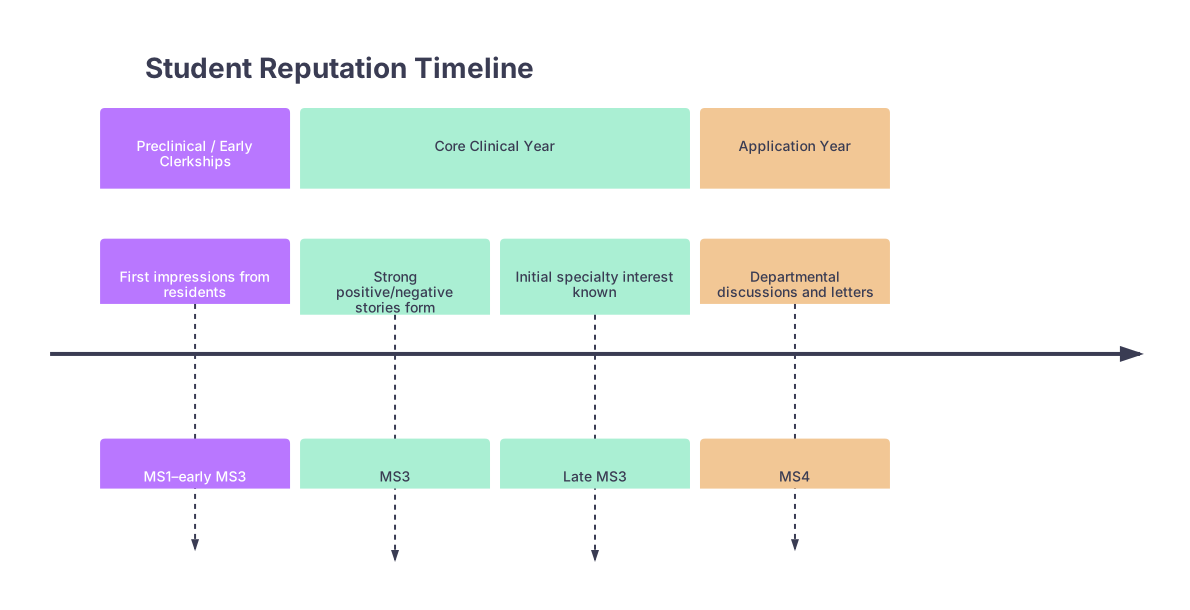
| Period | Event |
|---|---|
| Preclinical / Early Clerkships - First impressions from residents | MS1–early MS3 |
| Core Clinical Year - Strong positive/negative stories form | MS3 |
| Core Clinical Year - Initial specialty interest known | Late MS3 |
| Application Year - Departmental discussions and letters | MS4 |
MS1–2: Almost nobody cares about your day-to-day. But any major professionalism incident? It brands you.
Early MS3: This is when you really get on the radar. Not with specific labels yet, but with tone:
- “Quiet but solid.”
- “Sharp and engaged.”
- “Seems disinterested.”
- “A little arrogant.”
Late MS3: Once you start saying out loud, “I’m thinking about EM” or “I’m aiming for ortho,” your behavior on those relevant rotations gets magnified. Chairs will ask clerkship and course directors: “What do you think? Are they a good fit for us?”
MS4: At this point, the narrative is mostly written. A brilliant sub-I can help, but it rarely erases an established reputation. It just gives the chair permission to say: “They really grew; I feel good backing them now.”
What You Can Actually Control
You can’t control being in the room where your fate is decided. You can control what they have to talk about when your name comes up.
Here’s the distillation from years of hearing these conversations:
Create obvious specialty-consistent behavior.
If you want surgery, be the person who shows stamina, anticipates next steps, and doesn’t crumble under direct feedback. If you want psych, be the one who handles intense, messy situations with calm and professionalism. Chairs love alignment.Make residents your allies, not your audience.
They’re the ones who tell the best (and worst) stories about you. Ask for feedback early. Fix what you can. Don’t try to impress them with knowledge; impress them with reliability.Own at least one patient’s story on every rotation.
Chairs hear about the student who knew everything about “their” patient more than they hear about the student who honored with a 95 on the shelf. Ownership reads as real doctor potential.Have someone at the table who genuinely knows you.
It doesn’t need to be the chair. A clerkship director or respected faculty who can say, “I worked with her longitudinally; she’s the real deal,” is gold. That’s what turns a generic letter into an advocacy letter.Clean up small professionalism leaks early.
Chronic lateness, phone addiction, eye-rolling, gossip in front of staff—these tiny things balloon in faculty stories. You might think, “Everyone does it.” The difference is, you’re the one under discussion when someone decides to mention it.
A Quick Reality Check
You’re not a powerless character in this story. But you’re also not the director.
Departments have politics. Chairs have favorites. Some specialties are protectionist and guard their own; others are lazy and half-engaged in supporting students. You might do everything “right” and still lose out to someone whose uncle is faculty at a big-name program. I’ve seen that too.
What you can do is increase the odds that, when your name lands on that table, the first reaction isn’t: “Who?” or “Eh.”
You want someone to smile slightly and say, “Oh yeah. That one. They’d make a great [insert your specialty].”
That reaction doesn’t come from one big moment. It comes from dozens of small, unglamorous, often invisible decisions you made when you thought nobody important was watching.
The people in that room remember more than you think. And they talk more bluntly than anyone admits in public. But once you understand their lens, you can stop playing the wrong game—collecting meaningless lines on a CV—and start building the kind of reputation that actually moves chairs to speak up for you.
With that in place, you’re not just choosing a specialty anymore. You’re quietly making sure that specialty chooses you back when the doors close and the real conversations begin. The next step is learning how to signal your interest and fit early enough that they’re already rooting for you before you ever ask for a letter—but that’s a strategy session for another day.