
The personality stereotypes you’ve heard about specialties are wildly exaggerated.
And if you’re anything like me, that sentence does not feel comforting. Because your brain probably jumps straight to: “Yeah, but what if in my case… the stereotype is actually right?”
You know the ones:
- Surgeons are aggressive extroverts.
- Psych is for “soft-spoken feelers.”
- EM is for adrenaline junkies who never sit still.
- Path and rads are for antisocial vampires who hate people (yes, people actually say this out loud).
So now you’re sitting there in the library, trying to choose rotations or thinking ahead to residency, and this loop plays in your head:
“I like surgery but I’m quiet… will I just get eaten alive?”
“I love psych but I like talking and joking around. Am I too much?”
“I’m introverted, so I have to do something ‘behind the scenes,’ right?”
“I’m outgoing… am I going to be miserable staring at slides all day if I pick path?”
Let me be blunt: the way med students talk about “introvert vs extrovert” and specialties is shallow and mostly wrong. But the anxiety you’re feeling around it? That’s real. Because this isn’t just vibes. It’s your future day-to-day life.
Let’s unpack this properly, not Instagram-meme level.
The “Personality Fit” Myth That’s Quietly Making You Miserable
Here’s the lie a lot of us absorb without realizing:
“Every specialty has a correct personality type. If you don’t naturally match it, you’ll:
- be miserable,
- get bullied, or
- never match there anyway.”
I’ve literally heard an attending say on a surgery rotation:
“Yeah, if you’re introverted, don’t do surgery. You’ll get killed in this field.”
Then on psych:
“Our field is really about being open, warm, emotionally tuned-in. If that’s not you, this might not be the right fit.”
Cool. So if you’re not a perfect stereotype of any specialty, are you just… unemployable?
Here’s what actually happens in real life:
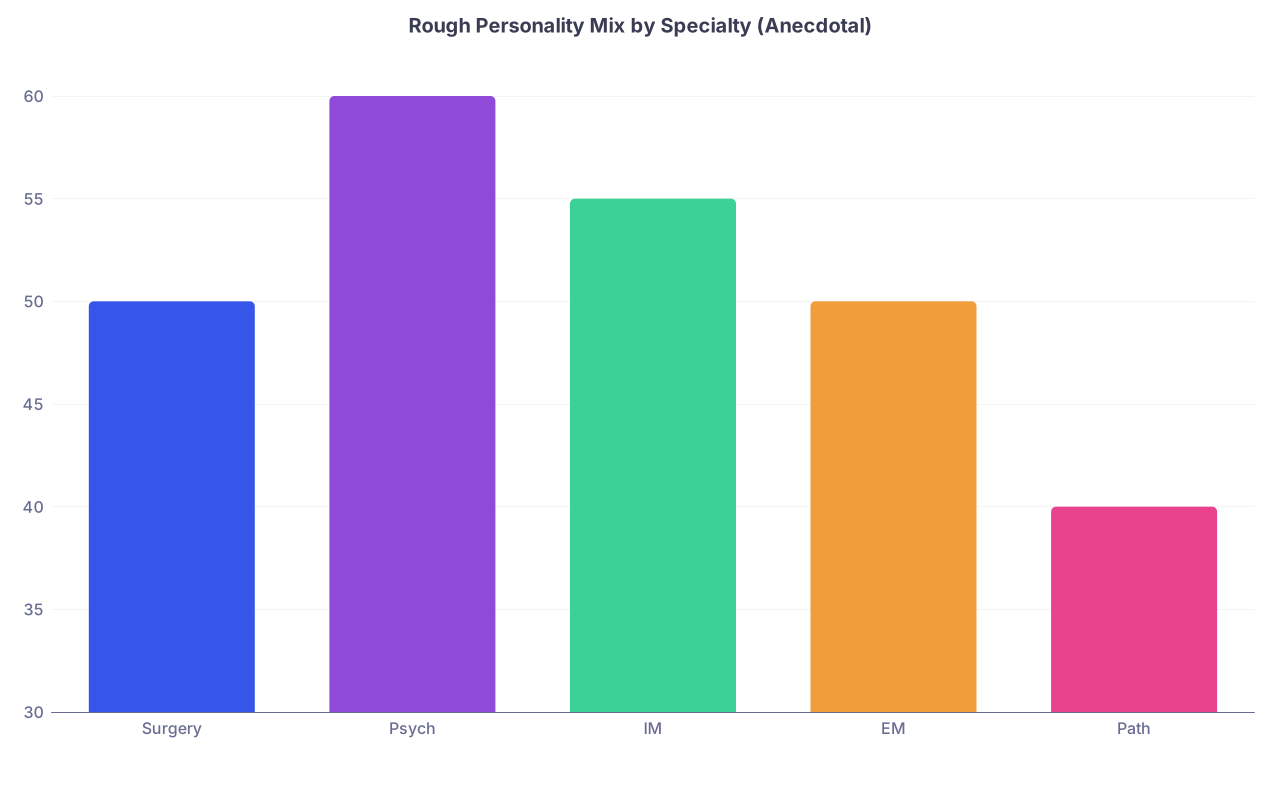
| Category | Value |
|---|---|
| Surgery | 50 |
| Psych | 60 |
| IM | 55 |
| EM | 50 |
| Path | 40 |
That bar chart is not real data; it’s just to make a point: every field has a mix. I’ve seen:
- Quiet, gentle trauma surgeons who barely raise their voice.
- Super bubbly, talkative pathologists who run half the hospital committees.
- EM docs who are more calm and observant than loud.
- Psychiatrists who are pretty blunt and not “soft” at all.
The obvious thing nobody tells you: medicine is a job, not a personality quiz. People adapt. The environment shapes you. You lean on your strengths and compensate for your weaker areas.
You don’t get assigned a specialty like a Hogwarts house based on Myers-Briggs.
What Actually Matters More Than “Introvert vs Extrovert”
Let’s strip this down to the stuff that really changes your quality of life in a specialty:
- What kind of energy drain your day has
- How much uncertainty and chaos you can tolerate
- How much face-to-face interaction you want
- Whether you prefer fast decisions vs slow thinking
- How you handle conflict and hierarchy
Introversion vs extroversion is only one tiny variable inside this mess.
A quick reality check on patient interaction

Almost every specialty involves:
- Talking to patients or their families
- Talking to nurses, consults, other physicians
- Dealing with some degree of conflict or negotiation
- Being “on” even when you’re exhausted
You don’t escape communication by picking something “introvert-friendly.” You just change the style of communication and the pace of it.
Psych: longer, slower conversations.
EM: lots of short, focused conversations under time pressure.
Path: talks more to clinicians than patients, but the stakes are high (“Is this cancer?”).
Surgery: relatively shorter patient interactions, more OR team dynamics, lots of hierarchy.
IM: steady stream of patient encounters and inter-team coordination.
So the real question isn’t “Am I too introverted?” It’s closer to:
- “Do I enjoy longer, deeper conversations?”
- “Do I like short, focused, goal-directed talks?”
- “Am I okay being constantly interrupted?”
- “Can I handle confrontation when I need to push back?”
Those matter way more to your daily happiness than the label you slap on yourself.
Worst-Case Scenarios You’re Probably Imagining (And What’s Real)
Let’s actually say the quiet part out loud—the scenarios running in your head at 2 a.m.
“If I choose a high-intensity, ‘extrovert’ field, I’ll get steamrolled.”
You’re picturing:
- Attending screaming at you for not speaking up.
- Being too anxious to call consults.
- Freezing during codes because “I’m not a natural leader.”
What I’ve seen instead:
- Quiet residents who lead codes very effectively because they’re calm and organized.
- Shy M3s who are awkward on week 1 and pretty solid by week 4 once they know the script.
- Attendings who care way more that you’re reliable and prepared than that you’re the loudest person in the room.
Can you be a super-timid, never-speaks, never-asks-questions person and thrive in EM or surgery? Honestly, no. Not long-term. But that’s not “introversion.” That’s underdeveloped communication skills and confidence, which can be built.
“If I choose a ‘quiet’ field, I’ll be bored and under-stimulated.”
Scenario in your brain:
- You, an “outgoing” person, sitting alone in a dark room as a radiologist, slowly decaying.
- You as a pathologist, never speaking to another human for 12 hours.
- You as a psych doc, endlessly listening and never getting to express yourself.
Reality:
- Radiologists constantly talk to each other and to other services, and many are aggressively social and funny.
- Pathologists do tumor boards, teaching, committees, and interact with surgeons and clinicians all day.
- Psych requires so much complex interaction that outgoing people often thrive there.
You’re not locked into a silent cave just because the field has less patient-facing time. And being outgoing does not equal “needs social stimulation every single minute of the day.”
How Personality Actually Shows Up in Different Specialties
Let’s be more concrete and brutal, because vague reassurance doesn’t shut the anxiety up.
| Specialty | Stereotype | What Really Matters |
|---|---|---|
| Surgery | Aggressive extroverts only | Tolerance for hierarchy, pressure, OR culture |
| Psych | Soft-spoken empaths | Patience, listening, boundaries, emotional stamina |
| EM | Hyperactive thrill-seekers | Comfort with chaos, fast decisions, teamwork |
| IM | Quiet, cerebral | Detail orientation, endurance, coordination skills |
| Path/Rads | Antisocial introverts | Visual focus, pattern recognition, precision |
Surgery
Fear: “I’m too introverted, they’ll eat me alive.”
Reality:
You need:
- To speak clearly and concisely.
- To handle blunt feedback.
- To function when people are stressed and impatient.
You do not need:
- To be the loudest voice.
- To be naturally confrontational.
- To love constant small talk.
There are quiet, meticulous surgeons who are loved because they’re careful, respectful, and reliable. You’ll have to stretch your comfort zone with assertiveness, though. No way around that.
Psychiatry
Fear:
Introverts: “I’ll be too exhausted from talking all day.”
Extroverts: “I’ll be too much. I’m not this calm, soft, therapist type.”
Reality:
- Sessions are structured. It’s not random socializing; it’s guided, purposeful.
- Extroverts do fine as long as they can listen without dominating.
- Introverts often actually like deep one-on-one conversations vs superficial chatter.
The real filter in psych isn’t introvert/extrovert. It’s:
Can you handle emotional heaviness without burning out or disengaging?
How to Stress-Test Your Personality Fit Without Ruining Your Life
You don’t need to commit your soul to a specialty just to see if you can survive a week of it.
1. Use rotations as personality experiments
Stop treating every core rotation like a personality referendum on your entire future. Use them more like A/B testing:
- On surgery: Notice how you feel about the OR team vibe, not just “Did I love cutting?”
- On psych: Notice if you’re drained or fulfilled after long talking days.
- On EM: Track whether the constant switching between tasks fries your brain or energizes you.

| Step | Description |
|---|---|
| Step 1 | Start Rotation |
| Step 2 | Observe Energy Levels |
| Step 3 | Note What Gave Energy |
| Step 4 | Note Specific Triggers |
| Step 5 | Adjust Next Rotation Focus |
| Step 6 | Energized or Drained? |
Tiny notebook or Notes app trick: after each day, write:
- 2 moments that felt good
- 2 moments that felt awful
Do that for 2 weeks and patterns will pop up that have nothing to do with “introvert/extrovert” and everything to do with workflow style.
2. Talk to residents who are “like you”
Deliberately find:
- The quiet EM resident.
- The outgoing path resident.
- The not-very-soft-spoken psych resident.
Ask them directly:
- “What parts of this job are hardest for your personality?”
- “What do you have to push yourself to do?”
- “What surprised you about the culture vs what people say?”
You will quickly see that nobody is a stereotype, but everyone has 1–2 personality friction points they’ve had to manage.
3. Be honest about skills vs identity
This is the sneaky one:
A lot of us decide, “I am an introvert/extrovert” as a way to protect ourselves from things we’re scared of, not because it’s pure temperament.
Examples:
- “I’m introverted” → actually means “I’m terrified of looking stupid when I speak up.”
- “I’m very extroverted” → actually means “Silence with patients makes me panic, so I talk nonstop.”
Those are skill gaps, not destiny.
You can:
- Learn a script for calling consults or presenting so you don’t freeze.
- Practice saying short, clear statements in codes or rounds.
- Practice tolerating 3 seconds of silence in a patient interview without filling it.
You don’t have to become a different person. You just need a few tools so your worst fears don’t keep winning.
The Exam / Med School Phase Twist You’re Probably Missing
Right now you’re probably:
- Drowning in exams.
- Exhausted from pre-clinicals or early clerkships.
- Social battery wrecked from being “on” constantly as a student who’s always being evaluated.
So your self-assessment is skewed.
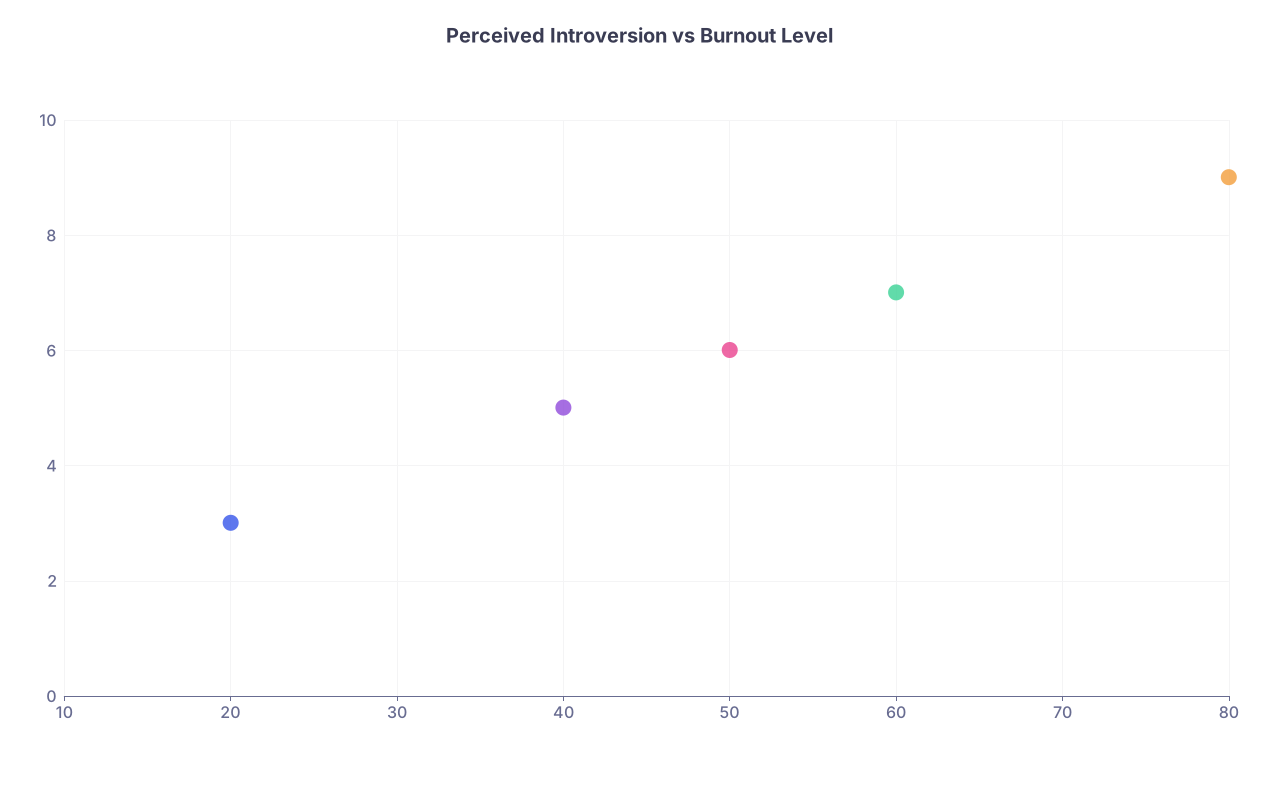
| Category | Value |
|---|---|
| Student 1 | 20,3 |
| Student 2 | 40,5 |
| Student 3 | 60,7 |
| Student 4 | 80,9 |
| Student 5 | 50,6 |
Again, fake data, real point: the more burned out you are, the more “introverted” or “overstimulated” you’ll feel. Which makes you think certain specialties are impossible.
I’ve watched people say:
- “I could never do EM, I’m dying after one shift as a student”
…then as residents they’re fine, because they:- Don’t have three exams that week.
- Actually know what they’re doing.
- Have some control and a functional schedule.
Or:
- “I could do clinic all day, this is so chill”
…then later realize:- The emotional drain of chronic disease + phone calls + inbox + EMR is brutal.
Your current level of sleep deprivation and stress is heavily distorting your signal. Be cautious about permanent decisions based on your most exhausted version of yourself.
If You’re Terrified You’ll Pick “Wrong” Based on Personality
Here’s the part nobody wants to admit: every specialty will stretch you outside your natural comfort zone somewhere.
You will be:
- Too quiet for some situations.
- Too blunt or too talkative for others.
- Awkward. Embarrassed. Out of sync.
And you’ll adjust. Slowly, clumsily, but you will.
What I’d worry way more about than introvert/extrovert:
- Do you hate the types of problems this specialty deals with?
- Does the lifestyle realistically match how you want to live outside the hospital?
- Can you see older attendings in that field whose lives you’d actually want?
Because if the problems interest you and the life structure works, you can stretch your personality. If both of those are off, no personality label will save you.

Quick Reality Anchors Before Your Brain Spirals Again
- There are introverts and extroverts in every specialty. Yes, even that one.
- Stereotypes are about culture and averages, not hard entry requirements.
- You’re going to grow. The version of you as an M3 is not the version of you as a PGY-3.
- Skills (assertiveness, listening, concise communication) are trainable. Your temperament isn’t a prison.
If you’re worried that you’re “too much” or “not enough” for a field—too quiet, too talkative, too sensitive, too blunt—that usually means you’re self-aware. That’s a good sign. The truly unfit people are the ones who never question themselves at all.

FAQ (Exactly 4 Questions)
1. I’m very introverted and hate constant small talk. Does that automatically rule out EM, surgery, or primary care?
No. Hating small talk doesn’t mean you can’t do those fields. EM and surgery involve mostly purposeful communication, not endless chit-chat. Primary care might feel heavier if you truly dread talking most of the day, but plenty of quiet, low-key PCPs exist who are loved because they listen well and don’t rush. The question is less “Do I talk a lot?” and more “Can I communicate clearly when it counts, even if it’s draining?”
2. I’m loud, talkative, and pretty expressive. Will I be miserable in something like radiology or pathology?
Not necessarily. Outgoing people can thrive in those fields because there’s still plenty of interaction—with colleagues, referring services, tumor boards, teaching. What you lose in constant patient flow you gain in deeper case-based collaboration. You may need to dial down the impulse to fill every silence, but that’s not a personality rewrite, just situational awareness. If you like the work of image/slide-based problem solving, your extroversion won’t cancel that out.
3. Will programs judge me as “wrong personality” and not rank me if I don’t match the stereotype?
Some interviewers absolutely have biases. That’s real. But you’re not being judged on “introvert or extrovert” as much as: Are you collegial? Safe? Teachable? Someone they can stand being around at 3 a.m.? I’ve seen quiet applicants match into EM and surgery because they came across as thoughtful and steady, and very outgoing applicants match into psych and path because they showed insight and professionalism. You don’t need to cosplay a stereotype. You just need to show you can function on that team.
4. How do I actually test if a specialty fits my personality without committing my whole life to it?
Use every rotation, elective, and shadowing opportunity like a targeted experiment. After each day, ask: What about today drained me? What gave me energy? Was it the pace, the conversations, the type of problems, or the people? Talk to residents who are closer to your temperament and ask how they’ve adapted. And be honest about what’s burnout vs what’s genuine mismatch. You’re not signing a lifetime contract just by liking a rotation—but ignoring how it feels in your body day after day is how people end up stuck.
Key points:
- There is no “too introverted” or “too outgoing” for a specialty—only specific skills you may need to stretch.
- Focus less on labels and more on the actual work, pace, and lifestyle of the field.
- Use rotations and honest reflection—not stereotypes—to figure out where your personality and the job can grow together.