
The way most medical students talk about “lifestyle specialties” is dangerously shallow—and it can wreck your long‑term career satisfaction.
You are being sold a half‑truth. Yes, schedule and flexibility matter. But if you let “lifestyle” dominate your specialty decision, you are walking straight into a different kind of burnout: the “I chose wrong and now I am trapped” kind.
Let me walk you through the mistakes I see again and again.
The Big Myth: Lifestyle = Happiness
The most common mistake is equating “good lifestyle” with “good life.”
Students say the same lines on every campus:
- “I want a chill field like derm or rads—good money, good lifestyle.”
- “I do not want to be miserable in residency; I want my evenings.”
- “I could do almost anything; I just want a 9–5 and no weekends.”
You know what those comments never mention? The actual work.
What you are really saying when you choose specialty based mostly on lifestyle is:
“I am willing to do work I do not enjoy, every day, for 30+ years, as long as the schedule is tolerable.”
That is not a plan. That is a slow trap.
Lifestyle is not a stable variable
Here is what students forget: the “lifestyle” of a specialty is not fixed. It shifts with:
- Market saturation in certain cities
- Hospital consolidation and RVU pressure
- Telemedicine expansion or collapse
- Policy changes, prior authorization, and payer mix
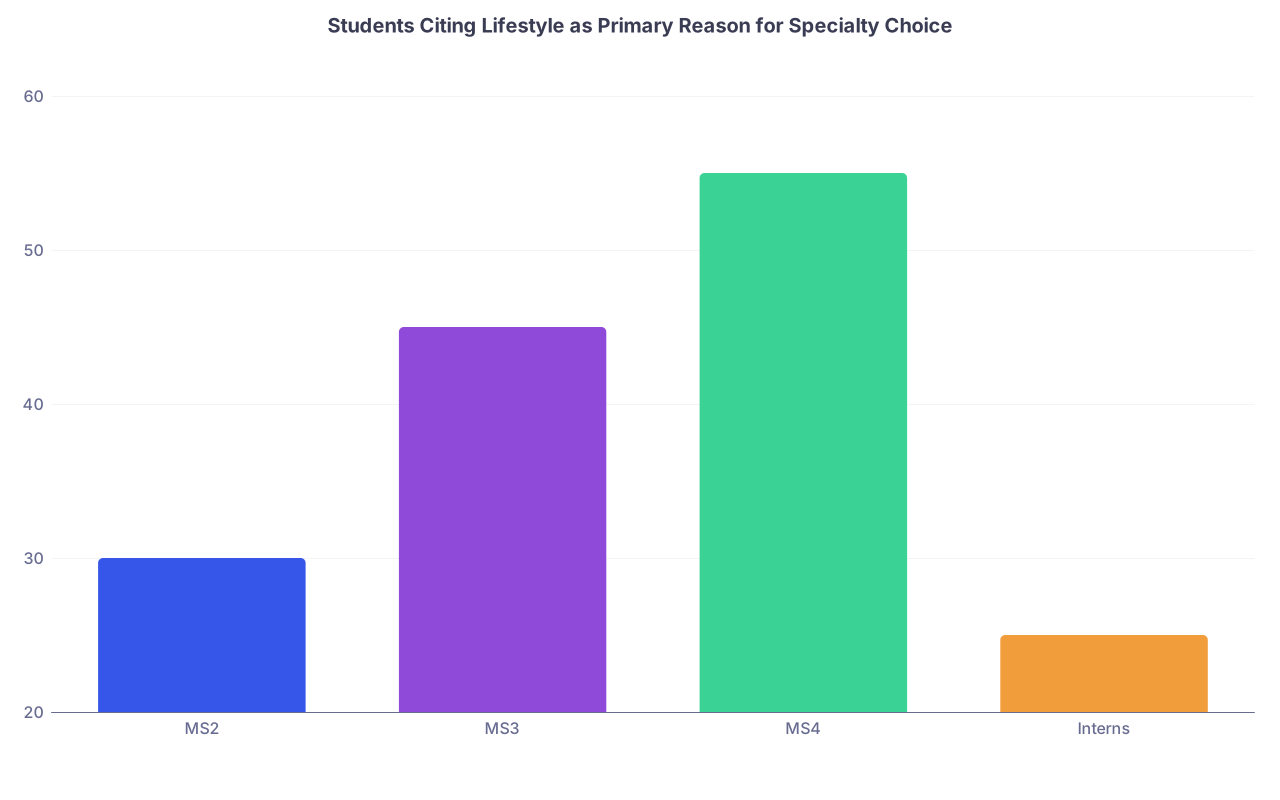
| Category | Value |
|---|---|
| MS2 | 30 |
| MS3 | 45 |
| MS4 | 55 |
| Interns | 25 |
Notice that many interns sober up fast. Once you actually do the job, “lifestyle” looks different than the fantasy version you had as an MS2.
If you overvalue lifestyle early, you risk choosing based on rumors and Instagram reels, not reality.
Mistake #1: Confusing “Fewer Hours” with “Lower Stress”
I have watched students run from surgery to “lifestyle specialties” to escape what they think is the problem: hours. Often they discover their real problem was something else entirely.
Common bad assumption
“If I have fewer hours, I will be less stressed and happier.”
Not necessarily. There are at least four other stress variables:
- Emotional load of the patient population
- Cognitive demand and constant uncertainty
- Pressure for productivity and throughput
- Fit with your temperament and attention span
If you hate ambiguity and cognitive overload, reading subtle CT scans all day in radiology can feel more stressful than a longer, more physical day in orthopedics.
If you are drained by emotionally intense conversations, outpatient oncology with “good clinic hours” can still wreck you.

How this backfires
The specific way this mistake explodes:
- You pick a supposedly “low‑stress” field.
- The hours are fine on paper. You are home for dinner.
- But your days are mentally or emotionally misaligned with who you are.
- You go home completely empty, questioning your career, not just your day.
That is worse than being tired.
Physical fatigue from doing work you care about is recoverable. Existential fatigue from doing work that does not fit you is not solved by a nap and a weekend.
Mistake #2: Using Lifestyle to Avoid Honest Self‑Assessment
Lifestyle can become a smokescreen. I have watched dozens of students tell themselves:
“I’m picking this specialty for lifestyle.”
But what is actually happening?
They are avoiding:
- Their discomfort with procedures or blood
- Their fear of high‑stakes decision making
- Their insecurity about competitiveness and Step scores
- Their anxiety about being “on stage” in the OR or in codes
So they hide all of that behind lifestyle language.
Let me be blunt. If you say:
“I really want lifestyle, so I am not considering surgery or EM.”
But you have never seriously asked yourself if you could grow to handle procedures, stress, or acute care, you are not making a mature decision. You are making a fear‑based one.
Lifestyle becomes the socially acceptable excuse.
The subtle long‑term damage
When you choose a specialty mainly to avoid fear, instead of moving toward what fits:
- You do not build the skills to face that fear in any context.
- You might miss the field that actually lights you up, simply because it scared you early.
- You tell yourself a story that you are “not the type” for certain work, when that was never really tested.
I have seen MS3s who loved the OR but panicked about being “good enough” for ortho or neurosurgery, so they pivoted to “chill” fields. Five years later, still talking about the OR. That regret does not go away.
Mistake #3: Believing Lifestyle is Intrinsic to the Specialty, Not the Job
Another trap: thinking “derm is lifestyle,” “hospitalist is not,” “OB/GYN is lifestyle poison.”
Completely wrong framing.
The real question is: what job structure within that specialty are you imagining?
| Specialty | Job Type | Typical Lifestyle Feel |
|---|---|---|
| Emergency Med | Academic, 0.8 FTE | Flexible, shifts, some nights but more control |
| Emergency Med | Community, high RVU | Heavy nights, high volume, burnt colleagues |
| Dermatology | Academic with research | Balanced, but grant and publishing pressure |
| Dermatology | High-volume cosmetic | Fewer emergencies, intense productivity push |
| Internal Med | Outpatient clinic | Regular days, call varies, admin creep |
| Internal Med | Nocturnist | Nights only, blocks of time off, social tradeoffs |
You can build a "lifestyle job" inside a traditionally demanding specialty. And you can absolutely find “soul‑crushing” jobs inside “lifestyle” fields.
If you base your decision on global specialty reputation instead of talking to people in different practice settings, you are working off fantasy data.
Red flag thinking
Watch out for these phrases in your own head:
- “Derm is chill.”
- “Hospitalist is terrible lifestyle.”
- “Radiology is always flexible.”
The more absolute your specialty‑level lifestyle beliefs, the more likely they are simplistic and wrong.
Mistake #4: Ignoring Who You Are When You Are Actually Working
This one frustrates me the most, because it is so avoidable.
Students will say:
“I loved peds, but I want better lifestyle, so I’m thinking rads.”
Then I ask specifics: “On peds, what did you like? Describe a good day.”
They say things like:
- “Being in the room with kids and families.”
- “Working in a team, rounding together.”
- “Seeing the change in the child over a few days.”
Then I ask: “On radiology, what did you like?”
- “Honestly, I was mostly on my phone when it was slow. It seemed chill.”
That is a flashing red warning sign.
You do not build a satisfying career out of being minimally bothered.
You build it out of the kind of work that engages you while you are doing it. The moments when time moves faster, your attention narrows in a good way, and you feel like “this fits.”
Overvaluing lifestyle makes students downplay those signals and chase the smoother calendar instead.
The mismatch that burns people out
If you are:
- Very social, you process by talking, and you like being in the room with patients and families.
- But you choose an isolated, screen‑heavy specialty because “no call, no nights” sounded ideal.
You may have open evenings and weekends. But your days will feel empty or misaligned.
That is how you end up hating a “good lifestyle” job.
Mistake #5: Trusting Med Student Rumor over Data and Direct Observation
You know the hallway chatter:
- “FM is dead; they all burn out.”
- “Anesthesia is getting replaced by CRNAs; lifestyle is tanking.”
- “EM is done; everyone’s miserable.”
- “Path is chill but you will never get a job in cities.”
Sometimes there is a grain of truth. But the conclusions are usually trash.

| Category | Value |
|---|---|
| Peers | 40 |
| Residents | 30 |
| Attendings | 20 |
| Actual Data | 10 |
Most students barely look at:
- Current job postings: call schedules, RVU expectations, location flexibility
- Specialty society workforce reports
- Actual resident hours and burnout data
- The wide variation between academic vs private vs hybrid jobs
Instead, they let one miserable PGY‑3 in the workroom define an entire field.
Here is the mistake: you overreact to noisy anecdotes and underweight real, structured information.
If you pick a field because “everyone says the lifestyle is good,” without seeing the range of actual practice models, your decision is built on gossip, not reality.
Mistake #6: Forgetting You Are Choosing a Residency Too
Many students talk as if they are choosing only their attending life:
“I don’t want to be rounding on Sundays for the rest of my career.”
“I do not want overnight calls at 45.”
Fine. But you are also choosing:
- 3–7 years of residency
- A training environment with a specific culture, schedule, and workload
- Colleagues who will shape your tolerance for that work
Plenty of “good lifestyle” specialties still come with brutal residencies in certain programs. Long hours. Heavy expectations. Toxic cultures. Just with more outpatient and less call.
If you go all‑in on “lifestyle specialty” and then end up in a malignant residency with poor support, what happened to your master plan?
You forgot to evaluate program‑level lifestyle.
Lifestyle is not just derm vs surgery. It is also Program A derm vs Program B derm. Same in anesthesia, EM, IM, everything.
Mistake #7: Underestimating How You Will Change Over 30 Years
You are choosing a field in your 20s. You will retire—if you are lucky—somewhere in your 60s or 70s.
Your needs will not stay static.
Common shift I see:
- In your 20s: you focus on hours and exam scores.
- Mid‑30s: you start caring more about meaning, control, and being good at what you do.
- 40s and beyond: you care about autonomy, respect, and having built something that feels like yours.
If you choose a specialty only because it looks easy now, without asking whether the actual work is something you can see yourself mastering and still caring about later, you are gambling.
And there is a brutal truth here: switching specialties after training is hard. Painful. Expensive. Politically messy.
Do not make this decision assuming you can casually “just switch later” if you get bored. You might be able to. Many cannot.
A Better Way to Think About “Lifestyle”
You should care about lifestyle. You would be foolish not to. But you must stop treating it like a single score or reputation.
Think of lifestyle as four separate questions:
- Daily experience: What does an ordinary Tuesday feel like—pace, intensity, interruptions?
- Schedule structure: Shifts vs clinics vs OR blocks, nights, weekends, home call.
- Control/autonomy: How much say will you realistically have over where and how you work?
- Internal fit: How does the work interact with your personality, values, and energy patterns?
If one of those is wildly off, a “good lifestyle” on paper will not save you.
How To Protect Yourself From the Lifestyle Trap (Without Overcorrecting)
You do not need a perfect algorithm. You need guardrails.
Here is a practical, low‑nonsense set of steps that stop people from making the classic lifestyle‑driven mistake.
1. Do a brutally honest “what work feels good” inventory
For each core rotation you have finished, write down:
- Tasks that made time go faster (procedures, family meetings, reading imaging, managing vents).
- Tasks that left you quietly satisfied at the end of the day.
- Situations that reliably drained you.
Patterns matter more than labels. If the best parts of your day were in the OR, do not pretend you are fine giving that up “for lifestyle” without really interrogating the cost.
2. Shadow the worst and best versions of lifestyle in that field
If you are considering radiology:
- Shadow an overworked community radiologist in a high‑RVU, under‑staffed environment.
- Shadow an academic radiologist with a mixed schedule and teaching time.
If you still like the work in both contexts—just prefer one—that is a good sign. If you only like the fantasy version, that is a bad one.
3. Talk to mid‑career attendings, not just residents
Residents complain. A lot. Sometimes fairly. Sometimes loudly and inaccurately.
Seek out:
- People 10–20 years out of residency.
- Both happy and unhappy in their field.
Ask them:
- “What did people get wrong about the lifestyle of your specialty when you were a student?”
- “If you had to do it again, what would you choose and why?”
- “What kinds of jobs in your field are complete lifestyle disasters? Which ones are sustainable?”
You will hear nuance you will never get on Reddit.
4. Explicitly rate “fit” and “lifestyle” separately
For each specialty you seriously consider, force yourself to rate two things out of 10:
- How much the content of the work fits you (procedures vs thinking, people vs data, acute vs chronic).
- How much the likely lifestyle of the job you would want fits your life goals.
You are allowed to pick something that is 8/10 on fit and 7/10 on lifestyle. You should be terrified of picking something that is 3/10 on fit and 9/10 on lifestyle.
Because that 3/10 is what you will feel every single day.
FAQs
1. Is it wrong to prioritize lifestyle if I come from a non‑traditional or financially strained background?
No. Wanting financial stability, time for family, or recovery from years of grind is rational. The mistake is not valuing lifestyle; it is letting it steamroll every other variable. The key question is: among the specialties that genuinely fit how you like to work, which options give you a lifestyle that supports your real constraints? Do not start with “what pays the most for the fewest hours.” Start with “what work can I tolerate and maybe even like,” then refine by lifestyle within that subset.
2. What if I honestly do not “love” any specialty? Then does lifestyle matter more?
If nothing lights you up, lifestyle absolutely becomes more important. But you still must avoid the worst trap: choosing a field you actively dislike just for schedule. Your bar shifts from “what do I love?” to “what can I stand, where I respect the work and can imagine getting good at it?” Within that “tolerable” group, yes, prioritize lifestyle. Just do not pretend that pure neutrality plus good hours will automatically become fulfillment. You may need to build meaning outside of work more deliberately.
3. How can I get real data on lifestyle instead of relying on rumors?
Start with three things: specialty society workforce reports (they usually publish on burnout, work hours, job market), large surveys like Medscape physician lifestyle / burnout reports (imperfect but directionally useful), and actual job postings on sites like NEJM CareerCenter or specialty‑specific boards. Look at call expectations, clinic volumes, RVU targets, and salary ranges. Then cross‑check that with conversations with attendings in different practice settings. If you are not seeing both data and real‑world stories, you are under‑informed.
4. What if I already ranked lifestyle too highly and I am deep into a specialty I regret?
You are not the first. Before you blow everything up, get specific. Is it the specialty itself, the current job/program, or your broader life context (location, support system, debt)? Talk to someone in your field who is genuinely content and ask what they changed: job type, FTE, academic vs community, niche within the field. Often there is more room to pivot within a specialty than students realize. If, after that exploration, the core work still feels wrong, then you start investigating retraining—carefully, with eyes wide open to the financial and personal costs.
Open your notes app or a blank page today and list the last three rotations you completed. Under each, write down the specific tasks that energized you and the ones that drained you. Then look at your current “lifestyle specialty” shortlist and ask, brutally: do these fields actually contain more of the work that felt right—or are you just chasing the easier calendar?