
The way people talk about “introvert vs extrovert specialties” is lazy and misleading. You are not doomed to dermatology because you like quiet, and you are not built for EM just because you’re outgoing.
What actually matters is how your interaction style holds up over a 10–12 hour shift, every day, for years—and whether the specialty’s default environment drains you or fuels you.
Let’s get concrete.
Step 1: Forget Labels. Map Your Actual Interaction Needs.
Do not start by asking, “What specialties are good for introverts?” That’s how you end up parroting Reddit instead of making a grown-up decision.
Start by answering this about yourself, in real scenarios you’ve actually lived.
A. How do you feel at the end of:
- A full day on inpatient medicine wards with constant pages and family talks?
- A psych rotation with 5–6 long, deep conversations?
- A surgery day with minimal chatter, focused team, and high-stress emergencies?
- A clinic day: 20–25 short visits back-to-back?
Now be honest: after each day, are you:
- Quiet but content?
- Wired and buzzing?
- Completely fried and avoiding human contact?
- Weirdly under-stimulated and bored?
You’re not diagnosing introversion vs extroversion here. You’re tracking energy patterns.
Do this for a week and write it down. Not in your head. On paper or in your notes app:
- “IM wards: 6 family meetings, 20 patient contacts, felt drained by noon.”
- “Outpatient peds: 24 quick visits, still had energy at 5 pm.”
- “OR day: almost no small talk, highly focused, mentally tired but not socially exhausted.”
This is your real data.
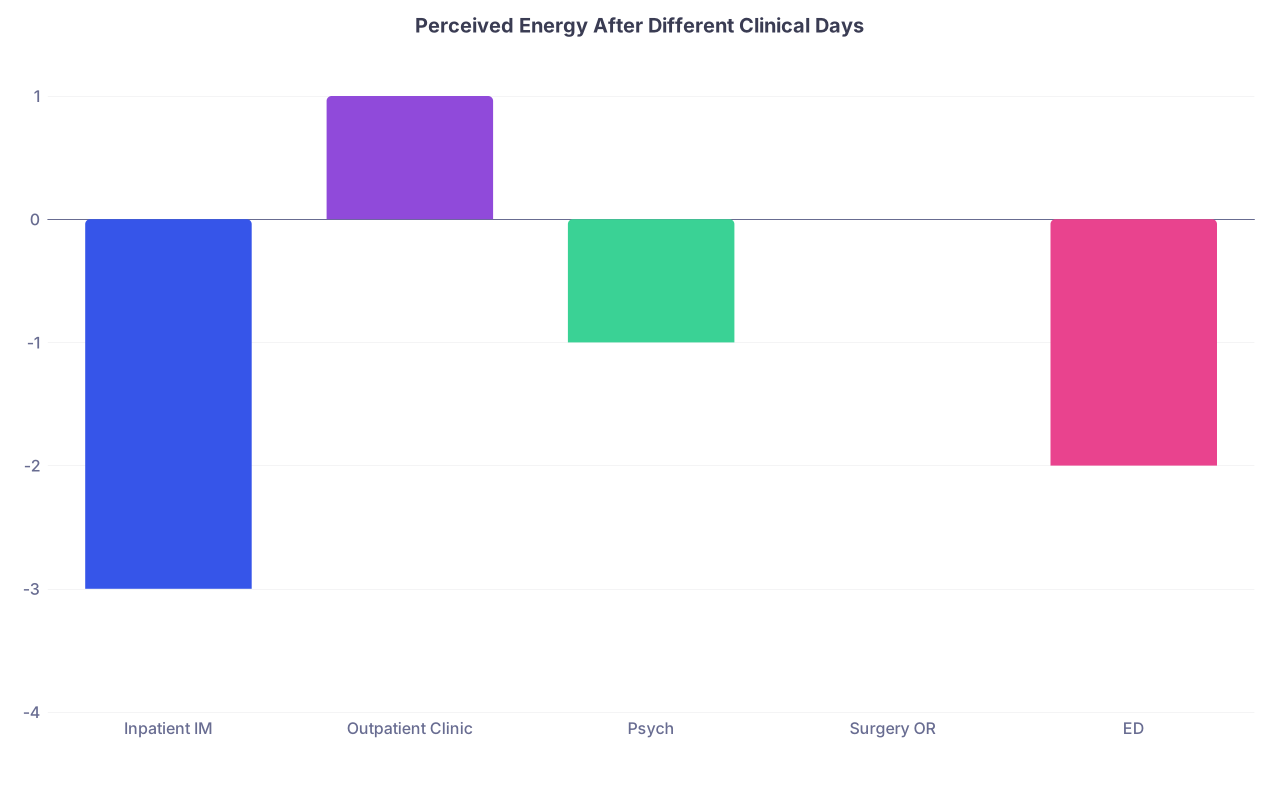
| Category | Value |
|---|---|
| Inpatient IM | -3 |
| Outpatient Clinic | 1 |
| Psych | -1 |
| Surgery OR | 0 |
| ED | -2 |
(Negative numbers = more drained; positive = more energized. Fill yours in.)
Next, ask three interaction-specific questions:
Depth vs breadth
Do you prefer:- 4–8 longer, deep conversations (psych, heme/onc, palliative)?
- 20–30 quick, focused touchpoints (EM, urgent care, many clinics)?
- Minimal direct contact, mostly task-based (path, rads, some procedural-heavy OR days)?
Control vs chaos
Can you tolerate constant interruptions and switching tasks mid-thought (ED, wards), or do you do best when you control the pace (path, rads, some outpatient subspecialties)?Verbal vs nonverbal work
Do you get satisfaction from talking through problems with patients and families, or from doing (procedures, reading images, writing notes, solving puzzles quietly)?
This is how you actually define your interaction style. Not a BuzzFeed quiz.
Step 2: Understand What “Introvert-Friendly” and “Extrovert-Friendly” Really Mean
Most students wildly misjudge specialty personalities because they only see attendings on their best behavior.
Here’s a more honest breakdown.
| Specialty Type | Patient Volume | Conversation Depth | Interruptions | Team Interaction |
|---|---|---|---|---|
| Inpatient Cognitive | Medium | Medium-High | High | High |
| High-Volume Outpatient | High | Low-Medium | Medium | Medium |
| Procedure/OR Heavy | Low-Medium | Low-Medium | Medium-High | High |
| Diagnostic (Path/Rads) | Very Low | Low | Low | Low-Medium |
| Psychiatry/Palliative | Low-Medium | Very High | Low-Medium | Medium |
Now let’s attach that to real fields.
Often better for quieter, lower-stimulation people (but not exclusively)
These tend to be more introvert-tolerant environments if you still have decent people skills:
Pathology
Limited direct patient interaction. Most “interaction” is with clinicians, tumor boards, and your own thoughts. Great if constant face time drains you.Radiology
More interaction than people think (phone calls, consults, procedures), but you’re not in a room with patients all day. Lots of solo cognitive work.Radiation Oncology
Mix of technical/planning and clinic. Fewer patients per day, longer relationships, scheduled conversations.Certain outpatient subspecialties (e.g., allergy/immunology, endocrinology, rheum in clinic-heavy setups)
Predictable clinic, moderate patient load, fewer crises.Some non-procedural fellowships where you control clinic tempo (hepatology clinic, MS clinic in neuro, etc.).
Often better for people who get energy from interaction and pace
These lean extrovert-tolerant, or at least stimulation-seeking:
Emergency Medicine
Constant new people, fast decisions, team coordination, interruptions. If you hate being “on” for 8–10 hours straight, you’ll suffer.Ob/Gyn L&D, Trauma Surgery, SICU
High-stress, continuous team communication, family updates, quick rapport-building.Pediatrics clinic, Primary Care, Urgent Care
High patient volumes, rapid rapport, lots of talking. A social marathon.Psychiatry (for a certain kind of extrovert)
Deep conversations all day. If you genuinely love talking, exploring stories, sitting with emotions, this can be energizing. If that drains you, psych can wreck you.
Hybrids that can work either way depending on setting
Internal Medicine
You can be inpatient-heavy (high interruptions, lots of family talks) or outpatient-heavy (scheduled visits, more control). You can also subspecialize later to match your style.Anesthesiology
OR communication is constant but usually brief and to the point. There’s some pre-op/post-op talking, but much of the day is task-focused.Surgery
OR time is intense, team-based, but not necessarily socially draining—it’s focused. Clinic can be variable. Many “quiet introverts” thrive here if they tolerate stress and hierarchy.
Step 3: Match Specific Scenarios to Your Reality
Let’s zoom in. Picture the actual day, not the fantasy version.
If you’re an introvert who still likes people
You might recognize yourself if:
- You like 1:1 conversations but hate being “on” around groups for hours.
- You dread nonstop interruptions.
- You need quiet time between intense interactions.
Look for specialties where:
- You control the schedule more days than not.
- The ratio of thinking/documenting to direct interaction is balanced.
- You can deepen relationships with a manageable number of patients.
Real-world fits to explore seriously:
- Outpatient subspecialties (endo, rheum, some neuro tracks)
- Radiation oncology
- Pathology or radiology if you’re happy with minimal patient contact
- Heme/Onc in the right practice setting (fewer patients, complex discussions, longitudinal care)
Pitfalls:
- Don’t assume psych is automatically “introvert-friendly.” If three 60-minute psych interviews leave you emotionally flattened, that’s a warning.
- Don’t pick rads or path just because you’re “shy” if you’ll miss direct patient contact and live interaction.
If you’re an introvert who feels socially exhausted most days of rotations
Different situation. You’re not just “quiet.” You’re done by noon.
You might:
- Avoid the workroom because chitchat drains you.
- Feel your brain shutting down after repeated patient/family conversations.
- Need serious alone time to recover.
You need to be more ruthless here. Look into:
- Pathology
- Radiology
- Highly procedural, less-talk-heavy tracks in some specialties (interventional rads, EP in cards, IR, but note: lots of coordination and consults)
- Hybrid academic roles with research + limited clinical days
And you should ask yourself bluntly:
“Can I function safely in a high-interaction specialty five days a week, for decades, without burning out or resenting patients?”
If that feels like a no, stop trying to force yourself into EM, FM, or general peds just because they’re “core specialties.”
Step 4: Use Rotations and Electives Like Stress Tests
You already have a testing ground. You’re in med school. Use it.
During each rotation, track three things daily for at least a week:
- Number of distinct patient/family interactions
- Number of “forced” social interactions with staff/team that you wouldn’t choose if you were alone
- End-of-day energy: 1–10 (10 = energized, 1 = demolished)
Then write one sentence:
- “Could I tolerate this level of interaction 4–5 days/week for the next 20 years?”
Do not ask “Could I do this for a month?” Almost everyone can. The bar is much higher.

| Step | Description |
|---|---|
| Step 1 | Finish Clinical Day |
| Step 2 | Count patient/family interactions |
| Step 3 | Rate end-of-day energy 1-10 |
| Step 4 | Write 1-sentence reflection |
| Step 5 | Shortlist specialty type |
| Step 6 | Rule out similar specialties |
| Step 7 | Repeat for 7-10 days |
Pattern you’re looking for:
- A few draining days? Normal.
- Chronically drained every single day on a high-interaction service? Important data.
- Consistently okay or even energized on certain types of days (e.g., OR, consults, quiet clinic)? Highlighted green.
Step 5: Adjust Within a Specialty Before You Cross It Off
This is where students mess up. They see one version of a specialty and assume that’s the whole field.
Example scenarios:
You’re an introvert who liked medicine but hated inpatient wards
You:
- Liked the thinking and complexity.
- Hated constant pages, family meetings in chaotic hallways, and social overload.
What this does not mean:
- “I can’t do IM.”
It might mean:
- You’re suited to outpatient IM or a subspecialty clinic.
- You’d like consult services more (defined questions, shorter interactions).
- You’re better off in a setting with smaller teams and fewer learners.
Same logic:
- Hated surgical rounds and OR banter, but loved focused procedural work?
Maybe you need a procedural specialty with less macho culture, not zero procedures. - Loved psych content but found back-to-back 60-minute interviews soul-crushing?
You might do better in consult-liaison psych or a mix of med-psych work where interviews are shorter and more targeted.
Before you kill a whole field, ask:
- “Is it the field, or this practice model, or this team culture that’s draining me?”
Sometimes you just hate one attending’s style. Do not build a 40-year decision around that.
Step 6: Look at Where Interaction Lives Outside Patient Care
People forget: your personality isn’t just affecting you with patients. It shapes how you handle:
- Rounds and presentations
- Teaching students
- Committee meetings
- Multidisciplinary conferences
- Conflict with nurses, consultants, admin
If you’re deeply introverted, 3 hours of tumor board + M&M + admin meetings can be more draining than clinic.
So look at the non-clinical interaction demands of different specialties:
- Surgery, EM, ICU – Constant team communication; high voice volume; frequent urgent coordination.
- Rads, Path – Concentrated communication in bursts (phone consults, tumor boards) but long stretches of solo work.
- Outpatient specialties – Patient-facing, but non-patient time may be mostly quiet charting.
Ask residents:
- “On a typical week, how many hours are you in mandatory meetings or conferences where you have to actively participate?”
- “How would you describe the social culture on your service—loud and group-y, or more quiet and independent?”
The extroverts often light up talking about the social side. The introverts will quietly tell you how they cope.
Step 7: Use Your Interaction Style as a Filter, Not a Cage
Here’s the reality: almost every specialty has introverts and extroverts who are happy.
The difference is:
- Happy introverts designed their practice to protect their energy.
- Happy extroverts chose environments that gave them enough stimulation and connection.
A few concrete examples I’ve seen:
- A very quiet, introverted EM doc who works mostly night shifts at a community ED. Fewer consultants, fewer families, fewer politics. Thriving.
- An “outgoing introvert” radiologist who loves brief consult calls and tumor boards but needs 3–4 hours of reading room quiet to function. Perfect fit.
- A talkative, people-loving pathologist who took on teaching, committee work, and leadership roles. Low patient contact, high human contact. Also a fit.
So don’t ask, “Can introverts do X?”
Ask, “Do I want to spend my finite energy dealing with the interaction style that X usually requires?”
And then be disciplined with your answer.
Step 8: Reality-Check with People Who Actually Do the Job
Don’t rely on subreddit stereotypes. Talk to human beings.
When you shadow or rotate, ask them targeted questions:
- “On a scale of 1–10, how socially ‘on’ do you feel you need to be during a typical day?”
- “Do you feel more drained by patient interaction, team interaction, or admin stuff?”
- “Are there introverts/extroverts in your program, and how do they fare?”
- “If someone said, ‘I get exhausted by constant interaction but I still like patients,’ how would you advise them about this field?”
Notice who pauses and says, “Honestly, this might be rough for you,” vs. “There are ways to make it work, like XYZ schedule/practice type.”
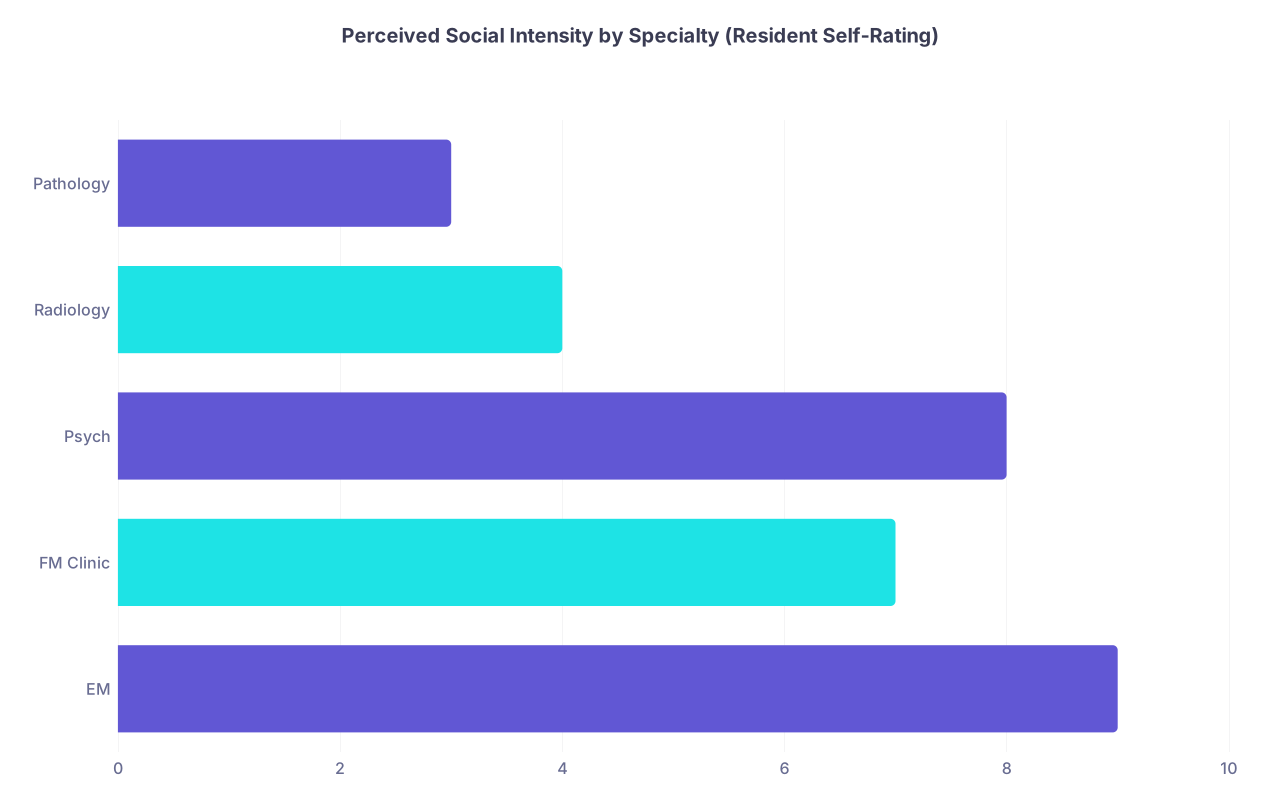
| Category | Value |
|---|---|
| EM | 9 |
| FM Clinic | 7 |
| Psych | 8 |
| Radiology | 4 |
| Pathology | 3 |
Take the answers seriously—especially from residents. They’re closer to what you’ll actually live.
Step 9: Decide on Your Tolerance, Not Just Your Preference
Everyone prefers something. That doesn’t matter as much as your tolerance range.
You might prefer fewer interactions but can tolerate moderate daily contact without harm. That widens your options.
Or you might have a low tolerance: high-interaction days wreck your mood, sleep, and functioning. In that case, you owe it to yourself (and your future patients) to pick a field that doesn’t push your baseline into burnout.
Ask yourself directly:
- “What interaction level is ideal for me on a typical workday?”
- “What level could I tolerate long-term without serious burnout?”
- “Which specialties and practice types cluster around that tolerance band?”
Write it down. Don’t keep this vague.
A Quick Sanity Check Matrix
Use this as a rough, personal filter—not as gospel.
| If this is you… | Then explore… |
|---|---|
| Drained by constant person-to-person contact | Path, Rads, outpatient subspecialties |
| Like people, but need breaks and control of pace | Outpatient IM, Endo, Rheum, Rad Onc |
| Energized by fast-paced, high-volume interaction | EM, FM clinic, Peds, Ob/Gyn |
| Prefer doing/procedures over talking | Anesthesia, Surgery, IR, EP |
| Enjoy long, deep conversations and emotional processing | Psych, Palliative, Heme/Onc |
Your job isn’t to pick the “correct” introvert or extrovert specialty.
Your job is to stop lying to yourself about what drains you—and then build a career that doesn’t require you to fight your nature every single day.
Open your notes app right now and list your last three clinical days; for each, write (1) how many meaningful interactions you had and (2) how you felt at the end on a 1–10 energy scale—then circle the day that felt most sustainable and ask: which specialties create more days like that?