
You’re not “undecided” – you’re greedy in the best possible way. You want clinic and the OR. Good. Now you need a plan.
If you’re a med student who lights up both when you’re managing complex clinic patients and when you’re scrubbed in cutting, you are in a very specific, tricky zone. People will try to force you into a box:
- “You’re too social for surgery.”
- “You’ll get bored in clinic if you’re procedural.”
- “Just pick medicine and do procedures on the side.”
Most of that advice is lazy. There are real hybrid paths that give you meaningful time both in clinic and in the OR/procedure room. But some “hybrid” options are actually 90% clinic with the occasional token scope. Others are 90% OR and you barely know what your clinic patients look like with their clothes on.
So if this is you—genuinely drawn to both spaces—here’s how to approach it like an adult, not a drifting MS3 hoping “it’ll just click someday.”
Step 1: Get Clear on What You Actually Like About Clinic vs OR
“Clinic” and “OR” are vague. You have to dissect what pieces of each environment you’re drawn to.
Ask yourself very specifically:
In clinic, do you enjoy:
- Longitudinal relationships? (“How’s your daughter’s graduation? Let's adjust your insulin.”)
- Complex diagnostic puzzles?
- Counseling and shared decision-making?
- High-volume, quick visits (15 mins or less) with focused problem-solving?
In OR/procedure land, are you more into:
- The technical “hands” part—suturing, scoping, using tools?
- The intensity and team flow of an OR day?
- The immediate gratification of fixing something physically?
- Sedation/anesthesia physiology and acute changes?
Concrete example:
I’ve seen students who say, “I like the OR,” but what they actually liked was the teamwork and clear hierarchy. Put them in a GI lab doing 20 scopes a day and they’re miserable. Another wants to “cut” but hates standing for 8 hours on a low-autonomy case. They end up thriving in a field with short, frequent procedures and fast turnover.
Write this down. Literally two columns: “Clinic – what I like” and “Procedures/OR – what I like.” This list will guide which specialties are actually hybrid for you, not just on paper.
Step 2: Know Your Real Hybrid Specialty Categories
Here’s the landscape. These are specialties where you can realistically have significant clinic and significant procedure/OR time.
| Specialty | Clinic % (typical) | OR/Procedures % (typical) |
|---|---|---|
| OB/GYN (generalist) | 40–60% | 40–60% |
| ENT (Otolaryngology) | 20–40% | 60–80% |
| Urology | 30–50% | 50–70% |
| Ophthalmology | 40–60% | 40–60% |
| Dermatology (proced.) | 60–80% | 20–40% |
| GI (advanced endoscopy) | 40–60% | 40–60% |
These are not rigid numbers, but typical patterns. Let’s go through the major buckets you should be thinking about.
1. Classic Surgical Hybrids (True OR + Clinic)
These are for people who like real OR cases and also like seeing awake humans in the office.
OB/GYN (generalist)
- Clinic: prenatal care, gyn visits, contraception, Pap smears, abnormal bleeding workups.
- OR/L&D: C-sections, hysterectomies, laparoscopies, D&Cs, deliveries (lots of deliveries).
- Reality: 50/50-ish blended life, but call can be brutal depending on job. Great if you like women’s health, continuity, and doing big procedures.
ENT (Otolaryngology)
- Clinic: sinus issues, hearing loss, head & neck cancer follow-up, pediatric ENT problems. Short, focused visits.
- OR: tonsillectomies, sinus surgeries, ear tubes, thyroids, neck dissections, fancy airway stuff.
- Reality: Procedurally heavy but you still have clinic days. Lots of precision work. Good for people who like anatomy and gadgets.
Urology
- Clinic: BPH, stones, hematuria workup, ED, prostate cancer discussions.
- OR: scopes, TURPs, stone surgeries, robotic cases (prostates, kidneys), vasectomies.
- Reality: Procedural and OR heavy but with a strong clinic component. Mix of older men, some women, some peds if you choose that niche.
Ophthalmology
- Clinic: refractions, diabetic eye exams, glaucoma management, retina checks.
- OR: cataracts, retinal procedures, corneal surgeries, glaucoma procedures.
- Reality: Truly hybrid. Clinic is very device-heavy, focused exams. OR days are often short, precise cases. Lifestyle can be excellent.
These fields scratch the “I want to operate” itch but you will still be in clinic a lot. If you’re obsessed with the OR and clinic feels like a chore, these might annoy you. If you want both genuinely, they’re prime options.
2. Medical Specialties with Heavy Procedures
These are “medicine with toys.” More sedations, scopes, caths, interventions. Less classic big open surgery.
Gastroenterology (GI)
- Clinic: IBS, IBD, liver disease, reflux, anemia workups.
- Procedures: EGDs, colonoscopies, ERCP, EUS depending on training.
- Reality: In some jobs, 2–3 days/week are procedural. Others, you are in clinic more. You’re usually not in a traditional OR but procedure suites. If you like physiology and scopes more than cutting, this fits.
Interventional Cardiology
- Clinic: follow-up of CAD, stents, chest pain, post-PCI management.
- Procedures: caths, PCI, sometimes structural heart (TAVR, MitraClip) with fellowship.
- Reality: Still a lot of medicine. But days in the cath lab are very “OR-like” in feel.
Interventional Radiology (IR)
- Clinic: much less than others, but there are IR clinics (PAD, oncology procedures, pain procedures).
- Procedures: embolizations, drains, biopsies, ablations, lines, minimally invasive treatments.
- Reality: Most of your day is procedural. But growing outpatient IR clinics give some longitudinal flavor.
Pulm/CC with bronchoscopy focus
- Clinic: COPD, asthma, ILD, pulmonary nodules, post-ICU care.
- Procedures: bronchoscopies, EBUS, sometimes pleural procedures.
- Reality: Hybrid in many places. If you add ICU, your life becomes even more procedure + high acuity.
3. Clinic-Heavy but Procedurally Rich
You’re in clinic most days, but your clinic is procedural.
Dermatology (especially surgical/oncologic derm or Mohs)
- Clinic: skin exams, rashes, acne, psoriasis, melanoma follow-up.
- Procedures: biopsies, excisions, Mohs surgery, cosmetic procedures, lasers, injections.
- Reality: This can feel very “hands-on,” but it’s not an OR in the classic sense. If what you love is using your hands and tools, this still might fully satisfy that.
PM&R with interventional spine/pain
- Clinic: musculoskeletal complaints, rehab planning, follow-ups.
- Procedures: joint injections, epidurals, radiofrequency ablations, some EMGs.
- Reality: Lots of injections and imaging-guided procedures. You’re not in a big OR, but you’re using needles and C-arms constantly.
Allergy/Immunology (less procedural but still some)
- Clinic: allergy evaluations, asthma, immunodeficiency.
- Procedures: skin testing, immunotherapy injections, sometimes food challenges.
- Reality: Procedures are small but frequent. This won’t scratch an OR itch, but might help if you just want some hands-on components.
Step 3: Look at Training Path, Not Just End Destination
A lot of students romanticize the attending job but forget they must survive residency/fellowship.
If you’re torn between IM→GI and surgery, for example, ask:
- Can you tolerate 3 years of mostly medical wards if you choose IM?
- Can you tolerate 5+ years of mostly surgical service and long OR days if you choose surgery?
Harsh truth:
You do not get to “skip to the good part.” A surgical attending job that’s 50/50 clinic/OR may still require a residency that is 80–90% OR/acute care, minimal clinic. Same for medicine: a procedural GI career still means several years doing inpatient medicine, wards, and ICU.
Here’s a simplified comparison:
| Final Career Goal | Residency Route | Total Training Years (typical) |
|---|---|---|
| Generalist OB/GYN | OB/GYN | 4 |
| ENT or Urology | ENT/Urology | 5 |
| Ophthalmology | Ophtho + prelim | 4–5 |
| GI with procedures | IM → GI fellow | 6–7 |
| IR with clinic | DR → IR pathway | 6–7 |
If you know you’ll be miserable doing pure medicine or pure surgery for years, that matters. You are not weak for acknowledging that. You’re realistic.
Step 4: Use Rotations Strategically (Not Passively)
During clinical years, you cannot afford to “just see what clicks” if you’re trying to thread a hybrid needle. You need to deliberately test hypotheses.
Here’s how:
A. Plan your rotations with intention
You want direct exposure to at least:
- One or two classic surgical hybrids (OB/GYN, ENT, Urology, Ophtho if available)
- One or two medical-but-procedural fields (GI, cards, pulm, IR, derm, PM&R)
Then, you do not just “see how it feels.” You track.
Create a quick note on your phone with sections for each rotation:
- Things I loved
- Things I hated
- Would I be okay if this were 80% of my life for 5 years?
- Clinic days: How did they feel by 3 pm?
- OR/procedure days: How did they feel by 3 pm?
If halfway through a rotation you realize: “I’m counting down the minutes in clinic but 6-hour OR days fly by,” that’s real data. Same if the opposite happens.
B. Ask attendings the right (non-fluffy) questions
Do not ask, “Do you like your work-life balance?” That’s useless.
Ask:
- “What percent of your week is clinic vs OR vs admin?”
- “If you could change that ratio, what would you change it to?”
- “As a resident, what was your breakdown?”
- “In your group, who has the most clinic-heavy schedule, and how did they negotiate that?”
Most will be surprisingly honest, especially away from other attendings.
Step 5: Understand That Job Design Can Move the Needle
The specialty isn’t the whole story. Within almost every hybrid specialty, the actual job can push you more clinic or more OR.
For example:
- OB/GYN: Some generalists do lots of surgery and L&D. Others are basically OB-heavy or office-heavy with minimal OR.
- GI: A partner might be scope-heavy (3 procedure days/week) while another is mostly clinic and admin.
- ENT: One partner may focus on head and neck cancer (big cases, lots of OR time), another on office-based rhinology or sleep.
So you need to ask yourself two things:
- Am I choosing a specialty where the range of possible clinic/OR mixes includes something I’d love?
- Am I okay hustling for the niche I want—picking the right fellowship, first job, and group?
If you need your ideal mix to be baked-in guaranteed, pick a field where the average job already looks right to you. If you’re flexible and willing to negotiate, more doors open.
Step 6: Pay Attention to Lifestyle Reality, Not Myths
Hybrid often means a busy life. You’re not just doing one type of work; you’re flipping between clinic, OR, call, and follow-ups.
Crucial questions:
- How do you tolerate unpredictability?
OB/GYN and some surgical fields: middle of the night calls, emergent cases. - How do you handle long stretches of standing/physical fatigue?
ENT/urology/ophtho are usually better than big open general surgery, but still physical. - How do you feel about emotional weight?
Gyn oncology ENT, urology with cancer, IR with oncologic work: heavy conversations.
Hybrid doesn’t magically mean “balanced.” It means “varied.” Big difference.
Step 7: If You’re Still Torn Between 2–3 Fields
Let’s say after rotations you’re stuck between:
- OB/GYN vs GI
- ENT vs Ophtho
- Urology vs IM→cards
Here’s how to break the tie:
Compare worst days, not best days.
On the worst day of OB (no sleep, crash C-section, fetal demise), can you stomach that more than the worst day of IM (3 decompensating patients, endless notes, social disaster)? Same for cards vs urology, etc.Look at “who your people are.”
Sit in on a department meeting if you can. Or just pay attention during conferences. Do you vibe more with surgeons’ energy or medicine people’s energy? It matters more than you think.Back-calculate from your non-negotiables.
Examples: “I will not do Q3 home call.” “I must live in a big city.” “I hate 24-hour calls.” Some specialties simply fit certain constraints better.Do a focused sub-internship/audition rotation in your top 1–2 choices and live like a resident. Do not just shadow. Be in the trenches.
Step 8: Concrete 4-Week Experiment You Can Run Now
If you’re in your clinical years and somewhat flexible in your schedule, try this:

| Step | Description |
|---|---|
| Step 1 | Week 1: Surgery-heavy |
| Step 2 | Reflect & Log |
| Step 3 | Week 2: Medicine-heavy |
| Step 4 | Reflect & Log |
| Step 5 | Week 3: Hybrid/procedural field |
| Step 6 | Reflect & Log |
| Step 7 | Week 4: Return to top 2 choices |
| Step 8 | Compare notes & decide direction |
Week 1: Spend as much time as possible on a surgical or OR-dominant service (OB, general surgery, ENT if you can swing it).
Week 2: Flip to a medicine-heavy week (wards, cards, pulm).
Week 3: Try to intentionally be in a hybrid field (GI, IR, derm, ophtho, urology).
Week 4: Go back to your top two contenders and pay attention to your energy levels.
Log your mood, interest, and fatigue every evening. Patterns will appear if you’re honest.
Step 9: Talk Smartly With Advisors (Without Getting Steamrolled)
Some advisors have a blunt bias: “If you’re not 100% sure on surgery, don’t do it.” Others push prestige: “Why GI over cards?” You need to enter these conversations with clarity.
When you meet, say something like:
“I’m strongly drawn to both clinic and procedures. So far my top options are X and Y. In X, I like [specific clinic aspects] and [procedural aspects]. In Y, I like […]. Could you help me pressure-test these choices from a training and long-term job perspective?”
Then ask:
- “If a student has my interests (clinic + OR), what factors do you see separating the people who end up happy in X vs Y?”
- “What do residents who regret their choice usually say?”
If you can, talk to residents and junior attendings more than senior chairs. They remember the decision stress more clearly and often give less filtered answers.
Step 10: Reality Check—No Field is Perfectly 50/50 Forever
You will not get a guaranteed, permanent precise mix of clinic and OR. Your ratio will evolve:
- As a resident vs early attending vs mid-career
- When you change jobs or join a new group
- Based on health, family, and burnout
So the real question is this:
“Which ecosystem (surgery-based, medicine-based, procedure-based) would I rather live in, even if the mix tilts sometimes?”
If you’d rather sit through a mediocre OR day than a mediocre clinic day, that tells you a lot. Same if the reverse is true.
Quick Comparison: Who Should Lean Where?
Here’s a 30,000-foot sanity check:
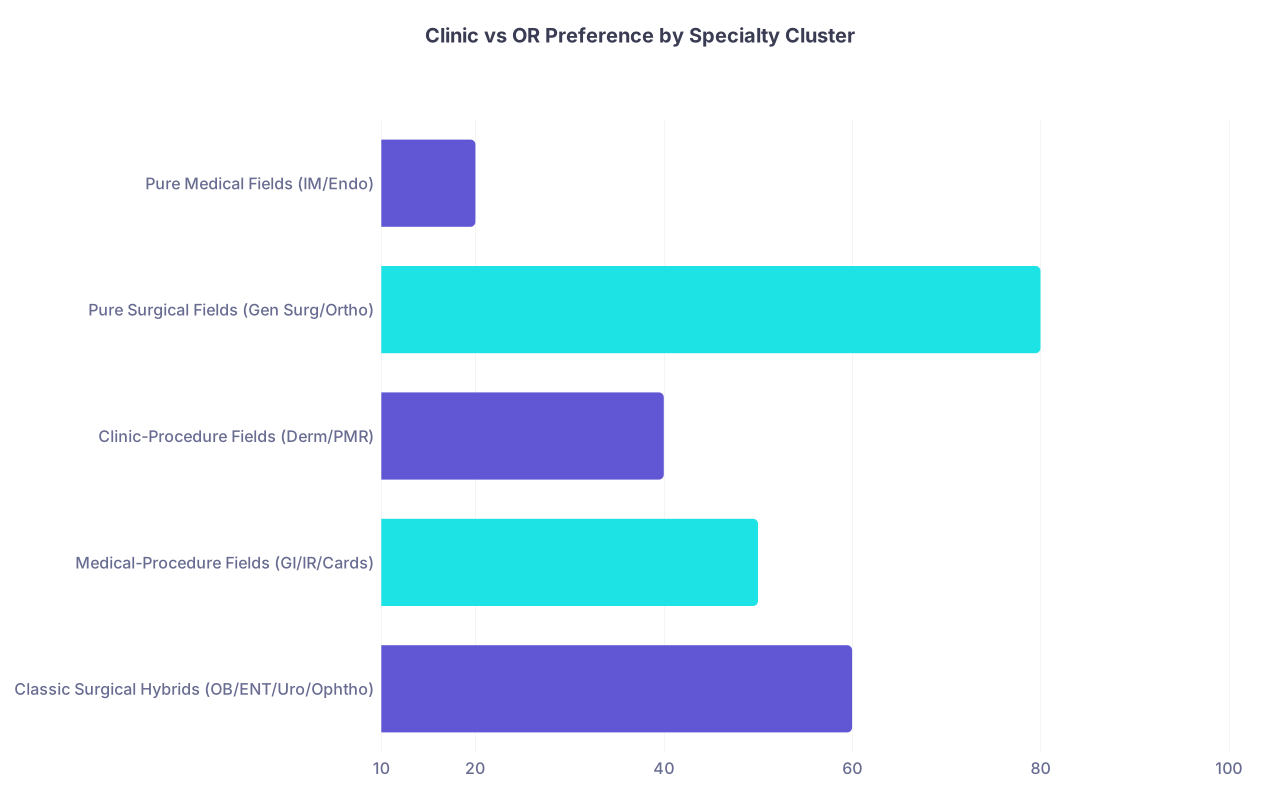
| Category | Value |
|---|---|
| Classic Surgical Hybrids (OB/ENT/Uro/Ophtho) | 60 |
| Medical-Procedure Fields (GI/IR/Cards) | 50 |
| Clinic-Procedure Fields (Derm/PMR) | 40 |
| Pure Surgical Fields (Gen Surg/Ortho) | 80 |
| Pure Medical Fields (IM/Endo) | 20 |
Roughly:
- If the OR is your happy place and clinic is “fine,” look at: ENT, Urology, Ophtho, some OB/GYN.
- If you really like clinic but want legit procedures, look at: GI, Interventional Cards, Pulm/bronch, IR, Procedural Derm.
- If you think you’ll burn out doing only clinic or only OR, prioritize hybrid fields where your average week genuinely splits.
FAQs

1. I like both IM and surgery. Should I just do a surgical hybrid because it has clinic anyway?
Not necessarily. If you fundamentally like medical reasoning—titrating meds, managing chronic disease, thinking about pathophysiology—forcing yourself into a surgical field because it “has some clinic too” can backfire. You’ll still spend a massive chunk of residency doing classic surgical work: long OR days, pre-op/post-op, surgical emergencies.
Flip the question: if you ended up in an IM-based procedural field (GI, cards, pulm) where your procedures feel OR-like but you’re still “medicine,” would you feel like you sold out your real interests or honored them? Your answer to that tells you more than any prestige ranking.
2. How do I know if I really like the OR or I just like being useful and busy?
Look at what you watch when nothing is expected of you. On an OR day:
- When you’re not needed, do you still watch every step, ask questions, replay the case in your head?
- Or do you find yourself gravitating toward updating notes, checking labs, chatting with the team, waiting for it to end?
I’ve seen students who seem “into surgery” during the case, but as soon as they have the option, they drift out to the floors or lounge. Those people usually end up much happier in GI, cards, or EM—still busy and useful, but not standing at an OR table all day.
3. Is EM a good hybrid clinic/OR option?
EM is hybrid in acuity and task variety, not clinic vs OR. You will do procedures (intubations, lines, reductions, lacerations), but you won’t have a traditional clinic panel or OR block time. Your “clinic” is the ED and your patients are mostly one-and-done.
If what you crave is longitudinal care plus procedures, EM won’t scratch that itch. If what you actually want is shifts, variety, and short intense encounters, it might. But EM is its own beast; don’t treat it as a generic compromise.
4. What if my school doesn’t have strong exposure to ENT, urology, ophtho, or IR?
Then you have to be proactive and slightly annoying (in a good way).
- Email the department coordinator and ask to shadow in clinic and in the OR for a few days.
- Use electives selectively—early if possible—to get real time on these services.
- Go to their resident conferences; you’ll learn both the content and the culture.
- If absolutely no exposure is possible, talk to residents or alumni in those fields via Zoom. Ask targeted questions about daily life, not just the match.
You cannot choose a hybrid field you have never actually seen. Virtual shadowing is better than nothing, but not enough. Push hard to get even a week.
5. I’m an MS2 pre-clinical. What’s the single most useful thing I can do right now?
Start logging what kind of thinking and working you enjoy in your current life.
During small groups, anatomy lab, clinical skills:
- Do you enjoy hands-on activities more than long discussions?
- Do you like detail-heavy anatomy and spatial reasoning, or more conceptual path/phys, or patient communication practice?
- When you shadow, write down your reactions to clinic vs procedural time that day—specific, not vague.
Then, as soon as 3rd year hits, aggressively sample at least one surgical hybrid and one medical- procedural field early (GI, pulm, derm, PM&R, IR if possible). Do not “save the interesting stuff for later.” You want real data early enough to pivot if needed.
Open your rotation calendar or planning spreadsheet right now and identify the next 8–12 weeks. Plug in, on paper, where you can deliberately test one surgical hybrid and one medical-procedural field. If you do not see both represented clearly, start emailing coordinators today to fix that.