
What if the “dream specialty” you’ve been telling everyone about since MS1 is actually a trap you set for yourself… before you ever touched a patient on the wards?
You’re in that awkward MS2 zone: drowning in path and pharm, Step/Level looming, and suddenly everyone around you is “interested in ortho” or “definitely going derm.” You feel behind if you do not have a specialty picked. So you start picking one.
This is where people screw themselves.
Let me walk you through the seven specialty-choice mistakes I watch MS2s make repeatedly — the kind that come back to bite them hard during MS3, residency applications, or even as early attendings.
You do not need a perfect answer right now. But you do need to avoid choosing for the wrong reasons.
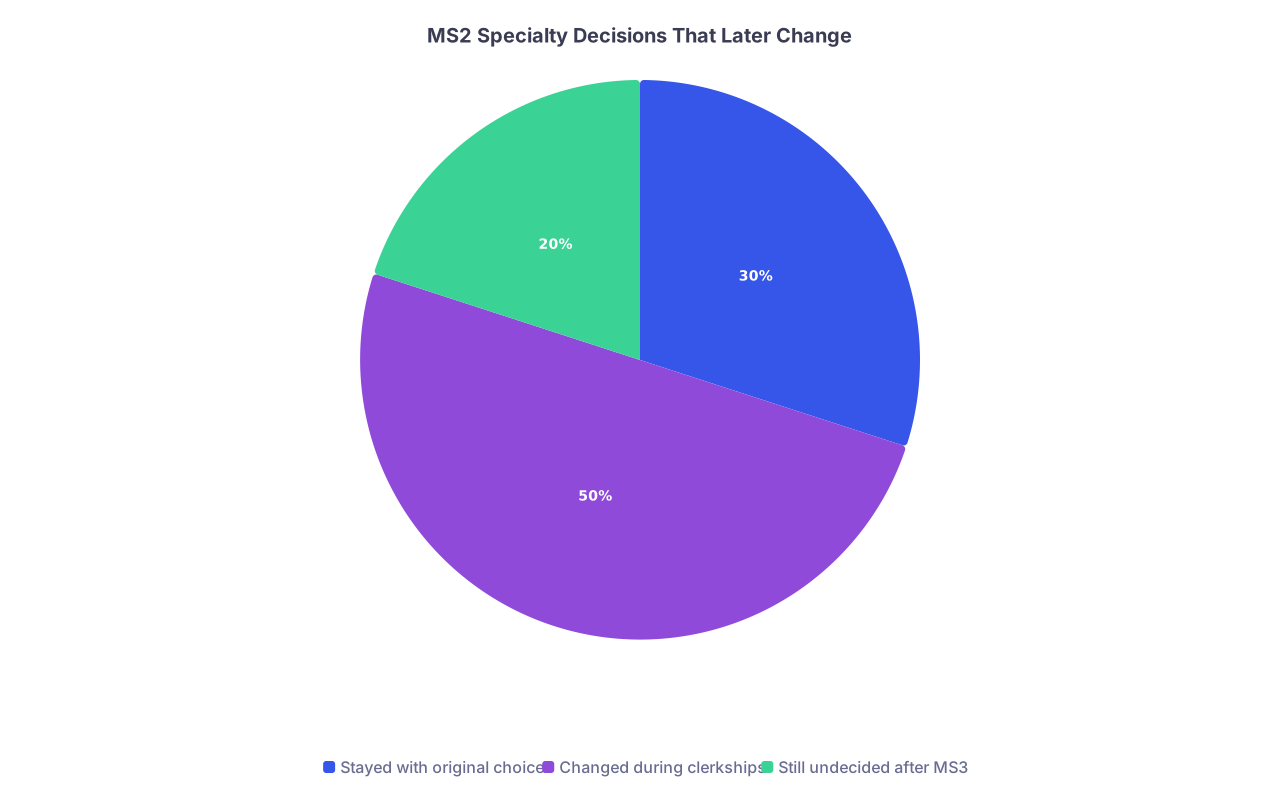
| Category | Value |
|---|---|
| Stayed with original choice | 30 |
| Changed during clerkships | 50 |
| Still undecided after MS3 | 20 |
1. Locking In a Specialty Before You’ve Done Any Real Clinical Work
This is the biggest, loudest, flashing-red mistake.
You’re in pre-clinicals. You’ve seen:
- PowerPoint slides
- Question banks
- Maybe a shadowing afternoon where everyone was on best behavior
And from that… you’re ready to “definitely do neurosurgery” for the rest of your life?
You’re making a 30–40 year decision based on what is basically marketing material.
What I’ve seen over and over:
- MS2: “I’m 100% ENT. Love the anatomy. Love the surgeries.”
- MS3 after ENT rotation: “The call. The lifestyle. The cases weren’t what I thought. But now I’ve already told everyone I’m ENT and joined the ENT interest group and started ENT research…”
Now they feel trapped by their own early branding.
How this mistake happens
- You feel behind your peers. So you overcorrect and “commit” early.
- You confuse liking content with liking the job. Pathophys of kidney disease? Cool. Actual nephrology clinic? Very different.
- You’ve shadowed once or twice and think that’s enough. It’s not. Everyone behaves differently when the med student is there for 2 hours.
How to avoid it
- Make a shortlist, not a declaration. For example: “Right now I’m curious about EM, IM, and anesthesia.” Full stop.
- When people ask your specialty: allow yourself to say, “I’m not committing until after clerkships.” That answer is more mature than false certainty.
- If your school pushes early decision-making, play along strategically, but privately keep your mind open.
You’re not late if you don’t know your specialty in MS2. The ones loudly “decided” now are usually the ones quietly panicking in MS3.
2. Choosing Based on Prestige, Ego, or What Impresses Other People
This one’s ugly but real.
Students don’t say, “I’m picking neurosurgery because it sounds impressive.” They say:
- “I just like challenging things.”
- “I want to work at the top of my abilities.”
- “I’m drawn to highly specialized, intellectually demanding fields.”
Sometimes that’s true. Often it’s code for: I like how people react when I say this specialty.
Here’s what I’ve seen go wrong:
- Student with Step 1 pass, borderline Step 2, average clinical feedback, insists on matching derm or plastics because they “won’t be happy in anything less competitive.” They end up burning out trying to force a fit — red-eye flights to every interview, 3 research projects they don’t care about, constant anxiety about being “good enough.”
- Or they don’t match. Then they’re scrambling into a prelim year they never even considered as a real possibility.

Red flags you’re prestige‑driven more than fit‑driven
- Your top reason for liking a specialty is: “It’s really competitive.”
- You feel embarrassed saying you might like FM, psych, peds, or IM because they’re “less prestigious.”
- When you think of switching from a competitive specialty to a more realistic one, your first emotion is shame, not curiosity.
Reality check
Prestige doesn’t:
- Help you at 3 a.m. when you’re on your third consult and haven’t eaten
- Fix a miserable clinic day with patients you don’t enjoy
- Make post‑call exhaustion any easier
What does help? Actually liking:
- The patient population
- The day‑to‑day tasks
- The team culture and schedule
How to avoid this trap
- Force yourself to write 3 reasons you like a specialty that have nothing to do with competitiveness, salary, or status. If you can’t, be honest with yourself.
- Spend time with residents in that specialty. Listen for how they talk about their day. Is the joy about the work or about the name on the badge?
- Talk to someone in a “non‑prestige” field who’s actually happy. You’ll quickly see how fake the prestige hierarchy is once people are out of med school echo chambers.
3. Ignoring Your Own Lifestyle Needs (Then Pretending You’ll “Adapt”)
MS2s severely underestimate how much lifestyle mismatch wrecks satisfaction.
Common delusion:
“I don’t care about lifestyle. I’m willing to work hard.”
Everyone says this. Very few mean it in the way ortho trauma call or CT surgery actually requires.
I’ve watched:
- A student who “didn’t care about lifestyle” choose EM, then realize shift work destroyed their sleep and mental health.
- A self‑described introvert choose a highly social outpatient field, then dread clinic every day.
- Someone who thought they’d be “fine” with 1–2 weekends a month on call… until they had kids and realized they never saw them awake.
You are not morally better if you suffer more. You’re just more burned out.
Key lifestyle dimensions you’re probably ignoring
- Schedule predictability – Do you actually tolerate last‑minute changes well?
- Nights/weekends/holidays – Be honest: will missing most holidays crush you, or are you truly indifferent?
- Physical stamina – Some bodies do not like 10‑hour OR days, however strong your will is.
- Emotional load – Psych, heme/onc, PICU, palliative care carry a different kind of exhaustion.
| Specialty | Nights/Weekends (Residency) | Schedule Predictability | Typical Patient Interaction |
|---|---|---|---|
| EM | Frequent nights/weekends | High (shift-based) | Short, intense encounters |
| IM | Some nights/weekends | Moderate | Longitudinal & acute mix |
| Surgery | Many early mornings, call | Low–Moderate | OR + brief post-op visits |
| Psych | Fewer nights (varies) | Moderate–High | Longer conversations |
| FM | Minimal nights (outpatient) | High (clinic-based) | Longitudinal relationships |
How to avoid self‑deception
- Stop saying “I’ll adapt” and start asking, “What has already burned me out in life?” Night shifts? Social overload? Long hours sitting or standing? Believe your past.
- Talk to PGY‑2s and above with a life vaguely like the one you want (kids/no kids, partner/no partner, hobbies). Ask what they had to give up.
- Remember: residency is worse lifestyle than most attendings, but often not by as big a margin as you’re imagining.
If the day‑to‑day reality of a field would make you miserable, it does not matter how “cool” the diseases are.
4. Treating Step Scores as Your Only Compass (Both High and Low)
Two opposite but equally dumb mistakes:
- Letting a high Step score bully you into a specialty you don’t actually want.
- Letting a lower Step score convince you you’re “not allowed” to consider something competitive that truly fits you.
I’ve heard both:
- “My Step 2 is 260; I’d be wasting it if I didn’t go for something like derm or rads.”
- “My Step 1 was pass on the second attempt, so I guess I have to do FM even though I loved my anesthesia elective.”
Both are wrong.
Scores are:
- A filter some programs use
- A rough signal about test taking, not your future happiness
That’s it.
How this breaks people
- High scorers chase the hardest-to-match specialties because they’re hard. They ignore red flags during electives (“I hate clinic days,” “The culture is toxic”) because they feel they “should” endure it.
- Lower scorers self‑eliminate from reasonable reach options early, never talk to advisors in those fields, and never build a strategic application.
Smarter way to use scores
- First: Decide what you actually like based on people, tasks, and lifestyle.
- Then: Use your score to build a realistic plan for that field, or adjacent fields that feel similar.
For example:
- You love hands-on procedures, short-term patient relationships, and acute care, but your score is modest. Maybe neurosurgery is a steep climb, but EM, anesthesia, or even critical care via IM might check many of the same boxes.
- You’re obsessed with skin disease, clinic, and visual diagnosis. If derm is statistically unlikely, could you see yourself in rheum, allergy, or IM with a strong derm interest?
Don’t let a number from one exam dictate everything. But don’t pretend program filters don’t exist either.
5. Letting One Personality (Usually Loud and Unhappy) Represent an Entire Specialty
Big one. And very sneaky.
You do one shadowing day. You get paired with:
- The burned‑out attending who tells you every specialty is terrible but “at least in ours you get paid enough.”
- Or the ultra‑happy unicorn who loves every case, works at a cushy private group, and has support most people in that field do not.
Then you generalize that one data point to the entire specialty.
I’ve seen:
- Students swear off surgery forever because of a single malignant attending during a 2‑week sub‑I.
- Others go all‑in on EM because they shadowed at a well‑staffed, academic ED with low boarding and great ancillary support — then are shocked later by real‑world ED boarding, workplace violence, and burnout.
Why this happens
- As MS2/MS3, your sample size is tiny.
- You’re desperate for a story that “makes sense.” So you look at one doctor, one team, and assume “this is ortho,” “this is psych,” “this is cards.”
How to protect yourself
- Get multiple data points in the same field:
- Different attendings
- Different practice settings (academic vs community, large vs small hospital)
- Pay attention to the median, not the outliers:
- Are most people mildly content, miserable, or enthusiastic?
- Do the residents look like they’re surviving or actually living?
And remind yourself constantly: “I’m seeing a slice of this specialty, not the whole thing.”

| Step | Description |
|---|---|
| Step 1 | MS2: Curiosity Phase |
| Step 2 | Create 3-5 Specialty Shortlist |
| Step 3 | Targeted Shadowing with Multiple Attendings |
| Step 4 | Talk to Residents & Fellows |
| Step 5 | MS3 Clerkships: Observe Day-to-Day Reality |
| Step 6 | Refine to 1-2 Serious Options |
| Step 7 | Advising & Competitiveness Check |
| Step 8 | Sub-Is & Focused Electives |
| Step 9 | Final Specialty Decision |
6. Building Your Entire Identity Around “Your” Specialty Too Early
This one is quieter but brutal when it backfires.
MS2s decide they’re:
- “The future interventional cardiologist”
- “The neurosurgery person”
- “The future pediatric oncologist”
Then they:
- Put the specialty in every bio and intro
- Join and run the interest group
- Take only research in that field
- Tell faculty, classmates, their family — everyone
What happens if:
- They hate the rotation?
- Their scores or evaluations make that field unrealistic at the programs they’d actually tolerate training in?
- They discover another specialty that fits them far better?
Now changing course feels like a public failure, not a healthy pivot.
I’ve watched:
- Students stay in a not‑great‑fit specialty because “everyone knows me as the ortho person.”
- Others switch too late because they were scared to admit they’d changed their mind.
Signs you’re over‑identifying too soon
- You feel defensive when someone casually asks, “Have you considered other fields?”
- The idea of changing specialties makes you more anxious about what people will think than about your actual day‑to‑day future.
- Your CV is 90% one field by MS2, with nothing else explored.
How to stay flexible
- Brand yourself around skills and themes, not just one specialty:
- “Interested in procedural, team‑based acute care fields”
- “Drawn to longitudinal relationships and complex chronic disease”
- Keep at least one project outside your early favorite field. It buys you options later.
- When talking to attendings, use language like:
- “Right now I’m leaning toward X, but I’m very open as I go through rotations.”
Your identity should be “future physician.” The specific flavor comes later.
7. Ignoring the Financial and Training-Length Reality
No, you don’t need a full financial plan in MS2. But pretending money and training length don’t matter at all? That’s another mistake.
The most common MS2 fantasy:
“I’ll do a 7-year residency plus 2-year fellowship, and then I’ll start my life.”
Reality:
- Those are your 20s and early 30s.
- You’ll probably want some mix of stability, relationships, maybe kids, maybe a house, maybe hobbies before you’re 40.
I’ve seen:
- People sign up for extremely long training pathways without fully absorbing:
- The opportunity cost
- The impact on partners and families
- The delay of earning an attending salary
- Others choose a longer, lower‑paid field believing salary “doesn’t matter,” then feel trapped 10 years later with loans, kids, and burnout.
No, money isn’t everything. But pretending it doesn’t matter is naive.
Variables you can’t ignore forever
- Length of training (residency + likely fellowship)
- Typical starting salary vs your debt load
- Geographic flexibility – Some niche subspecialties have jobs clustered in limited areas.
- Malpractice risk and insurance costs in certain fields
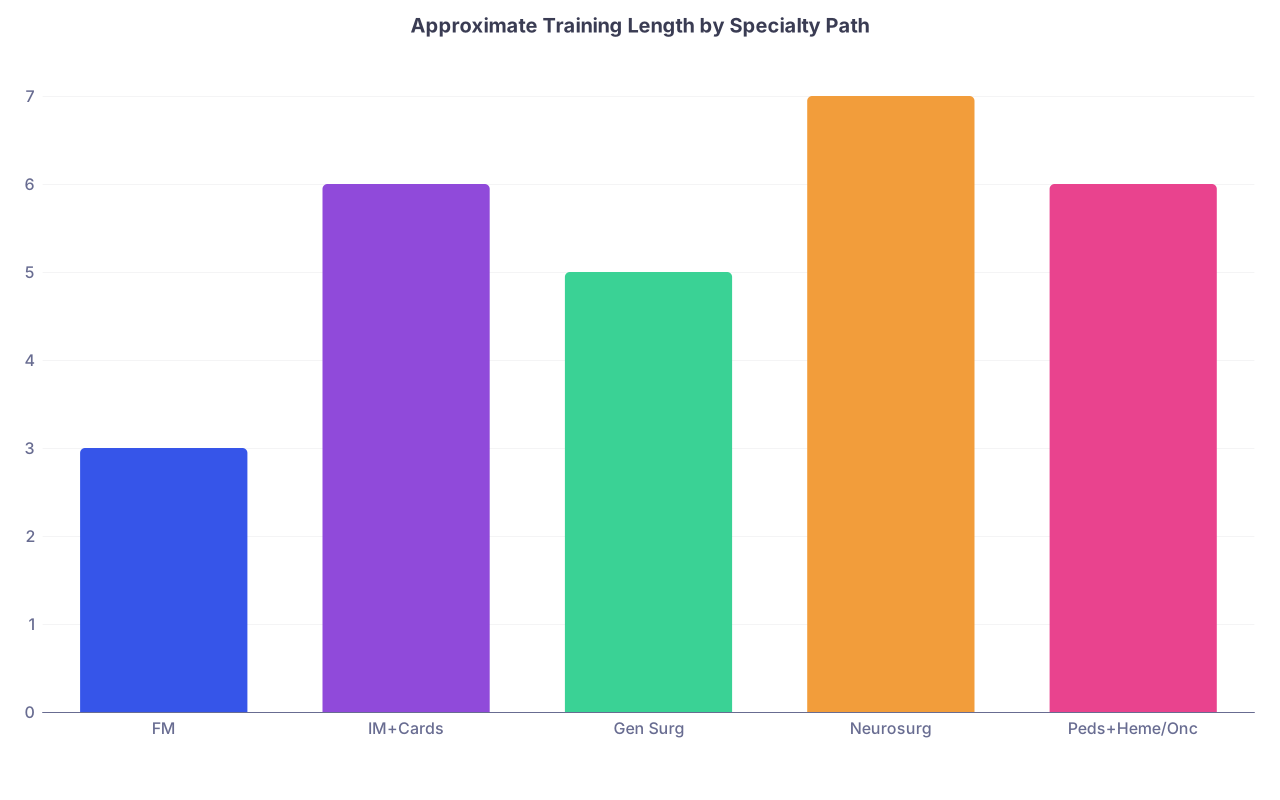
| Category | Value |
|---|---|
| FM | 3 |
| IM+Cards | 6 |
| Gen Surg | 5 |
| Neurosurg | 7 |
| Peds+Heme/Onc | 6 |
Numbers are approximate, but you get the point.
How to avoid financial blindness
- Run a rough projection:
- Years in training × likely salary bands × your loan total
- Talk to attendings 5–10 years out in your possible fields. Ask how their financial life actually feels. Not just the number.
- Make sure you’re not assuming, “It’ll all sort itself out.” That’s how people end up in golden handcuffs doing high‑paying work they hate because they can’t afford to leave.
You’re allowed to care about money and time. It doesn’t make you less “calling‑driven.” It makes you realistic.
How to Explore Wisely as an MS2 (Without Trapping Yourself)
You don’t have to be passive. You just have to be smart.
Use MS2 to:
- Build a shortlist of 3–5 specialties you’re curious about
- Do targeted shadowing: 1–2 half days with different people in each field
- Talk to residents, not just superstar attendings
- Start noticing what drains you vs what energizes you:
- Long conversations vs quick procedures
- Clinic vs hospital
- Kids vs adults vs everything
- Working alone vs in big teams
Your goals in MS2 are:
- Rule out obvious bad fits (e.g., you faint in the OR every time, but “kinda” want to do surgery).
- Collect enough data so that during MS3, you’re not starting from zero.
Do not:
- Declare a forever specialty in your email signature
- Anchor your self‑worth to matching one specific field
- Bet your future happiness on what impresses your classmates this year
FAQ (Exactly 3 Questions)
1. Do I need to have a specialty picked by the end of MS2?
No. You need curiosity and a shortlist, not a locked decision. By end of MS2, it’s reasonable to have 3–5 specialties you’re interested in exploring more through clerkships and shadowing. You’re not behind if you can’t name The One yet. You’re behind if you’ve prematurely married a specialty with no real experience.
2. What if I’m already “that person” known for a specific specialty and I’m having doubts?
Then quietly start collecting data in other fields. Shadow outside your “brand.” Set up meetings with advisors in different departments. You don’t owe anyone consistency at the expense of your happiness. When you’re ready to pivot, be simple and direct: “After more clinical experience, I realized X wasn’t the best fit, and I’ve become really excited about Y.” Most people will respect the honesty.
3. Should I avoid competitive specialties altogether to be “safe”?
No. Avoiding competitiveness entirely is just as foolish as ignoring it. If a competitive specialty genuinely fits your values, personality, and lifestyle preferences, explore it seriously. But at the same time, build a realistic backup strategy early and listen when advisors with actual match data tell you what’s feasible. Ambition is fine. Self‑deception is not.
Key points to walk away with:
- Do not “decide” your specialty in MS2 based on vibes, prestige, or one attending; you’re writing a script with almost no data.
- Protect your flexibility: explore widely, brand yourself loosely, and don’t let ego or early identity lock you into the wrong path.
- Use scores, lifestyle, finances, and training length as inputs — not dictators — and be brutally honest about what day‑to‑day work you can live with for decades.