
It’s February of your M2 year. You just heard a classmate say, “I matched derm largely because of my research.”
You look at your CV. One half-finished QI poster. A random case report in geriatrics. You’re now thinking, “I want ortho… did I just screw myself?”
You did not necessarily screw yourself. But a lot of students quietly do. Not because they are lazy. Because their research strategy is a mess.
Let me walk you through the most common research mistakes that close doors to competitive specialties — and how to avoid learning the hard way in M4 when it is basically too late.
Error #1: Treating “Any Research” as Good Enough
This is the classic one.
You hear over and over: “Programs like to see research.”
So you sprint toward the first project that will have you.
- Random bench project with no clinical angle
- A lonely QI project that never leaves your hospital’s intranet
- Basic science in nephrology when you’re secretly aiming for neurosurgery
Then MS4 hits. You’re applying ENT. And your CV screams “general medicine QI enthusiast.”
Here is the ugly truth:
- For competitive specialties, field-aligned research matters a lot
- “Any research” is better than no research, but it is not equally valuable
- Late pivots into a competitive field are brutally hard without some related output
What this mistake looks like in real life
- The future ortho resident who did 3 summers of endocrinology basic science because “that PI was nice”
- The derm hopeful who spent 400 hours on a COVID QI project in IM, with no publications and no derm names on the paper
- The radiology applicant with 6 case reports in OB, but zero imaging-related work
These people are now trying to explain their story in personal statements and interviews. Some manage. Many do not.
How to avoid it
You do not need to know your specialty on day one. But you also should not drift.
By mid M2, force yourself to answer two questions:
- What are the 3–4 specialties I’m realistically considering?
- Of those, which 2 are even moderately competitive? (derm, ortho, ENT, plastics, rad onc, neurosurg, urology, ophtho, EM in some regions, etc.)
Then make this rule:
- At least 50–70% of your research time should be within or adjacent to those fields.
“Adjacent” matters. For example:
- Considering neurology vs psychiatry? Neuroimaging, stroke outcomes, dementia projects — all reasonable for both.
- Considering IM vs cards? An HF hospitalization outcomes project works for both IM and cards fellowship goals.
You don’t have to perfectly guess your path. You just have to stop doing totally random, low-yield projects that box you into nothing.
Error #2: Confusing Activity Volume with Impact
Another big one. Students think: “If I have 7 posters, I’m golden.”
Programs think: “If you have 7 posters and no manuscripts or meaningful work, you’re probably just paper-chasing.”
Here’s what quietly kills people applying to competitive specialties:
- Endless low-yield posters with no follow-up publications
- Case reports presented at tiny, local meetings only
- Projects where your name is author #10 of 14 and you can’t even explain the methods
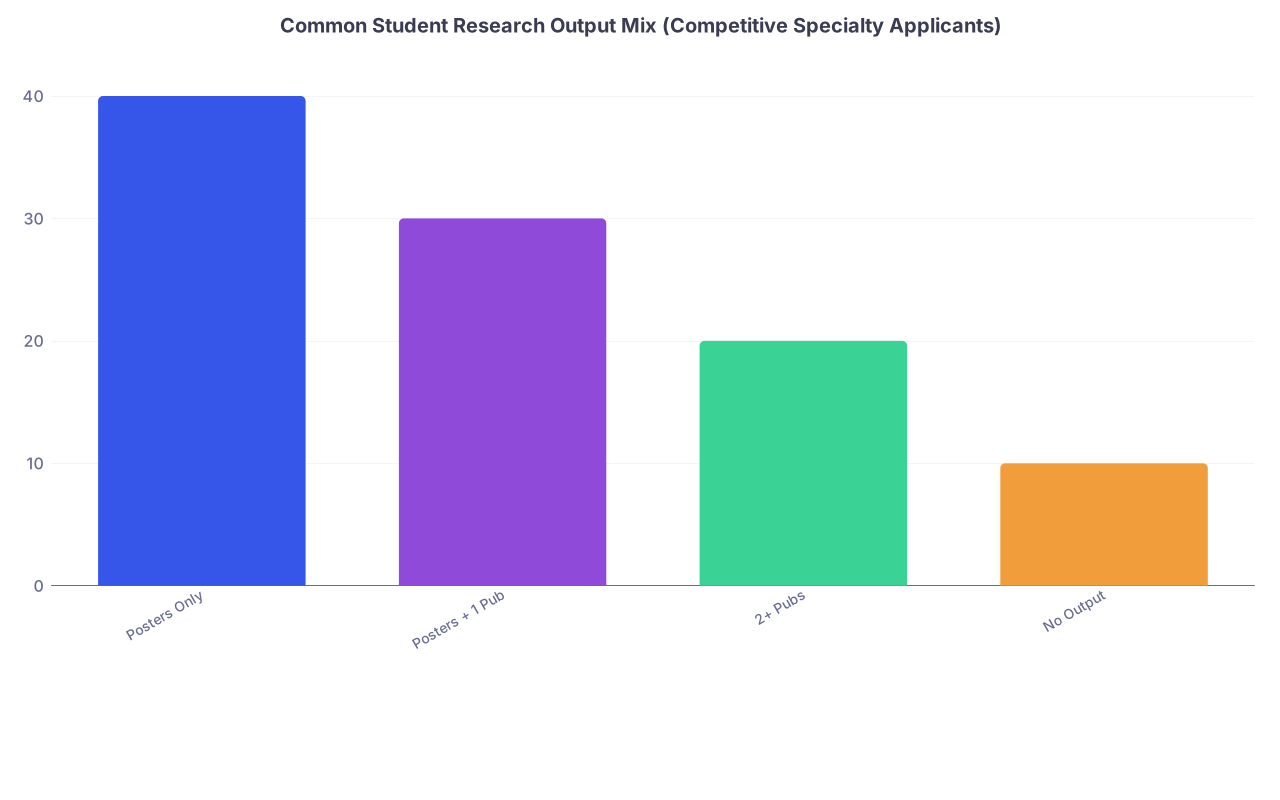
| Category | Value |
|---|---|
| Posters Only | 40 |
| Posters + 1 Pub | 30 |
| 2+ Pubs | 20 |
| No Output | 10 |
You don’t need Nature or NEJM. But if you want derm, ortho, ENT, plastics, neuro, urology, etc., you should not be graduating with only:
- 3–6 posters, 0 real papers, and
- No clear primary contributions
Better rule of thumb
Aim for at least one of the following by early M4 if you’re aiming high-competitiveness:
- 1–2 first- or second-author publications in or near your specialty
- Or 2–3 solid middle-author papers where you actually did work and can explain it
- Or 1 strong, ongoing project with clear depth (prospective, multi-center, meaningful outcomes)
You don’t have to be a research machine. But if your entire research story is, “I went to a bunch of poster sessions,” that’s weak.
How to avoid the “poster-only” trap
Before joining a project, ask bluntly:
“What is the realistic end product — poster only, or manuscript planned? What timeline do you expect?”Prefer projects where:
- Someone on the team has actually published in the last 1–2 years
- There is a written plan for manuscript submission (journal targets, approximate date)
- The attending has a track record of students getting publishes, not just posters
If you are already in the poster-only world, salvage mode looks like:
- Pick 1–2 strongest projects and push them to manuscript status
- Be the annoying person who offers to write the draft, do stats, handle revisions
- Get concrete submission dates from your team instead of vague “someday we’ll write this up”
Error #3: Starting Too Late and Expecting a Miracle
The most painful conversations I have are with M4s saying, “I want derm now, what can I do?”
In October. Of M4.
Let’s be honest: that’s almost always too late for a meaningful research turnaround.
Timelines matter. A lot.
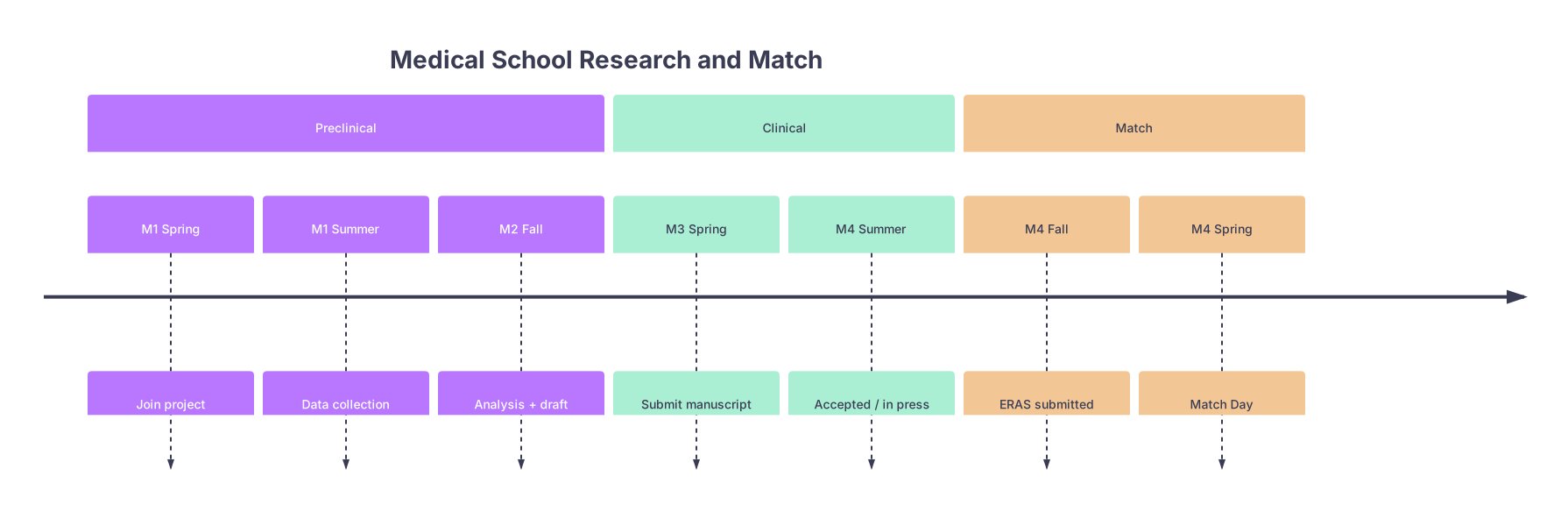
| Period | Event |
|---|---|
| Preclinical - M1 Spring | Join project |
| Preclinical - M1 Summer | Data collection |
| Preclinical - M2 Fall | Analysis + draft |
| Clinical - M3 Spring | Submit manuscript |
| Clinical - M4 Summer | Accepted / in press |
| Match - M4 Fall | ERAS submitted |
| Match - M4 Spring | Match Day |
You cannot cram a 2-year pipeline into 6 months before ERAS.
Signs you’re starting too late
- You first begin looking for research after Step 1
- You “plan to find a derm project” during M3 with 60–80 hr clinical weeks
- You figure you’ll do a research year after you realize your Step 2 is below averages
Can you match competitive specialties starting late? Occasionally yes, but usually at the cost of:
- A full research year or two
- Switching specialties last minute
- Accepting a weaker geographic or program-position match
Safer timing
You don’t need to be in a lab week one. But if you’re even thinking about a competitive specialty, your clock is:
- M1 Summer: Prime time to start at least one serious project
- M2: Critical year to produce actual outputs or at least have data ready
- M3: Harder to start from scratch; better for continuing and finishing what you began
If you’re already behind:
- Prioritize fastest path to output:
- Retrospective chart reviews
- Systematic reviews with experienced mentors
- Well-scoped case series with available data
Stop fantasizing about a big, multi-year prospective trial if you have 12 months to ERAS. That’s not a project; that’s a delusion.
Error #4: Picking Mentors for “Nice” Instead of “Effective”
This one stings, because you should work with kind people. But kindness without productivity can quietly wreck your specialty options.
I’ve watched students get stuck for 18+ months with:
- A beloved, sweet attending who never publishes
- A charismatic fellow who “has ideas” but no track record
- A brand-new faculty member who promises the world but has zero systems in place
You know how that ends?
You did a ton of work. They wrote nothing. Your name shows up nowhere.
Red flags your “mentor” is actually a research dead-end
- They can’t show you recent PubMed entries with med student co-authors
- They have 1–2 old publications, but nothing in the last 3–5 years
- They’re constantly saying, “Once I have time, we’ll finish this…” for months
- They’re chronically late responding, cancelling meetings, or “forgetting” details of the project
You don’t need a Nobel laureate. You need someone who ships work.
Simple mentor quality check
When you’re considering a new mentor, quickly check:
Do they have:
- At least 3–5 publications in the last 3 years?
- At least 1–2 papers with medical student or resident co-authors?
Ask senior students:
- “Who actually gets students on papers around here?”
- “Who should I avoid if I need something published by M4?”
During the first 1–2 meetings, ask:
- “What are reasonable timelines for outputs for students on your projects?”
- “Can I take first pass at writing to help move things faster?”
If they’re vague, defensive, or over-promise (“we can probably get 4–5 papers out of this by next summer”) — big red flag.
You’re not just choosing projects. You’re choosing who controls your timeline.
Error #5: Overcommitting and Underfinishing
The “CV bloat” problem.
Students collect projects like Pokémon, then finish almost nothing.
It looks ambitious in M2. It looks weak and scattered in M4.
What it looks like:
- “Involvement” with 6–8 projects
- Only 1–2 ever see daylight
- You can barely explain what you did on half of them
Program directors do not care that you were briefly “on” a fancy-sounding study. They care that you can:
- Start something
- See it through
- Produce something tangible
Why overcommitting kills your options
- You spread your limited time across too many half-done things
- You get a reputation (quietly) as someone who starts but doesn’t finish
- When you finally decide your specialty, you have no deep story — just scattered noise
For competitive fields, depth beats chaos. A PD would rather see:
- 2–3 cohesive, completed projects with clear roles
than - 7 half-baked lines on your ERAS “Research” section
Safer approach
Limit yourself.
- Active projects at any given time: 2–3 max
- New project rule: you cannot add another until you’ve:
- Submitted a manuscript, or
- Presented the work and handed off remaining tasks cleanly
And be ruthless about cutting losses:
- If a project has been stalled for 6+ months with no forward motion, schedule a frank talk:
- “What’s the realistic path to completion? Can we time-box this or shift roles so this actually gets written?”
If the answer is vague or clearly going nowhere — step back and reallocate your effort where it can actually produce something.
Error #6: Ignoring Specialty Culture and Expectations
Different specialties care about research in different ways. Acting like they’re all the same is lazy and dangerous.
Here’s the reality:
| Specialty | Typical Expectation | Red-Flag Situation |
|---|---|---|
| Dermatology | Multiple field-related pubs | Zero derm-related work |
| Orthopedics | Ortho outcomes/basic science | Only unrelated IM QI |
| Internal Med | Any solid clinical research | Absolutely no research |
| EM | Increasingly values research/QI | No projects or weak story |
| Psychiatry | Flexible but prefers psych/neuro work | Nothing patient-related at all |
And no, this doesn’t mean you must have X publications to match. But you do need to respect the pattern.
Common mismatch mistakes
- Wanting derm but having only:
- a single case report in geriatrics and
- some hospital QI about readmission rates
- Aiming for ortho with:
- 3 psych posters and
- a public health paper on vaping habits
This screams “last-minute specialty switch” or “unclear interest.” Programs notice.
How to align without locking yourself in too early
If you’re still deciding:
- Choose projects that keep several doors open, like:
- Pain management (anesthesia, PM&R, ortho, neuro)
- Oncology outcomes (IM, rad onc, heme/onc, surgery)
- Imaging-heavy topics (radiology, neuro, EM, surgery)
- Try to pair general research with at least one field-leaning project in any specialty that’s even a maybe
You’re not branding yourself at 21. You’re positioning your application so it doesn’t look random when you eventually choose.
Error #7: Completely Neglecting Basic Skills (Stats, Writing, Data Handling)
A lot of students treat research as “CV padding.” Programs treat it as an informal test:
- Can you handle data?
- Can you think in hypotheses?
- Can you write something coherently?
If your answer to all three is no, that bleeds into how you’re perceived as a future resident.
Common self-sabotage:
- You avoid learning even basic statistics
- You depend entirely on someone else to “do all the analysis”
- You have no idea how to:
- Clean data
- Generate a basic table or figure
- Write a methods or results section
You don’t need to be a biostatistician. But you can’t be helpless.
Minimal skill set that keeps doors open
By the end of med school, especially if you want a competitive field, you should at least:
- Understand:
- p-values, confidence intervals, common tests (t-test, chi-square, regression conceptually)
- Be able to:
- Use basic Excel/Sheets for cleaning small datasets
- Read a typical clinical paper and explain what they did
- Write a passable first draft of an introduction and discussion
If you treat research as something to “get credit for” without actually learning anything, that comes out in interviews. And PDs read right through it.
Error #8: No Coherent Narrative Tying Research to Your Specialty Choice
Last big one. But it’s lethal.
You did some research. Maybe quite a bit. On paper, it looks… scattered. In person, you explain it poorly.
You say you’re passionate about neurosurgery. Your CV says:
- Global health in maternal mortality
- A cardiology outcomes poster
- An H&P teaching curriculum project
- A single neurosurgery shadowing week
That’s dissonant. Interviewers notice.
Your research does not have to be perfectly linear, but it needs to support your story, not contradict it.
How this hurts you
- Personal statements feel strained: “My long-standing interest in ortho…” (with no ortho anything)
- Interview answers fall flat:
- “So tell me how your research led you here?”
- [You talk about some random nephrology project for 5 minutes]
It gives the impression that you either:
- Chose your specialty late for superficial reasons, or
- Are just saying what you think they want to hear
How to fix (or at least soften) a scattered record
Identify a theme that can reasonably connect your projects:
- “I’ve consistently been interested in how disease impacts function and quality of life…” (could link IM, rehab, ortho)
- “Across my projects, I’ve gravitated to work with procedural components…” (can connect IM procedures, EM, surgery)
Practice clear, honest explanations:
- “Early on, I explored X, then realized I was more drawn to Y, which led me to my later projects in [specialty].”
Add at least one or two specialty-specific projects as soon as you commit:
- Even a smaller, fast-turnaround project in your chosen field helps anchor your narrative.
Your goal is not to pretend you had a perfect, predestined path. It’s to show a believable evolution toward your chosen specialty, backed by some aligned work.
Quick Reality Check: Are You Quietly Limiting Your Options?
If you’re not sure whether your research choices are closing doors, ask yourself — today — these questions:
- Do I have any research in or near the specialty I’m leaning toward?
- Have I finished at least one project to full publication or serious submission?
- Am I currently on 2–3 max active projects, or am I spread across a dozen?
- Can I name one mentor who has successfully gotten students published in the last 2–3 years?
- Could I explain in an interview, in 2–3 minutes, how my research connects to my specialty choice?
If you’re answering “no” to most of these, your research strategy isn’t just suboptimal. It is actively limiting your future options.
Fix it now. While you still can.
Final Takeaways
- Do not treat “any research” as good enough if you’re even considering a competitive specialty. Field-aligned or adjacent work matters.
- Prioritize finishing a few solid, mentor-backed projects over collecting endless low-yield posters. Depth and completion beat scattered noise.
- Choose mentors, timelines, and projects that give you real outputs and a coherent story that actually supports your chosen specialty — not one that undermines it.