
Some specialties do not “guide” you to decide early. They recruit you. Aggressively. And it’s not for the reasons they tell you on the tour.
Let me tell you what actually happens behind the doors you never see.
The Recruitment Game You Don’t Know You’re In
There’s a quiet arms race happening between specialties and between programs. You feel it as “advice,” “mentorship,” and “opportunities.” They experience it as “pipeline management,” “workforce planning,” and “protecting our applicant pool.”
On your side of the curtain, it looks like this:
- You’re an M1 or M2. A charismatic surgeon or radiologist tells you, “If you’re even thinking about this specialty, you really need to get involved early.”
- You hear, “It’s super competitive, you basically need research and mentorship by first year if you want a shot.”
- You watch your classmates quietly “commit” to a path before they’ve even finished their core clerkships.
On the other side of the curtain, behind closed doors in faculty meetings, it sounds different:
- “We need to lock in our own students before they get poached by derm or radiology.”
- “We’re losing too many strong applicants to ortho; we need to start recruiting earlier.”
- “If they haven’t started with us by M2, statistically we’re not going to land them.”
They’re not all villains. Many genuinely want to mentor you. But do not mistake this: in some specialties, you’re being treated like talent to be captured early, not a learner who deserves time to explore.
And some of you are saying yes to a long career based on a carefully groomed illusion.
Why Certain Specialties Push Early: The Real Motives
Let’s get blunt. Different specialties push early for different reasons, but the patterns are pretty consistent.
1. They’re Afraid of Losing You to “Hotter” Fields
Programs know the hierarchy of fantasy specialties in students’ heads: dermatology, plastics, orthopedics, interventional cards, radiology. They also know which rotations come later and might “steal” you.
So they try to get their hooks in before that happens.
I’ve sat in a meeting where a surgical program director literally said: “If we don’t get face time with them before third year, anesthesia will scoop them up once they see their lifestyle.” No metaphor. No subtlety.
Specialties that push early tend to be:
- Historically competitive (ortho, derm, plastics, ENT, neurosurg)
- Lifestyle-sensitive but procedurally cool (rads, anesthesia, EM used to be here more)
- Or terrified of applicant shortages (family med, primary care, some pathology programs)
But the frequency and intensity of the “decide early” message isn’t really driven by what’s best for you. It’s driven by how threatened they feel by competing specialties and how insecure they are about their pipeline.
2. Their Application Expectations Are Unrealistic for a Late Decider
Here’s the unspoken math. For some specialties, if you truly start from zero interest in late M3, you’re behind. Not because you’re incapable. Because their process is built for early adopters.
| Specialty | Typical Early Push Starts | Why They Push Early |
|---|---|---|
| Dermatology | M1 fall–M2 | Heavy research, few spots, protect pipeline |
| Orthopedics | M1–M2 | Home program loyalty, research, letters |
| Neurosurgery | M1 | 7-year programs, need “commitment” |
| Plastic Surgery | M1–M2 | Integrated programs, research expectations |
| ENT | M1–M2 | Limited spots, research, faculty familiarity |
Why they want you early:
- Research expectations that realistically take 1–2 years to produce anything meaningful.
- Letter writers who want to say “I’ve known this student since M1 and they’ve shown consistent dedication.”
- Home programs that heavily favor “known quantities” who’ve hung around since pre-clinicals.
- Integrated programs (like plastics) that basically demand early lock-in.
Do you need to start that early to be a good physician in that field? No. But do they structure their expectations like you should have? Absolutely.
So rather than admit, “We’ve built a needlessly front-loaded system that disadvantages late bloomers,” they flip it and tell you, “If you’re serious, you need to decide early.”
3. They Want Cheap, Motivated Labor and Easy CV Fodder
The “come join our specialty interest group and we’ll plug you into research” line? Often code for “we need people to crank out data, chart review, and recruitment for our projects.”
You think:
“They believed in me early and gave me a chance.”
They think:
“We have a few hungry M1s who’ll handle the grunt work for this multicenter study and maybe one of them will stick around to match into our program.”
That doesn’t mean it’s bad for you. You get experience, a mentor, maybe a poster or a pub. It can be a fair trade.
The problem is when that early research and mentorship slowly becomes psychological glue that keeps you in a specialty you’re not actually sure about. You’ll tell yourself:
- “I’ve already invested 2 years of work with this department.”
- “My best letters will come from this field.”
- “I don’t want to disappoint Dr. X; they really went to bat for me.”
That’s how sunk-cost bias and loyalty get weaponized against your own uncertainty.
4. They’re Playing a Long-Game Branding Strategy
Some departments run their med student pipeline like a college recruiting operation.
I’ve seen:
- Formal spreadsheets tracking M1–M2 “prospects”
- Phrases like “high-yield student” and “flight risk to derm”
- Faculty assigned to “cultivate” specific students
You think you’re just “grabbing coffee with a mentor.” Behind the scenes, you may literally be on a list discussed at quarterly “education meetings.”
In some specialties, especially the brand-conscious ones (plastics, dermatology, ortho, neurosurg), there’s also status involved:
- “Our students are competitive for top programs.”
- “We regularly place people at [Elite Institution].”
- “We run a robust early mentorship program.”
You become a data point in their success slide deck. That’s not evil. But don’t pretend it’s purely altruistic.
5. They Need to Justify Their Existence to the Institution
Unpopular truth: Some departments push early not because their specialty is so competitive, but because they as a department are insecure.
Low-volume programs or smaller specialties (pathology, PM&R at some places, certain surgical subspecialties) know that if they don’t actively “sell” their field, they’ll be ignored.
So they:
- Schedule lunch talks early in M1
- Run “skills workshops” designed to impress you
- Offer “exclusive” shadowing or skills labs to first and second years
Again, that can be good exposure. But realize what’s driving it: they need bodies and interest to justify faculty lines, resident spots, and budget. They aren’t just nurturing your curiosity. They’re protecting their department.
How This Pressure Actually Warps Your Decision-Making
The real damage isn’t that people are talking to you early. That can be good.
The damage comes when the system rewards early apparent commitment more than actual informed choice.
You Start Confusing Access With Destiny
You’ll see this over and over:
- The student who got early derm research assumes, “I’m a derm person now,” even if they loved inpatient medicine.
- The M1 who found an ortho mentor first concludes, “I belong in ortho,” long before they’ve done surgery, anesthesia, EM, or IM.
- The student who spent two summers in neurosurg research can’t admit they hate the lifestyle after their sub-I, because their whole CV points in one direction.
You confuse “this is where I got an opportunity early” with “this is what I’m meant to do.”
Different thing. Very different.
You Overweight Mentors’ Opinions and Underweight Your Daily Reality
Faculty who like you will start saying things like:
- “You’d be a great radiologist. You have the right brain for this.”
- “You’re too smart for primary care.”
- “You’re definitely competitive for our field. Don’t sell yourself short.”
You start to internalize their narrative about you. Meanwhile, your own lived experience on rotations—what days feel good, what drains you, what patient interactions stick with you—gets shoved into the background.
I’ve watched students openly miserable on a surgical clerkship cling to an early “identity” as a surgeon because a big-name faculty member told them they had “surgeon hands” and “the temperament for the OR.”
They heard validation. I heard possession.
You Underestimate How Long a Career Actually Is
Specialties that push early implicitly frame the decision as a big cliff: if you don’t jump now, you’ll never have this chance again.
Reality: there are more back doors, fellowships, and lateral moves in medicine than they tell you.
Do some doors close if you don’t play the early game? Sure. Integrated plastics from nothing as a late M3? That’s rough.
But tying yourself to something you’re ambivalent about because “I’ll lose my shot” is exactly how people end up bitter, burned out, and trapped.
Most attendings who are honest will tell you: the joy or misery of your day-to-day life has less to do with the prestige of your specialty and more to do with how compatible it is with your personality, tolerance for chaos, and need for control/autonomy.
That’s the calculation you should be rushing toward. Not the CV arms race.
Who Actually Needs to Decide Early (and Who Really Doesn’t)
Let me cut through the noise. There are only a few scenarios where early leaning is truly helpful or practically necessary.
Specialties Where Early Matters for Logistics
These fields usually benefit from early thinking because of research expectations, program durations, or competition level:
- Dermatology
- Integrated Plastic Surgery
- Neurosurgery
- Orthopedics
- ENT
- Sometimes IR, radiation oncology, and very high-tier rads or competitive surgical subspecialties
Not “you must sign blood in M1.” But you probably want:
- Some research started by early M2
- Visible involvement in the department
- Relationships with potential letter writers
But even in these fields, the truth is: a strong M3 who goes all-in, especially at a home program with supportive faculty, can still make it work. You just don’t hear those stories as loudly.
Specialties Where Early Is Mostly About Ego and Pipeline
There are specialties that push early not because of hard logistical constraints, but because they want mindshare, identity, and security:
- Many internal medicine subspecialties (cards, GI, heme/onc) recruiting you to IM early
- Fields anxious about future applicant pools (EM post-burnout era, some psychiatry programs)
- Certain departments with insecurity around prestige who want to brand themselves as “selective”
For these, early exposure is fine. Early decision is unnecessary.
You can explore, join interest groups, do a project, and still keep your flexibility. Their panic about “pipeline” does not need to be your problem in M1.
Specialties Where Early Is Purely Optional
For a lot of careers, your most important decisions can wait until after you’ve seen the real thing:
- Internal medicine (categorical)
- Pediatrics
- Family medicine
- Psychiatry (at most places)
- Neurology
- Pathology at many programs
- PM&R at many places
- Most community-level rads and anesthesia gigs
Will early exposure help you get better letters or a couple of extra projects? Sure.
Will deciding as an M3 instead of an M1 actually harm your future happiness or competitiveness in any real way? For most of these, not significantly—especially if you’re generally a solid student.
How to Use Early Exposure Without Getting Trapped
You don’t need to reject early mentorship to maintain your freedom. You just need to be more tactical than most students are taught to be.
Treat Every Early Opportunity as a Rotation Preview, Not a Contract
Work with that derm mentor. Join the ortho research project. Shadow the neuroradiologist. Just keep a quiet rule for yourself:
“I’m collecting data, not pledging allegiance.”
Ask real questions. Watch the attendings between cases or between patients. Look at how tired they are at 3 a.m. or 4 p.m. Listen to how they talk about their work when they think you’re not listening closely.
The subtext matters more than the sales pitch.
Protect at Least One Year of Genuine Ambivalence
The students who choose best usually give themselves at least some protected time when they’re allowed to be honestly unsure.
That might look like:
- M1–early M3: “I’m honestly exploring. I’ll show up fully wherever I am, but I’m not committing yet.”
- Mid M3: “Now I’m allowed to narrow down in a deliberate way.”
- Late M3–early M4: “Now I run the actual strategy for one or two realistic plans.”
The mistake is feeling obligated to have a one-word answer for “What specialty are you going into?” in M1–M2. You can just say, “I’m interested in a few things and waiting until after rotations to really decide.” That sounds weak to insecure people. To mature clinicians, it sounds sane.
When a Mentor Starts Pushing, Ask Yourself Who Benefits
You’ll feel it when the conversation shifts from mentor to recruiter.
Phrases to watch:
- “You should really lock this in soon.”
- “If you want this, you need to show unwavering commitment.”
- “Exploring other fields may send the wrong message.”
That’s not mentorship. That’s control.
You can respect their time and investment without surrendering your autonomy. You do not owe any faculty member your specialty choice as a form of gratitude.
If you decide to switch, you can say:
“I’ve really appreciated everything you’ve done for me. After experiencing my other rotations, I realized I’m better suited for X. I wanted to be honest with you and also thank you for the mentorship—it genuinely shaped how I think, even if I’m going a different direction.”
Anyone who responds to that with anger or guilt-tripping is confirming you made the right call.
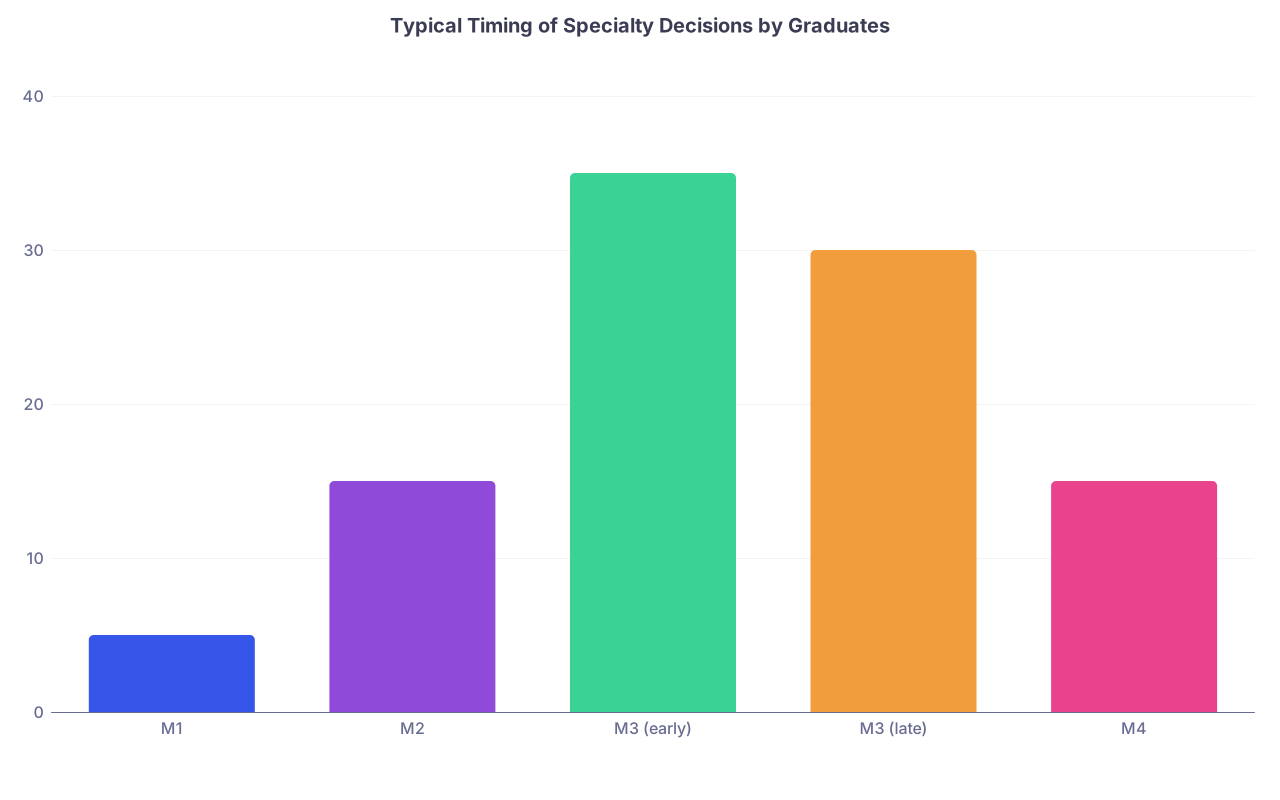
| Category | Value |
|---|---|
| M1 | 5 |
| M2 | 15 |
| M3 (early) | 35 |
| M3 (late) | 30 |
| M4 | 15 |
Most grads don’t truly commit in M1–M2. The system just makes you feel like everyone else has.
A Simple Framework: What You Should Actually Be Optimizing For
Instead of “What specialty wants me to decide early?”, you should quietly run a different filter.
You’re looking for:
- Work patterns that don’t grind you down: acute vs chronic, fast-twitch vs slow-twitch, inpatient vs outpatient.
- Emotional exposure you can live with: death, uncertainty, constant family discussions vs procedural focus and less relationship continuity.
- Control of your time: call patterns, nights/weekends, unpredictability you can actually tolerate.
- How much of your identity you want tied to your job.
The early-pushing specialties are very good at drowning out those questions with “opportunity,” “prestige,” and “competitiveness.”
The smartest students I’ve seen used the early exposure, took the research, milked the mentorship—and still walked away when their body on rotations told them, “No.”
They matched well anyway. Often better. Because they were finally aligned with something that fit them, not something that claimed them first.

| Step | Description |
|---|---|
| Step 1 | Early Exposure M1-M2 |
| Step 2 | Stay Open & Explore Others |
| Step 3 | Deeper Involvement & Research |
| Step 4 | M3 Core Rotations |
| Step 5 | Commit & Strategize |
| Step 6 | Reassess & Pivot |
| Step 7 | Interest Growing? |
| Step 8 | Daily Work Feels Right? |
This is the flow you want. Not the reverse, where you commit first and then try to rationalize every bad feeling away.
The Quiet Truth: Faculty Know This Is Messed Up
Here’s one more thing they won’t say in the info session.
A lot of attendings hate how early and performative specialty choice has become. I’ve heard:
- “We’re rewarding certainty over wisdom.”
- “I worry we’re selecting for brand-chasers rather than people who actually like the work.”
- “Half the students who commit in M1–M2 are really just scared of not matching.”
But they keep playing the game because:
- Programs feel competing forces—if they slow down, rivals won’t.
- Chairs want their match lists to look shiny.
- Nobody wants to be the first to relax expectations and risk weaker applicant numbers on paper.
So they keep nudging you to choose early, while privately admitting to each other that the entire system is warped.
You don’t control the system. But you do control how much you let it colonize your mind.