
Acute Care vs Longitudinal Care: Matching Your Brain to Specialty Style
Most students choose specialties based on vibe, prestige, or what their last attending told them they would be “great at.” That is backwards. You should start with this: how your brain likes to work in acute care vs longitudinal care.
Let me be blunt. If you mismatch your cognitive style with your specialty’s tempo, you can still “succeed” on paper. But you will be quietly miserable. Burned out not because medicine is hard (it is) but because you picked the wrong kind of hard.
This is the distinction you’re actually wrestling with when you say things like:
- “I like the ED but hate clinic.”
- “I enjoy complex ICU physiology but rounding all day drains me.”
- “I love following my patients for years, but codes make me freeze.”
You are talking about style of care: acute vs longitudinal. So let’s dissect this like an exam stem.
Core Difference: How Time Moves Around the Patient
At the simplest level:
- Acute care: Short timelines, high-intensity decisions, rapid feedback.
- Longitudinal care: Long timelines, lower-intensity decisions per encounter, delayed feedback.
Now let me make that concrete.
In acute care (ED, ICU, anesthesia, trauma surgery, hospitalist on acute floors), your brain lives in:
- Present tense: “What is going to kill this person in the next minutes–hours?”
- Narrow focus: Stabilize, rule out the big bad stuff, safely disposition.
- Rapid pattern recognition: You do not have all the data. You move anyway.
In longitudinal care (outpatient IM, family medicine, endocrine, rheum, pediatrics clinic, many psych practices), your brain lives in:
- Long arcs: “What will this person’s life and health look like in 5–10 years?”
- Broad context: Family, social determinants, habits, comorbidities.
- Iterative refinement: You rarely fix everything now. You nudge, re-evaluate, repeat.
The trap: most students only experience these as “rotations I liked or hated” without understanding why. That is where people make bad specialty decisions.
Let me show you the pattern beneath your preferences.
How Different Brains Thrive in Acute vs Longitudinal Care
You are not a blank slate. You already have a cognitive style. On rotations, you probably noticed something like this.
The “Acute Care Brain”
This is the student who:
- Perks up when a trauma alert is called, even at 3 a.m.
- Feels more comfortable in the first 10 minutes of a workup than in a 2-year diabetes management plan.
- Gets bored with long, slow, stable patients but finds crashing patients oddly focusing.
- Will check vitals, mental status, airway reflexes before opening the EMR.
Internally, their thought process is:
- “What is the worst-case scenario and how fast do I need to move?”
- “What can I rule out or fix in the next hour?”
- “Do I need to escalate, consult, or transport?”
Concrete example: An ED patient with chest pain.
Acute-care brain runs:
- “ACS, PE, dissection, tension pneumo, tamponade: which can kill them now? Start with vitals, EKG, bedside US, trops, CXR, aspirin, nitro if appropriate. Do they look sick?”
They accept that:
- They will not fully “complete” the story.
- They will probably never see this patient again.
- Their job is risk stratification and safe disposition.
If this feels natural and satisfying, that matters.
The “Longitudinal Care Brain”
This is the student who:
- Loves continuity clinic and can recall patients’ children’s names.
- Enjoys medication titration, chronic disease algorithms, and tracking changes visit-to-visit.
- Finds one-off ED consults frustrating because “I just met them and now they’re gone.”
- Actually likes med reconciliation and life planning.
Internally, their thought process is:
- “What matters for this patient over the next decade?”
- “How do we align treatment with their life, values, and resources?”
- “What is realistic adherence for this person?”
Same chest pain patient, seen in outpatient clinic.
Longitudinal-care brain runs:
- “We have ruled out ACS/PE recently; this is probably GERD/musculoskeletal. But zoom out: uncontrolled lipids, smoking, obesity, sedentary lifestyle. Their 10-year risk is awful. How do we modify that over time, given their job, stress, and health literacy?”
They get satisfaction from:
- Seeing A1c drop over a year.
- Watching a teenager with asthma become an adult who self-manages.
- Advancing life goals, not just surviving today.
If this is where you light up, listen to that.
Where Specialties Actually Sit on the Acute–Longitudinal Spectrum
Stop thinking in boxes like “surgery vs medicine.” This is the more useful map.
| Specialty / Setting | Primary Style |
|---|---|
| Emergency Medicine | Strongly Acute |
| Anesthesiology | Strongly Acute |
| Critical Care (ICU) | Acute-leaning |
| Trauma / Acute Care Surgery | Strongly Acute |
| Hospitalist Medicine | Mixed, acute |
| Outpatient Internal Med | Longitudinal |
| Family Medicine Clinic | Strongly Long |
| Outpatient Pediatrics | Longitudinal |
| Endocrinology/Rheum/ID OP | Longitudinal |
| Outpatient Psychiatry | Strongly Long |
Is this table perfect? No. But it is better than how most people classify these fields.
Now, some nuance.
Mixed-Mode Specialties (Where Students Get Confused)
Certain specialties look acute from afar but are actually bimodal.
Obstetrics & Gynecology
- OB triage, L&D, emergency C-sections → acute.
- Prenatal care, infertility, menopausal management → longitudinal. If you only loved the OR and deliveries, but hated prenatal clinic, pure OB/GYN might grind you down. Conversely, if you adored continuity with pregnant patients but dreaded 3 a.m. sections, think about outpatient-heavy practice or related fields (MFM, REI, or even FM-OB).
Cardiology
- Cath lab, STEMI calls, CCU → acute.
- CHF clinic, primary prevention, lipid management → longitudinal. The outward “sexy” part (caths, codes) is a sliver of many jobs. The bulk is long-term risk modification in clinic. Your brain needs to be able to tolerate both.
General Surgery
- Acute: emergency chole, trauma, perforated viscus.
- Longitudinal: cancer follow-up, bariatric weight-loss trajectories, hernia recurrences. Some surgeons enjoy clinic; others endure it. On your rotations, pay close attention to how you feel on clinic days versus OR days.
Psychiatry
- Mostly longitudinal in outpatient and many inpatient settings.
- But: acute stabilization in psych ED, inpatient crisis units. If you only enjoyed emergent psych consults and hated slow med titrations and therapy, pure outpatient psych will feel too slow.
Pediatrics
- Outpatient well-child checks: highly longitudinal.
- NICU, PICU: highly acute. You can land almost anywhere on the spectrum inside pediatrics. So “I like kids” is not enough.
How Your Brain Handles Time, Uncertainty, and Closure
This is where it gets real. Ignore lifestyle memes for a moment. Focus on how your brain behaves under three specific conditions.
1. Relationship to Time Pressure
In acute care, time pressure is the defining feature.
You will:
- Make decisions with incomplete information.
- Act before having perfect imaging or labs.
- Have to tolerate the feeling of “this might be wrong, but waiting is worse.”
Some people’s cognition sharpens under that. They can triage their own thinking:
- What is immediately dangerous?
- What can wait 30 minutes?
- What can be pushed to outpatient?
Others freeze. Or they become compulsive test-orderers to soothe their anxiety. That is a problem in the ED or ICU, where time and resources matter.
In longitudinal care, the time pressure per decision is low, but the time span is long.
- You can read guidelines after clinic to refine your plan next time.
- You iterate: adjust meds, check labs next visit, reassess.
If the idea of constantly “rushing” and prioritizing under fire exhausts you, your brain may prefer the longer, slower cognitive loops.
2. Tolerance for Unfinished Stories
Acute care means incomplete arcs.
You stabilize the GI bleed in the ED. They go upstairs. You do not see them again. You intubate, resuscitate, and pass off. Months later, you might see their name scroll by in the obituary section. That is it.
Some brains find that freeing: “I did my job in my part of the chain. Next.”
Others find it deeply unsatisfying. They want to know:
- Did that new antidepressant actually help?
- How did the patient handle the cancer diagnosis over months?
- Did the bariatric surgery change their life?
If you have a compulsive need for narrative closure, be very wary of fields where you rarely see long-term outcomes.
Longitudinal care lets you:
- See the arc.
- Build the story across years.
- Watch your plans succeed or fail in real life.
But that also means you must tolerate chronic, unresolved problems. You will not “fix” most of your panel. You will live in imperfection for decades.
3. Cognitive Load and Multitasking Style
Acute care days: lots of tasks, short interactions, constant switching.
- 12+ patients in the ED, some crashing, some waiting on imaging.
- ICU with six vented patients, multiple drips, family meetings nestled between codes.
Your brain needs to handle:
- Rapid context switching.
- Remembering pending items.
- Making quick, approximate decisions.
Longitudinal clinic:
- Fewer patients at once (though often fully booked).
- Each visit involves a broad cognitive sweep:
- Preventive care
- Chronic conditions
- New complaint
- Psychosocial context
- But much less minute-by-minute crisis.
Some students find the sustained, broad focus of a 30-minute complex outpatient visit more mentally draining than three quick ED patients. Others are the exact opposite.
Be honest about your cognitive stamina profile.
Rotations as a Testing Ground: What To Watch For
Most students passively experience rotations and then later try to remember what they liked. That is a mistake. You should be actively collecting data on your brain.
Use this mental checklist on each rotation:
At 4 p.m., how do you feel?
- ED or ICU day: Are you tired but wired, or completely cooked and snappy?
- Clinic day: Are you mentally drained by the constant “holistic” thinking, or do you feel pleasantly tired?
What kind of patient encounter re-energizes you mid-day?
- Acute-care brain: “The rapid sepsis workup patient woke me up.”
- Longitudinal brain: “The follow-up for hypertension where we reviewed home BPs and lifestyle changes made me feel like this is what medicine should be.”
What kind of cognitive work do you procrastinate?
- In ED: Do you put off disposition thinking because it is tedious?
- In clinic: Do you drag your feet on preventive care and long-term counseling, but love acute complaints?
Which environments bring out your best thinking under stress?
- Rapid code? Hospital fire drill? You feel strangely calm?
- Or do you excel most when you have time to think, chart, and plan?
You do not need a formal scoring system, but you do need a pattern.
Exam Style vs Real-World Cognitive Style
Here is where people get tripped up by Step exams.
Board exams are designed primarily for:
- Longitudinal reasoning: chronic disease algorithms, guideline-based management.
- Clean, fully specified problems with “one best answer.”
That skews students’ self-concept:
- “I am good at medicine because I score high on tests.”
- Then they hit the ED, and the grainy CT, and the unclear history, and they do not enjoy the ambiguity.
The exam brain:
- Likes closed-book, complete-information, algorithmic reasoning.
The acute-care brain in practice:
- Needs to operationalize “sick vs not sick” with missing data and time pressure.
So do this sanity check:
- Did you enjoy the feel of the ED/ICU rotation even if the cognitive content felt messier than UWorld questions?
- Or were you only comfortable when cases looked like NBME stems?
If you are addicted to complete information and clean closure, pure acute care will feel cognitively abrasive day after day.
On the flip side, if you found yourself internally rolling your eyes at the 15th question about CAP antibiotic regimens but you loved hands-on rapid decision-making, do not let your Step score drag you into a purely longitudinal field you will resent.
How Different Specialties Structure Time and Relationships
Let me map out a few representative specialties through this acute–longitudinal lens. Not the brochure version. The actual cognitive workflow.
Emergency Medicine
- Style: Strongly acute, episodic, shift-based.
- Time: Minutes–hours per patient.
- Relationship: One encounter, maybe two.
Daily cognitive tasks:
- Snap triage of complaint severity.
- Quick pattern recognition: who is septic, who is anxious, who is both.
- Decide on tests that change today’s management, not everything that could ever be wrong.
If you need depth, continuity, and closure on each story, EM will itch. If you thrive on “putting out fires” and moving on, this may be home.
Inpatient Hospitalist
- Style: Acute-leaning, but with short arcs (days–week).
- Time: Hours–days–week.
- Relationship: You may see them daily for a week, then never again.
Cognition:
- Synthesize new data every day.
- Manage evolving conditions (CHF exacerbation, COPD flare).
- Coordinate with consultants and plan disposition.
Good for brains that:
- Enjoy dynamic problems over a few days.
- Like the pace of wards rounds but not the whiplash chaos of ED.
- Still accept incomplete long-term arcs.
Outpatient Internal Medicine / Family Medicine
- Style: Strongly longitudinal.
- Time: Months–years.
- Relationship: Panel-based; you know “your” patients.
Cognition:
- Big-picture risk management.
- Balancing guideline recommendations with messy reality.
- Iterative problem-solving with lots of psychosocial variables.
If you wrote in your third-year reflection that the most meaningful moment was watching a diabetic patient trust you enough to start insulin after months of work, your brain is probably wired for this.
If that sentence makes you fall asleep, it is not.
Anesthesiology
- Style: Acute, bounded episodes.
- Time: Minutes–hours per case.
- Relationship: One encounter per surgery.
Cognition:
- Front-loaded planning (airway, comorbidities, expected blood loss).
- High-intensity vigilance during induction and emergence.
- Quiet monitoring during the middle, with readiness to pounce.
Feels good to:
- People who enjoy physiology, numbers, immediate cause-and-effect.
- Those who like intense focus followed by short recovery intervals.
Does not feel good to:
- Anyone who is deeply relational and needs longitudinal continuity to feel satisfied.
Outpatient Psychiatry
- Style: Strongly longitudinal; slow arcs.
- Time: Weeks–years per treatment plan.
- Relationship: Deep, repeated interactions.
Cognition:
- Complex, nuanced formulation.
- Tracking subtle changes over long time frames.
- Managing uncertainty: is this med helping, is this therapy working?
If your favorite parts of rotations were long, honest conversations and slow trust-building, this fits. If you are suffocating by visit 5 with the same patient and the same story, you will not thrive here.
Practical Framework: Matching Your Brain to Specialty Style
Let me give you a concrete way to think about this. Imagine two scales:
Preferred Time Horizon of Impact
- Short (minutes–days): acute care.
- Medium (days–weeks): inpatient medicine/surgery.
- Long (months–years): outpatient, chronic care fields.
Need for Relational Continuity
- Low: You are satisfied doing excellent technical care with minimal long-term relationship.
- High: You feel empty without deep, ongoing therapeutic relationships.
Plot yourself honestly.
Then overlay a third variable: Stress Response Style Under Uncertainty
- You sharpen and prioritize under time pressure.
- You spiral, overthink, or emotionally shut down under time pressure.
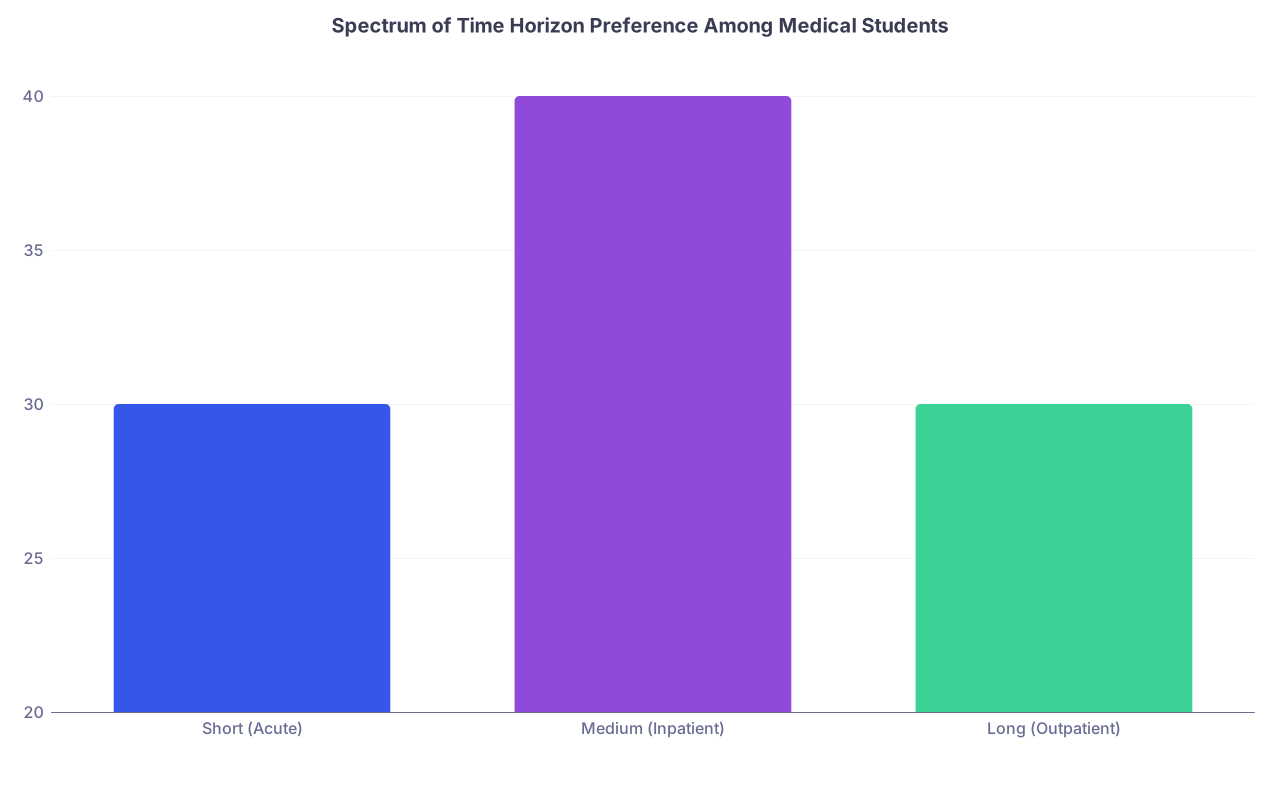
| Category | Value |
|---|---|
| Short (Acute) | 30 |
| Medium (Inpatient) | 40 |
| Long (Outpatient) | 30 |
This is not a personality quiz for fun. This is career triage.
If you write:
- Time horizon: short.
- Relational continuity: low.
- Stress response: sharpens under pressure.
You should at least give serious, non-romanticized consideration to:
- EM, anesthesia, ICU, trauma/acute care surgery.
If you write:
- Time horizon: long.
- Relational continuity: high.
- Stress response: better with time to think.
Your short list should center around:
- Outpatient IM/FM, outpatient peds, outpatient psych, endocrine, rheum, heme/onc (clinic-heavy), geriatrics.
There are many hybrid paths (cardiology, GI, pulm, OB/GYN). But going against your core pattern just because a field is “competitive” or “prestigious” is how you end up that attending everyone knows is technically excellent and quietly miserable.
A Simple Flow to Sanity-Check Your Choice
Use this as a mental decision tree, not a rigid algorithm.

| Step | Description |
|---|---|
| Step 1 | Start: Reflect on rotations |
| Step 2 | Consider EM, Anesthesia, ICU, Trauma |
| Step 3 | Consider Hospitalist, Inpatient-focused IM/Surgery |
| Step 4 | Consider Outpatient IM/FM, Peds, Psych, Subspecialty Clinics |
| Step 5 | Hybrid fields: Cardio, GI, Pulm with both acute and clinic |
| Step 6 | Primarily acute careers fit |
| Step 7 | Hybrid outpatient + inpatient model |
| Step 8 | Purely outpatient, low-acuity focus |
| Step 9 | Prefer time horizon |
| Step 10 | Need strong continuity? |
| Step 11 | Tolerate acute crises? |
Walk yourself through this at least once before locking in your specialty choice.
What To Do If You Are Genuinely Split
Some of you will read this and say, “I genuinely like both. I liked the ED and clinic. Now what?”
Good. That gives you flexibility. Your job is to understand which you want to be the core of your identity and which you are satisfied having as a smaller piece.
Real options for “both-brain” people:
- Internal Medicine or Family Medicine, then:
- Do a mix of inpatient and outpatient.
- Add urgent care or moonlighting in ED-like settings.
- Pediatrics:
- Mix general peds clinic with NICU/PICU time.
- OB/GYN:
- You will inherently mix acute (L&D, OR) with longitudinal (prenatal, GYN clinic).
- Combined or hybrid programs:
- Med-Peds: lets you do acute/inpatient and outpatient across age ranges.
- EM/IM or EM/FM combined residencies if you truly want both shift-based acute work and long-term panel care.
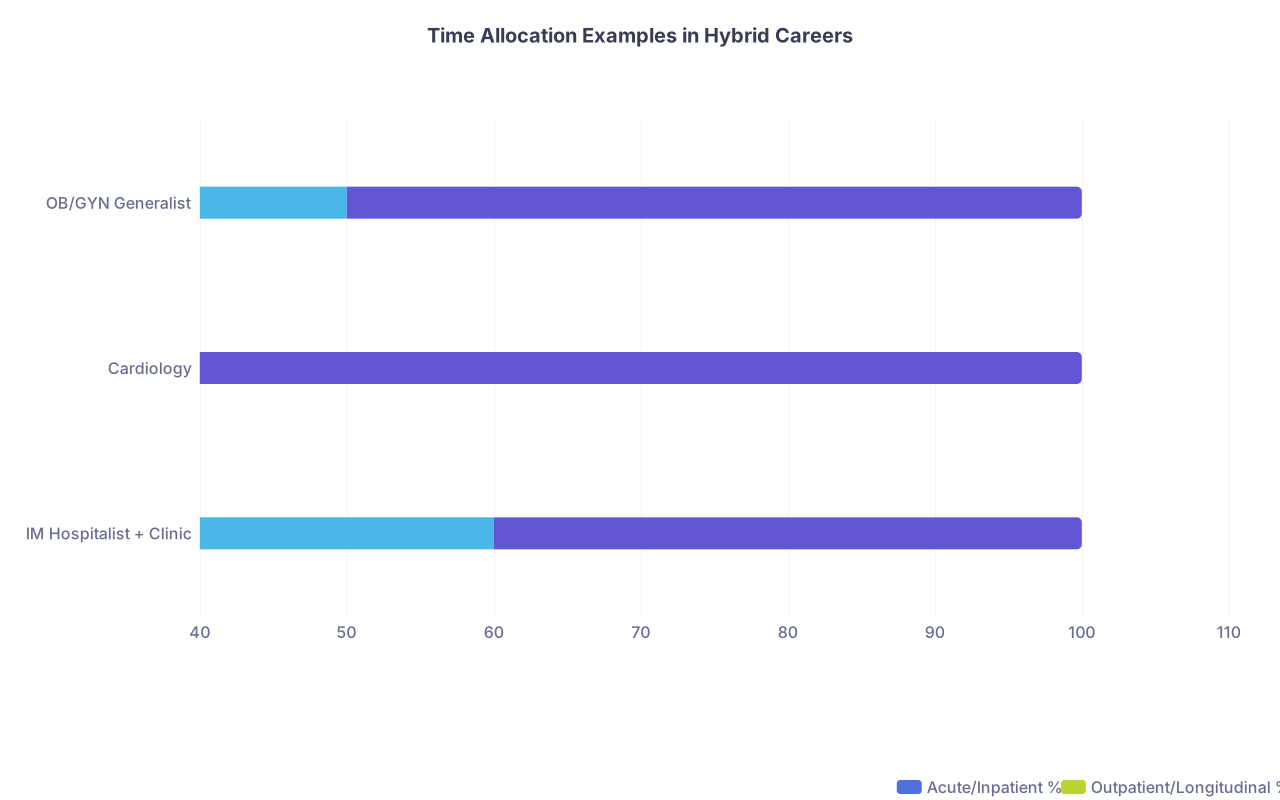
| Category | Acute/Inpatient % | Outpatient/Longitudinal % |
|---|---|---|
| IM Hospitalist + Clinic | 60 | 40 |
| Cardiology | 40 | 60 |
| OB/GYN Generalist | 50 | 50 |
The mistake is pretending you are a “both-brain” person when actually the acute shifts drain you to the bone or the clinic days make you want to quit medicine. Your body and your mood after each type of day are better data than your CV.
Two Concrete Exercises You Should Actually Do
You do not need a 50-page career workbook. You need focused, honest reflection.
Exercise 1: The 10-Shift / 10-Clinic Log
During third year (or early fourth), for 10 ED/ICU shifts and 10 clinic days, after each one jot down:
- Energy level at start vs end (0–10).
- One moment that felt “this is why I like medicine.”
- One moment that felt “I could not do this forever.”
At the end, do not overthink it. Just count:
- On which type of day did you write more positive moments?
- On which type did you describe stress that felt good vs stress that felt corrosive?
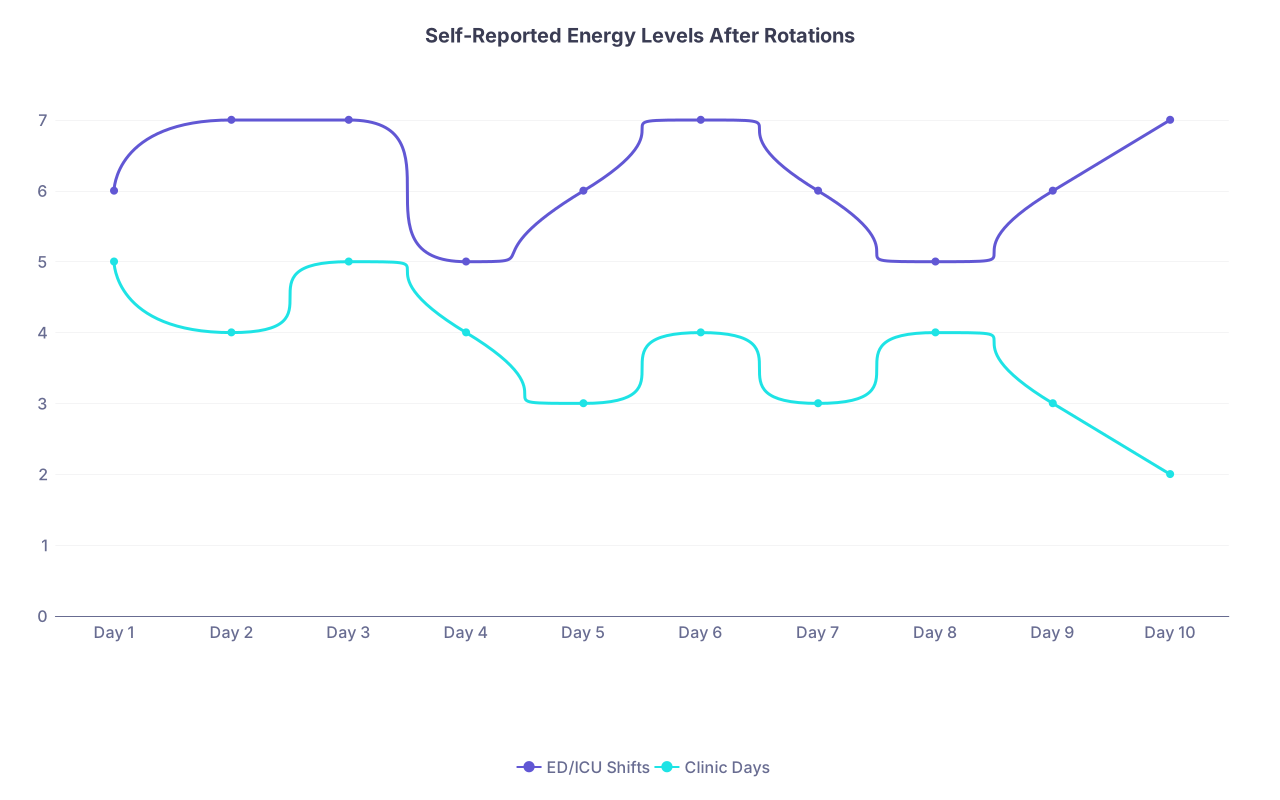
| Category | ED/ICU Shifts | Clinic Days |
|---|---|---|
| Day 1 | 6 | 5 |
| Day 2 | 7 | 4 |
| Day 3 | 7 | 5 |
| Day 4 | 5 | 4 |
| Day 5 | 6 | 3 |
| Day 6 | 7 | 4 |
| Day 7 | 6 | 3 |
| Day 8 | 5 | 4 |
| Day 9 | 6 | 3 |
| Day 10 | 7 | 2 |
This dumb-looking graph, drawn for your own data, tells you more than half the “how to choose a specialty” talks you will sit through.
Exercise 2: The “Worst-Case Day” Test
For each specialty you are considering, explicitly picture:
- What is a typical worst day? (Not malpractice-level, just garden-variety awful.)
- If that happened 2–3 times a month, could you still see yourself doing this job for 20+ years?
Examples:
- EM worst day: 2 resuscitations that go badly, waiting room full, understaffed nurses, admin breathing down your neck about throughput.
- Outpatient IM worst day: 30 booked patients, multiple complex social issues, three no-shows, EMR crashes, no time to pee, 2-hour charting backlog at night.
- Psych worst day: multiple suicidal patients, limited beds, arguing with families, documentation hell.
- OB/GYN worst day: emergency sections, hemorrhage, fetal demise, clinic backlog.
Your reaction matters. If one of these makes you think, “Horrible, but I could handle it,” vs another that triggers “Absolutely not, I would switch careers,” that’s data.
A Quick Reality Check on “You Can Always Change Later”
Yes, people switch. FM to EM, IM to anesthesia, psych to IM, and so on. I have seen it. It is possible.
It is also:
- Logistically painful (loans, reapplying, moving).
- Personally draining (feels like failure to many, even when it is actually courage).
- Professionally costly (lost seniority, delayed attending salary).
So no, you are not signing a blood oath at 25. But also do not use “I can always change” as an excuse to ignore what your brain and body are screaming on rotations.
Visualizing Your Career Arc
One last image: your career as zones of cognitive style over time.
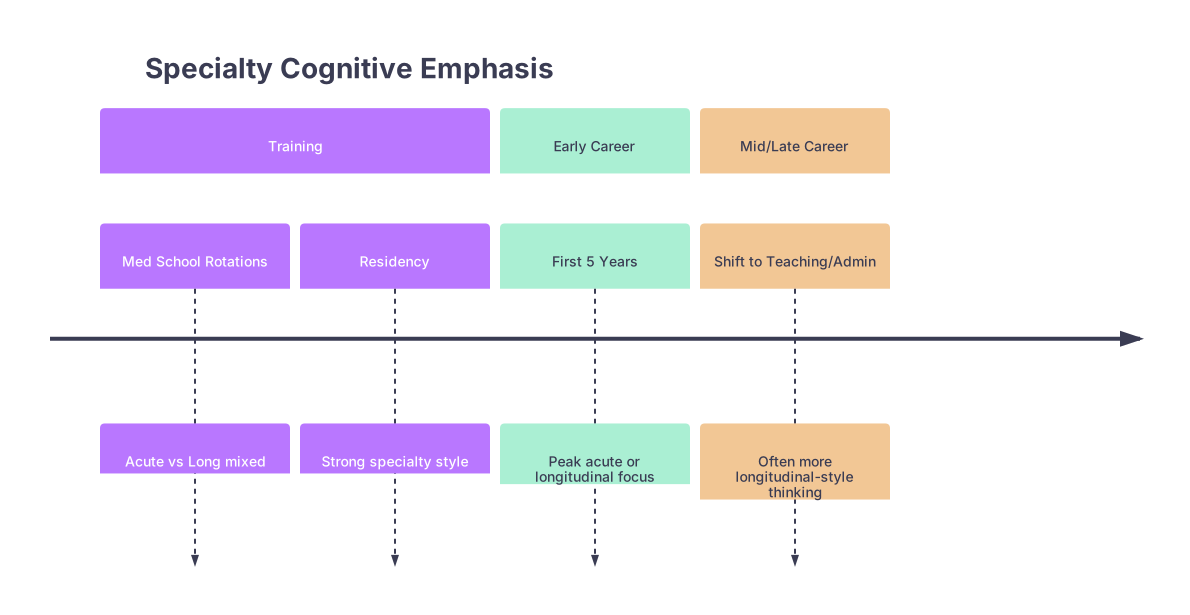
| Period | Event |
|---|---|
| Training - Med School Rotations | Acute vs Long mixed |
| Training - Residency | Strong specialty style |
| Early Career - First 5 Years | Peak acute or longitudinal focus |
| Mid/Late Career - Shift to Teaching/Admin | Often more longitudinal-style thinking |
Early in your career, your day-to-day will be strongly dominated by your specialty’s core style. Later, you might do more teaching, leadership, or hybrid work. But if you pick a field that fundamentally fights your brain, those early years can break you before you ever reach the more flexible phase.
Key Takeaways
- Acute vs longitudinal care is not a vibe difference; it is a fundamental cognitive style difference. Your brain is already giving you a preference on rotations. Stop ignoring it.
- Map yourself honestly on three axes: preferred time horizon, need for relational continuity, and stress response under uncertainty. Then align specialties with that pattern, not with prestige or outside pressure.
- Use real data from your own life—energy logs, “worst-day” visualizations, and how you feel at 4 p.m. on different rotations—to choose a specialty style that your brain can sustain for decades, not just survive for residency.