
Most “personality fit by specialty” advice is lazy, outdated, or flat‑out wrong.
Let’s fix that.
You have heard the clichés: surgeons are “decisive doers,” psychiatrists are “deep listeners,” radiologists are “introverts who hate people,” EM docs are “adrenaline junkies.” Some of that has a grain of truth. A lot of it is mythology repeated by people who have never read a single methods section in a psychometric paper.
I am going to walk through what the actual research shows about personality profiles across specialties, where it is weak, where it is consistent, and how you should and should not use it to choose your field.
Not vibes. Data.
1. The Core Model: What Are We Even Measuring?
Before you start matching “your personality” to a specialty, you need to know what the studies are actually talking about.
Most of the better studies use one of three models:
Big Five (Five‑Factor Model)
- Extraversion
- Agreeableness
- Conscientiousness
- Neuroticism (sometimes called Emotional Stability, reversed)
- Openness to Experience
MBTI (Myers‑Briggs) – far more popular in culture, far weaker psychometrically.
- Extraversion–Introversion
- Sensing–Intuition
- Thinking–Feeling
- Judging–Perceiving
A few use specialty‑specific or ad‑hoc tools:
- Grit scales
- Locus of control
- Tolerance for ambiguity
- Risk‑taking scales
- Empathy scales (Jefferson Scale, etc.)
Here is the hard truth:
The Big Five has decent reliability and predictive validity in medical training outcomes. MBTI is fun workshop material, not serious selection science.
If you want a serious “fit” conversation, anchor it in Big Five–type traits and related constructs: conscientiousness, extraversion, empathy, tolerance of ambiguity, risk tolerance, need for control, preference for procedures vs cognitive work, etc.
2. What the Literature Actually Shows by Specialty
I will walk through the patterns that are reasonably consistent across multiple studies. None of these are absolutes. Think of them as probability tilts, not rules.
To help you keep it straight, here is a summary table first, then we will dissect.
| Specialty Group | Extraversion | Conscientiousness | Agreeableness | Neuroticism (Emotional Stability) | Openness / Tolerance of Ambiguity |
|---|---|---|---|---|---|
| Surgery (esp. Ortho) | High | High | Lower–Mod | Higher stability (lower neurotic) | Lower–Mod |
| Internal Medicine | Mod | High | Mod–High | Mod | High |
| Pediatrics | Mod–High | High | High | Mod | Mod–High |
| Psychiatry | Mod | Mod | High | Higher neurotic (less stable) | High |
| Emergency Medicine | High | Mod | Mod | High stability | High risk tolerance |
| Radiology / Pathology | Low–Mod | High | Mod | Mod | Mod–High |
| Anesthesiology | Mod | High | Mod | High stability | Mod |
“High” and “Low” here are relative to other specialties, not absolute population norms.
2.1 Surgery and Surgical Subspecialties
The stereotype of the “type A surgeon” is not purely invented.
Common findings:
- Higher extraversion compared to many cognitive specialties
- High conscientiousness (they get stuff done, reliably)
- Lower agreeableness on average, particularly in hierarchical cultures
- Lower neuroticism (so, more emotionally stable on average)
- Somewhat lower openness, especially to ambiguity; preference for clear action
A typical study pattern: surgical residents score higher on “assertiveness,” “dominance,” and “sensation seeking,” lower on “harm avoidance” and “anxiety,” compared with internal medicine or psychiatry.
You see this play out in the day‑to‑day. Surgeons tend to like:
- Immediate feedback from intervention
- Binary outcomes: bleeding vs not bleeding, perfused vs not perfused
- Decisive team structures (“This is my patient, my OR, my call”)
Where people get this wrong:
They reduce it to “You must be an extroverted, aggressive alpha to be a surgeon.” I have seen quiet, thoughtful, meticulous introverts thrive in ENT and plastics because they love the technical craft and can function under high stakes. They may not enjoy trauma surgery nights with a loud, high‑octane team, but they still operate at an elite level.
2.2 Internal Medicine and Subspecialties
IM is the default home of the “cognitive” medical student.
Aggregate traits:
- Conscientiousness: consistently high
- Openness: higher than surgical fields – interest in ideas, complexity, nuance
- Agreeableness: moderate to high – collaborative, team‑oriented
- Extraversion: middle of the road; you see a spread
- Neuroticism: moderate – you do get more worriers and ruminators
What stands out in real life: IM types tolerate ambiguity and cognitive complexity better. They are more willing to say “We do not know yet. Let’s gather more data.” That is a personality disposition as much as a skill set.
Subspecialties fracture a bit:
- Cardiology and GI tend to have more procedural, high‑decisiveness personalities
- Endocrine, rheum, ID often skew more toward pattern‑seeking, tolerant‑of‑uncertainty, high‑openness folks who can marinate in complex diagnostic puzzles
2.3 Pediatrics
Pediatrics attracts a distinct cluster.
Research and what you see on the wards align:
- Agreeableness: high. They are more cooperative, compassionate, and “others‑oriented”
- Conscientiousness: high (schedules, follow‑up, vaccine logistics – these people are organized)
- Extraversion: moderate to high – you spend all day talking to families and kids
- Openness: moderate to high – more flexible in communication styles
- Neuroticism: middle zone; you see anxious peds residents, but the culture is supportive
People often say “peds people are nice.” That is not wrong. Studies using empathy scales show pediatricians scoring higher on measures of empathic concern and perspective‑taking than some other groups.
Caveat: You can be a blunt, no‑nonsense, not‑cute person and still be an excellent neonatologist. Talking to anxious parents in a NICU at 3 a.m. has less to do with your love of stickers and more to do with steady communication and emotional bandwidth.
2.4 Psychiatry
Psychiatrists are interesting. The stereotype is “introspective, empathic, maybe a bit neurotic.” Research supports a version of that.
Patterns:
- High openness – comfortable with abstract, symbolic, psychodynamic material
- High agreeableness – at least on average
- Conscientiousness: variable, moderate
- Neuroticism: sometimes higher than other specialties – more self‑critical, emotionally reactive profiles are overrepresented
- Extraversion: mixed, often moderate; you can be quite introverted and still manage one‑on‑one conversations well
There is also a repeated association with higher tolerance for ambiguity and greater comfort with psychosocial complexity. If you crave a single correct answer with a clear endpoint each day, psychiatry will torture you.
2.5 Emergency Medicine
EM is the high‑intensity, shift‑based world. The data and the lived experience match: they skew toward risk‑tolerant, novelty‑seeking personalities with high extraversion.
Findings:
- High extraversion
- High sensation seeking, risk tolerance
- Conscientiousness: moderate – enough to function in chaos, but not obsessive
- Emotional stability: generally high; panic‑prone people self‑select out
- High tolerance for uncertainty in the moment (you make decisions with partial data)
EM people usually enjoy:
- Variety – “no two shifts the same”
- Rapid decision making, teamwork in acute situations
- Clear roles during a crisis
But do not over‑romanticize. The same traits that attract people (action, novelty) also correlate with burnout risk when the job devolves into crowd control and endless boarding. Long‑term satisfaction depends heavily on systems, not just personality.
2.6 Radiology and Pathology
Radiology and pathology are often miscast as “for introverts who hate people.” That is sloppy.
What the better data show:
- Slightly lower extraversion on average
- High conscientiousness – meticulous, detail‑oriented
- Moderate agreeableness
- Openness: moderate to high – strong interest in pattern recognition, tech, imaging
- Comfort with delayed feedback and indirect patient contact
People who choose these fields often enjoy:
- Deep focus work without constant interruptions
- Pattern recognition and “visual puzzles” (for rads)
- Analytic, data‑driven thinking
- Less emotionally charged face‑to‑face work, more technical or cognitive focus
Are plenty of radiologists quite extroverted? Yes. Talk to the IR folks or the subspecialists who present at tumor boards. The “introvert in a dark room” stereotype is 20 years out of date.
2.7 Anesthesiology
Anesthesia sits at an interesting intersection: procedure‑heavy, physiology‑driven, time‑pressured, but also repetitive and protocolized enough to suit methodical thinkers.
Studies suggest:
- High conscientiousness – obvious reason: you keep people alive under anesthesia
- High emotional stability – you cannot fall apart when vitals tank
- Moderate extraversion – enough to manage OR team dynamics and surgeons
- Moderate openness – physiology nerds do well; wild novelty seekers less so
- Agreeableness: moderate; you negotiate constantly with surgeons and nurses
I have noticed an overrepresentation of people who like:
- Clear role boundaries (“I manage the airway and hemodynamics”)
- Short feedback loops
- A mix of routine and adrenaline
They tend to be less interested in chronic longitudinal relationships and more in acute physiologic management.
3. The Research Quality Problem: Why You Should Be Skeptical
Now the uncomfortable bit: a lot of “personality by specialty” research is weak.
Common problems:
Cross‑sectional design
- Most studies measure residents or attendings already in a specialty. That blurs selection effects (who applies) with socialization effects (who stays and how the culture molds them).
Small, single‑institution samples
- “We studied 42 IM residents at one university and 35 surgery residents and found…” Not exactly generalizable.
Overuse of MBTI
- MBTI has poor test‑retest reliability and weak predictive validity. Yet older papers happily claim “Surgical residents are more ESTJ.” Take that with a large grain of salt.
Cultural and cohort effects
- A 1995 study of German surgical residents is not describing the same professional culture you will enter in 2026 in the US or UK.
Publication bias
- Studies that “find differences” are more likely to be published than those that show “everyone overlaps heavily.”
So you must use these data as trend signals, not diagnostic criteria. They tell you what kinds of people tend to cluster in each field, not whether you personally “belong” somewhere.
4. The Biggest Myth: “Match Your Personality, Then You Will Be Happy”
This is where a lot of students go off the rails.
They take a personality test, see “high extraversion, high risk‑tolerance,” and decide EM or surgery are their destiny. Or they see “introverted, high openness” and assume they must pick radiology or psychiatry.
That is not how this works.
Several longitudinal studies have tried to predict specialty choice or satisfaction from personality alone. The predictive power is modest at best.
What matters at least as much:
- Workload and schedule (nights, weekends, call structure, shift vs continuous)
- Value alignment (do you care about outcomes this specialty actually moves?)
- Tolerance for bureaucracy and systems friction
- Financial and geographic constraints
- Mentors and role models you meet at key times
Personality is one lens. Not the lens.
There are also dangerous self‑fulfilling loops. You tell yourself, “I am an introvert; I cannot handle surgery.” So you never actually test that assumption under supervision in a supportive environment. Or you think, “I am an extrovert; I will be miserable in radiology,” ignoring the reality that modern radiology involves constant multidisciplinary interaction.
I have seen “mismatched” examples do just fine:
- Very introverted but highly conscientious student thriving in trauma surgery because they love the OR and accept the team banter as background noise.
- Loud, extroverted, theatre‑kid‑turned‑med‑student doing brilliantly in pathology because they love teaching and conference time, not just the scope.
The more honest frame:
Your personality will shape which parts of a specialty drain you and which parts refill your tank. That balance is what you need to analyze.
5. How to Actually Use Personality Data When Choosing a Specialty
Let me break this down practically.
You are in medical school. You want to choose wisely. You have a sense of your traits, maybe you have done a Big Five or MBTI or just know yourself. How do you turn that into a rational specialty choice without falling for stereotypes?
5.1 Step 1 – Map Your Real Traits, Not Your Self‑Image
Do not just label yourself “a people person” or “detail‑oriented.” Translate it into more specific trait patterns:
- How do you handle constant interruptions?
- Do you recharge with solo work or social contact?
- Do you need closure and clear outcomes, or can you live with uncertainty?
- How anxious do you get when you are responsible for high‑stakes decisions?
- Do you enjoy manual skills and repetitive practice, or do you get bored quickly?
If you want something semi‑objective, a decent Big Five inventory (like IPIP‑NEO based tools) is much more useful than MBTI.
Then look at your extremes. Moderate traits can flex; extreme traits drive friction.
For example:
- Extremely high need for control? You may suffer in chaotic ED settings.
- Extremely high anxiety and perfectionism? You may struggle with time‑critical, high‑stakes procedural fields unless you learn solid coping mechanisms.
5.2 Step 2 – Understand the Demands of Each Specialty at a Trait Level
Instead of saying “peds is for nice people,” unpack the job into traits and demands. A simple way is to think across a few axes:
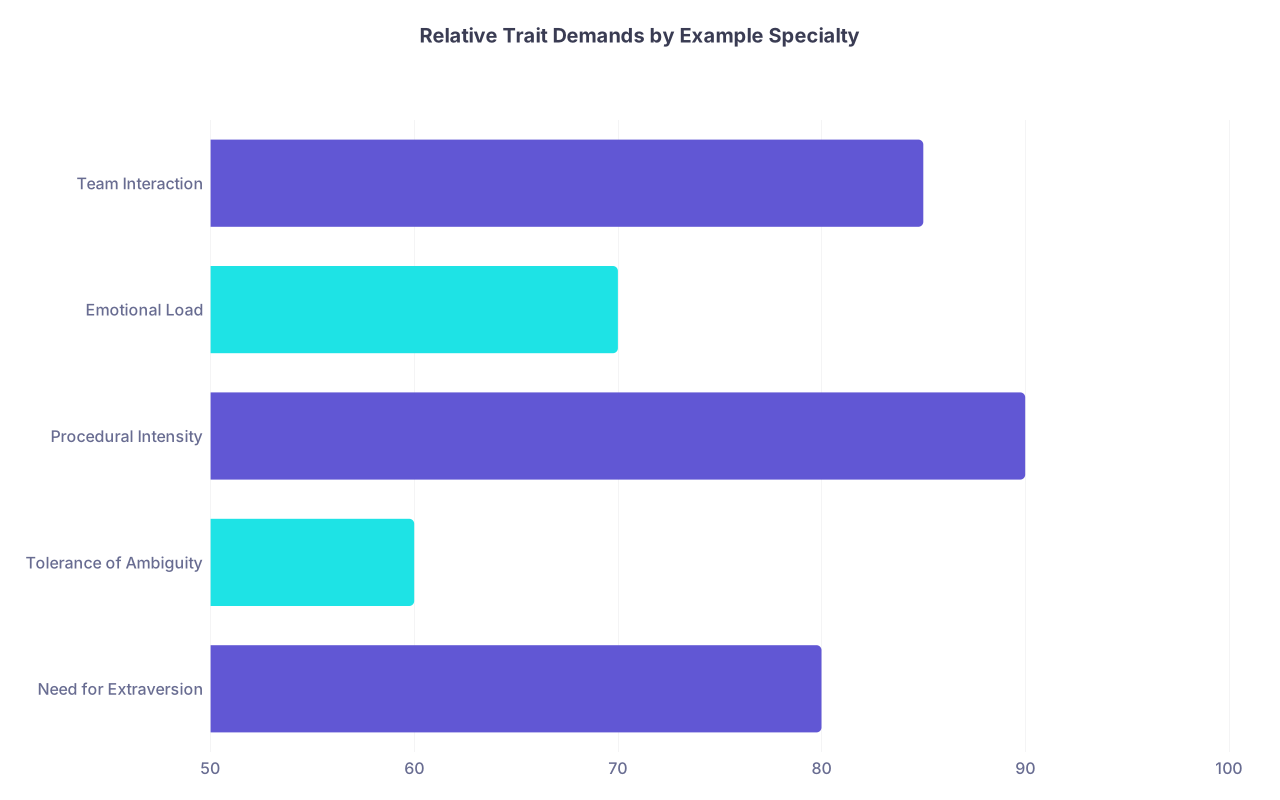
| Category | Value |
|---|---|
| Need for Extraversion | 80 |
| Tolerance of Ambiguity | 60 |
| Procedural Intensity | 90 |
| Emotional Load | 70 |
| Team Interaction | 85 |
(Imagine this as, say, a typical general surgery score pattern.)
For each specialty you are considering, informally rate:
- Required sustained social interaction (patients, families, teams)
- Procedural density and manual skills demand
- Tolerance for uncertainty (diagnostic, prognostic)
- Emotional exposure (death, chronic suffering, conflict)
- Need for immediate decision making vs prolonged deliberation
Then compare that to your trait map. Where are the severe mismatches? That is where you at least pause and ask whether your coping strategies are strong enough to compensate.
5.3 Step 3 – Use Rotations as Real‑World Stress Tests, Not Just CV Checks
Personality–specialty fit does not live on a questionnaire. It lives in your day on the wards.
During each core rotation, explicitly track:
- Which tasks left you mentally energized vs completely drained by the end of the day
- How you felt under the division’s typical stressors (codes, difficult families, OR delays, endless notes)
- How well your natural tempo matched the work (fast turnover vs slow thoughtful consults)
Do this in writing. Not in your head. A simple weekly log is enough.

| Step | Description |
|---|---|
| Step 1 | Self-assess traits |
| Step 2 | Learn real specialty demands |
| Step 3 | Do core rotations intentionally |
| Step 4 | Log energy & stress weekly |
| Step 5 | Identify 2-3 good matches |
| Step 6 | Seek mentors & sub-Is |
| Step 7 | Refine based on lived experience |
This is where personality meets reality. I have watched students certain they were future surgeons realize they loathed the culture and constant urgency – despite loving anatomy. I have also seen “non‑procedural” students light up on OB call when they discovered they loved hands‑on work.
Your reaction under authentic stress is more trustworthy than a test label.
5.4 Step 4 – Get External Feedback (The Right Kind)
Ask senior residents and attendings who know you:
- “What aspects of this field do you think fit my temperament?”
- “Where do you see me struggling long‑term based on how I work?”
Do not ask, “Do you think I am a surgeon / psychiatrist / radiologist?” That invites stereotype answers. Ask them to describe behaviors: how you make decisions, how you handle conflict, how you manage fatigue. Then infer fit from that.
The best mentors will say things like:
- “You are very reflective and comfortable sitting with uncertain diagnoses. That is good for IM, ID, rheum.”
- “You seem to get frustrated when cases drag on and no one makes a call. That might be tough in certain cognitive fields.”
5.5 Step 5 – Decide What You Are Willing to Grow Into
Personality is not fixed marble. It is more like firm clay. Traits are relatively stable, but how they show up in behavior is modifiable.
If you choose a specialty that rubs against a core trait, you must be explicit about whether you are willing to train the necessary counter‑skills.
Examples:
- Introvert in EM: You will need robust social recovery strategies and boundaries to avoid burnout.
- Anxious perfectionist in anesthesia: You will need to build rapid decision‑making routines and learn to “good‑enough” things in real time.
- High‑empathy, highly sensitive person in oncology or palliative care: You must develop emotional boundaries and effective debrief structures.
The more misaligned your baseline personality is with the field’s demands, the more intentional you must be about coping.
6. Some Specialty‑Specific Nuances Students Commonly Misunderstand
Let me hit a few persistent myths and correct them.
6.1 “Radiology and Pathology Are for People Who Do Not Like Patients”
What actually matters is:
- Whether you need direct, face‑to‑face emotional contact with patients to feel your work is meaningful.
- Whether you can derive satisfaction from indirect impact: being the person who makes or clarifies the diagnosis.
Plenty of very socially skilled people choose rads/path because they enjoy interacting with clinicians, teaching, and being a system‑level consultant more than doing 20‑minute office visits.
6.2 “Psychiatry Is For People Who Have ‘Issues’”
Yes, psychiatrists tend to be more introspective, sometimes more emotionally complex. That does not mean you must have had your own psychiatric illness to be good at it, nor that having one makes you automatically suited.
Better predictors:
- Your ability to maintain boundaries while still being empathic
- Your tolerance for chronicity and non‑linear progress
- Your comfort with murky “truth” and multiple explanatory models
6.3 “Surgery Requires You To Be Aggressive And Loud”
No. It requires you to be decisive under uncertainty, handle stress well, and manage a hierarchy effectively.
I have seen soft‑spoken, almost gentle surgeons run phenomenally tight OR teams. They do it through consistent calm authority, not volume.
What warns me more than introversion is paralyzing indecision or an inability to handle being “the final answer” for critical situations.
6.4 “Pediatrics Is Just For People Who Love Kids”
Yes, you need to be able to interact with children. But on most days, a large chunk of your communication is with parents and systems (schools, social services).
More critical:
- Patience
- Ability to explain complex things at multiple developmental levels
- Comfort with advocacy and sometimes conflict with institutions
6.5 “EM Is For Adrenaline Junkies”
The adrenaline parts are there. But the core skill is operational: managing flow with limited resources and incomplete data while staying cognitively sharp.
If you just like thrills and hate paperwork, EM will punish you. Hard. The days are full of risk‑stratification, protocol work, and documentation, not just codes.
7. Pulling It Together: A Framework You Can Actually Use
Let me synthesize this into a usable process.
Get a reasonably accurate picture of your personality traits, especially:
- Extraversion / introversion
- Conscientiousness
- Emotional stability vs anxiety
- Openness to complexity / ambiguity
- Empathy / agreeableness
- Risk tolerance and need for control
Translate your core traits into needs and vulnerabilities.
- Need: deep focus time, structured days, low emotional confrontation
- Vulnerability: high reactivity to chaos, ruminating over mistakes, people‑pleasing
For each serious specialty contender, describe it in the same language:
- What does a typical day demand socially, cognitively, emotionally, procedurally?
- Where are the stress points residents complain about?
Compare your map to the field’s demands. Label each intersection as:
- Synergy (your trait helps)
- Neutral (no major effect)
- Friction (your trait works against job demands)
Do not automatically avoid friction. But do create a plan:
- “If I choose X, I know my high anxiety will be stressed. I will need early mentorship, therapy or coaching, and good sleep hygiene to stay functional.”
- Or, “My introversion will be taxed by constant conversations in clinic. I need to protect my off‑time and maybe choose a subspecialty with more procedural or lab time.”
That is how an adult uses personality data. Not as destiny, but as engineering constraints.
FAQ (5 Questions)
1. Should I take a personality test to choose my specialty?
You can, but treat it as one input, not the deciding factor. A Big Five–based assessment is more scientifically grounded than MBTI. Use the results to clarify your tendencies (e.g., tolerance of ambiguity, extraversion level), then test those tendencies against real rotations. If a test contradicts what you consistently experience on wards, trust your lived data more.
2. Are certain personalities more likely to burn out in specific specialties?
Yes, mismatch between personality and work demands raises burnout risk. For example, highly conflict‑averse, high‑empathy individuals with poor boundaries may struggle more in fields with constant high‑stakes, emotionally charged conversations (oncology, ICU, EM) unless they build protective skills. But systems factors (workload, staffing, leadership) are often more important than personality per se.
3. Can my personality change enough during training to affect fit?
Core traits are moderately stable, but your behaviors, coping skills, and preferences can shift. Medical training often increases conscientiousness and emotional resilience while sometimes also increasing anxiety. Do not bank on a complete personality makeover, but assume you can stretch somewhat in response to demands, especially with intentional effort.
4. What if I love two very different specialties that seem to match different sides of my personality?
That is common. Many students feel pulled between, say, surgery and psychiatry, or EM and radiology. In that situation, look beyond “personality fit” and focus on: day‑to‑day activities, long‑term lifestyle, training length, and what kind of problems you actually want to solve for 30 years. You can also look for hybrid paths (e.g., interventional psych, pain, ICU, EM‑IM) that integrate aspects you like.
5. Is there any personality type that is “wrong” for medicine in general?
No specific “type” is universally wrong, but some extreme combinations make training harder: very low conscientiousness, very low empathy with poor insight, or extreme emotional instability without treatment. Medicine can accommodate introverts, extroverts, highly analytical minds, and highly relational ones. The key is self‑awareness and choosing an environment where your strengths help more than your vulnerabilities hurt.
With that foundation, you are ready to stop asking, “What personality fits which specialty?” and start asking the better question: “Given who I actually am, where can I do excellent work and stay sane over a career?” The next step is pairing this understanding with brutally honest exposure on your rotations and sub‑internships. That is where the real decision gets made—but that is a story for another day.