
It is 10:45 p.m. You are post-call from surgery, still smelling faintly of betadine, replaying the satisfaction of closing fascia on a laparotomy… and also remembering how much you hated pre-rounding on 18 patients whose main issue was “dispo.” Yesterday afternoon you were on neurology clinic and found yourself weirdly energized after 40 minutes dissecting a cryptic neuropathy case.
You keep hearing: “Are you a hands person or a brain person? Procedural or cognitive?”
That binary sounds clean. Reality is not. Let me break this down specifically.
You are not choosing between “surgery” and “thinking.” Every specialty lives somewhere on a procedural–cognitive spectrum, but the mix, the tempo, the feedback loop, and the lifestyle around that mix are what actually decide if you will thrive or burn out.
This is the article you read before you lock in your third-year electives and start telling people, “I think I am going into X.”
1. Forget the buzzwords: what “procedural” and “cognitive” really mean
People use “procedural” and “cognitive” sloppily. So let us define them the way your future day-to-day will experience them.
Procedural specialties
When people say “procedural,” they usually mean:
- A significant chunk of your time is in a procedure room, OR, cath lab, endo suite, IR suite, etc.
- Your work product is a physical intervention: cutting, injecting, ablating, stenting, scoping, biopsy, device placement.
- Revenue (and scheduling) are driven by CPT codes that have a procedural RVU premium.
True high‑procedural fields include:
- General surgery and surgical subspecialties (ortho, ENT, urology, neurosurgery, plastics, vascular, CT)
- Interventional cardiology, EP, interventional radiology
- GI (heavy endoscopy), pulmonary (bronch, advanced pulm), some pain and interventional PM&R
- OB/GYN (especially if you actually do surgery, not mostly clinic OB)
Mixed but procedure-heavy:
- EM (lacs, intubations, lines, reductions, bedside US, but also a ton of pure decision-making)
- Anesthesia (procedures galore, but the “procedure” is often 5–10 minutes with a lot of high-stakes cognitive work in between)
When you are procedural-heavy, your day feels like blocks. Cases. Turns. You measure your work in “how many scopes” or “how many joints” you got done, not “how many diagnostic dilemmas I solved.”
Cognitive specialties
“Cognitive” does not mean “no procedures ever.” It means:
- The primary value you provide is diagnostic reasoning, risk stratification, and longitudinal management.
- You generate plans more than you generate tissue samples.
- Most of your time is talking, examining, and thinking at a computer – not manipulating tools in a procedural space.
Predominantly cognitive fields include:
- General internal medicine, hospitalist medicine
- Endocrinology, rheumatology, infectious disease
- Hematology/oncology (with some procedural elements like biopsies, LPs, but those do not define the field)
- Neurology, geriatrics, palliative care, allergy/immunology
- Psychiatry (yes, procedural ECT exists; no, it does not define 99% of psych practice)
- Many outpatient pediatric subspecialties
Mixed cognitive with minor office procedures:
- Outpatient family medicine, general pediatrics, some derm (though derm can become very procedural depending on practice model)
Your day in a cognitive field feels like a series of puzzles and negotiations. Less “I fixed this with my hands,” more “I organized complex data and changed the trajectory.”
2. The spectrum: where specialties really sit
You need to get rid of the false dichotomy and see the continuum.
| Specialty | Procedural vs Cognitive Balance* |
|---|---|
| Neurosurgery | 90% procedural / 10% cognitive |
| General Surgery | 80% procedural / 20% cognitive |
| GI (typical practice) | 70% procedural / 30% cognitive |
| Emergency Medicine | 50% procedural / 50% cognitive |
| Cardiology (non-interv) | 40% procedural / 60% cognitive |
| Internal Medicine (outpt) | 20% procedural / 80% cognitive |
*These are broad, real-world approximations, not rigid numbers. Individual jobs vary.
Now, here is the subtlety nobody explains:
- You can often “dial” your personal mix within a specialty. Example: a cardiologist can skew more cognitive in clinic or more procedural in EP/cath. A general surgeon can choose a breast-focused practice (more clinic, less marathon cases) vs acute care surgery (tons of emergent OR).
- But the culture of the field has a default. Neurosurgery residents do not get praised for “excellent discharge planning.” Rheumatologists do not win awards for “fast joint injections.” The identity of the field shapes what is valued and thus how happy you feel.
If you try to force a cognitively wired brain into a “cases-first” culture, or a hands-first brain into a “guideline + documentation” culture, you will pay for it. Daily.
3. How your brain actually works: cognitive vs sensorimotor reward
Strip away prestige, money, and your parents’ opinions. You are left with this question:
What kind of problem-solving gives you a dopamine hit?
Cognitive reward: you enjoy…
- Long differential diagnoses
- Integrating labs, imaging, phys exam, and history into a story
- Pattern recognition in complex data (“this looks like APL, not just anemia”)
- Longitudinal wins: seeing A1c drop over months, relapses prevented, functional gains over time
- Talking patients through uncertainty and trade-offs
Example: On internal medicine you find yourself staying late to look up an odd electrolyte pattern. You enjoy morning report. You like arguing over anticoagulation guidelines.
Procedural/sensorimotor reward: you enjoy…
- Precise hand skills, tools, and devices
- Real‑time problem solving under time pressure
- Clear before/after differences: the fracture reduced, the vessel opened, the mass removed
- Tactile feedback: the “pop” of entering a vessel, suture throwing, scope navigation
- The choreography of a team in a physical space
Example: You are weirdly content suturing for 2 straight hours. You remember the feel of a tough fascia layer. You do not mind standing for long cases; the time compresses.
Most students have some of both. The trick is: which one sustains you when you are tired, behind on notes, and annoyed?
If you are honest, you already know which of these scenarios sounds more like “good tired” vs “soul-drained.”
4. Hidden variables: what actually drives long-term fit
This is where students go wrong. They look only at “do I like procedures?” or “do I like complex thinking?” and ignore the ecosystem those preferences live in.
Let me walk through the non-obvious factors.
4.1 Time granularity: seconds vs minutes vs months
Procedural fields:
- Operate on the scale of seconds to hours.
- Feedback is immediate. The vessel is bleeding or not. The stone is out or not.
- The emotional roller coaster is fast and steep.
Cognitive fields:
- Operate on days to months.
- Feedback is delayed. Your hypertension plan “works” over years.
- The emotional curve is flatter, but more sustained.
If you are impatient with slow payoffs, certain cognitive fields will frustrate you. If you hate thinking in real time under pressure (“the blood pressure is 50, do something now”), you will hate acute procedural work.
4.2 Tolerance for uncertainty vs desire for control
Every field has uncertainty. But the dominant flavor differs.
Procedural:
- Uncertainty: anatomy variation, intra-op surprises, device failure, perioperative complications.
- You control a lot with your own hands, but when complications happen, they feel very personal.
Cognitive:
- Uncertainty: diagnostic ambiguity, incomplete evidence, human behavior (adherence).
- You control the plan, but outcomes are shared with patient choices, systems, and time.
Ask yourself: do you prefer “I own the immediate physical outcome” or “I guide a long-term trajectory with shared responsibility”?
4.3 Relationship with patients: episodic vs longitudinal
Procedural-heavy specialties:
- A lot of episodic encounters. You fix something discrete and often hand back to primary care.
- There are exceptions (vascular surgery, some neurosurgery follow-up, bariatric surgery, etc.), but the intense longitudinal relationship is not the core.
- The relationship is often technical-trust based: “I trust you to do this thing to me.”
Cognitive-heavy specialties:
- Longitudinal relationships are the point. You are there through flares, relapses, life events.
- A large part of the work is motivational, educational, and relational.
If the idea of seeing the same patient for 10+ years bores you, you should not pretend IM clinic or rheumatology will suddenly feel fascinating in practice.
4.4 Team and culture fit
I have watched this mismatch trigger career regret more than any other factor.
Procedural cultures (surgery, IR, cath lab, etc.):
- More hierarchical. Clear lines: attending > fellow > resident > intern > student.
- Blunt communication is normalized. Feedback is immediate and not always gentle.
- Workdays are built around cases, turnover times, and block schedules.
Cognitive cultures (IM, neurology, psych, etc.):
- More horizontal discussion. Team-based rounds, shared decision-making.
- There is still hierarchy, but tone is more “conference table” than “battlefield.”
- The workday rhythm is clinic lists, rounds, family meetings, documentation.
If you wilt under sharp criticism or OR-style command voice, high-surgery density may grind you down. If you hate 60-minute family meetings and consensus-building, some cognitive fields will drive you insane.
5. A practical, stepwise way to test your fit (not just vibe check it)
Here is how I would tell a second-year who is genuinely undecided to approach this for real.
Step 1: Do a brutally honest “energy audit”
Grab a sheet of paper. List:
- Rotations or days that left you energized.
- Rotations or days that left you depleted.
Do not label them “good” or “bad” based on prestige. Just note your visceral state after:
- Busy OR days
- Full clinic days
- Night float
- ICU blocks
- Consult-heavy days
Highlight patterns. Did you feel “good tired” after 8 hours in the OR but “dead” after 6 hours of clinic? Or the opposite? That pattern is not random.
Step 2: Track your micro-preferences during rotations
On your next few clerkships, pay attention to what you seek out when nobody is forcing you:
- On surgery: are you trying to get into the OR every chance you get, or are you relieved when you are sent to clinic or wards?
- On IM: do you volunteer to present complicated patients with huge problem lists, or do you prefer “clean” cases with a clear intervention like a tap or biopsy?
- On EM: are you chasing every intubation and lac repair, or staying at the computer to unpack complicated chest pain risk stratification?
Write this down weekly. Your memory will rewrite history later to fit your narrative; do not trust it.
Step 3: Purposefully contrast 2–3 specialties at each “corner” of the spectrum
Before you commit to anything, you should have:
- At least one “pure” cognitive experience: full IM wards or clinic month, neuro, rheum, ID, or similar.
- At least one “pure” procedural experience: robust surgery month, interventional subspecialty elective, or anesthesia/IR GI-heavy block.
- One mixed field: EM, OB/GYN, certain cardiology or pulm rotations.
Watch not only what you enjoy, but how tired you are after 2–3 weeks. The novelty of the OR wears off. So does the novelty of nicely reasoned notes.
Step 4: Investigate job variability within specialties
This is where everyone underestimates flexibility.
Example: Internal Medicine
- Hospitalist: cognitive-heavy, acute, less procedures, blocks of days/nights.
- Proceduralist tracks: some places have dedicated inpatient procedure teams (lines, taps, biopsies).
- Primary care: chronic disease management, continuity, very cognitive, low procedure load unless you build a niche.
Example: Anesthesiology
- Academic cardiac anesthesia: high-intensity cases, TEE, emergent situations, lots of procedures.
- Outpatient community anesthesia: short cases, turnover focus, still procedural but very different vibe.
- Pain fellowship: more longitudinal and office-based, heavy interventional procedures.
You are not choosing “GI” or “neurology” in a vacuum; you are choosing a job type that you should research now, not after residency.
6. Lifestyle, money, and external pressure: be honest about what you are trading
I will be blunt: ignoring these factors is naive. But over-weighting them is how people end up miserable.
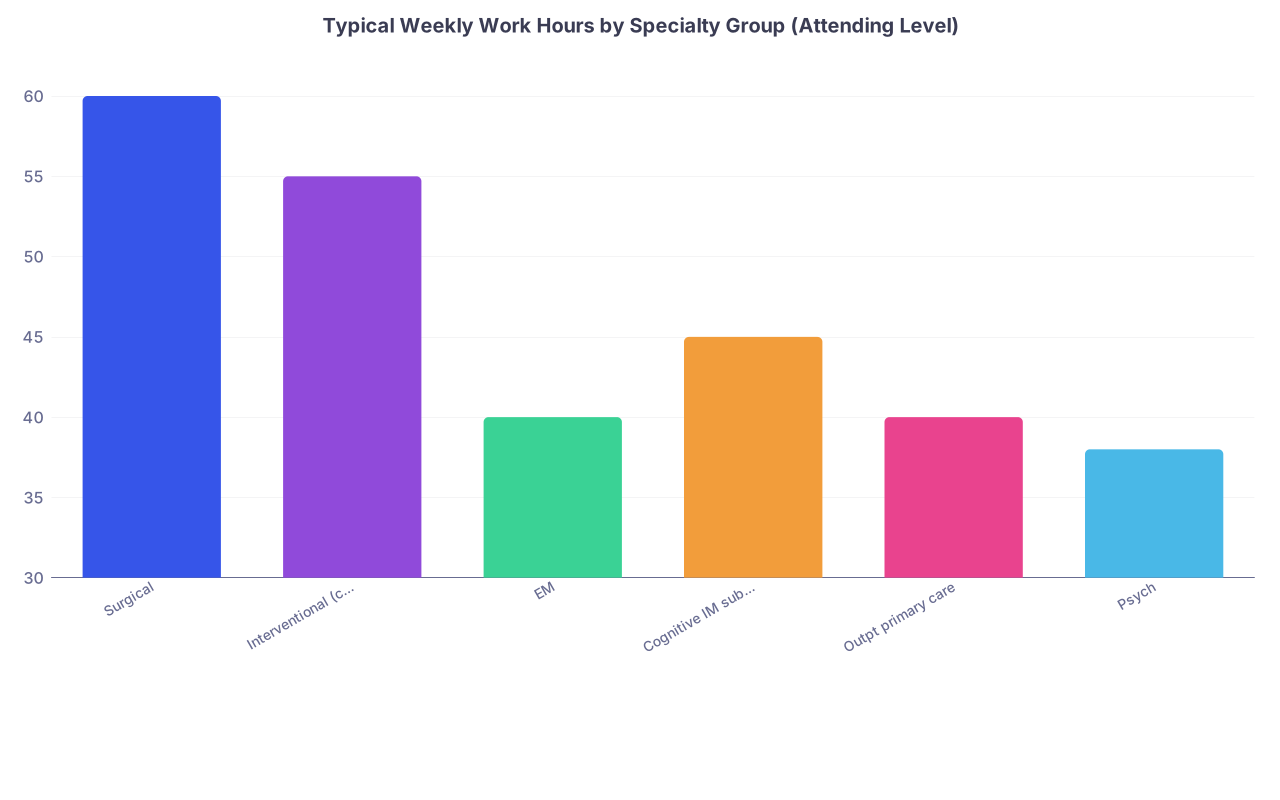
Time and lifestyle reality
| Category | Value |
|---|---|
| Surgical | 60 |
| Interventional (cards/IR) | 55 |
| EM | 40 |
| Cognitive IM subspecialty | 45 |
| Outpt primary care | 40 |
| Psych | 38 |
These are averages. Individual jobs can break the mold. But trends matter.
Greater procedural intensity often pairs with:
- Earlier mornings (pre-op, pre-rounding)
- Longer or less predictable days (cases running over, add-ons)
- More call that is physically in-hospital or tied to emergent interventions
Cognitive fields often have:
- More predictable clinic hours
- Call that is more phone-based and consultative
- Less physically exhausting but mentally draining days
If you are already barely tolerating 60–70 hour weeks as a resident, do not fantasize that the private practice ortho group working 4 days a week is your default destiny. It exists; you might not get it.
Income and financial pressure
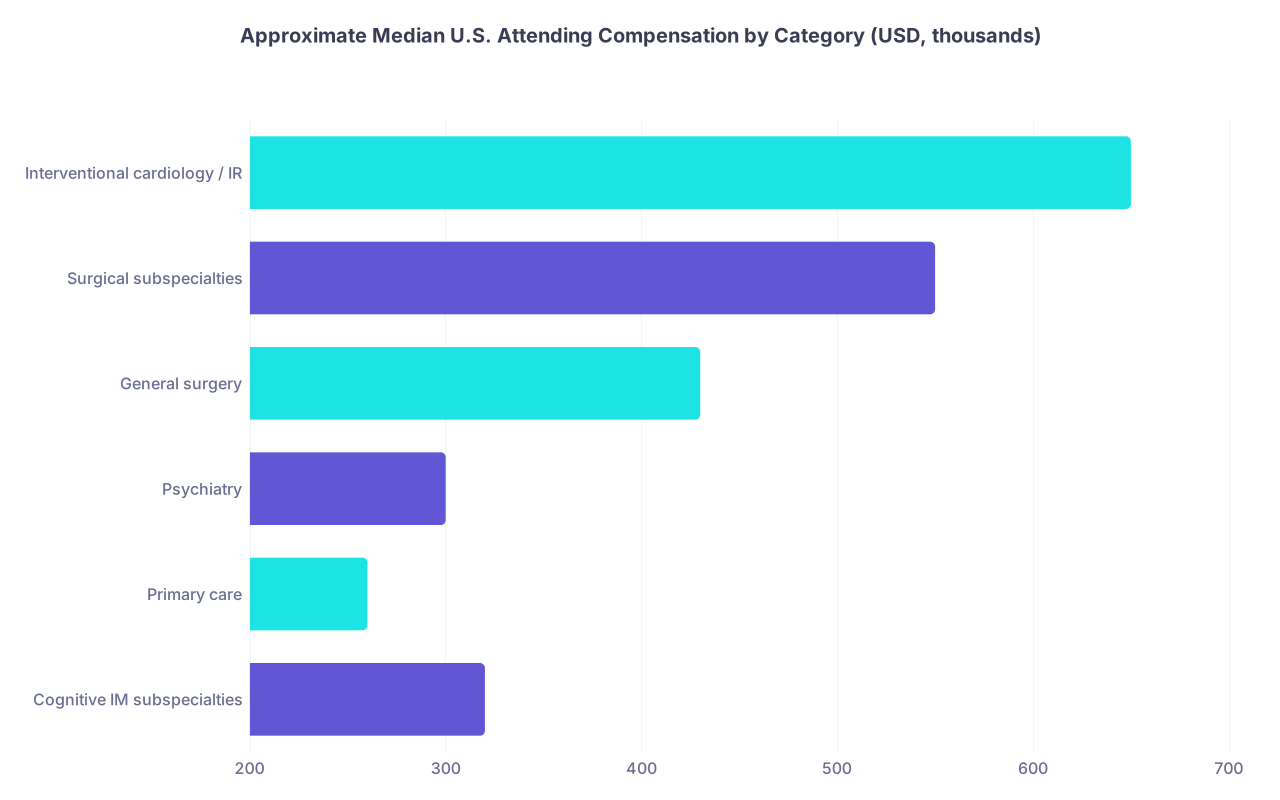
Yes, on average, procedural fields earn more. The RVU system pays more for doing than thinking.
But the distribution has nuance.
| Category | Value |
|---|---|
| Cognitive IM subspecialties | 320 |
| Primary care | 260 |
| Psychiatry | 300 |
| General surgery | 430 |
| Surgical subspecialties | 550 |
| Interventional cardiology / IR | 650 |
Rough, moving targets. Not a contract. Use them to understand orders of magnitude, not to pick your field.
What matters more than raw income is:
- Debt load and your risk tolerance for lifestyle delays
- Your willingness to work more hours for a higher ceiling
- Your internal narrative: if you choose a lower-paying cognitive field, will you constantly resent it?
Do not pretend money “does not matter” if you obsess over it. And do not choose a surgical field only for the check if you hate standing in the OR. That is a 30-year sentence.
External expectations and identity
At least one of these will apply to you:
- Family pushing toward surgery or something they deem prestigious
- Faculty subtly nudging you into their own specialty
- Peers equating field difficulty/competitiveness with worth
Let me be very clear: that pressure will be gone 3 years out. Your day-to-day misery or satisfaction will not.
I have watched brilliant procedural minds switch to cognitive fields and vice versa. The ones who do well are the ones who choose based on how they like to spend an average Tuesday, not what makes a good Instagram bio.
7. Red-flag mismatches to watch for (and what to do if you see yourself)
Some patterns usually predict trouble. If you recognize yourself, do something now, not five years from now.
“I love the OR, but I hate everything else about surgery”
If that sounds like you on your surgery clerkship:
- You love cases. You hate pre/post-op management, notes, floor calls, and the “surgical personality” around you.
- There are ways to get high procedural density with less of the surgical baggage: consider anesthesia, interventional radiology, EM in a procedure-heavy shop, maybe GI.
Action: Get an anesthesia or IR elective, plus a robust EM rotation. See whether you enjoy being the proceduralist without ownership of the entire peri-op course.
“I like thinking, but I feel bored without some hands-on work”
You are not stuck. Many “cognitive” fields have procedural niches:
- Neurology: EMG/NCV, botox, LP clinics
- Rheumatology: joint injections, ultrasound-guided procedures
- Heme/onc: bone marrow biopsies, LP/chemo
- Pulm/critical care: bronch, lines, pleural procedures
- Allergy/immunology: skin testing, challenge protocols
Action: When you rotate through these, follow the attendings who do procedures. Ask what proportion of their week is procedural vs clinic. Imagine yourself in their shoes.
“I love procedures, but documentation and computers drain me”
Bad news: in 2026 medicine, there is no escape from the EMR. Procedural notes, pre-op assessments, and post-op documentation are still documentation.
However:
- Procedural and anesthesia workflows do tend to have more templated notes and less narrative documentation than complexity-heavy cognitive specialties.
- Certain fields (like rheum, complex IM) are documentation hell because decisions are nuanced and justification-heavy.
If you truly despise charting, do not choose the subspecialty where every visit is a 15‑problem, 10‑medication saga with long-term risk narratives.
“I want a life, so I will pick something ‘easy’ regardless of fit”
This is how people turn a reasonably controllable specialty into a personal nightmare. You can burn out in outpatient psych. You can thrive in transplant surgery if your temperament lines up with the chaos.
Action: Decide how much you are willing to trade:
- If lifestyle is top priority, focus on within-specialty job selection and practice setting more than board-certified label alone.
- But do not override a strong cognitive vs procedural leaning purely for lifestyle signaling (e.g., “I will do derm because the hours are good” when you hate clinic and love acute problems).
8. A concrete self-assessment tool (use this, do not just think about it)
Here is a 10‑item forced choice exercise. For each pair, circle A or B quickly. Do not overthink.
A: I feel most satisfied after a day of 4–5 complex procedures, even if I barely talked to patients.
B: I feel most satisfied after a day of thorny diagnostic or management conversations, even if I did not do a single procedure.A: I like problems where the path is: gather data → decide → intervene now.
B: I like problems where the path is: gather data → discuss options → follow over time.A: I would rather master a small set of technical skills to a very high level.
B: I would rather master a broad range of knowledge and pattern recognition.A: I am okay with most of my workday being on my feet, in physical spaces like OR/procedure rooms.
B: I prefer most of my workday seated or moving between exam rooms and a workstation.A: A patient I see twice – pre‑op and then for post‑op check – is fine with me.
B: I want to see my patients regularly and follow their lives.A: I tolerate (even enjoy) real-time pressure and snap decisions.
B: I prefer having more time to consider and synthesize before making decisions.A: I like working in smaller, tighter teams with clear leadership hierarchy.
B: I like more distributed-team, discussion-based environments.A: My ideal day has variety in physical tasks (scrubbing, positioning, suturing, scoping).
B: My ideal day has variety in cognitive tasks (differentials, guidelines, risk calculations).A: The risks that scare me most are missing a bleed, perforating, or technical failure.
B: The risks that scare me most are missing a subtle diagnosis or mismanaging a chronic condition.A: If I had only 2 hours, I would pick an extra procedure over an extra family meeting.
B: I would pick an extra family meeting over an extra procedure.
Count your A’s and B’s.
- 7–10 A’s: You are wired more procedural. You should seriously consider fields where your day is anchored by doing things with your hands.
- 4–6 A’s: Mixed. You need to be in a field or job where you can modulate your mix.
- 0–3 A’s: You are more cognitively oriented. Forcing yourself into a high-procedural field because you “kind of liked the OR” is risky.
Then sanity check those results against your energy audit and rotation experiences. If they align, stop second-guessing. If they conflict, you need more targeted exposure, not more rumination.
9. Putting it together: a decision algorithm you can actually use
Here is a clean, practical flow. Print this in your mind.

| Step | Description |
|---|---|
| Step 1 | Start: Reflect on rotations |
| Step 2 | Count A/B answers in self-assessment |
| Step 3 | Count A/B answers in self-assessment |
| Step 4 | Prioritize procedural specialties |
| Step 5 | Consider mixed fields with procedural emphasis |
| Step 6 | Prioritize cognitive specialties |
| Step 7 | Explore surgery, IR, GI, anesthesia, EM |
| Step 8 | Explore IM subspecialties, neuro, psych, palliative |
| Step 9 | Explore EM, OB/GYN, cards, pulm, mixed jobs within fields |
| Step 10 | Talk to attendings about real job structures |
| Step 11 | Choose 2-3 away or advanced electives to test |
| Step 12 | Energy higher after procedures or thinking? |
| Step 13 | 7+ As? |
| Step 14 | 3 or fewer As? |
Use this to structure your next year:
- Decide if your default leaning is more procedural, more cognitive, or mixed.
- Shortlist 3–5 specialties that fit that leaning.
- Design your electives deliberately to test those shortlists under real conditions.
- Talk to attendings not just about “why they chose X,” but about their daily activity breakdown: percent procedures vs clinic vs paperwork.
You are not trying to find the perfect specialty. You are trying to avoid a fundamentally incompatible one.
FAQ (exactly 4 questions)
1. Can I switch from a procedural to a cognitive specialty (or vice versa) later if I choose wrong?
Yes, but it is painful. Switching from something like general surgery to anesthesiology, EM, or a medicine field happens, but involves: reapplying, explaining the switch, sometimes repeating internship, and usually losing time and money. The earlier you realize the mismatch (MS4 or PGY1), the better. The more “competitive” and niche the new field, the harder the jump. Do not bank on an easy escape hatch. Assume your first choice needs to be good enough to live with.
2. Are there truly “balanced” specialties if I am right in the middle of procedural vs cognitive?
Emergency medicine and OB/GYN are the classic mixed fields. Certain flavors of cardiology, pulm/critical care, and GI also give a real mix: clinic plus high-procedure blocks. But remember: you can manufacture balance by job design. An internist running a procedural service or a neurologist with a heavy EMG/Botox practice lives a more procedural life than stereotype suggests. Focus on fields that allow internal diversity, then understand what jobs actually exist.
3. How much should I let lifestyle and salary influence my choice compared to procedural vs cognitive fit?
Treat procedural vs cognitive fit as the foundation. Lifestyle and salary are modifiers. If you hate the day-to-day tasks of a field, no salary will fix that after the novelty wears off. If you genuinely like both procedural and cognitive work, then use lifestyle and compensation differences as tie-breakers. But if your gut/energy data strongly point you in one direction, ignoring that for an extra $150k a year is a long-term gamble with your mental health.
4. What if I enjoy both OR days and clinic days equally and still feel stuck?
Then you need more granular data. Within rotations, pay attention to micro‑moments: Do you enjoy suturing or the pre‑op consent conversation more? Do you feel more satisfied solving a subtle diagnostic question or seeing an immediate technical result? You may also be the kind of person who thrives on variety; in that case, look at jobs that cycle between blocks (e.g., EM with teaching/admin days, pulm/CC with alternating ICU and clinic weeks). The solution for “I like both” is usually a specialty or job built to let you regularly change gears, not locking yourself into one extreme.
Key points to walk away with:
- “Procedural vs cognitive” is not a slogan; it is a description of how your brain likes to work all day, every day. Take that seriously.
- Use structured self-assessment – energy audits, real rotation patterns, and the A/B exercise – rather than vibes or external pressure.
- Choose a field where your natural cognitive vs procedural lean aligns with the culture and tasks of the average Tuesday, not the highlight reel.