
25% of residents say call schedule alone would have made them choose a different specialty.
That is not “work-life balance.” That is people regretting a 7–10 year decision because of nights and weekends. So if you are in medical school trying to choose a specialty and you are not dissecting call structure, you are doing this blind.
Let me break this down properly.
The Three Call Models You Actually Need To Understand
Forget the jargon you hear on the wards. The vast majority of U.S. residencies in 2025 are running some mix of three core models:
- In-house call
- Night float
- Home call / pager call
You will see hybrids, but they are all variations on this theme.
| Category | Value |
|---|---|
| IM (wards/heme-onc) | 2 |
| Gen Surg | 3 |
| OB/GYN | 3 |
| Peds | 2 |
| Anesthesia | 1 |
| Radiology | 1 |
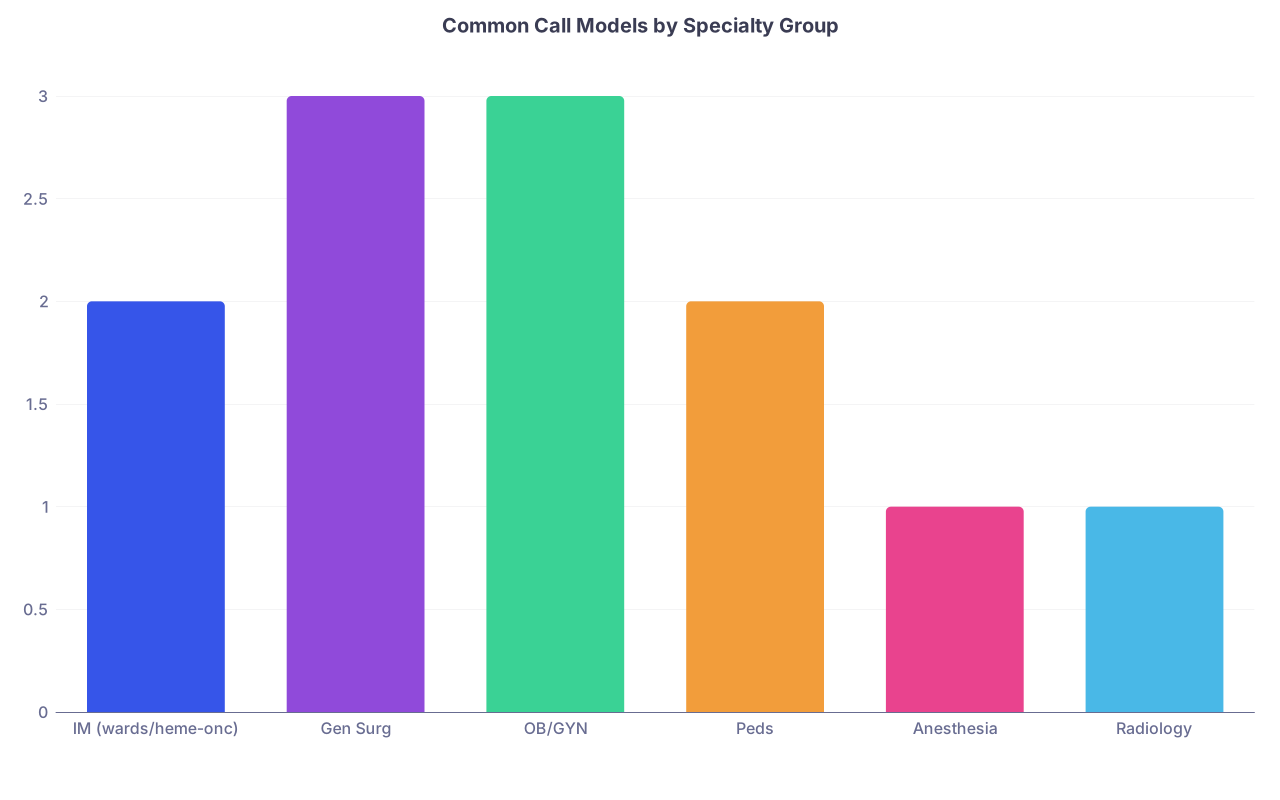
Interpret that bar chart the right way: the more “procedure-heavy and acute” the specialty, the more they lean on in-house and night float. The more clinic-based and elective, the more home call or no call at all.
1. In-House Call
You are in the hospital physically. Usually 24–28 hours. You admit, cross-cover, handle codes, and you do not stop moving.
Typical patterns you will see:
- Q4 call: every 4th night in-house
- 24 + 4: 24 hours in the hospital + up to 4 hours to finish work
- “Short call” vs “long call” on services like internal medicine or pediatrics
Pros (from a resident perspective, not the wellness committee marketing):
- Intense but contained. You know which days will be brutal.
- Actual team presence overnight. Seniors and attendings are often on-site.
- You see real pathology. Night admissions are not “follow-up labs.” They are septic, crashing, or unstable.
Cons:
- Recovery days are wrecked. Post-call you are a zombie.
- Sleep disruption is extreme. Especially on surgical/OB nights.
- Fatigue errors are real. You will write a wrong order eventually if you are pushed to the edge repeatedly.
You see heavy in-house call in:
- General surgery, trauma, neurosurgery
- OB/GYN (especially labor and delivery)
- Pediatrics (NICU, PICU, peds wards)
- Some internal medicine wards at large academic centers
2. Night Float
Night float is simple: you work nights for a block of time, usually 5–7 nights a week, for 1–4 weeks at a stretch. You go home in the morning, sleep in the day, repeat.
Patterns:
- 6p–7a, Sunday–Thursday or Monday–Friday
- Week-on / week-off in some smaller programs
- Resident + intern night teams rotating every few weeks
Pros:
- Predictable days off. No flipping back and forth between days and nights.
- Legal duty hours easier to maintain. Program directors like that.
- You avoid some of the worst 28-hour call marathons.
Cons:
- Chronic circadian destruction. You are permanently on jet lag.
- Social isolation. Your days off are when everyone else is working.
- People underestimate how brutal “just nights” are. After week 2, it catches up.
You see night float heavily in:
- Internal medicine
- Pediatrics
- OB/GYN at busier centers
- Some surgical subspecialties trying to soften traditional call (ENT, ortho in certain programs)
3. Home Call / Pager Call
You are not physically in the hospital by default. You carry a pager/phone. When something happens, you answer from home, maybe handle it remotely, maybe drive in.
Patterns:
- Q3–Q7 home call, depending on program size and volume
- Sometimes “home call” that is functionally in-house because call-ins are constant
- 24-hour periods where you are technically free but realistically tethered to a 20-minute radius
Pros:
- You see your own bed more often. Actual home time between calls.
- Less constant noise and chaos. No ED alarms every 3 minutes.
- Better tolerated for older residents with families.
Cons:
- Sleep fragmentation. Paged every 45 minutes from midnight to 4 a.m. is worse than one all-nighter.
- You are never truly off. Anxiety spike every time your phone buzzes.
- Driving while half-asleep at 3 a.m. is its own safety issue no one likes to discuss in front of ACGME.
You will see home call in:
- Anesthesia (post-call home call, pain, regional in some places)
- Radiology, especially after early years
- Many surgical subspecialties at smaller hospitals: ENT, urology, plastics, ortho
- Neurology (stroke call)
- Cards, GI, heme-onc attendings — and sometimes senior fellows
How Call Looks Specialty by Specialty (Realistic, Not Brochure Version)
Let me give you the patterns that actually matter when you are picking where you will spend your twenties.

Internal Medicine
Bread and butter of hospital life. Also where you first really taste night float.
Common call structure:
- Wards: night float + occasional long-call days
- ICU: in-house 24-hour or 12-hour shifts (days / nights)
- Electives: usually no call or lighter home call
Example pattern I have seen at a large academic IM program:
- PGY-1:
- Wards: 4+2 schedule (4 weeks wards, 2 weeks ambulatory) with 6–7 nights of night float per 4-week block
- ICU: 6 days per week, q3–q4 in-house call or night shifts
- PGY-2/3:
- More supervisory night float, fewer brutal ward nights, but still rotating through ICUs
Reality check: if you hate nights, you will suffer in IM residency. Post-residency, this lightens dramatically if you choose outpatient clinic, but hospitalist work is still highly shift-based with nights and some weekends.
General Surgery
Surgery is where you meet the old-school, in-house q3–q4 model and understand what fatigue actually means.
Patterns:
- PGY-1:
- Heavy in-house q3–q4 call on general and trauma
- Some rotations with night floats on trauma or vascular at larger centers
- Upper levels:
- More home call on certain subspecialty services
- Still real in-house call on trauma and acute care surgery
Typical scenario: you start a busy trauma month with q3 in-house call. You go home post-call at noon if you are lucky; 2 p.m. more realistically. You still get paged about your own patients. Then you are back the next day at 5:30 a.m.
Surgical culture also expects more “informal” hours. Pre-rounds, post-op checks, “just swing by OR 4.” That stacks on top of formal call.
Choosing surgery means accepting that for several years, you will have:
- More in-house call
- Less protected sleep
- Weekend and holiday call that is not negotiable
If that thought fills you with dread now, it will not magically feel better as a PGY-2.
OB/GYN
OB is deceptive. Students see happy babies and clinic days. Residents see 2 a.m. hemorrhages and ten active laboring patients at once.
Call patterns:
- Labor and Delivery:
- Almost always in-house 24-hour call or 12-hour night shifts
- Very high acuity with real “you cannot be sleepy” decisions
- GYN services:
- Combination of in-house and home call, depending on hospital
- MFM / High-risk OB:
- Often in-house or very intense home pager call
OB/GYN call has two unique stressors:
- Unpredictability — you can have a totally quiet night or three back-to-back emergencies.
- Emotional weight — bad outcomes hit harder when a previously healthy person crashes suddenly.
Night float is common, but even then, your “night” is often slammed. If you want a mostly office-based life with minimal nights, classic OB-heavy practice is not your endgame. Many people move toward GYN-only or sub-specialize later for a reason.
Pediatrics
Peds is like internal medicine’s younger cousin, with some unique twists.
Call patterns:
- Peds wards: night float or q4–q5 in-house call
- NICU / PICU:
- 12-hour or 24-hour in-house shifts, high acuity, very protocol-driven
- Outpatient/specialty clinic: often no call or home call only
One thing peds does a bit better than some adult fields: team-based nights with real supervision. But your responsibility load scales fast.
From a lifestyle angle:
- If you love nights and acute care: NICU/PICU can be oddly satisfying, very focused work.
- If you dread nights: future general clinic peds can be fairly gentle — but residency will still have heavy inpatient blocks.
Anesthesiology
On paper, anesthesia looks cushy. In reality, call can be very program-dependent and heavily tied to trauma burden.
Typical structure:
- Early residency:
- OR shifts + in-house call for emergent cases and obstetric anesthesia
- Night float blocks at some centers
- Senior years:
- More home call: you get called in for ruptured AAA, emergent C-section, craniotomy at 2 a.m.
A pattern I have seen: 1–2 in-house calls per week on busy services, plus one weekend per month with both Saturday and Sunday coverage expectations.
The trade-off: when you are not on call, life can be nice. Predictable OR daytime, often less scut, and post-call truly means going home. But “home call” can be misleading; high-volume centers can page you in multiple times per night.
Radiology
Here the call model is almost the inverse of surgery.
Call patterns:
- Early years:
- In-house evening shifts to read ER studies
- Night float blocks (e.g., 7 nights on, 7 nights off)
- Later years / attendings:
- More home call, especially teleradiology setups
- Nighthawk systems where attendings sit at home (or a reading center) and cover remotely
Radiology nights are mentally draining, but physically less punishing than running to codes. You sit, you interpret, your brain is humming at 1 a.m., but you are not also sprinting between three floors.
If you are OK with irregular sleep but want less physical chaos, radiology nights are often more sustainable over decades than surgical call.
Psychiatry, Neurology, Derm, Path, etc.
Let me rapid-fire the ones students always ask about:
- Psychiatry: mix of home call and in-house nights for inpatient psych or C/L services. Lower physical intensity, but some very emotionally draining nights.
- Neurology: lots of home stroke call; at big stroke centers that can function like in-house call because the pager never stops.
- Dermatology: minimal call in most programs, usually home call only for inpatients or urgent consults. This is one reason people fight to get in.
- Pathology: usually home call and not that frequent, often only for transplant or frozen section issues. Nights are not a major lifestyle driver here.
Call “Culture” vs Call “Structure” (Both Matter)
Two IM programs can have nearly identical formal call schedules and feel wildly different to live in. Why? Culture and how rigidly rules are enforced.
| Factor | Program A (Better) | Program B (Worse) |
|---|---|---|
| Post-call time | Out by 11 a.m. | Staying until 3–4 p.m. |
| Covering for sick calls | True jeopardy system | Informal peer coverage |
| Workload on call | 6–8 admits | 14–16 admits |
| Senior backup | Readily available | “Don’t bother me at night” |
Both programs could write “q4 in-house call” in their brochures. Living in them is not the same experience.
What to watch for on interview day:
- How residents talk about post-call. Listen for phrases like “depends on the attending” (red flag).
- How they describe jeopardy. If the sick-call backup is theoretical, you will end up working sick.
- Whether people laugh when you ask about ACGME duty hours. Dark humor is fine. Eye-rolling is not.
How Call Patterns Evolve After Residency
Medical students obsess over residency call and completely ignore what happens after graduation. Big mistake.
Your attending life can look very different:
- Hospitalist IM:
- 7-on/7-off 12-hour shifts, including nights. No call on off weeks.
- Outpatient IM or Peds:
- Mostly clinic, maybe phone call at night for your own patients. Relatively mild.
- General surgeon in a smaller town:
- 1-in-3 home call that behaves like in-house on weekends.
- Subspecialty surgeon in a large group (e.g., ortho sports):
- Limited call, more elective OR, heavier clinic. Much kinder lifestyle.
- OB/GYN private practice:
- solo/2–3 MD group: very frequent call, you basically own all your own deliveries
- large group: call dispersed, more nights off, but still real nights.
If your long-term plan is outpatient clinic with minimal nights, then suffering through a few years of residency call may be tolerable. If you secretly want trauma surgery but are already dreading nights as an MS2, that mismatch will not age well.
How To Actually Use Call Schedules To Choose A Specialty
This is the part most students blow off. They just ask, “Is the lifestyle good?” and call it a day.

| Step | Description |
|---|---|
| Step 1 | Identify Tolerance for Nights |
| Step 2 | Consider Acute Fields: EM, Surgery, OB, ICU |
| Step 3 | Favor Clinic-heavy Fields |
| Step 4 | Compare Call: In-house vs Night Float |
| Step 5 | Look for Home Call or No Call |
| Step 6 | Ask Residents About Volume & Culture |
| Step 7 | Align with Long-term Career Goals |
| Step 8 | OK with Frequent Nights? |
Here is the grown-up way to do it.
Step 1: Be honest about your sleep and stress tolerance
Think back to your worst overnight study sessions or clinical rotations:
- Could you function safely at 5 a.m. after zero sleep?
- Did you recover in 1 day or did it take 3?
- Did night shifts leave you wired and miserable?
Do not romanticize this. If you already know nights wreck you, banking on “I will adjust” is wishful thinking.
Step 2: Separate “residency pain” from “career reality”
Some specialties are front-loaded pain:
- OB/GYN, general surgery, anesthesia, EM: brutal residency, somewhat more controlled attending life in the right job.
- IM, peds: decent residency, but many attending jobs still carry nights/weekends.
Others are front-to-back light:
- Derm, path, outpatient psych: relatively light call for both residency and career.
Make a two-column list:
- Residency call reality for that field
- Typical attending call patterns in your ideal future practice
Do not ignore either side.
Step 3: Ask specific, uncomfortable questions on the trail
Not “How is the call schedule?” Everyone lies or sugarcoats that.
Ask residents:
- “On a typical 24-hour call, how many hours of sleep do you realistically get?”
- “How many admissions are you responsible for on a call night?”
- “What time did you leave the hospital after your last three post-call days?”
- “In the past month, did anyone go over duty hours?”
Ask more than one resident. Senior and junior. See if answers match or if people glance nervously at faculty before answering.
Step 4: Look at sample schedules — and read between the lines
Most programs will show you a “sample schedule.” That is often the prettiest rotation they can find. Ask them:
- “Can I see a ward month and an ICU month for each PGY year?”
- “How many total call nights per month on average for intern year?”
Also, ask how often they change models. Some programs “pilot” a more humane schedule for recruitment season, then drift back to old patterns.
How Night Float, In-House, and Home Call Actually Feel Day-to-Day
One thing you do not get as a student: the tempo and psychological feel of each call type.
| Category | Value |
|---|---|
| In-house 24-hr | 9 |
| Night Float 6 nights | 7 |
| Home Call (light) | 3 |
| Home Call (busy) | 8 |
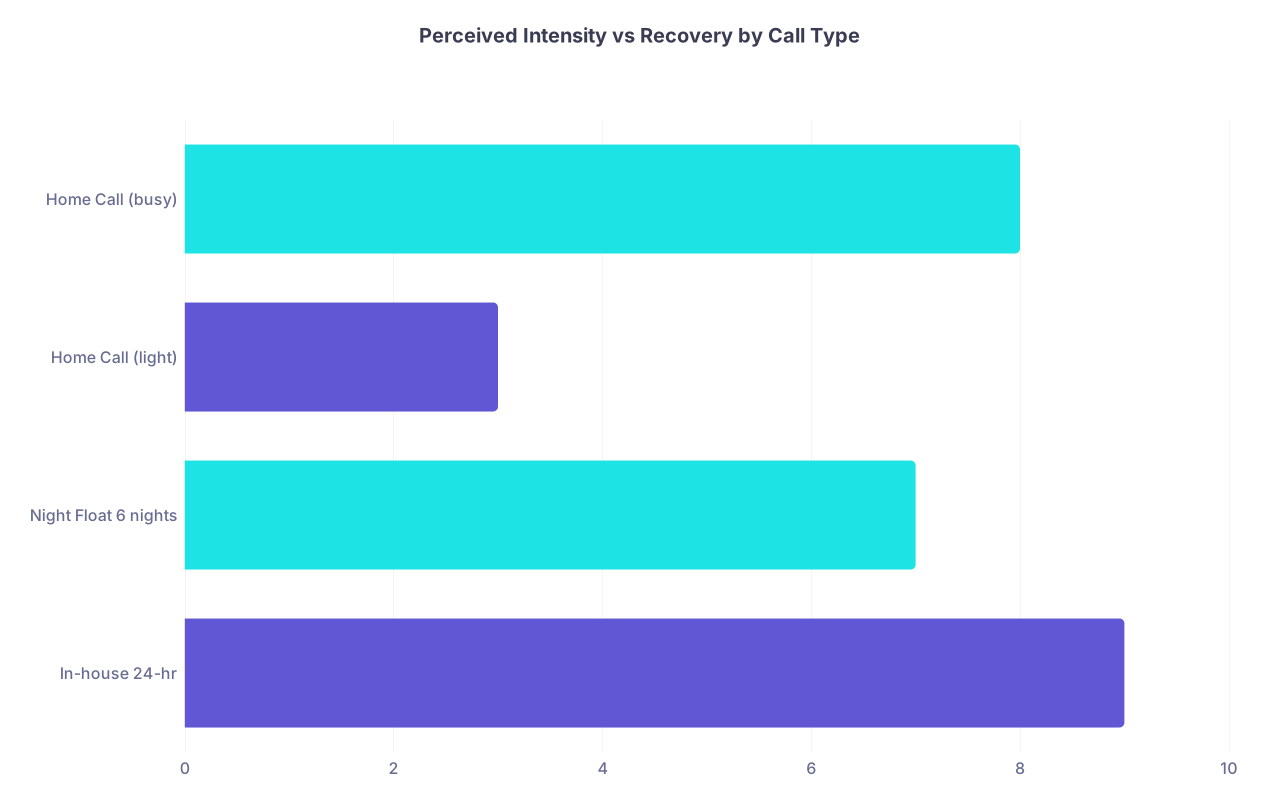
On a 1–10 “this is killing me” scale (my opinion, backed by what residents actually say):
- In-house 24-hr: 9
- Acute, focused misery. You are spent but you have a clear endpoint and a post-call crash.
- Night float 6 nights/week for 4 weeks: 7
- Less intense each night, but the chronic repetition drains people. Your body clock never stabilizes.
- Home call (light, true light): 3
- Occasional pages, maybe one drive-in a month. Many subspecialty attendings live like this. Tolerable.
- Home call (busy, functionally in-house): 8
- You lie in bed with one eye open, pager going off constantly, still have to function in clinic next day. Shockingly exhausting.
The big psychological difference:
- In-house call: you are obviously at work. Your brain accepts it.
- Home call: you are “sort of” off, but not really. Harder boundary. More resentment when it is busy.
Some people prefer clean, in-house suffering. Others like being physically at home even if paged a lot. Know which camp you are in.
Quick Specialty Comparison Snapshot
This is a crude but useful way to look at the landscape.
| Specialty | Nights/Call Intensity | Common Model Mix |
|---|---|---|
| General Surgery | Very High | In-house + some night float |
| OB/GYN | Very High | In-house + night float |
| EM | High | Shift work, no traditional call |
| IM | Moderate–High | Night float + some in-house |
| Pediatrics | Moderate–High | Night float + in-house (ICU) |
| Anesthesia | Moderate–High | In-house + home call |
| Neurology | Moderate | Home call + some in-house |
| Psychiatry | Low–Moderate | Home call + occasional in-house |
| Radiology | Low–Moderate | Night float + home call |
| Derm/Path | Low | Minimal, mostly home call |
This is not precise. Programs can vary wildly. But if you think you are signing up for “lifestyle” surgery or OB without call, you are kidding yourself.
FAQs
1. Is emergency medicine really better since it has no “call”?
EM has no traditional 24-hr call or pager. It has shift work. That means you know exactly when you work, but you will absolutely work nights, weekends, and holidays. Many EM docs feel the cumulative circadian disruption more at age 40 than at 28. If you hate nights, EM is not a loophole.
2. Can I just “power through” a bad call-heavy residency if I plan on a chill outpatient job later?
Sometimes. But burnout is front-loaded. If you are barely holding it together as an intern, 3–5 more years of that can push you out of medicine entirely or into any job that feels like an exit. Do not bank your mental and physical health on a hypothetical future cushy job.
3. Do competitive programs usually have worse call schedules?
Not always. Some of the brand-name programs have moved aggressively toward night float and genuine enforcement of duty hours because they can recruit without abusing residents. The worst offenders are often mid-tier programs with high volume, low staffing, and an old-school culture. You have to ask residents directly; reputation on paper does not predict call quality consistently.
4. What is one concrete thing I should do as a student to evaluate call before ranking programs?
On every interview day, find one resident away from faculty and ask: “If you could change one thing about the schedule here, what would it be?” If the answer is call-related (and it often is), get specifics. How many nights? How bad are they really? Use that to compare across programs. Do not just look at the slide with “night float system” on it and assume it is humane.
Key points to keep in your head:
- Call structure (in-house, night float, home call) is as defining for your life as the actual content of the specialty.
- The same written schedule can feel completely different depending on culture, enforcement, and workload.
- If your sleep tolerance and stress profile do not match your specialty’s call reality, no amount of “passion” will save you from burning out.