It’s 10:30 p.m. You’re on the couch post-call, half in scrubs, half in pajamas, ice pack on your joints, inhaler within reach. Group chat is buzzing: classmates arguing about derm vs ortho vs EM. Your reality is different. You’re not just asking “What do I like?” You’re asking, “What can my body actually tolerate in five, ten, twenty years?”
This is where a lot of students with chronic illness get stuck. You love medicine. You can push through more than most people realize. But you also know the crash that comes after a 28-hour call. Or the migraine that follows a day of fluorescent lights and skipped meals. Or the autoimmune flare that knocks you out for a week.
You’re not choosing a hobby. You’re choosing a career that will intersect with your disease every single day. Let’s be strategic about it.
Step 1: Get Brutally Honest About Your Disease Reality
Do this before you start mapping specialties. Not in vague terms. In painfully specific ones.
Ask yourself:
- What are my hard physical limits right now?
- What are my likely future limits based on natural history of my disease?
- What triggers flares or episodes for me?
- How often do I need medical appointments, labs, infusions, or procedures?
Write it down. Literally.
You want details like:
- “If I’m on my feet >4–5 hours straight, my back pain becomes a 7/10 and I can’t focus.”
- “Bright lights and missed meals → migraines within 12–24 hours, sometimes with vomiting.”
- “I need an infusion every 6–8 weeks that wipes me out for 1–2 days.”
- “I have unpredictable syncope episodes when dehydrated or standing too long.”
Then, categorize your limitations into three buckets:
Non-negotiables (can’t safely do, ever or long-term)
Example:- Can’t reliably lift >25–30 lbs
- Can’t safely stand continuously for >2 hours
- Need predictable access to bathrooms (IBD, IC, POTS, etc.)
Modifiable with accommodations
Example:- Need scheduled breaks to sit/hydrate/eat
- Need avoidance of overnight calls
- Need ability to cluster appointments on certain days
Currently hard, but may change with better control
Example:- Still titrating meds
- In remission for 6 months, unclear durability
- Rehab/physical therapy ongoing
Do not sugarcoat this to make a specialty “fit.” I’ve seen people do that to chase surgery, EM, or OB, then hit a wall in intern year and have to bail in a much more painful way.
Step 2: Understand the Real Physical Demands of Different Specialties
Forget stereotypes like “derm is easy, surgery is hard.” Reality is more nuanced. But yes, some patterns are brutally consistent.
Here’s how to think: hours, body position, intensity, and predictability.
| Specialty Type | On-Feet Time | Night/Call Burden | Predictability | Physical Strain Level |
|---|---|---|---|---|
| OR-heavy surgical | Very High | High | Low | Very High |
| Procedure-light IM | Moderate | Moderate | Moderate | Moderate |
| Clinic-based (psych, derm, etc.) | Low–Moderate | Low–Moderate | High | Low–Moderate |
| Shift-based acute (EM, ICU) | Moderate–High | High | Low | High |
| Lifestyle surgical (ophtho, ENT outpt-heavy) | Moderate–High | Moderate | Moderate | High |
High-Impact / OR-Heavy Fields
Think: general surgery, ortho, neurosurgery, OB/GYN (especially MFM or high-volume L&D), vascular, CT.
Common features:
- Long cases (4–10+ hours) on your feet.
- Lead aprons for cases with fluoro.
- Unpredictable nights and weekends.
- Extreme circadian disruption during training.
If your disease involves:
- Orthostatic intolerance / POTS
- Chronic pain limiting standing
- Severe fatigue syndromes
- Unpredictable flares that fully knock you out
…then these become very risky long-term. Can some people with chronic illness do them? Yes. But they are the exception, and they usually have milder or highly controlled disease plus strong support/accommodations.
Shift-Based Acute Care
Think: EM, critical care, some hospitalist models, anesthesia (varies by practice), trauma.
Common features:
- Nights, evenings, weekends standard.
- Adrenaline, rapid decision-making, high acuity.
- Sometimes you can cluster shifts and have days off, but nights are nights. Your body will pay.
Bad mix if your illness flares with:
- Sleep disruption
- Stress/catecholamine surges
- Missed meals/hydration
- Temperature extremes (resus rooms aren’t exactly climate-controlled)
However, for some people with episodic conditions that are fine between flares, shift work can be workable if they can front-load and then recover. You need brutal self-knowledge here.
Clinic-Dominant / Outpatient Fields
Think: outpatient IM/FM, psych, derm, allergy, rheum, endo, outpatient cards, PM&R (with a range), pathology, radiology, some subspecialty consult practices.
Common features:
- More sitting options. You can structure your room so you sit during most of the day.
- Daytime-heavy schedules in many practice models.
- More predictable weeks, easier to plan around infusions, flares, appointments.
- Training can still be rough (IM/FM residency is no joke), but the end state is often modifiable.
If you need:
- Frequent labs/infusions
- Regular follow-ups with your own subspecialists
- Reliable sleep
- Time for physical therapy or self-care
…then these are usually safer ground.
Step 3: Know Which Factors Actually Matter Long-Term
Medical students obsess over residency years. You should zoom out. Residency is 3–7 years. Your career is 30+.
Focus on:
What attending life looks like in that field
Don’t just ask residents. Talk to attendings 10–15 years in. Ask:- “What are your hours like really?”
- “How easy would it be to reduce to 0.6–0.8 FTE in this field?”
- “Do people successfully work part-time here without being punished financially or professionally?”
Flexibility of practice models in that specialty
Does the specialty have:- Viable part-time roles?
- Telehealth options?
- No-call or low-call jobs?
- Outpatient-only tracks?
How rare vs replaceable the specialty is
The rarer/“elite” the skill set, the less flexible the job market.
A general psychiatrist can more easily shape their schedule than the only pediatric neurosurgeon in a 4-state region.Geographic flexibility
Some specialties cluster in big academic centers. If you need to be near a tertiary hospital for your own care, that can align well—or force you into high-intensity environments if your field only lives there.
Step 4: Map Your Specific Condition to Specialty Demands
Let’s be concrete. I’ll generalize; obviously every person is different.
If you have significant fatigue (e.g., SLE, RA, ME/CFS, systemic illness)
You want:
- Predictable days.
- Ability to sit often.
- Limited nights and 24+ hour calls (especially long-term).
Relatively safer targets:
- Psych
- Outpatient-based IM subspecialties (endo, rheum, allergy, heme/onc if you can handle occasional intensity)
- Derm
- PM&R (depends heavily on exact job—observe before committing)
- Pathology
- Radiology (though call exists, can be manageable depending on group)
Fields to approach with caution:
- EM
- Very heavy inpatient subspecialties (cards with lots of call, GI with tons of procedures)
- Surgery, OB, any residency that lives in the OR or call rooms
If you have mobility limits or chronic musculoskeletal pain
You want:
- Jobs that don’t require standing for long periods.
- Minimal lifting or moving patients/equipment.
- Environments where using a stool/sit-stand desk is normal or at least not a big deal.
Safer:
- Psych
- Telemedicine-heavy roles
- Radiology, pathology
- Cognitive IM subspecialties with clinic focus
Risky:
- Ortho, surgery, OB, anesthesia (standing a lot)
- EM (constant walking/standing)
- Some procedural-heavy subspecialties (IR, GI, interventional cards)
If you have a disease with unpredictable flares (IBD, migraines, sickle cell, etc.)
Key issue: unreliability. You may need unplanned days off. That’s rough in small teams, in the OR, or in specialties where canceling a day means chaos.
You want:
- Larger group practices where colleagues can cover.
- More outpatient work where last-minute rescheduling is annoying but not dangerous.
- Jobs with cross-coverage built in.
Safer:
- Group outpatient psych or IM/FM
- Larger health systems with robust cross-coverage
- Telehealth roles (eventually)
Risky:
- Solo practice anything
- Small surgical groups
- Niche subspecialties with little backup
Step 5: Be Smart About Disability, Disclosure, and Accommodations
You’re working with two separate systems:
- School/training (ADA, Section 504)
- Future employment (ADA, job-specific)
During Medical School and Residency
You’re entitled to reasonable accommodations, but the culture is…variable.
Examples that can be reasonable:
- Modified call schedule (e.g., no q3 overnight, but q6 with other duties balanced)
- Ability to sit during rounds/clinic
- Breaks for meds, hydration, snacks, bathroom
- Flexible scheduling for medical appointments
- Using mobility aids, compression garments, tinted lenses, etc.
What’s not likely to fly:
- “I can’t ever work nights, weekends, or more than 30 hours/week” in a high-intensity residency.
- “I need to leave whenever I feel tired” without structure.
Be strategic:
- Document your condition with treating physicians. Get clear letters describing functional limitations, not just diagnoses.
- Talk to your Student Disability Office before MS3. Get accommodations approved on paper.
- For residency, some people disclose fully; others disclose partially focusing on “medical condition with functional limitations X and Y.” There’s no one right answer, but pretending you have no limitations and hoping to “power through” is how you end up sick, burned out, and possibly needing to leave the program.
Step 6: Use Rotations as Stress Tests, Not Just Interest Tests
Most students approach rotations like “Do I like this content/patient population?” You need an extra layer: “What does this do to my body and brain over time?”
For each rotation, track:
- Pain level (morning / midday / evening)
- Fatigue
- Flares or symptom spikes (date, severity, context)
- Sleep patterns
- Time for meds, nutrition, hydration
Do this for:
- Surgery
- Medicine wards
- EM
- Outpatient-heavy rotations
- Any elective in a specialty you’re considering
You’re not judging by “I survived 2 weeks.” You’re asking: “Could I do THIS pattern for YEARS and still have a life?”
If you barely held it together on a 4-week surgery rotation and needed a week to recover, you already have your answer, no matter how much you enjoyed the OR.
Step 7: Think Long-Game: Money, Insurance, and Job Security
Chronic illness changes the financial and logistical calculation. You cannot ignore this.
Key variables:
Income stability and floors
If you go part-time or need to step back:- Does the specialty still pay enough at 0.6–0.8 FTE for your meds, treatments, and living?
- Some fields have high hourly rates but few part-time slots; others have more flexible hiring.
Health insurance realities
You’ll probably:- Need robust coverage long-term
- Be locked into employer-based insurance or pay a lot on the exchange if you go solo
Hospital systems and large groups often have better benefits and more cross-coverage, which helps if you’re out.
Risk of suddenly not being able to do procedures
What if your fine motor function worsens? Or you develop a tremor? Or vision problems?
If your entire practice is procedural (GI, IR, surgery, ophtho), your ability to earn can crash if your hands/eyes/back fail. Cognitive-heavy specialties have more built-in backup plans.
Step 8: Build a Shortlist and Pressure-Test It
Let’s say, after honest reflection and rotations, you narrow it to:
- Psychiatry
- Rheumatology (via IM)
- Radiology
Now you stress-test each.
For each specialty, answer:
What would a typical attending week look like at:
- 1.0 FTE
- 0.8 FTE
- 0.6 FTE
What are the training years like realistically? Can your disease handle 3 years of IM with nights and wards? Or is the direct route (psych, path, radiology) more realistic?
If your disease gets 30% worse, can you still practice in that field at any capacity?
Are there non-clinical options that fit naturally with this specialty later?
- Teaching, consulting, informatics, quality improvement, administration
- Some fields feed into these better than others
Then go talk to actual physicians in those specialties who:
- Are parents
- Are caring for elderly relatives
- Have visible or disclosed health conditions
- Or simply value their life outside work
Those folks tend to be more honest about constraints and possibilities.
Step 9: Accept Trade-offs Without Self-Punishing
Here’s the part almost no one says out loud:
You may not be able to choose the thing you once romanticized.
You might have to walk away from the OR, or the trauma bay, or the NICU.
That doesn’t mean you’ve “failed.” It means you did the actual adult thing: aligning your career with your reality so you can still be a doctor in 20 years instead of a cautionary tale.
You’re trading:
- Some prestige or drama
- Some ego-boosting moments
- Maybe some pay (depending on specialty)
For:
- A body that isn’t wrecked at 50
- A chance at long-term career sustainability
- Enough energy left for relationships, hobbies, and actual life
That’s not weakness. That’s strategy.
A Simple Framework to Use Right Now
If you feel overwhelmed, use a quick scoring system on specialties you’re considering. Rate each 1–5 (1 = terrible fit, 5 = great fit):
- Physical demands vs your limits
- Schedule predictability
- Night/weekend burden
- Ability to work part-time
- Cognitive vs procedural balance (what your body can handle)
- Geographic/job flexibility
- Long-term adaptability if your disease worsens
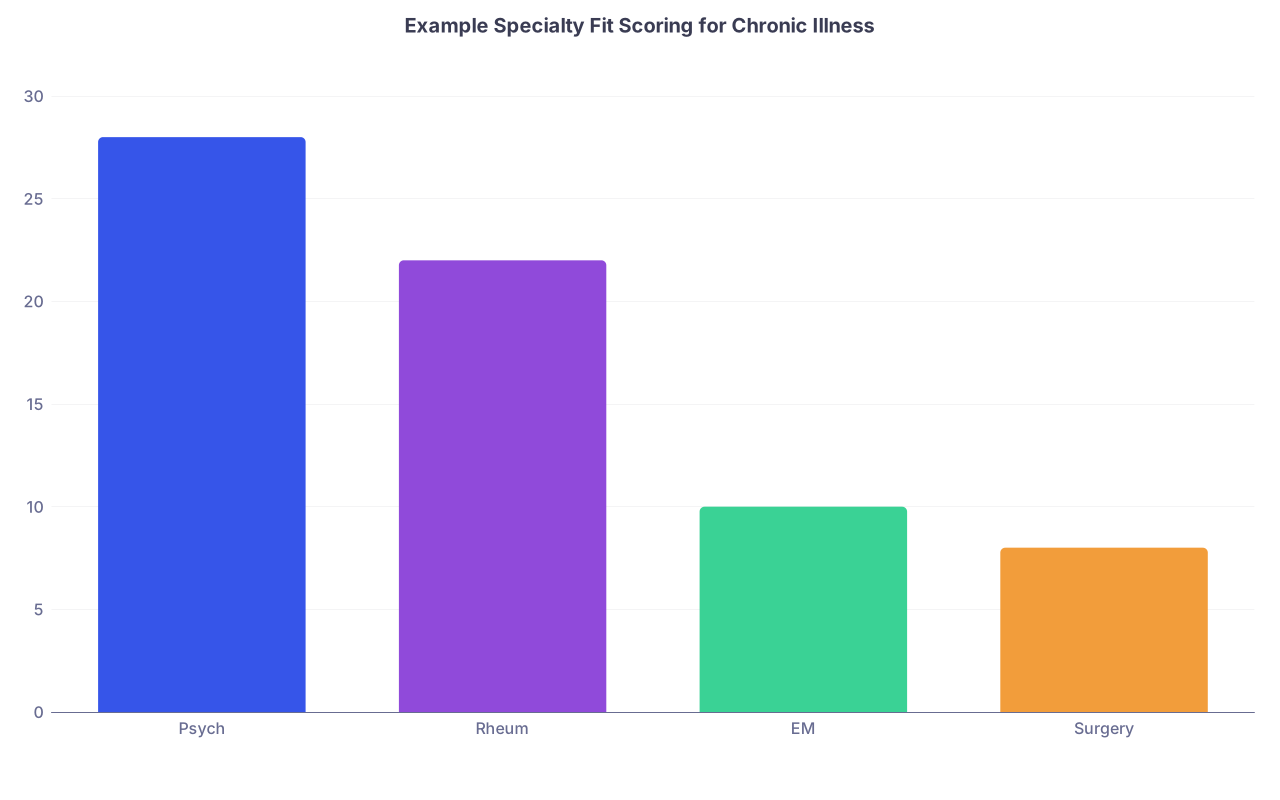
| Category | Value |
|---|---|
| Psych | 28 |
| Rheum | 22 |
| EM | 10 |
| Surgery | 8 |
This isn’t scientific. It just forces you to think concretely instead of vaguely vibing your way through decisions.
Example Scenarios
Two quick composites (based on patterns I’ve seen, not specific individuals).
Scenario 1: SLE with Fatigue + Joint Pain
- Struggled significantly on surgery rotation: pain 8/10 by afternoon, flare after weeks 2 and 4.
- Loved inpatient medicine, but 28-hour calls triggered 3-day recoveries.
- Did a psych elective: 8–5 days, mostly sitting, fatigue manageable.
Smart play:
- Seriously consider psych, maybe outpatient IM subspecialties where you can aim your career toward clinic-heavy practice.
- Avoid procedures and OR-heavy fields.
- Plan for part-time or lower-intensity role by mid-career if disease progresses.
Scenario 2: Well-Controlled Crohn’s, Infusion q8 Weeks
- Generally well but infusions take 1–2 down days.
- Can handle standing and nights during rotations without major issues.
- Really enjoys rheum and heme/onc content; likes the diagnostic puzzles.
Smart play:
- IM residency is doable, but factor in infusion timing and flare risk.
- Choose programs with strong support, sick call systems, and a reasonable culture (not malignant war zones).
- Long-term aim for outpatient-heavy rheum or heme/onc practice in a large group where colleagues can cover infusion weeks.
Use Your Lived Experience as an Asset
One last thing: your chronic illness is not just a problem to “manage.” It also gives you:
- Empathy your colleagues often fake but you actually feel.
- A real understanding of living with disease, medication side effects, insurance nightmares, and “medical fatigue.”
- A built-in BS detector for platitudes we throw at patients.
You will connect with patients differently. You will spot issues other doctors miss. Choose a specialty where that lived experience actually matters and can be used—chronic disease management fields, psych, palliative, primary care, rheum, endo, GI, heme/onc. Those are all places where longitudinal care and empathy really change outcomes.


| Step | Description |
|---|---|
| Step 1 | Identify Disease Limits |
| Step 2 | Map to Physical Demands |
| Step 3 | Shortlist 3-4 Specialties |
| Step 4 | Stress Test on Rotations |
| Step 5 | Discuss Accommodations |
| Step 6 | Evaluate Long-Term Fit |
| Step 7 | Select Specialty and Target Programs |

Key Takeaways
- Be honest about your real functional limits now and likely in 10–20 years, then match specialties to that reality, not your fantasy.
- Prioritize fields with predictable schedules, flexibility, and multiple practice models so you can adapt as your disease changes.
- Use rotations, mentors, and accommodations strategically—not to prove you can “tough it out,” but to test whether a specialty is sustainable, not just survivable.