
The culture of medicine lies to you about work hours. Then your kids, your partner, and your own body call its bluff.
If you already know you need reasonably predictable hours for family, you’re not “less committed.” You’re just being honest earlier than most. That’s an advantage—if you use it correctly.
This is the guide I wish more MS2s and MS3s had when they start whispering, “I don’t think I can live like my surgery preceptor.”
Let’s be specific. You’re likely in one of these boats:
- You already have kids or a partner with a rigid schedule.
- You’re the default caregiver for a parent/sibling.
- You’re dead set against a life of missing every soccer game, birthday, and bedtime.
- You know chronic sleep deprivation wrecks your mental health.
You’re not trying to work 30 hours a week. You just want:
- A reasonable cap on hours.
- Some control over when those hours happen.
- Minimal “surprise” nights/weekends/holidays.
You won’t find perfection. But you can stack the deck heavily in your favor with the right specialty + practice model.
Step 1: Get Honest About What “Predictable” Means for You
Before you chase specialties, define your actual non‑negotiables. Vague “better lifestyle” talk is useless. You need numbers and clear lines.
Ask yourself, right now:
- How many hours a week are you willing to work, average (not peak)?
- How many evenings per week do you absolutely want free?
- How many weekends per month can you tolerate working?
- Are you okay with early mornings? Late evenings? Nights?
- Is being home for bedtime important most nights?
- How far are you willing to live from the hospital/clinic?
If you don’t write these answers down, you’ll drift. And drifting in 3rd year is how you end up loving the dopamine hit of a trauma activation and pretending call every third night is “fine.”
Let me give you a concrete frame:
| Preference Type | Example Boundary |
|---|---|
| Weekly hours | 45–55 max on average |
| Evenings | Home by 6:30 pm 4+ nights/week |
| Weekends | 1–2 working weekends per month |
| Nights | 0 regular nights; occasional only |
| Call | Home call only, no in-house q3–4 |
You don’t need to hit all of these. But you should know which ones you absolutely won’t compromise on. Those will matter more than whether radiology vs psych sounds more interesting on paper.
Step 2: Separate “Specialty Culture” From “Practice Model”
This is where students get burned. They ask: “Which specialty has the best lifestyle?” Wrong question.
Two better questions:
- Within a specialty, which practice models have predictable hours?
- For my non‑negotiables, which specialties even have lifestyle‑friendly niches?
You can have:
- A brutal family medicine inpatient-heavy job with hospital call.
- An extremely chill cardiology role doing only clinic and non‑urgent imaging.
- A cushy radiology practice ruined by overnight telerads shifts.
- An OB/GYN with a group laborist model working 7-on/7-off and nothing in between.
So yes, specialty matters. But practice structure matters just as much once you’re out of residency.
For now, as a med student, you need a direction. Let’s walk through specialties by probability of building a predictable-hours life—assuming you choose your practice carefully later.
Step 3: Specialties That Usually Pair Well With Predictable Hours
These are specialties where, if you intentionally choose the right job, you can often get:
- Mostly daytime work
- Limited or no nights
- Limited weekend work
- A schedule you can put on the fridge and trust
1. Outpatient Adult Psychiatry
If you want maximum control over your time and can tolerate the emotional weight: psych is a top contender.
Typical outpatient private/group practice psych:
- 8–5 or 9–4 clinic days.
- Rare true emergencies you must physically respond to.
- On-call is often phone only or hospital-based and optional if you choose pure clinic.
- Lots of part‑time and hybrid telehealth options.
Realistic pattern: 4 clinic days (8:30–4:30), 1 admin/telehealth day, no weekends, no nights. If you join a call group, it’s often light and phone‑based.
Where it goes sideways:
- Inpatient psych with cross‑coverage and rapid turnovers can feel chaotic.
- Understaffed systems dump high-acuity patients on fewer docs.
Bottom line: If predictable hours matter, focus your future psych career on outpatient work, ideally in a decent-sized group practice or health system.
2. Outpatient Internal Medicine / Primary Care (With Guard Rails)
Primary care can be either heaven or hell for lifestyle. It depends entirely on:
- Panel size
- Support staff
- Call coverage
- RVU/volume pressure
The “good” version:
- 8–5 clinic, last patient 4–4:30.
- Home by 5:30–6 most days.
- One evening clinic per week, maybe.
- Shared call with a large group, phone only, rotating weekends.
- Hospitalists cover all inpatient work.
The “soul‑crushing” version:
- 20–25+ patients/day, constant double booking.
- Charting until 8–9 pm at home.
- Frequent add‑ons, squeezed-in “urgent” visits.
- You cover your own patients in the hospital or nursing homes.
If you choose IM/FM for predictable hours, you must be ruthless later about:
- Seeking systems with hospitalists (you do clinic only).
- Walking away from jobs that demand constant double-booking.
- Negotiating admin time and panel size, not just salary.
For now, as a student: pay close attention during outpatient IM/FM rotations to how tired the attendings look and what time they actually leave.
3. Radiology (Diagnostic, in the Right Group)
Radiology is a classic “quietly good” lifestyle specialty if you avoid certain traps.
Pros for predictability:
- Highly shift-based: 7–3, 8–5, 10–6, etc.
- Once your shift ends, your list hands off. No late patient messages. No “just one more” family meeting.
- Many practices with no home call; others with defined night/weekend shifts that are scheduled months in advance.
- Remote work options increasing (telerads).
The downsides:
- Someone must cover nights. Many early-career rads work evenings/nights.
- High-intensity days: you’re reading all the time; little downtime.
- Competitive entry; you need solid scores and strong performance.
If you’re happy living on a defined shift schedule and you don’t need total avoidance of nights (just predictability), radiology is very workable for family life. Especially mid-career, when you can often tilt toward more daytime work.
4. Pathology
Path is one of the most underappreciated lifestyle answers for students who like medicine but not the idea of constant direct patient drama.
Typical attending pattern in many groups:
- 8–5ish weekday work.
- Limited or no nights.
- Some weekend call, often light, with well-defined responsibilities.
- When you’re home, you’re home.
Caveats:
- Frozen sections and intra-op consults during the day can disrupt flow, but that’s still almost always daytime.
- Smaller groups may have more frequent call responsibilities.
If you enjoy diagnostics, pattern recognition, and you actually liked histology and lab stuff, path can give you one of the most family-friendly setups in medicine.
5. Allergy/Immunology, Endocrinology, Rheumatology (Outpatient-Heavy Subspecialties)
These IM subspecialties are often 90–100% clinic with minimal emergent inpatient work.
Common features:
- Predictable clinic hours.
- Mostly scheduled follow-ups and consults.
- Relatively few “drop everything and come in” phone calls.
Endo and rheum sometimes cover inpatient consults at larger centers, but you can seek outpatient-only roles or systems with protected clinic time and shared consult coverage.
Allergy/immunology is especially schedule-friendly—shorter visits, many procedures are predictable and scheduled.
These are great if you like complex medicine but don’t need adrenaline.
6. Dermatology
Derm is about as close as you’ll get to classic business-hours medicine:
- Mostly 8–5 weekdays.
- Procedures are scheduled.
- Emergencies exist but are rare.
- Many practices close early Fridays.
The problem: it’s very competitive. You need the grades, the Step scores (or strong clerkship performance now that Step 1 is pass/fail), and often research. If you’re dead-set on predictable hours and have the academic chops, derm is a logical target.
Step 4: Specialties Where Practice Model Is EVERYTHING
Some specialties can be either pretty manageable or absolutely punishing, depending on how you structure your practice.
1. Anesthesiology
People love to say “anesthesia has great lifestyle.” Sometimes true. Often not.
Better setups for family:
- Large groups with defined shifts (e.g., 7–3, 7–5, 11–7).
- Protected post‑call days.
- Minimal trauma/emergent cases if you’re at a community hospital without a Level I trauma center.
Tough setups:
- Short-staffed practices where cases run until whenever the OR is done.
- High trauma / transplant centers where you’re up all night frequently.
- Groups with heavy in‑house call and lots of add-on cases.
For students: pay attention not just to how anesthesiologists talk about their day, but whether they’re hanging around hours after their “scheduled” end time.
2. Emergency Medicine
Here’s the truth no one advertises: EM is predictable in hours, unpredictable in life rhythm.
Pros:
- Shifts are defined. A 3–11 shift ends at 11 or close.
- No home charting. When you leave, you’re done.
- You know months in advance when you’re working.
Cons:
- Nights/weekends/holidays are guaranteed.
- Circadian rhythm hell if your group mixes day, evening, night.
- Recovering from back‑to‑back shifts can steal your “off” days.
If your non‑negotiable is “home at roughly the same time each day” or “no regular nights,” EM will make you miserable. If your priority is pure hours control and your family can tolerate you being off on random Tuesdays and working Saturdays, EM can actually work.
But do not lie to yourself: your kids’ school events and holidays will collide with your shifts. Often.
3. Hospitalist Medicine
Hospitalist work is built on predictable blocks, not predictable days.
Typical patterns:
- 7-on/7-off, 12-hour-ish days.
- 5-on/5-off or 14-on/14-off at some places.
- Nights are either part of the rotation or handled by nocturnists.
Upside:
- When you’re off, you’re off. True stretches of time off for family, travel, or side projects.
- Kids often adjust to “dad/mom is gone this week, but home all next week.”
Downside:
- On weeks are brutal for family time. You may see your kids briefly in the morning and at bedtime, if that.
- If nights are in the rotation, your body and home life will feel it.
If your partner has a static 9–5 and you want big chunks of time off to be deeply present, hospitalist work can actually be a decent compromise. But you must both be on board with “intense on weeks.”
Step 5: Specialties That Fight Predictable Hours (Be Realistic)
If you absolutely, non‑negotiably want mainly 9–5 weekdays with rare exceptions, you should be cautious about certain fields unless you’re okay with a very niche practice later.
OB/GYN
Babies do not care about your family dinner.
Can it be made livable? Yes—with:
- Large group practices with laborists covering L&D.
- Gyn‑only practices that don’t do OB.
- Academic positions with mostly clinic + OR.
But the default OB/GYN attending life: unpredictable call, emergent sections, middle-of-the-night labor checks, and weekend pages.
If your heart burns for OB/GYN, look for:
- Jobs where you don’t follow your own patients on L&D.
- Gyn‑only roles (fibroids, endometriosis, surgery).
- Hospital-employed models with formalists/laborists.
Just don’t assume “I’ll figure it out later.” Many OB/GYNs are trapped by practice structures that were obvious red flags from day one.
General Surgery and Most Surgical Subspecialties
Surgery plus family is not impossible. But the hours are harder to sandbox.
Realities:
- Early morning rounds and OR starts.
- Cases that run over. A “2-hour case” that becomes 6.
- Middle-of-the-night emergencies (perforations, bleeds, trauma).
- Heavy call, especially early in your career.
Lifestyle niches exist: breast surgery, some plastics, some ophthalmology, some orthopedic elective-only practices. But getting to those often requires years of grind in less controlled environments.
If you must have surgery and also must have predictable hours, you’re playing the game on hard mode. Not unwinnable, but you’d better be intentional every step:
- Choose fellowships with more elective, scheduled cases.
- Avoid trauma centers for long-term jobs.
- Seek large groups that can spread call widely.
Step 6: Don’t Ignore Geography and Setting
You can pick the chillest specialty on earth and still get wrecked if you choose the wrong setting.
Big teaching hospital:
- Pros: more colleagues to share call, more subspecialization.
- Cons: academic pressure, later OR days, complex patients, committees.
Small community hospital:
- Pros: sometimes lighter call, fewer middle-of-the-night emergencies if low acuity.
- Cons: less backup, you may be the only person in your specialty—so you’re always on.
Outpatient multispecialty group / large HMO (think Kaiser, big health systems):
- Often the best bet for defined clinic hours and shared coverage.
- More standardized expectations.
- Less autonomy, more bureaucracy.
Private solo practice:
- You own your time but also your stress.
- Fantastic if structured well; terrible if you can’t say no.
As a student: when you’re on rotations, ask attendings two questions:
- “What time do you usually get home on a typical day?”
- “How many weekends/nights are you on call each month?”
People will fudge, but watch for that pause. That tells you more than their words.
Step 7: How to Use Your Clinical Years Strategically
You’re in med school. You don’t control much yet. But you can absolutely gather data.
Here’s how to treat your clerkships:
- Track the actual hours your attendings keep. Write it down.
- Notice how often their families come up—and in what tone.
- Ask residents what they would pick now knowing what they know.
During a rotation, make yourself a little table in your notes:
| Specialty | Attending Type | Start–End Time | Nights/Weekends | General Mood |
|---|---|---|---|---|
| IM clinic | Academic | 8:30–6:30 | 1 weekend/mo | Tired, rushed |
| Psych OP | Private group | 9–4:30 | Rare | Calm, present |
| EM | Community | 3–11 | 8 nights/mo | Mixed |
Patterns will emerge quickly if you do this honestly across rotations.
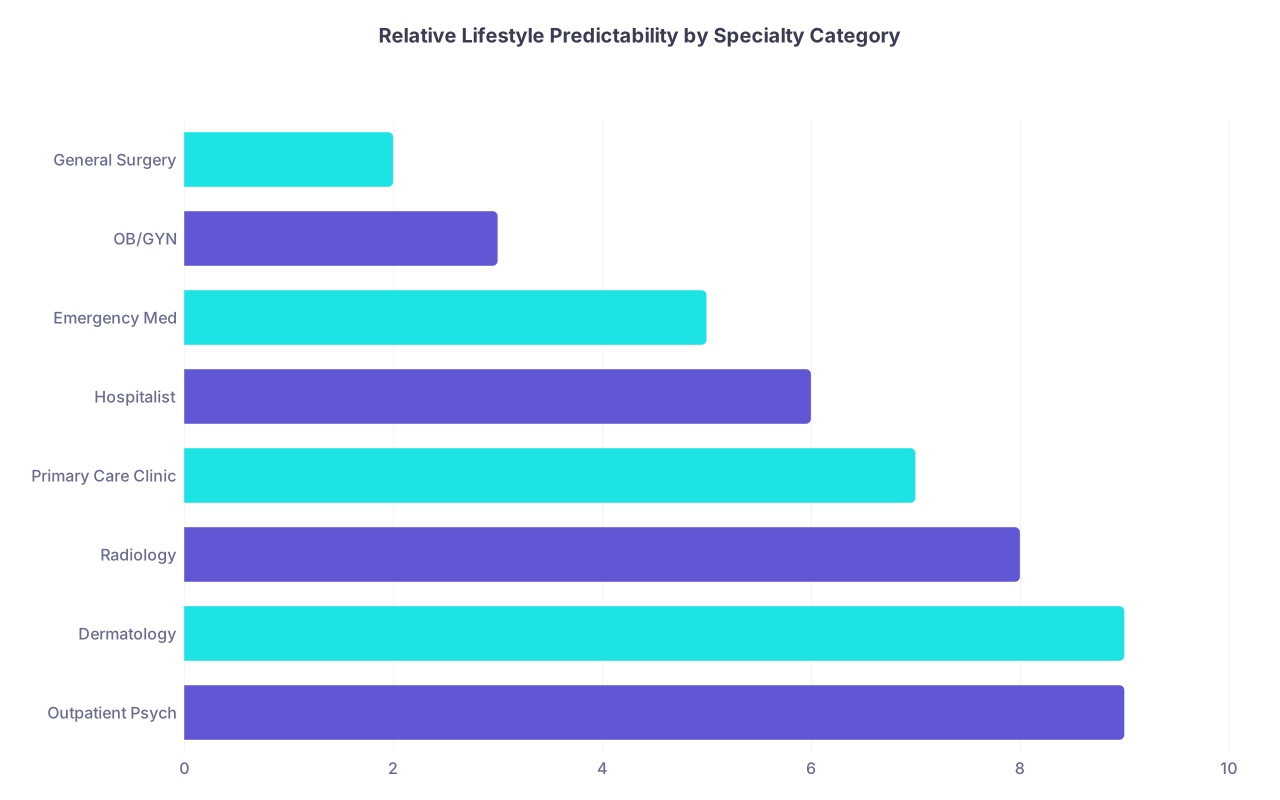
| Category | Value |
|---|---|
| Outpatient Psych | 9 |
| Dermatology | 9 |
| Radiology | 8 |
| Primary Care Clinic | 7 |
| Hospitalist | 6 |
| Emergency Med | 5 |
| OB/GYN | 3 |
| General Surgery | 2 |
(10 = highly predictable hours possible with the right job; 1 = inherently unpredictable even with effort.)
Step 8: How Family Constraints Should Affect Your Specialty Choice Now
Let’s get blunt.
If you:
- Are already a single parent, or
- Have a partner with a demanding, inflexible job, or
- Have chronic health issues that flare with sleep deprivation,
then specialties heavily dependent on call, middle-of-the-night emergencies, and long OR days are a bad bet. Not because you can’t do them. Because you’ll be layering high risk on top of high risk.
That doesn’t mean you have to pick the “softest” specialty. It means:
- Bias toward outpatient, clinic-heavy fields.
- Avoid fields where the core identity is emergent care.
- Think about childcare backup plans now, not as a future theoretical.
Fans of “do what you love, lifestyle will follow” never show you their divorce paperwork.
Step 9: Concrete Short-Term Moves (While You’re Still in School)
What to do this year and next:
Shadow in the exact practice model you think you want.
Not just “derm.” Outpatient adult derm in a community group. Not just “psych.” Suburban outpatient psych with kids at home.Schedule electives accordingly.
If you’re leaning radiology vs psych vs primary care, spend actual time in each, paying attention to the lived life of attendings, not just the content.Have uncomfortable, honest talks with attendings who have kids.
Ask: “If you were choosing again with your family in mind, would you still pick this?”
I’ve heard cardiologists say “yes” and OBs say “absolutely not” and vice versa. Useful data.Be explicit in career advising meetings.
Say: “I will not accept a future with regular all-night call. What specialties and practice types realistically fit that?” Force the conversation.Don’t let prestige seduce you.
Nobody at your kid’s kindergarten cares that you’re an interventional whatever. They care whether you’re there.

| Step | Description |
|---|---|
| Step 1 | Define Family Priorities |
| Step 2 | Set Non-Negotiable Boundaries |
| Step 3 | Observe Rotations with Lifestyle Lens |
| Step 4 | Consider Psych, Derm, Allergy, IM/FM Clinic |
| Step 5 | Consider Radiology, Path, Subspecialties |
| Step 6 | Evaluate Call and Nights |
| Step 7 | Shadow Real Practice Models |
| Step 8 | Decide Shortlist of 2-3 Fields |
| Step 9 | Outpatient vs Inpatient Preference |
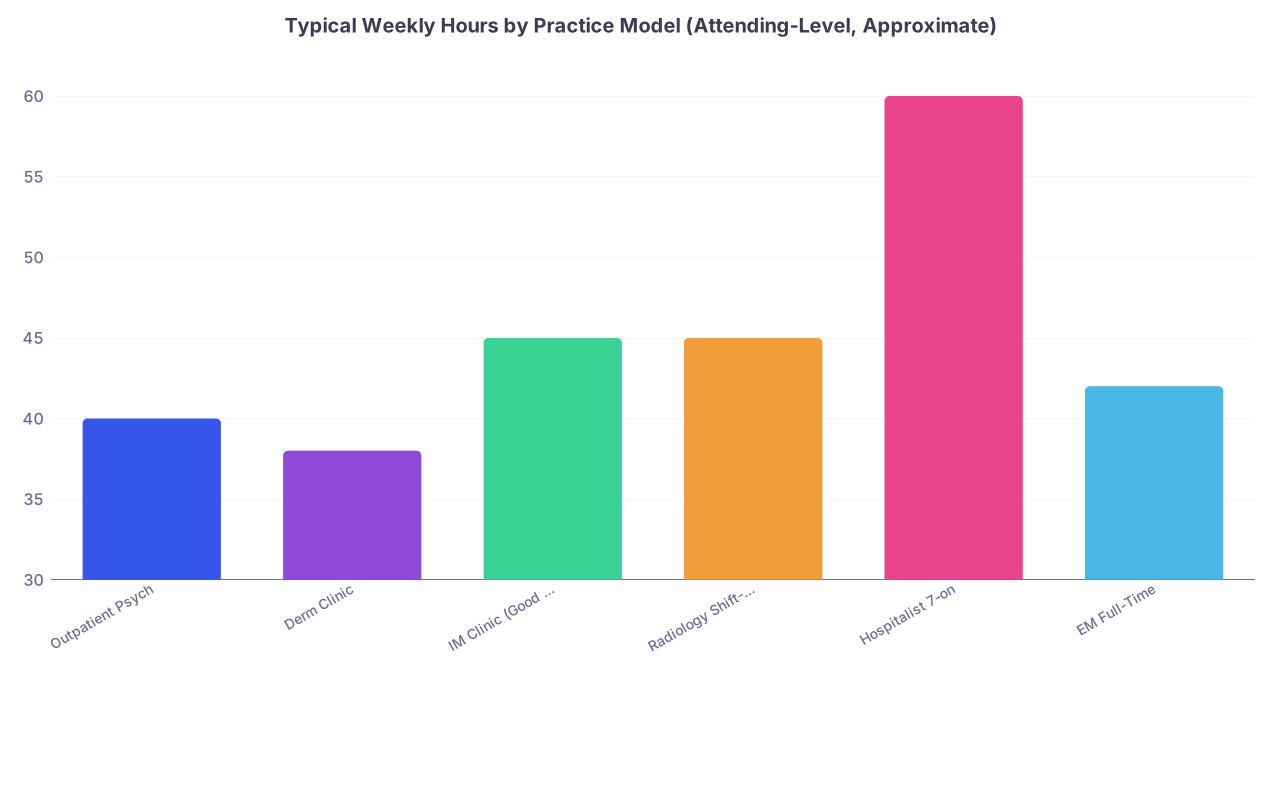
| Category | Value |
|---|---|
| Outpatient Psych | 40 |
| Derm Clinic | 38 |
| IM Clinic (Good Setup) | 45 |
| Radiology Shift-Based | 45 |
| Hospitalist 7-on | 60 |
| EM Full-Time | 42 |
These are rough and depend heavily on the actual job—but they reflect what I see repeatedly when people make intentional, lifestyle-conscious choices.
Step 10: The Mindset Shift You Need
If you need predictable hours for family, you have to treat your time the way others treat their CV.
Most students optimize for:
- Most prestigious specialty.
- Most competitive program.
- Most “interesting” cases.
You’re optimizing for:
- Sustainable presence at home.
- A schedule you can plan life around.
- Enough mental bandwidth left after work to be a human being.
That means:
- Saying no to specialties that would impress other residents but crush your home life.
- Accepting that some people will silently judge your “lifestyle” choice. Let them. They won’t be tucking your kids in.
- Being strategic early instead of trying to “fix it later” with magical thinking about future jobs.
You only get one shot at the core training path. It’s much easier to dial up intensity (take leadership roles, add procedures, shift into a busier job) than to escape a field whose baseline hours are hostile to your life.
If you remember three things
- “Predictable hours” comes from specialty + practice model + setting, not specialty alone. You must care about all three.
- Outpatient-heavy fields (psych, derm, path, allergy, rheum, endo, well-structured primary care, many radiology jobs) give you the best odds—if you stay picky about the specific job later.
- Do not wait. Use your clinical years to observe actual lives, not just diseases. Ask blunt questions, track real hours, and choose a path where your family can exist as more than an afterthought.