
When Your Partner’s Career Limits Location: Choosing a Flexible Specialty
What do you do when you realize your partner’s job makes you basically a one- or two-city doctor—while your dream specialty tends to cluster in big academic hubs?
If that’s where you are, you’re not alone. I’ve seen this exact scenario way more times than anyone admits publicly:
- Your partner is locked into a specific city or region (industry hub, family business, military posting, government work, unique niche job).
- You’re in med school, trying to choose a specialty.
- Every talk you hear assumes you can “go where the programs are.”
- You can’t.
Let’s walk through how to handle this like an adult instead of just “hoping it’ll work out” (which is how people end up scrambling into a SOAP spot 1500 miles away from their spouse).
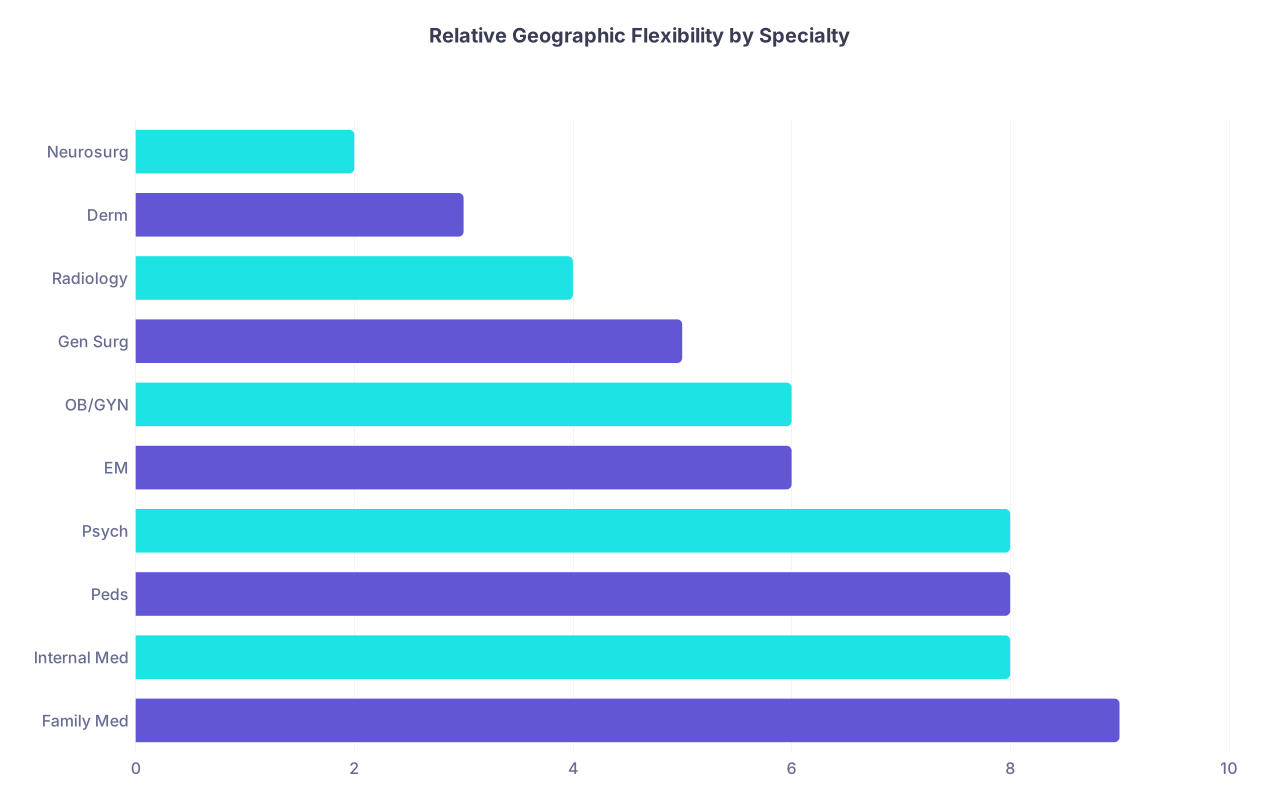
| Category | Value |
|---|---|
| Family Med | 9 |
| Internal Med | 8 |
| Peds | 8 |
| Psych | 8 |
| EM | 6 |
| OB/GYN | 6 |
| Gen Surg | 5 |
| Radiology | 4 |
| Derm | 3 |
| Neurosurg | 2 |
(10 = very flexible, 1 = highly restricted; rough, not gospel)
Step 1: Get Brutally Honest About Your Partner’s Constraints
Before you obsess over specialties, you need clarity on the non-negotiables.
You’re not just choosing “what I like.” You’re choosing what has to coexist with:
- One person whose job only exists in a few major cities
- Or someone tied to a family business in a small town
- Or a partner with licensure restricted to one state
- Or immigration/visa rules that narrow you to specific regions
Do this on paper, not just in your head.
List actual cities/regions that are realistic for your partner’s career.
Not “we’d love Seattle.” More like: “My partner’s entertainment law job is realistically: LA, NYC, maybe Atlanta.”Rank them:
“Must-have,” “would be okay,” “stretch but possible.”Map them against reality using basic filters:
- How many residency programs in each city?
- Academic vs community?
- Any programs actually in your future specialty possibilities?
If your partner truly has only 1–2 realistic cities, that’s a strong signal: You must prioritize broadly available specialties and large program counts.
If you have 5–10 cities, you’ve got more room, but you still can’t act like you’re fully location-flexible.
This is the part where people lie to themselves. Don’t. If your partner cannot move from Houston because of a family business, stop secretly planning a neurosurgery career that needs a specific academic center in Boston “if it works out.” It probably won’t.
Step 2: Understand Which Specialties Are Location-Flexible
Not all specialties are created equal for couples with location constraints. Some are everywhere. Some only live where there’s a large academic ecosystem.
Here’s the blunt version.
| Flexibility Tier | Examples | Typical Availability |
|---|---|---|
| High | FM, IM, Peds, Psych, Anesthesia, Gen Surg | Almost every region, mix of community and academic |
| Medium | EM, OB/GYN, Radiology, Neurology, PM&R | Many cities, but fewer programs per city |
| Low | Derm, ENT, Urology, Ophtho, Ortho, Gas, Cards, GI, Heme/Onc | Clustered in larger cities/academic centers |
| Very Low | Neurosurg, CT Surg, Plastics, Rad Onc | Very few programs nationally, often big academic hubs |
You want to think in three time frames:
- Residency match – Can you realistically match near your partner?
- Fellowship (if needed) – Will you have to move again and blow up their job?
- Attending job market – Will community/nearby jobs exist, or are you tied to university centers forever?
High-flex specialties (good for tight geography)
Typical “safer” bets if your partner is geographically constrained:
- Family Medicine
- Internal Medicine (without being dead-set on ultra-competitive subspecialties)
- Pediatrics
- Psychiatry
- Anesthesiology
- General Surgery (with some caution, but still reasonably spread out)
These live in both big metros and mid-size cities. And often in multiples per city.
If your partner must stay near a mid-size city with one academic center and surrounding community hospitals, these are the areas where you’ll usually find at least one residency and multiple eventual job options.
Medium-flex specialties
- Emergency Medicine
- OB/GYN
- Radiology
- Neurology
- PM&R
They’re present in most major regions but not always in small cities or rural areas, and usually fewer programs per city. Good if your partner has a handful of possible cities, not one.
Low-flex and ultra-specialized
Derm. Neurosurg. ENT. Plastics. Rad Onc. Urology. Even Cards/GI/Heme-Onc strongly tied to academic training environments and large groups.
Can you still do these with a location-limited partner? Yes—if:
- You have multiple viable cities
- You and your partner are okay separating temporarily for training, or
- Their job is eventually mobile, just not now
If your partner will never be mobile and you’re locked to one small-ish city long term, picking neurosurgery or derm is basically betting your relationship on a lottery.
Step 3: Reverse Engineer From the Map, Not From the Dream
Most med students start:
“What specialty do I want?” → “Where can I train?”
You? You start:
“Where can we actually live?” → “What specialties can reasonably exist there?”
Very different.
Pull up the map for a city your partner is realistically tied to—say, Charlotte, or Tulsa, or San Diego, or Detroit.
Then do this:
- Look up every residency program within 60–90 minutes.
- Group them by specialty.
- Count: how many programs in your possible fields of interest?
If you’re only seeing one tiny program in your chosen specialty within that entire radius, you should not count on that single program working out. A single residency program is not a plan; it’s a wish.
But if you see:
- 3 IM programs
- 2 Peds
- 2 Psych
- 2 FM
- 2–3 Anesthesia / Gen Surg / OB
- A smattering of others
Now you’ve got some redundancy. That’s what you want.
Step 4: Reality-Check Your Competitiveness
Geographic restriction makes you less flexible. So your application has to be more competitive.
What does that mean in practice?
If you’re targeting a region with:
- Fewer programs
- Or more desirable cities (Seattle, Denver, San Diego, Austin, Boston, NYC)
You’re up against applicants who are willing to move from anywhere. You’re not special to the program just because you “really want to be there with your partner.” Hundreds of people “really want” to be there.
You need to ask, now, in MS1–MS3:
- Where would my board scores, class rank, and CV realistically land me?
- Am I positioning myself for “I can match most places in this region” or “I’d be lucky to match anywhere at all”?
If your scores and performance are average and your partner is locked to one highly competitive city, you might need to:
- Choose a more flexible specialty
- Or expand your geographic radius
- Or consciously accept that training apart for a few years might be needed
Wishing doesn’t change math. More competitive location = you need to carry more weight.
Step 5: Decide Where You’re Willing to Flex – And Where You’re Not
You can’t lock everything at once:
- Exact specialty
- Exact city
- Exact program caliber
- Zero separation from partner
- Minimal training length
Pick what’s non-negotiable, and what’s negotiable.
Some options:
Non-negotiable: stay with partner; flexible on specialty
You pick a specialty that’s reasonably available near them. You swallow your pride that maybe you won’t be a skull-base neurosurgeon.Non-negotiable: specific specialty; flexible on living apart temporarily
You match where you can. You and your partner do long-distance for residency/fellowship with a plan and timeline.Non-negotiable: both partner’s job and your dream hyper-competitive specialty, same city
This is the fantasy option. If you choose it, at least be honest that you’re betting your relationship and career on very long odds.
I’ve watched couples try to pretend they’re doing #1 while acting like they’re doing #3. That’s how you get:
“I only applied to 6 neurosurgery programs near my girlfriend in LA” followed by “I didn’t match.”
Be explicit with each other:
“What are we actually willing to give up, and what are we actually not willing to give up?”
Step 6: Use Dual-Career Strategy Like a Professional, Not a Panicked Student
You’re not the first couple with this problem. There’s a whole concept for you: dual-career couples.
Here’s how to approach it smartly:
Start the conversation early
Not MS4 January. MS2–MS3 is better.
You both need to know:
- Is your partner willing to change jobs, companies, or industries later?
- Is there any remote/hybrid future for them, even if not now?
- Are they promotion-tracked in a way that roots them to one place?
If they say, “My career is literally only viable in DC or NYC,” treat that like a law of physics in your planning.
Use the couples match strategically (if relevant)
If your partner is also in medicine, couples match can help, but it is not magic.
You still need:
- Broad specialty choices (or at least one of you in a broad specialty)
- Enough combined programs in a region to make pairings realistic
- Willingness to rank a lot of combinations, including imperfect ones
Do not:
Both pick highly competitive, low-volume specialties and insist on a single metro area. That’s the “how did we both not match?” path.
If your partner is non-medical
Your leverage moves more like this:
- You apply broadly in a geographic band rather than one city only (for example: all of New England, or the Texas triangle, or SoCal).
- Your partner explores industry-adjacent roles that may exist in more cities than they realize.
- You target specialties and programs where local industry is strong enough to support their job.
Example: Partner in finance? You’ve got options in NYC, Chicago, SF, Boston, Charlotte, some Texas cities.
Partner in film? Realistically LA, NYC, Atlanta, maybe a few others. Much tighter. Your specialty better be broad.
Step 7: Consider Fellowship and Long-Term Job Market Before You Commit
If your chosen specialty typically requires fellowship to get the job you actually want, you’re not choosing “3–4 years away.” You’re choosing 6–7+ years of potentially needing flexibility.
Cardiology, GI, Heme/Onc, Neonatology, some critical care, peds subspecialties—these often mean:
- Step 1: Match into residency (with geographic constraints)
- Step 2: Compete nationally for fellowship (often with less geographic choice)
- Step 3: Then find a job where both your skills and your partner’s industry exist
If your partner is locked to one city that has:
- One IM residency
- One Cards fellowship
- Two large hospitals employing cardiologists
Ask yourself: How many “cards job in this exact city” are going to open exactly when you finish? It’s safer than neurosurgery, sure. Still not great if you refuse to ever move.
For broad specialties (FM, Psych, Peds, IM generalist, Anesthesia), the attending market is much more forgiving. That’s a huge deal for you.
Step 8: Mentally Separate “I Like It” From “I Can Build a Life With It”
You might love your derm rotation. Or your neurosurg shadowing. Or ENT clinic. Enjoy it. Learn from it.
Then ask a separate question:
“Can I, with my partner’s constraints, plausibly build a career and a stable life in this specialty without constant geographic warfare?”
Sometimes the answer is no. And that’s not failure. That’s responsible decision-making.
I’ve seen students mature a decade in one conversation when they realize:
“I like derm a lot, but I also like Psych and IM. My partner is locked to one mid-size metro with few academic centers. If I pick psych or IM, we actually stand a chance of staying together and not living apart for 7 years.”
That’s not “giving up on your dream.” That’s choosing a different dream: one where your profession and your relationship can coexist.
A Simple Framework if You’re Stuck
If you’re truly torn between “dream specialty” and “relationship reality,” run this thought experiment:
Imaginary world A:
You match your dream specialty in a different city. Your partner can’t move. You live apart for 5–7 years. Assume you do match somewhere, but you don’t control where. How does that feel?Imaginary world B:
You choose a more flexible specialty, less shiny maybe, but available in your partner’s city. You two live together. You still have a respected career and stable life, but you never become, say, a spine surgeon.
Which scenario feels like a regret you can live with?
There’s no universally right answer. But pretending the tradeoff doesn’t exist is the only consistently wrong answer.

| Step | Description |
|---|---|
| Step 1 | Partner has strong location constraints |
| Step 2 | Prioritize high-flex specialties |
| Step 3 | Mix of high- and medium-flex specialties |
| Step 4 | More room for lower-flex specialties |
| Step 5 | Choose specialty present in partners cities with multiple programs |
| Step 6 | Consider competitive specialties but apply broadly |
| Step 7 | How many viable cities? |
| Step 8 | Willing to live apart? |
FAQs
1. Is it “wrong” to choose a specialty mainly because it’s more flexible for my relationship?
No, that’s not wrong. That’s being realistic about your actual life. The idea that “pure passion” should override every other factor is romantic nonsense. People choose specialties for all sorts of practical reasons: lifestyle, income, geography, length of training. Prioritizing your relationship and long-term stability is legitimate. The only mistake is lying to yourself about what you’re doing—own the choice.
2. Should my partner be willing to move for my residency if their job is more flexible?
If their job is actually more flexible, yes, it’s reasonable to expect some movement. But don’t just assume that. Sit down and map it out together: what cities hold decent prospects for both of you? What would it cost them career-wise to move? You’re not ranking specialties in a vacuum; you’re negotiating a shared life. Sometimes the answer is “they move once for your training, then you commit to prioritizing their career in the next move.” Make it explicit, not vague.
3. Can I “try” for a super competitive, location-limited specialty and just back-up into a more flexible one?
You can, but you have to design that backup before ERAS, not during SOAP panic. That means:
- Applying to both the competitive specialty and the backup, intentionally
- Understanding that once you SOAP into the backup, you’re probably not circling back later
- Being honest about how your application stacks up
If you’re aiming for something like derm or neurosurg in one specific metro and think “worst case I’ll scramble into IM there,” you’re kidding yourself. SOAP is chaos and you do not control where those backup spots will be.
4. What if I genuinely have no idea what city we’ll end up in because my partner’s career is still evolving?
Then your best move is to protect your future options. That usually means:
Pick a specialty with lots of programs and a wide eventual job market across cities and community settings (IM, FM, Psych, Peds, Anesthesia, Gen Surg, etc.). The more uncertain the geography, the more you should favor specialties that exist everywhere. You can’t control their career trajectory yet—but you can avoid backing yourself into a niche that only lives in 10 cities nationwide.
Key Takeaways:
- Start with your partner’s real geographic limits, not your fantasy map.
- Choose specialties with enough program and job density to give you redundancy near where your partner can work.
- Be explicit about tradeoffs: specialty, location, and staying together during training—you don’t get all three on your terms.