
The moment you hit your core clerkships, people start labeling you behind your back: “surgeon” or “cognitive doc.” And those labels stick much harder than you think.
I’ve watched this for years in faculty rooms, pre-round huddles, and resident workrooms. Students are still sweating their shelf scores while the team has already decided, “She’s going to be a surgeon,” or “He’s clearly a medicine brain.” They are not waiting for your ERAS personal statement to tell them who you are. They’ve already decided which box you live in.
Let me walk you through how that actually happens.
The Quiet Sorting Hat: How You Get Labeled Without Knowing
There’s no form that says “Label this student: Surgeon vs Cognitive Doc.” But functionally, it might as well exist.
On rounds, between cases, in sign-out, you get summarized in one line. I’ve heard variations of this hundreds of times:
- “Smart kid. Total medicine brain.”
- “She’s definitely one of us.” (said in the OR)
- “Good with patients but not a proceduralist.”
- “I don’t see him in clinic. He needs movement.”
Those one-liners become your reputation across departments. They get repeated when someone asks, “How is that MS3 doing? Thinking about surgery?” or “Would they fit our IM program?”
You think you’re exploring. They think they’re categorizing.
Here’s the truth most students miss: the “surgeon vs cognitive” label is less about what specialty you say you want and more about how your behavior patterns under pressure. How you move when nobody is “evaluating” you. How you think when you’re tired. Whether your eyes light up in the OR or gloss over in a four-page note.
And yes, they’re watching. All the time.
What Program Directors Mean By “Surgeon Type”
I don’t care if it’s general surgery, ortho, ENT, neurosurg, urology, OB/GYN. The core “surgeon type” pattern looks the same to faculty.
Let me translate the real criteria they’re using.
1. Action Bias vs Reflection Bias
Surgeon types want to do something. Now.
You see it on day one of the surgery rotation. There’s the student standing in the corner, typing on their phone brain, trying to memorize steps. And there’s the other student:
- Already scrubbing before being asked.
- Stepping up to move the bed without being told.
- Reaching for the suction when the field floods, without panicking.
That second one gets called “a surgeon.”
It’s not about brute extroversion. It’s how your mind defaults when there’s a problem. Surgeon types think:
“What can we do right now to fix this?”
Cognitive types think:
“What does this mean, and what patterns does it fit?”
Both are valuable. But only one feels at home in an OR.
2. Tolerance for Chaos and Mess
Surgeon types have a high tolerance—almost a preference—for messy, incomplete information in a high-stakes moment.
Two students on trauma call, 2 a.m.:
Student A freezes when three things happen at once: vital signs dropping, family crying, trauma attending barking orders. They step back, start asking themselves if the patient might have XYZ diagnosis, mentally rifling through UpToDate articles they read last week.
Student B leans into it. Grabs the blood pressure cuff. Holds pressure where the intern points. Doesn’t need all the information before acting on the part they understand.
Guess which one the trauma team calls “one of us”?
No one says it out loud, but surgeon faculty test this constantly. Fast pages. Sudden “scrub in now” moments. Last-minute add-on cases. They’re gauging if you short-circuit with chaos or get sharper.
3. Physicality: How You Use Your Body
This one’s not politically correct, but it’s true: surgeons notice if you’re comfortable being physical with medicine.
Not just “arms strong enough to hold retractors.” I mean:
- Do you naturally step in to help move a patient up the bed?
- Do you adjust the retractor angle before someone tells you, because you can see the attending’s line of sight is blocked?
- Do you anticipate the next step physically—turning the lights, positioning the patient, managing cords?
Faculty clock this in seconds. I’ve sat next to attendings in the OR saying quietly: “This student thinks with their hands” or “He’s all in his head; medicine guy.”
You’re not fooling them by saying, “I’m really interested in surgery.” They’re focused on what your body language says when you think nobody’s grading it.
4. Relationship With Time and Decisiveness
Surgery is unforgiving about time. A lot of cognitive fields stretch it: hold the diuretic, recheck tomorrow, follow up outpatient. In surgery, indecision costs blood loss, OR minutes, complications.
Even as a student, faculty see little signals of your “time stance”:
- Do you waffle when presenting: “It could be this, or this, or this…” with no leading impression?
- Or do you say, “My leading concern is X, but I considered Y and Z because…”?
Surgeons aren’t looking for cocky students. They’re looking for people who are willing to commit to a working plan, accept they might be wrong, and adjust fast.
The “surgeon label” quietly lands on students who can do that. The ones who never commit? They get put in the “cognitive” bucket, often unfairly but consistently.
5. Emotional Economy
Here’s something very few people will tell you: surgeon types tend to compartmentalize emotion differently.
They’re not heartless. The good ones care deeply. But they know how to put feelings on a shelf during the crisis and pull them back down later.
On call, patient crashes and dies. Two students:
One is visibly shaken for hours, can’t re-engage with the rest of the work. They ruminate in front of the team. “I just keep replaying it.”
The other looks a little grim, stays focused, finishes scut, maybe circles back at 3 a.m. in the call room with, “Can I ask you about what happened with that patient earlier?”
Residents clock that. They’re not judging your humanity, they’re evaluating your ability to keep functioning when bad things happen at 2 a.m.
That’s what they mean when they say, “She has a surgeon temperament.”
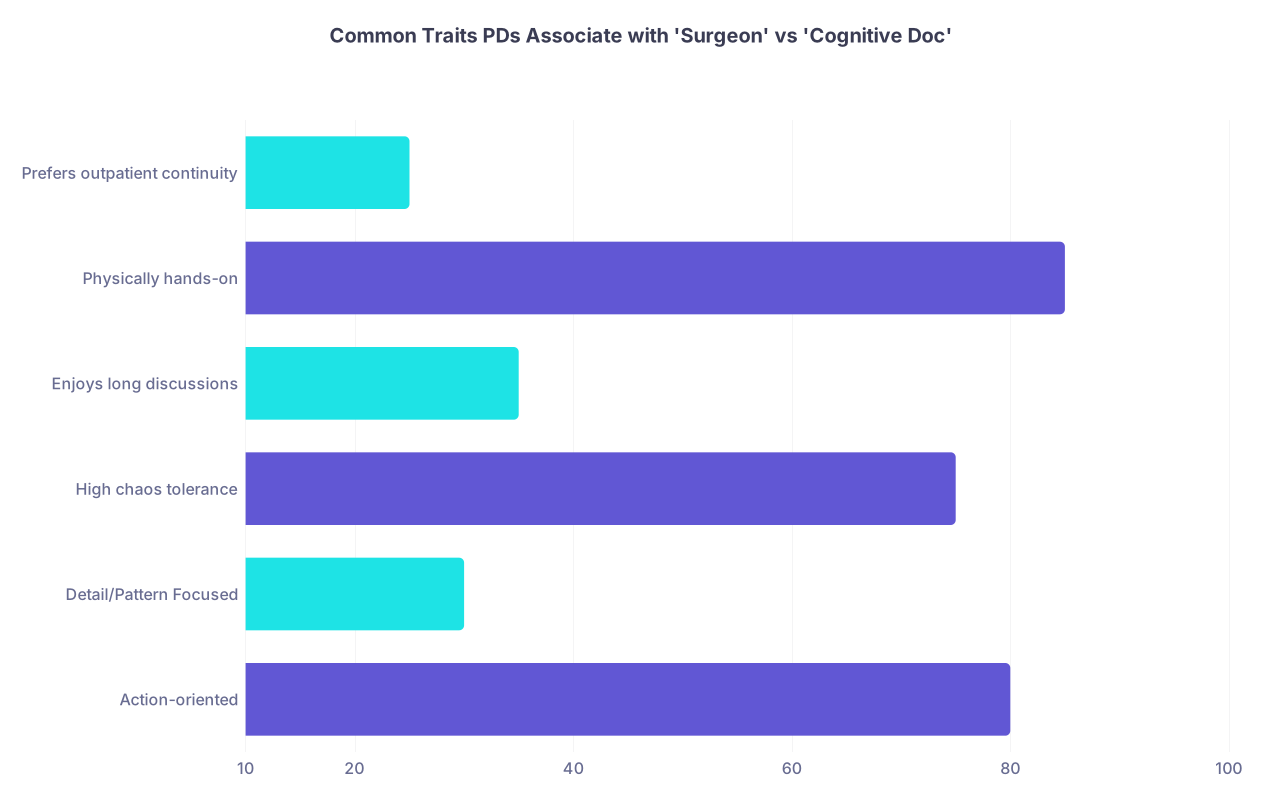
| Category | Value |
|---|---|
| Action-oriented | 80 |
| Detail/Pattern Focused | 30 |
| High chaos tolerance | 75 |
| Enjoys long discussions | 35 |
| Physically hands-on | 85 |
| Prefers outpatient continuity | 25 |
What “Cognitive Doc” Actually Means (From The Faculty Side)
“Cognitive doc” is not an insult. Internists, neurologists, rheumatologists, endocrinologists, GI, ID—these are the people other doctors call when they’re out of ideas.
When attendings say “cognitive,” they’re talking about more than “likes reading.” They’re flagging a very particular way of engaging with medicine.
1. Pattern Matching Over Fix-It-Now
Cognitive types get a thrill out of sorting complex, tangled data into a coherent story.
You see it on internal medicine, neurology, psych, even complex peds:
- The student who loves deep-diving labs, prior notes, imaging.
- The one who finds the CT from 3 years ago that changes everything.
- The student who, when the attending asks, “What’s the unifying diagnosis?” pauses, looks at the board, and lights up as they connect anemia + neuropathy + weird weight loss.
Their reward center fires when a scattered puzzle snaps into place.
Put that same student in a long day of lap choles where everything goes smoothly? They’re bored out of their mind by case three. The residents know. “Definitely medicine.”
2. Comfort With Ambiguity Over Speed
Internal medicine, neurology, rheum, ID—these fields live in ambiguity. They manipulate probability over days and weeks, not seconds.
Watch how students handle a patient with three possible diagnoses:
Surgeon-type student: “If it’s X, we should do Y now. If it’s Z, we’ll need to talk to surgery anyway. Maybe we should get the CT right away.”
Cognitive-type student: “Well, the pretest probability is highest for X because of A, B, C, but Y could explain symptom 3, and I want more info from prior labs and imaging before escalating.”
Faculty love that on the medicine side. On surgery, that same student gets labeled “hesitant,” “too much in their head.”
Same brain. Different environment. Different label.
3. Depth Over Breadth of Task
In clinic, cognitive types want to dig. They’re the student who spends 30 minutes with one patient, comes back with a beautifully organized history, and three thoughtful differentials.
They’re also the student who silently dies inside when told, “We’re 40 minutes behind, just focus on the main problem.”
They remember minutiae: dates of symptom onset, exact drug doses, tiny changes over time. On rounds:
- Their presentations are dense but structured.
- They anticipate the question “Why did you pick that diagnosis?” and have a thoughtful, literature-based answer.
Attendings on medicine services will literally say, “They’re one of us,” and start nudging them toward IM, neuro, or subspecialty clinics.
4. Relationship With Procedures
Huge misconception: cognitive types hate procedures. Wrong.
Many cognitive docs enjoy procedures—but as part of a bigger diagnostic or longitudinal thinking game (cardiology with caths, GI with scopes, pulm with bronch, rheum with biopsies). They’re less interested in living in the OR for 10 hours and more interested in:
- What the procedure tells them.
- How it changes the long-term plan.
- How it fits into pathophysiology.
If you light up equally for solving the “why” of a disease and then doing the targeted procedure that addresses it, you’re right in the cognitive–procedural hybrid zone: GI, cards, pulm, heme/onc, IR.
Medicine faculty notice how you talk about procedures. Are you obsessed with the technique itself, or with the brainwork before and after?
5. Emotional Stance: Attachment Over Adrenaline
Cognitive types are often more drawn to continuity and story over adrenaline:
- They remember patient narratives months later.
- They care about outpatient follow-up, social context, little life details.
- They feel energized by multi-visit arcs, not crisis snapshots.
Surgeon attendings see that and think, “They’ll be wasted in the OR.” Medicine and neuro attendings think, “We should recruit them.”
Again: same personality, different service, completely different narrative built around you.

How The Label Spreads Behind Closed Doors
You think your evals are the only permanent record. They’re not. The hallway conversations are.
Here’s what happens in real life:
A third-year student finishes surgery, then rotates through IM. The IM clerkship director emails the surgery director: “Hey, how was this student? They’re talking about surgery vs medicine.”
The reply is never a long essay. It’s one or two sentences:
- “Great worker, clearly a surgeon type.”
- “Strong on the floor, but not really OR-inclined. More cognitive.”
- “Very smart but struggled with pace—would thrive in IM.”
Those short labels shape everything: who writes your letters, how strongly, and for which specialty. I’ve watched a single “He’s really a medicine brain” comment kill the seriousness of a half-hearted “I might apply to gen surg” conversation.
Residents do the same thing. They talk about who they’d want on their team as colleagues. That’s the real vote.
How You Accidentally Send The Wrong Signal
Plenty of students end up mis-labeled because they don’t understand what behaviors scream “surgeon” or “cognitive” to faculty.
Scenario 1: The Aspiring Surgeon Who Looks Cognitive
You tell everyone you’re “really interested in surgery,” but:
- You look dead behind the eyes after case 2.
- On pre-rounds, your notes are over-detailed, medicine-style, with a 10-point differential on a straightforward appy.
- When asked for plans, you hedge forever.
- You disappear when there’s heavy lifting—transfers, turning, bed moves—but reappear eagerly for case conferences.
To the team, that reads as: “Likes the status of surgery, but not the work. More cognitive.”
I’ve watched PDs quietly move these students into the “will probably end up in IM or radiology” box. Even while the student is still talking about ortho in the OR.
Scenario 2: The Future Internist Who Gets Tagged as a Surgeon
Flip side. You think you’re probably IM, but on surgery you:
- Show up early, eager, never complain.
- Anticipate needs in the OR like you’ve been there for months.
- Handle chaos on call like you’ve been wired for it.
The residents start telling the PD, “We need this one.”
If you don’t speak up and say, “I’m leaning heavily toward IM but want to get good at acute care,” the system will automatically route you toward surgery in people’s heads. You’ll get invited for more home-call, pulled into complex cases, then later you’ll struggle to convince IM faculty you’re “really one of them” because you never showed your cognitive side as openly.

| Step | Description |
|---|---|
| Step 1 | Clinical Rotation Start |
| Step 2 | Early Behaviors Observed |
| Step 3 | Surgeon Type Impression |
| Step 4 | Cognitive Type Impression |
| Step 5 | Informal Comments to Faculty/Residents |
| Step 6 | Clerkship Director Summary |
| Step 7 | Letter of Recommendation Tone |
| Step 8 | Program Director Perception at Application |
| Step 9 | Action vs Reflection Bias |
Using The Label Instead of Letting It Use You
Here’s the key: you do not control whether people label you. You do control what evidence you give them.
Step 1: Pay Attention to Where You Naturally Come Alive
This isn’t about what sounds impressive at cocktail parties. It’s about where your brain feels correctly calibrated.
Notice:
- Do you feel more like yourself scrubbing a case at 9 p.m. or sitting in a quiet workroom picking apart a puzzling lab pattern?
- After a long chaotic call night, do you think, “That was awful, I never want to do that again,” or “That was brutal, but I kind of loved the intensity”?
- Do you find 6 back-to-back clinic visits draining or satisfying?
Your honest answers here often match how attendings are already quietly labeling you. If they don’t, there’s a mismatch you need to fix—either in behavior or self-awareness.
Step 2: Signal Your True Direction Deliberately
If you know you lean “surgeon” but you’re still exploring, say that out loud to non-surgical attendings:
“I’ve really enjoyed the OR and I’m considering surgery, but I care a lot about thinking through complex medicine. I’d appreciate feedback on whether you see a better fit anywhere.”
That does two things. It:
- Makes them actually look for fit instead of rubber-stamping the obvious.
- Invites them to describe how they see you. You get intel on your label.
If you’re cognitive-leaning, same approach on surgical rotations:
“I’m leaning toward a cognitive field like IM or neuro, but I wanted to see how I function in a more acute, procedural environment. Any feedback on what you see as my strengths and weaknesses?”
Now your “cognitive-ness” isn’t interpreted as disinterest in surgery; it’s seen as part of intentional exploration. Subtle but huge shift.
Step 3: Understand How This Touches Your Letters
Letters of recommendation are coded. PDs read through the fluff and look for alignment:
For surgical applicants, they want to see: “Hard-working, unflappable under pressure, technically adept, great in the OR, took ownership on call.”
For cognitive applicants, they want to see: “Exceptionally thoughtful, excellent clinical reasoning, synthesizes complex data, longitudinal follow-up, outstanding communication.”
You can shape this by the kind of work you lean into on each rotation.
On surgery, even if you’re going into IM, show that you can handle pace, responsibility, and acute thinking. The letter will say, “Would be an asset to any residency, including medicine.” That line carries real weight.
On IM, if you’re going surgical, push yourself to present tight plans, not rambly differentials. You want, “Surprisingly decisive and action-oriented—would excel in procedure-heavy fields.”
| Student Behavior | Surgery PD Interpretation | IM/Neuro PD Interpretation |
|---|---|---|
| Hesitant to commit to a plan | Not a surgeon temperament | Thoughtful, good fit |
| Anticipates needs in crises | Strong surgical potential | Great for ICU/acute care |
| Loves long complex discussions | Might be bored in OR | Ideal cognitive doc |
| Physically engaged with patient care | Good procedural candidate | Good for cards/GI/pulm |
| Thrives in continuity clinic | May prefer outpatient field | Strong IM/endo/rheum fit |
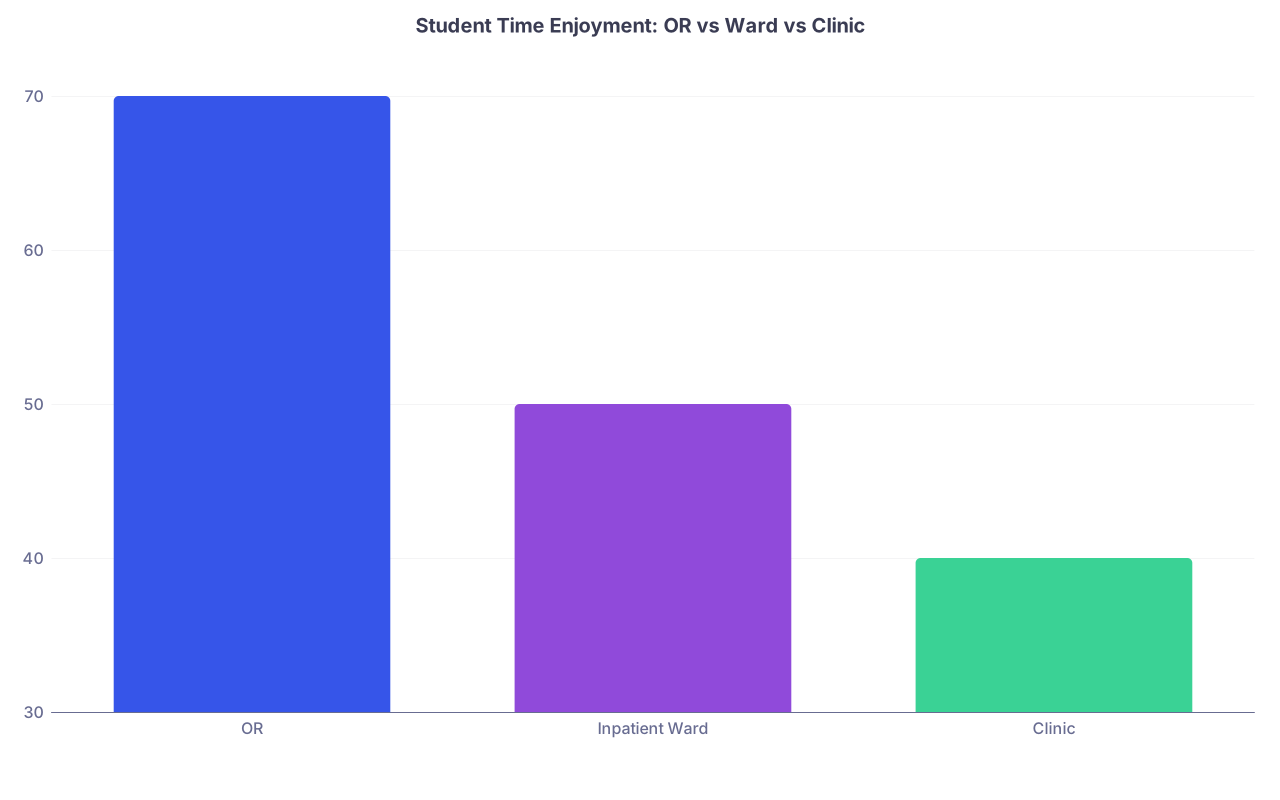
| Category | Value |
|---|---|
| OR | 70 |
| Inpatient Ward | 50 |
| Clinic | 40 |
Step 4: Don’t Let Prestige Myths Override Your Wiring
I’ve seen students fight their own temperament for the wrong reasons:
- Brilliant cognitive students pushing themselves into surgical paths because they think “real doctors operate.”
- Natural surgeons suffocating in overcognitive specialties because they’re scared of lifestyle myths.
Every attending can tell you a story of the “wrong fit” resident who burns out or bails after PGY-2. It almost always comes back to this mismatch: how they’re wired vs what the specialty demands every damn day.
You can fake it for a 4-week rotation. You cannot fake it for a 5-year residency.
Listen to how people describe you. Then ask yourself if that description matches the person you want to be at 2 a.m. on year four of training.

How To Act When You’re Truly Undecided
Some of you genuinely sit in the middle. You love the OR and complex puzzles. You’d be honestly happy doing either. That’s not indecision—it’s range.
Here’s how to handle it like a grown adult, not a drifting student.
Rotate with intentional experiments:
On surgery: Lean all the way into being “that” student—early, hands-on, own patients, embrace chaos. See how you feel after four weeks of that intensity.
On IM/Neuro: Lean fully into the deep-thinking side—long charts, evidence-based plans, careful follow-up. See whether the slower burn of cognitive work leaves you satisfied or restless.
Then listen carefully to the language in your feedback:
- “You’re definitely one of us.”
- “You could do anything, but I really see you in X.”
- “You handled Y better than most residents.”
The consistency of those comments over multiple services is your real data.

| Category | Value |
|---|---|
| Student 1 | 1,4 |
| Student 2 | 4,4 |
| Student 3 | 2,1 |
| Student 4 | 3,3 |
| Student 5 | 5,2 |
(Here, 1 = strongly cognitive, 5 = strongly surgical; x-axis = student self-rating, y-axis = average faculty label.)
Notice how often those dots don’t line up in real life.

The Bottom Line
Program directors, attendings, residents—they’re labeling you as “surgeon” or “cognitive doc” long before you submit ERAS. They do it based on your default behavior under pressure, your relationship with time, chaos, and ambiguity, and where your energy spikes or drains on a normal day.
Three things to remember:
- The label is already being made; your job is to shape the evidence people see so it matches who you actually are.
- Listen to the patterns in how faculty describe you—that’s your true specialty “mirror,” whether you like what you see or not.
- You can fake a rotation. You cannot fake a career. Choose the side—surgeon or cognitive doc—where your wiring and the work line up when it is 3 a.m., you are exhausted, and the outcome really matters.