
The hierarchy of specialties on academic rounds is real, and pretending it doesn’t exist is how students get quietly sidelined.
Everyone in an academic hospital feels it, but almost no one says it out loud. On paper, all specialties “collaborate.” In reality, there’s a pecking order that shapes whose opinion is deferred to, whose pages get answered first, whose consult notes get read, and which students are taken seriously.
You feel that discomfort on rounds? The subtle way some services walk in like they own the place, and others are treated like consultants for “annoying details”? That’s the unspoken hierarchy.
Let me walk you through how it actually works when the doors close and the students aren’t in the room.
1. The Core Power Structure: Who “Owns” the Patient
Here’s the first truth no one tells you as a student: hierarchy on rounds starts with who owns the patient, not who knows the most.
In the academic world, especially at big university hospitals, there’s a mental map that attendings and residents use. They’d never show it on a slide, but it drives everything.
The service that “owns” the patient is usually:
- General medicine (academic internal medicine)
- General surgery
- Sometimes hospitalist services in community/academic hybrids
Everyone else — cardiology, nephrology, ID, ortho, anesthesia, ICU — is technically “consult.” And consult = advisor, not owner.
But the prestige hierarchy within that is different from the ownership hierarchy. That’s why you’ll see this weird dynamic:
- Cardiology fellow walks in: medicine residents suddenly become very interested.
- Palliative care walks in: half the room subconsciously checks their phones.
- Orthopedics walks in: surgery residents roll their eyes but immediately change half their plan to match whatever ortho says.
Ownership gives you control; perceived prestige gives you gravity. Put them together, and you understand rounds.
Let me show you how the culture tends to stack specialties inside academic hospitals.
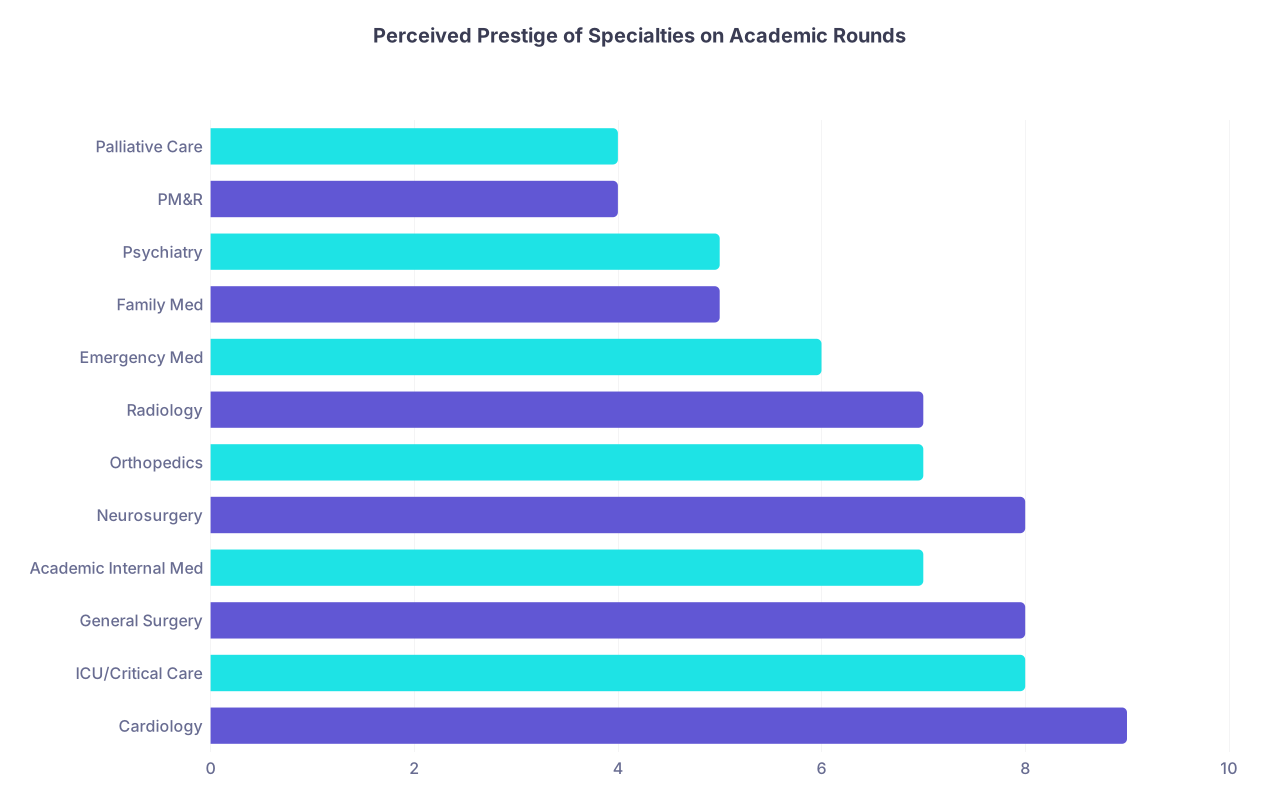
| Category | Value |
|---|---|
| Cardiology | 9 |
| ICU/Critical Care | 8 |
| General Surgery | 8 |
| Academic Internal Med | 7 |
| Neurosurgery | 8 |
| Orthopedics | 7 |
| Radiology | 7 |
| Emergency Med | 6 |
| Family Med | 5 |
| Psychiatry | 5 |
| PM&R | 4 |
| Palliative Care | 4 |
Is this “fair”? No. It’s just how people act.
2. Medicine vs Surgery: The Cold War Driving Everything
The most important divide you have to understand is not cardiology vs nephrology. It’s medicine vs surgery. That’s the Cold War that shapes tone, notes, how pages are answered, and what you as a student are implicitly expected to value.
Here’s the unfiltered version.
On most academic rounds:
- Medicine thinks surgery is simplistic and arrogant.
- Surgery thinks medicine is verbose and indecisive.
On a real medicine team I worked with, the attending would routinely say after a surgical consult: “Ok, now let’s do the actual thinking.” That’s not a joke. That’s a worldview.
On the surgery side, in a pre-op huddle, I heard an attending tell the intern: “If medicine hasn’t cleared them yet, it just means they haven’t finished the echocardiogram they ordered for everyone over 50.” Again — not a joke. A reflex.
Who wins the hierarchy war on your campus depends on culture:
- At some places (think big-name IM powerhouses), academic medicine is the intellectual core of the hospital.
- At others (big surgical empires, transplant centers, trauma meccas), surgery is the sun and everyone else orbits them.
Your clue is simple: which department chairs are treated like actual royalty? Which lectures the Dean “strongly encourages” students to attend? Whose grand rounds are standing room only?
Your standing as a student rises or falls depending on how well you understand which “side” your institution subconsciously favors.
3. Subspecialty Status Games: Who Walks in Like They Matter
On academic rounds, not all consults walk in with the same energy. Attendings and residents will never teach you this directly because it sounds petty. But watch body language during consult presentations and you’ll see it.
Let’s break a few down.
Cardiology: The Golden Child of Medicine
Cardiology is the power broker of internal medicine at most academic centers.
They:
- Control the cath lab (procedures = revenue = institutional respect).
- Speak in a language of guidelines, trials, and numbers that IM worships.
- Have highly visible morbidity and mortality if you ignore them.
On rounds, when cardiology writes “recommend beta blocker uptitration; consider repeat TTE,” medicine nods like it’s scripture. No one wants to be the resident who ignored cards and had a patient spiral.
As a student: If you sound competent talking about ACS, heart failure, and Afib, medicine attendings will slot you as “strong” very quickly. Unfair, but true.
ICU / Critical Care: Fear-Based Respect
Critical care has one major advantage: everyone is terrified of their patients crumping.
If the MICU fellow calls the floor and says, “We should transfer this patient,” notice how fast that happens compared to a nephrology suggestion about tweaking dialysis timing. When the ICU team shows up on rounds, there’s a palpable tension: they deal with the worst outcomes; no one wants to look stupid in front of them.
You’ll see attendings defer with phrases like, “Let’s run this by MICU,” which is academic code for, “We’ll do whatever they suggest if they’re interested.”
Infectious Disease vs Everyone Else
ID has a strange role. To medicine residents, they’re indispensable. To surgery, they’re “the people who tell us to pull lines and stop the one antibiotic that was actually working.”
On academic medicine services, an ID note can change an entire plan. But here’s the secret: half the residents only read the “RECOMMENDATIONS” section and skim everything above it.
Students who can present cultures, prior abx history, and risk factors in a clean narrative win huge points with both ID and IM. Because most residents present ID cases badly.
Nephrology, Endocrine, Rheum: Cognitive Respect, Low Drama
These are the “smart” consults. Quietly respected, often completely ignored during busy call days.
- Nephrology: respected unless they’re fighting about fluids vs diuresis.
- Endocrine: listened to once sugars get dangerous or sodium gets weird.
- Rheum: revered for obscure diagnoses but rarely driving daily management.
For students, these are gold rotations for learning, but not where you’ll see the sharpest hierarchy games. They don’t control life-or-death moments as visibly, so they get less swagger.
4. The Surgical Pantheon: Who Actually Calls the Shots
In surgery, hierarchy is even more brutal and more honest. No one pretends it’s flat.
The rough internal stack looks something like this at many academic centers:
| Service | Typical Perceived Status |
|---|---|
| Trauma/Transplant | Very high |
| Surgical Oncology | High |
| Vascular Surgery | High |
| General Surgery | Core/central |
| Neurosurgery | High but separate |
| Orthopedics | High revenue, variable |
| Plastics | Prestige varies widely |
In practice:
- Trauma and transplant: Everyone jumps when they talk. These services own the sickest surgical patients, run full ICUs, and have brutal schedules. Residents on these teams are often treated like they’re made of steel.
- Surgical oncology and vascular: Academic cachet. Complex cases, long OR days, lots of research output.
- Ortho: Money. Lots of it. In some hospitals, that’s all that matters. In others, medicine walks around thinking orthopedics is “bone carpentry with Sawzalls.”
During multidisciplinary rounds (ICU, transplant, tumor boards), you’ll see who really drives decisions by who speaks last and whose plan actually happens. That’s the person with power, not necessarily the one with the most evidence.
As a student, if you get in good with a high-status surgical service (trauma, transplant, surg onc), people in the institution remember your name. They assume you’re “strong” before they see your Step scores.
5. “Soft” Specialties: How They’re Dismissed and When They’re Not
There’s a quiet, ugly truth you’re going to feel if you haven’t already: some specialties get subtly dismissed on rounds even when they’re right.
Psychiatry
On medicine and surgery rounds, psych is often treated like a nuisance unless:
- The patient is suicidal.
- The patient is blocking discharge.
- The patient is delirious and pulling lines.
I’ve watched this happen: psych writes a long, thoughtful note on capacity. The medicine attending flips past 90% of it and only asks, “So… capacity yes or no?” That’s the level of respect many psych consultants expect outside their own turf.
Students who express interest in psych on medicine or surgery often get the little eyebrow raise. The, “Oh, interesting…” with nothing behind it. That’s the hidden bias.
Family Medicine
In big academic centers, FM is wrongly seen as “what you do if you don’t match something harder.” Completely ignores the reality of scope and burnout. But that’s the stereotype in many ivory towers.
You’ll hear nonsense like: “Oh they’re family med, they’ll just send it back to us anyway.” I’ve literally heard that on a call with a hospitalist complaining about a community FM doc.
If you say you’re leaning FM on an academic IM rotation, some attendings mentally downgrade your “ambition.” They should not. But they do.
Palliative and PM&R
Palliative care gets called when people are exhausted — family exhausted, team exhausted, patient exhausted. Everyone is relieved they’re here. No one wants to admit they should’ve called them three days earlier.
Physical medicine & rehab (PM&R) gets treated as logistics on medicine services: “Where can we send this patient so they’re not here?” Within their own world, though — especially at big rehab centers — they run the ship.
As a student, expressing interest in these fields can go two ways:
- With decent attendings: they’ll respect your insight and maturity.
- With insecure attendings: they’ll assume you “couldn’t cut it” elsewhere.
You have to know which one you’re talking to before you volunteer too much career planning.
6. How This Hierarchy Affects You as a Student
Here’s the part you actually care about: how does this unspoken hierarchy change your life in med school, and what does it mean for choosing a specialty?
1. Your “Signal” Depends on Which Services Like You
Letters of recommendation are not created equal. At academic centers, the strongest signals come from:
- Big-name sub-specialists with national reputations
- Chiefs of service in “high status” departments (cards, ICU, surg onc, neurosurg)
- Program directors and APDs in core departments
If you blow away a random consult attending in a low-status service that the rest of the hospital ignores, your letter may be glowing but weak.
On the flip side, a “solid” letter from a powerhouse specialty where the bar is high can outweigh a flowery letter from a less respected niche.
So no, you don’t need to chase prestige for its own sake. But you should understand the reality: who writes your letter matters as much as what it says.
2. Specialty Choice: You Are Absorbing Bias Without Realizing It
Your sense of “what’s important” is being shaped by how attendings talk about other specialties when they think no one is paying attention.
- If you’re on medicine, you’ll hear constant subtle disdain for surgery’s “lack of nuance.”
- If you’re on surgery, you’ll hear non-stop jokes about medicine’s “20-problem lists and no plan.”
- If you’re on psych, you’ll hear about “medical” vs “psych” patients in a way that suggests psych isn’t “real” medicine.
- If you’re in EM, you’ll absorb a worldview where inpatient teams are slow and outpatient docs are always dumping.
And then you go home and think you had an independent revelation that “cardiology is the most interesting” or “I just don’t respect psych as much.” No. You just swallowed your environment’s bias.
You need to separate what you actually like doing from what the power structure tells you is “serious.”
3. How You’re Evaluated on Rounds
Attendings won’t admit this, but what they see as “strong student performance” is heavily skewed by their own specialty’s values and the pecking order.
- On a medicine service that worships cardiology and ICU, a student who crushes heart failure management and ventilator settings looks like a star.
- On a surgery service that worships the OR, a student who is technically clumsy but great at endocrine physiology will be politely ignored.
- On a psych service, a student who keeps obsessing over potassium levels instead of actually talking to the patient will be seen as missing the point.
The hierarchy also shows up in what questions are even asked of you. You’ll get grilled endlessly on ACS, sepsis, delirium. Almost never on palliative frameworks, disability, rehab potential, or family dynamics.
So you get the message — overtly or not — that the highest-yield knowledge lives where the prestige sits. That’s how students end up with narrow, lopsided skill sets.
7. Reading Your Institution’s Culture: A Survival Skill
Not every hospital has the same hierarchy. The trick is learning to read yours quickly.
Ask yourself:
- Which grand rounds feel like mandatory events?
- Whose consults are seen as annoying, and whose are “we should really involve them”?
- When there’s a disagreement between services, who usually wins?
- Which specialties the Dean name-drops during “look how great we are” talks?
Then watch the micro-level:
- On multidisciplinary ICU rounds, who actually finalizes the plan?
- When cardiology and nephrology disagree about fluids vs diuresis, who does the team follow?
- Does your IM program have a “cardiology track” that gets disproportionate attention?
- Does your surgery department talk about trauma like it’s a calling and everything else is secondary?
Once you see the pattern, you can stop taking it personally when someone subtly devalues your interests. You’re watching a system defending its own status.
8. How to Use This Knowledge Without Becoming Cynical
Knowing this hierarchy exists shouldn’t push you into or out of a specialty. It should just stop you from being manipulated by it.
Here’s what I tell students behind closed doors:
- Don’t choose a specialty to impress the hierarchy. It will never be impressed enough to justify your burnout.
- Understand the hierarchy so you can game it when necessary: strong letters, wise mentors, good rotations.
- But when it comes to your career, listen more to how you feel on call at 2 a.m. than to what your IM attending thinks of psych.
You can respect the reality of the pecking order without letting it run your life.
9. A Few Concrete Scenarios You’ll Recognize
To make this less abstract, let me walk you through things you’ll actually see.
Scenario 1: The “Annoying” Consult
Medicine patient. Complicated post-op delirium. Psych is consulted. You’re the MS3 on the team.
Psych writes:
- Detailed mental status
- Recommendations about antipsychotic dosing
- Strong suggestion to remove lines, improve sleep, and reduce nighttime vitals
On rounds, your attending says: “Ok, we’ll start the Seroquel. The rest is kind of ideal-world stuff.”
Translation: psych’s pharmacology advice is respected; their holistic recommendations are treated like fluff. That’s the hierarchy in action.
Scenario 2: Trauma vs Everyone
Surgical patient. Polytrauma, in the ICU. Medicine is grudgingly consulted for “co-management of complex medical issues.”
ICU rounds:
- Trauma attending: “We’ll take them back to the OR this afternoon.”
- Medicine team: “We’re really worried about cardiac risk.”
- Trauma attending: “Noted. Anesthesia will manage.”
Guess whose plan happens?
Student takeaway: if you’re the one person on the team who can translate between trauma’s priorities and medicine’s fears coherently, you become valuable very fast. Most students just absorb the power dynamic and stay quiet.
Scenario 3: The Cardiology Worship
Floor patient with vague chest pain. Troponins negative. EKG non-ischemic. You present a nuanced story, leaning toward non-cardiac.
Senior resident: “Let’s just get a cards consult.”
Cardiology fellow sees the patient for 5 minutes, says: “Chest pain atypical, no further workup needed.”
Next day, the attending praises the decision to get cards involved. Your original assessment gets forgotten. That’s not an accident. That’s a hierarchy that trusts cardiology’s word more than its own trainees — and certainly more than a student.
You can either resent that, or quietly learn which voices carry weight and why.
10. The Only Parts You Actually Need to Remember
Let me end this the way I’d end a late-night mentor conversation when you’re too tired for fluff.
Three things:
The unspoken hierarchy of specialties on academic rounds is real, and it shapes almost everything: how teams talk, how decisions are made, whose notes get read, and how you’re evaluated. Stop pretending it’s a meritocracy; learn to see the status games.
That hierarchy is not a reliable guide to what will make you happy or fulfilled in your career. It’s a guide to institutional ego, revenue, and historical bias. Respect it enough to navigate it. Ignore it when choosing your specialty.
Your job in med school isn’t to win the hierarchy. It’s to understand it well enough that you can get what you need from it — strong letters, opportunities, mentors — and then walk away toward the work you actually want to do, not the work that impresses the loudest people on rounds.
You don’t have to worship the pecking order. You just have to stop being blind to it.