
The fear of burnout is quietly choosing more specialties than any advisor ever will.
You and I both know it. You’re not just asking “What do I like?” anymore. You’re asking: “What will destroy me the least?”
You’re scrolling Reddit threads about anesthesia regrets, EM implosions, IM misery posts, derm people saying they’re bored, surgery people saying they’re broken. Every specialty has a horror story. And your brain is going, “Okay… so where do I lose the least?”
Let’s walk straight into that anxiety instead of pretending it’s irrational. Because it’s not irrational. It’s just unstructured.
The uncomfortable truth about burnout and specialty
Here’s the blunt part: you can burn out in any specialty.
Yes, even derm. Yes, even path. Yes, even the “lifestyle” fields.
On the flip side, people stay genuinely happy and engaged in EM, gen surg, OB, trauma, ICU. For decades. Not because those jobs are magically gentle. Because the fit is right and the rest of their life structure (boundaries, support, values, money, schedule) is aligned.
So the fantasy of finding a specialty that “protects you” from burnout is… wrong. Completely wrong. What you’re actually trying to do is manage risk, not eliminate it.
That’s the part nobody explains. So instead, you’re left doing emotional math in your head like:
- “If I pick surgery, odds of divorce + depression + no kids = 90%?”
- “If I pick family med, will I be bored and resentful and still burned out but… poor?”
- “If I pick EM, will the specialty even exist in 10 years?”
You’re trying to solve a probability problem with vibes and Reddit anecdotes. No wonder you’re stressed.
Let’s give your brain something more concrete to work with.
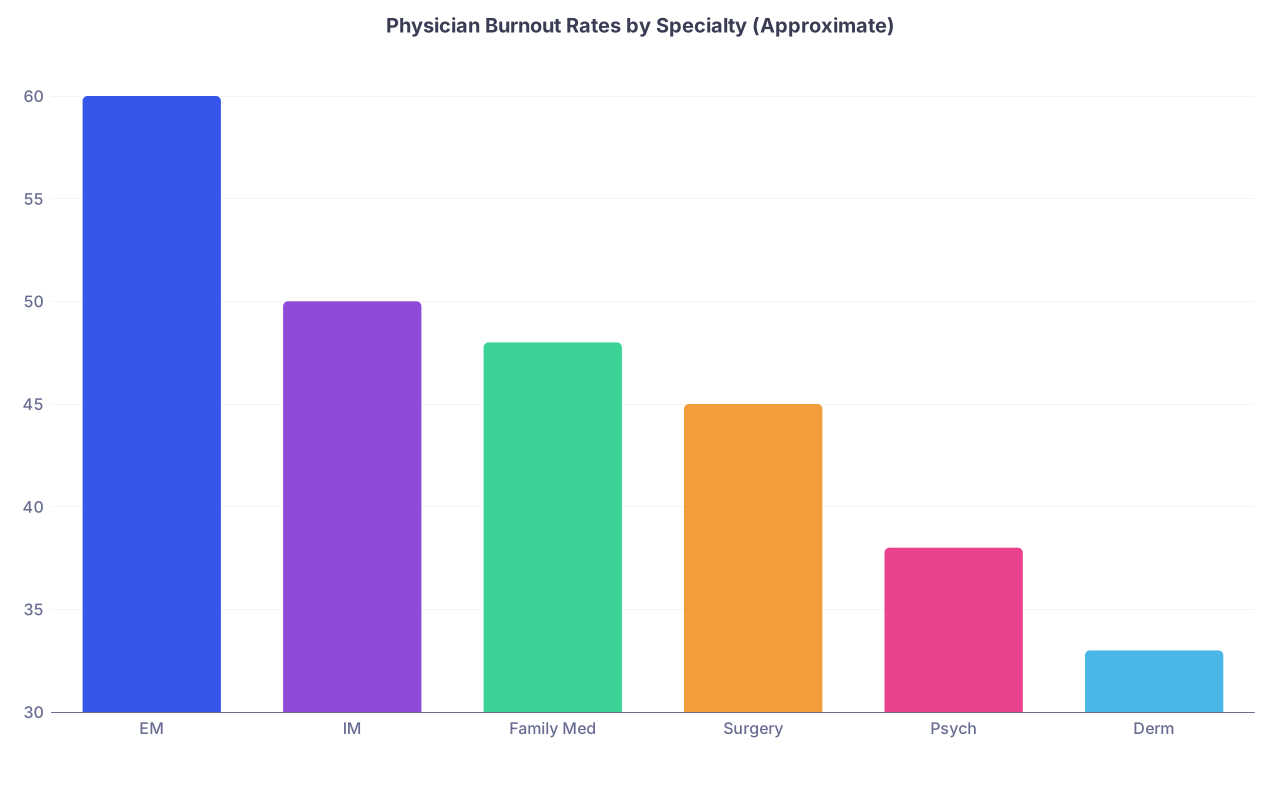
| Category | Value |
|---|---|
| EM | 60 |
| IM | 50 |
| Family Med | 48 |
| Surgery | 45 |
| Psych | 38 |
| Derm | 33 |
Numbers like these float around (they change by year and study, but the pattern is similar): burnout is high almost everywhere. Differences exist, but they’re not “safe” vs “doomed.” They’re “hot stove” vs “still pretty hot stove.”
So if you’re trying to pick a specialty only to avoid burnout, you’re aiming at the wrong target. You’re optimizing around the wrong variable.
The better question is: “Given that burnout risk is everywhere, how do I choose a field where:
- The kind of stress matches how I’m wired, and
- The lifestyle available in that field can realistically support the life I want?”
That’s a different conversation than “What has the lowest Reddit horror count?”
The three kinds of risk you’re actually afraid of
You keep saying “I’m afraid of burning out,” but that’s a big, vague word. When I listen to anxious med students talk, what I actually hear are three separate fears dressed up as one.
1. Workload risk: “Will this just physically crush me?”
This is the image of dragging yourself into the hospital at 5 a.m. for the fifth 80-hour week in a row, eating granola bars over a keyboard, crying in your car after a 28-hour call.
Some specialties front-load this more (surgery, OB, some IM residencies) but then get better. Others spread the load out more evenly (EM shifts, hospitalist work, urgent care) but you feel it in other ways (nights, circadian chaos).
The key part: residency misery does not always equal attending misery. You’re probably over-weighting the residency pain because that’s what you see. But the rest of your life is a lot longer than those 3–7 years.
Workload risk is real, but it’s not static. It changes:
- By practice setting (academic vs community vs private vs concierge)
- By region (rural hospitalist vs cushy urban group)
- By FTE status (1.0 vs 0.7 with job share)
So when you’re thinking “I can’t do IM because I saw one resident die on wards,” you’re extrapolating from the worst, most intense version of that specialty.
2. Emotional risk: “Will this break my soul?”
You’re probably not just afraid of being tired. You’re afraid of becoming numb. Cold. Angry. That person who rolls their eyes at patients and says, “They’re all non-compliant anyway.”
Different specialties burn your emotional fuel in different ways:
- EM: constant unknowns, high acuity, lots of chaos, little closure
- Psych: vicarious trauma, chronic suicidality, emotional heaviness
- Peds: sick kids, parental dynamics, code situations that haunt you
- Oncology: loss, long-term suffering, existential grief
- Outpatient primary care: unending chronic issues, paperwork, feeling like a cog
This matters. If you’re hypersensitive to grief, peds ICU might be brutal. If constant stimulation fries your nervous system, EM nights will eat you. If boredom and repetition wreck you, pure outpatient clinic might be its own unique hell.
You’re not fragile for thinking about this. You’re smart. But again, it’s about fit, not “safe vs unsafe.”
3. Identity risk: “What if I become someone I hate?”
This is the subtle one. The fear that in choosing a specialty, you’re locking in a version of yourself:
- The surgeon who only half-knows their kids because they’re always post-call
- The outpatient doc who feels like a refiller of meds on a conveyor belt
- The anesthesiologist who feels invisible and replaceable
- The psychiatrist who feels isolated from the “real medicine” crowd
You’re scared of waking up at 45 with money and status and this gut-level sense of, “I sold myself out.” That’s a valid fear. And it should be part of your specialty decision.
But none of this is predetermined by the label “IM” or “EM” or “psych.” It’s heavily shaped by:
- Who you work with
- How many hours you work
- Whether you have the guts (and financial runway) to say no and change directions
Which brings me to the next painful truth.
The mistake: treating specialty choice like a one-way door you can’t ever reopen
The story in your head probably goes like this:
- I pick wrong.
- I suffer silently because I’m trapped.
- I burn out, hate my life, maybe quit medicine.
- Game over.
But in real life, I’ve seen:
- EM to anesthesia
- Surgery to radiology
- Peds to psych
- IM to path
- OB to primary care
- Full-time inpatient to locums, telehealth, urgent care, occupational med
No, switching isn’t easy. It costs money, ego, time, and sometimes another match process. But it’s way more common than the doomsday version you’re imagining.
You’re treating specialty choice like a marriage with no divorce. It’s much closer to a long-term relationship with exit costs. That still deserves respect. It just doesn’t justify pure terror.
Let’s anchor that with something more concrete:
| Starting Field | Common Pivot | Main Trade-Off |
|---|---|---|
| EM | Urgent Care | Less acuity, more routine complaints |
| Surgery | Wound Care | Fewer ORs, more clinic-based work |
| IM Hospitalist | Outpatient IM | More continuity, less night work |
| OB/GYN | Gyn-only | No L&D, more OR/clinic balance |
| Peds | Urgent Care | Fewer complex chronic cases |
These aren’t failures. They’re adjustments. You’re allowed to adjust.
So the question becomes: “Given that I can pivot later if I absolutely must, where would I bet my energy first, knowing who I am right now?”
That’s a lot less terrifying than “I have to perfectly predict my 60-year-old self’s needs from a call room at 2 a.m.”
How to think about burnout risk without losing your mind
Let’s talk strategy, not vibes. Because your anxiety is trying to do a job: protect you. It’s just doing it in a really loud, messy way.
Here’s a framework that actually helps.
1. Separate “training misery” from “career misery”
You need to ask two different questions on each rotation:
- Could I tolerate this residency long enough to get through it?
- Could I build an attending life in this specialty that matches how I want to live?
Those are not the same thing.
I’ve seen people love EM residency and absolutely hate attending EM shifts. I’ve seen people miserable as surgery interns and then legitimately happy as attendings with more control.
On your rotations, mentally label what you’re seeing:
- “This is residency-specific pain.” (scut, constant pages, hierarchy nonsense)
- “This is baked into the specialty.” (night work in EM, OR days in surgery, clinic volume in FM)
If the thing that terrifies you is mostly residency-specific, don’t throw the whole specialty away yet.
2. Match the type of stress to your wiring
Instead of aiming for “low stress,” aim for “stress I can handle and sometimes even enjoy.”
Ask yourself:
- Do I recharge with variety and adrenaline, or does that fry me?
- Do I like long-term relationships with patients, or do I prefer intense, short episodes?
- Does being “the final decision maker” excite me or paralyze me?
- Do I crave procedures, or do they just feel like extra pressure?
If you’re introverted, sensory-sensitive, and hate uncertainty, EM is probably going to feel like getting slapped in the brain every shift. If you get bored easily, hate paperwork, and love immediate results, long primary care days might feel like slow emotional suffocation.
Neither one is “more burned out” in the abstract. But for you, one will be.
3. Look at range of lifestyles, not the stereotype
Every specialty has a stereotype:
- Surgeons: 100 hours a week, no life
- Derm: golf by 2 p.m.
- Psych: couch, long talks, low stress
- EM: 12 shifts, then four days off and you live at REI now
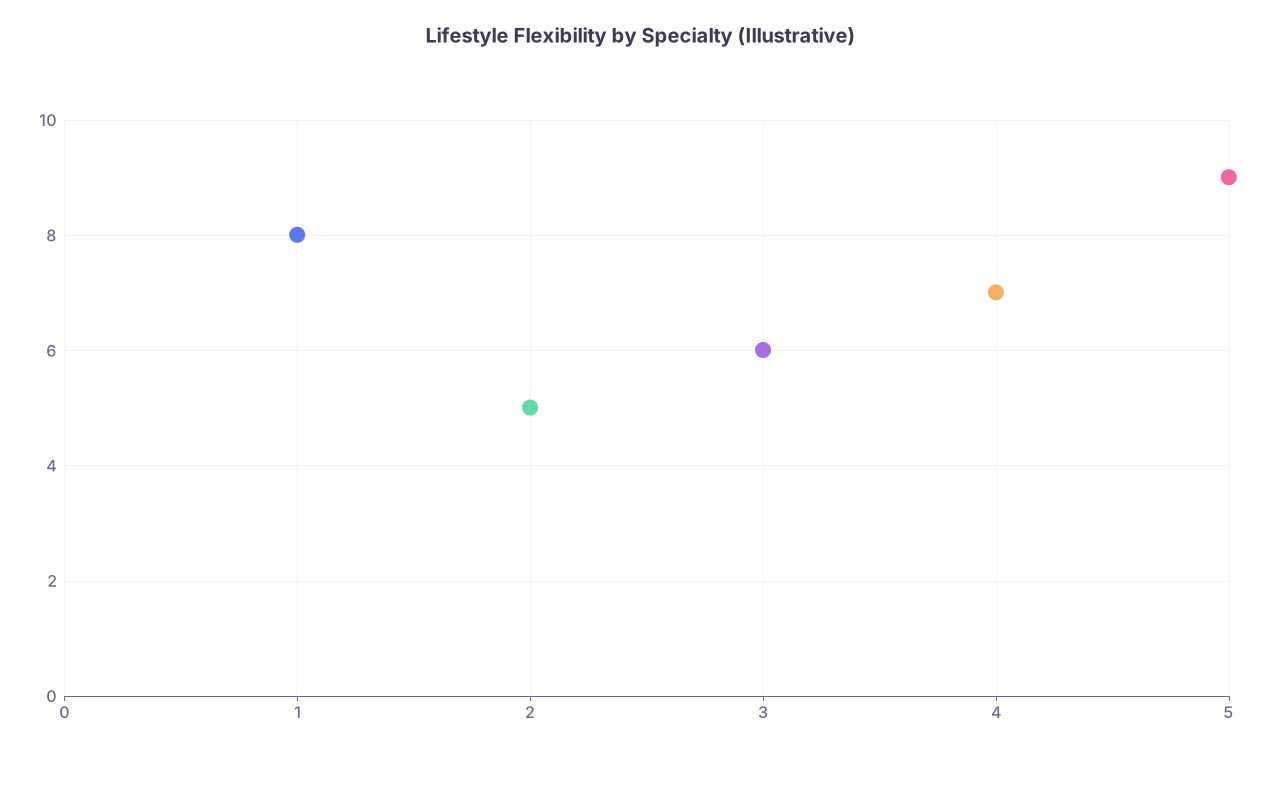
Reality is more like a scatterplot than a single point.
| Category | Value |
|---|---|
| EM | 1,8 |
| IM | 3,6 |
| Surgery | 2,5 |
| Psych | 4,7 |
| Derm | 5,9 |
Pretend the x-axis is “ability to control schedule” and y-axis is “ceiling for work-life balance.” Every dot is a different job inside that specialty. EM has some brutal, shift-heavy jobs and some 0.6 FTE, mostly-day-shift setups. Psych can be VA, private practice, inpatient, telehealth.
When you think “burnout risk,” also ask: “Does this specialty offer me multiple escape hatches within it if my first job sucks?”
Fields with lots of practice models (IM, FM, EM, psych, anesthesia) give you room to move around without starting from zero.
4. Audit your actual non-negotiables
This is where anxiety lies to you. It tells you everything is a non-negotiable.
“I need: no nights, no weekends, no call, no death, no angry patients, no paperwork, high pay, interesting cases, short training, flexible schedule, and prestige.”
Yeah. So does everyone. That job doesn’t exist.
You need to be brutally honest with yourself about what’s actually sacred and what’s “strong preference.”
Examples of true non-negotiables might be:
- “I want kids and I am not willing to be gone most nights/weekends long-term.”
- “My mental health cannot handle constant exposure to severe trauma.”
- “I know I crumble on chronically flipped sleep cycles.”
Strong preferences might be:
- “I’d really like procedural work.”
- “I like talking to patients more than charting.”
- “I like teams more than solo work.”
You’ll still make compromises. But at least you’ll know which compromises are survivable and which are deal-breakers for your future self’s sanity.
What to do right now if burnout fear is paralyzing you
Here’s how I’d triage this if we were sitting in a call room at 1 a.m. and you were spiraling.
- List your top 3 candidate specialties you’re actually considering, not all 20 that flash through your head at 3 a.m.
- For each one, write down:
- Specific burnout fears (not just “burnout,” but “never see my family,” “constant death,” etc.)
- One example of a job in that specialty that seems like lower burnout (clinic-only, 0.8 FTE, VA, etc.)
- Talk to at least one attending in each field who seems… not dead inside. Ask them:
- What burns people out here?
- Who does well in this field long-term?
- If you had to redesign your career right now to protect your sanity, what would you change?
- Then ask yourself the blunt question: “If I had to start residency tomorrow in one of these, which would I be least upset about?”
Not which is perfect. Which feels the least like betrayal of yourself.
That’s usually where your real answer is hiding under the noise.
FAQ: The Burnout-Terrified Med Student Edition
1. If I already feel burned out in med school, does that mean I can’t handle a “hard” specialty?
Not automatically. Med school burnout is often from lack of control, constant evaluation, and feeling like you’re always behind. That’s different from being an attending with more autonomy. But your current burnout does hold data: how you respond to sleep loss, chaos, emotional exposure. Don’t ignore that, but don’t overgeneralize it to “I’m too weak for X.” Think in specifics: what, exactly, is killing you right now? Exams? Night shifts? Constant people? Those patterns matter more than the label “burnout.”
2. Is it stupid to pick a ‘lifestyle’ specialty mainly because I’m scared of burning out?
It’s not stupid. It’s just incomplete. If you pick something you don’t actually like just for lifestyle, you can end up a well-rested, well-paid, deeply miserable doctor. I’ve seen outpatient-only folks bored out of their minds. I’ve seen derm and radiology attendings who feel trapped. Lifestyle matters, but so does fit. If you’re going to lean lifestyle-heavy, make sure you’ve actually experienced that field enough to know you won’t hate the day-to-day.
3. Do higher burnout specialties ruin your personal life automatically (marriage, kids, friends)?
No. They make it harder. Not impossible. Plenty of surgeons, EM docs, OBs have healthy marriages and kids who know them. The ones who pull it off usually have partners who genuinely understand the trade-offs, strong boundaries around time off, and eventually adjust their workload (fewer nights, academic roles, niche practices). If you want a family, you don’t have to avoid all “hard” specialties. You just have to be ruthless later about job selection and boundaries.
4. How much should online forums and Reddit horror stories influence my choice?
They’re like reading only 1-star Yelp reviews and assuming the restaurant serves poison. People in pain are louder. Burned out physicians post more than quietly content ones. Use forums to identify themes (“prior auths in outpatient IM suck,” “EM nights mess with your sleep”), but not as a final verdict. For every horror story online, there’s a mid-career doc who adjusted their hours, changed settings, and is… fine. They just don’t write dramatic posts about being fine.
5. What if I choose a field and then realize 3 years in that I hate it?
Then you’ll have two options: adjust within the field (change jobs, settings, hours) or pivot out (another residency, fellowship, non-clinical work). Both paths are painful, but they’re real. You will not be the first person to do it, and you won’t be the last. Your anxiety wants you to believe that a “wrong” choice equals permanent life ruin. In reality, it usually equals 2–5 years of hard course correction, which sucks but is survivable.
6. If the risk of burnout is everywhere, does my specialty choice even matter?
Yes. A lot. You can’t dodge all risk, but you can choose the kind of stress, the population you care about, the day-to-day tasks that drain vs energize you, and the number of built-in escape hatches. That’s huge. Your goal isn’t to find a burnout-proof field (doesn’t exist). It’s to choose a field where the inevitable hard days still feel connected to a life you actually want.
If you remember nothing else, keep these three things:
- You’re not choosing “burnout vs no burnout.” You’re choosing which stress and how much control you’ll eventually have over it.
- Residency is not the final form of any specialty. Don’t judge a 30-year career solely by your exhausted intern self.
- You are allowed to adjust later. The choice matters, but it’s not the last choice you ever get to make.