
Most people are not “naturally gifted” with surgical hands—no matter what they tell you.
Let me say that again, because your brain will try to reject it: the majority of residents who end up in surgery, EM, GI, anesthesia, OB, you name it—did not start out as steady-handed prodigies doing perfect sutures in M2.
You’re not the only one whose hands shook the first time they tried to tie a knot. Or whose attending said, “Here, let me take over,” after 30 painfully awkward seconds trying to load a needle driver.
You’re just the only one inside your head, so it feels like everyone else is fine and you’re the outlier.
Let’s tear into this properly.
The Fear You’re Actually Asking About
You’re not just asking, “Can I choose a procedural field if my hands-on skills are weak?”
You’re asking:
- “What if I’m too clumsy for this?”
- “What if I hurt someone?”
- “What if attendings think I’m a joke?”
- “What if I commit to a field and then find out I physically can’t do it?”
- “What if I’m already behind everyone and it’s too late to catch up?”
That spiral? Totally standard.
Here’s the blunt answer: yes, you can still choose a procedural field if you’re anxious about your skills right now. The more accurate question is: can you tolerate the learning curve, the embarrassment, and the repeated failure long enough for your skills to catch up?
Because skills do catch up—for almost everyone who sticks with it.
There are only a few “hard stop” situations, and they’re rarer than your anxiety wants you to believe.
What “Being Bad With Your Hands” Actually Looks Like in Med School
You know what doesn’t get talked about enough? How unbelievably awkward almost everyone is at the beginning.
First time scrubbed in:
- You contaminate your gown.
- You hold the needle driver backward.
- You stab the glove instead of the skin.
- You take 6 minutes to tie 1 knot and it still looks like a sad pretzel.
You walk out convinced: “I’m not cut out for this.”
But here’s the thing: procedural competence in med school is fake data. You just don’t get enough reps to know anything definitive.
Let me show you what’s normal for most med students in procedural-heavy rotations:
| Stage | Suturing Competence | Confidence Level |
|---|---|---|
| Start of 3rd year | Almost none | Very low |
| Mid-surgery rotation | Clumsy but improving | Low to medium |
| End of surgery rotation | Basic interrupted sutures | Medium (still anxious) |
| Start of residency (PGY1) | Rough but functional | All over the place |
If you’re behind this curve, you’re not doomed. It probably just means:
- You didn’t get many chances.
- You froze when you did get chances.
- You didn’t practice between OR days.
None of that is permanent. It just feels permanent right now.
The Ugly Truth: What Actually Matters for Procedural Fields
Here’s what people think matters:
- Having “natural hands”
- Being magically good with instruments the first time
- Being calm under pressure from day one
Here’s what actually matters:
- How quickly you improve when you practice deliberately
- Whether you can stay teachable instead of shutting down
- How you perform by the end of intern year, not start of M3
- Your ability to focus, follow steps, and not be defensive when corrected
I’ve watched:
- A student who looked “hopeless” at suturing in M3 become the go-to closer by PGY-2 in general surgery.
- A med student who trembled every time they touched the laryngoscope become an excellent anesthesiologist.
- An EM resident who struggled to place IVs early on become the person nurses called in for the impossible lines.
The pattern? They didn’t quit just because their early data was bad.
Procedural skill is a trainable motor skill. It’s much closer to learning an instrument than to having blue vs brown eyes. You’re judging yourself like someone picking up a violin for the third time and going, “I’m not a prodigy, I should never play music again.”
That’s how absurd it looks from the outside.
But What If I’m Actually Too Clumsy?
Fine. Let’s go worst-case, since that’s where your brain is living anyway.
True “hard limit” situations exist, but they’re rare:
- Significant uncorrectable tremor that doesn’t respond to treatment.
- Major uncorrected vision issues (depth perception, severe stereopsis problems).
- Severe motor disabilities that make handling instruments impossible even with adaptations.
- Neurologic conditions that cause unpredictable loss of control.
If you’re worried about any of these, don’t guess. See:
- Neurology for tremor or motor control.
- Ophthalmology for depth perception / binocular vision.
- Occupational therapy for fine motor assessment and adaptation.
People with mild tremors, ADHD, mild anxiety, or just generic clumsiness? I’ve seen them in surgery, EM, GI, anesthesia, OB, IR. Not theoretical. Real people.
Again, the real question is: are you willing to do more reps, slower, and tolerate more frustration than the naturally coordinated people?
Because yeah, you might need more time. You might need more deliberate practice. You will have some brutally humbling moments.
That still doesn’t mean “you can’t.”
Anxiety vs. Ability: The Part Nobody Warns You About
Your anxiety is allowed in the OR. It just can’t drive.
A lot of what feels like “I don’t have the hands for this” is actually:
- Performance anxiety under attending eyes
- Fear of being judged by scrub techs and nurses
- Shame from one bad comment that burned into your brain
You’re not shaking because your muscles are defective. You’re shaking because an attending is staring at you silently while the room is dead quiet and you’re on stitch #1.
That’s not a motor problem. That’s a nervous system in fight-or-flight.
And you can work on that:
- Breathing before you touch the field (4–6 calm breaths).
- Saying out loud what you’re going to do: “I’ll place the needle at 90 degrees here, evert the edges, then…” (It helps organize your brain.)
- Asking for stepwise feedback: “Can you walk me through where you’d put the next stitch?”
- Practicing on models until your hands know what to do even when your brain is screaming.
Because here’s the kicker: once your muscle memory builds up, your anxiety matters less. Your hands know what to do. You stop reinventing the wheel every time you hold a driver.
How Much Practice Is Actually Possible Before Residency?
You might feel like: “I’ll never catch up, I’ve barely done anything.”
So let’s actually look at what you could do in med school if you decided, “Okay, I’m anxious but I’m going to treat this like a long game.”
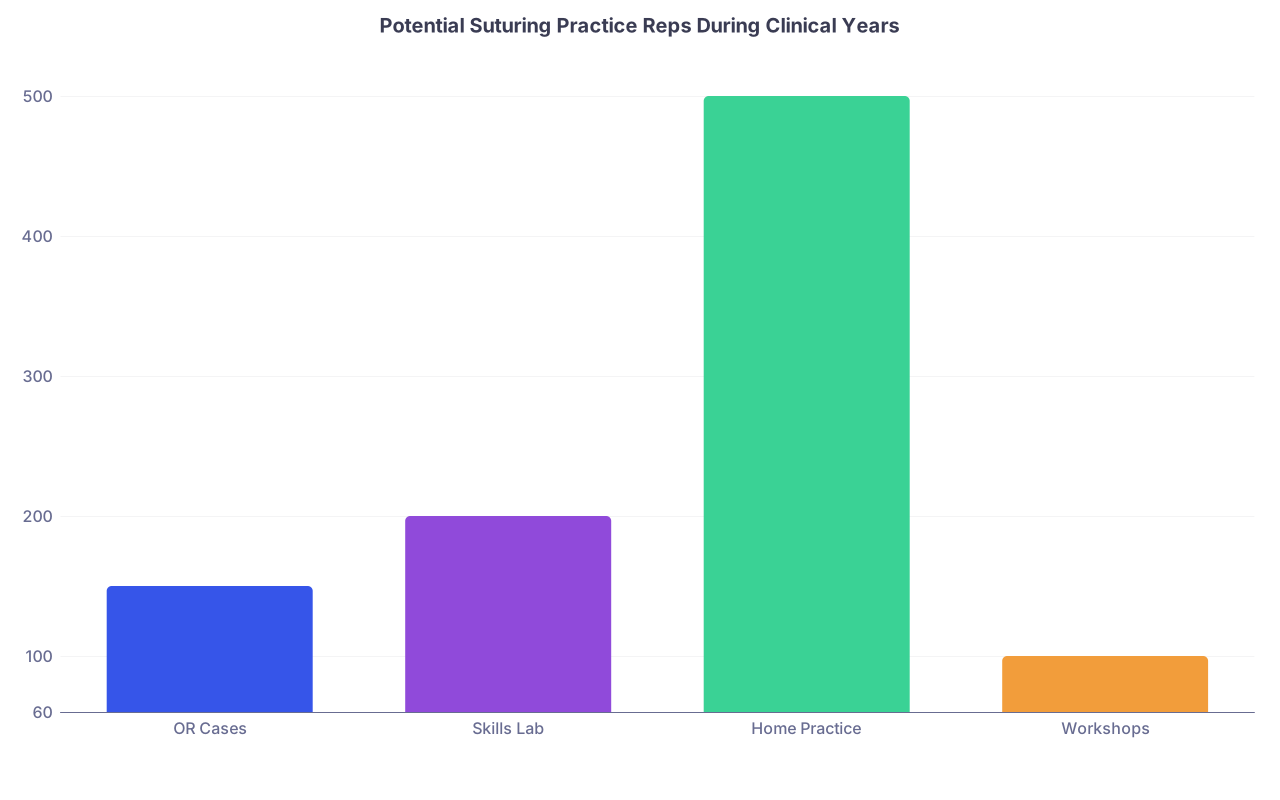
| Category | Value |
|---|---|
| OR Cases | 150 |
| Skills Lab | 200 |
| Home Practice | 500 |
| Workshops | 100 |
Those numbers aren’t random. They’re realistic if you intentionally seek opportunities.
- OR cases: Even if you only throw a few stitches per case, over months that adds up.
- Skills lab: Most schools give you open access or optional sessions. Most students barely use them.
- Home practice: Cheap suture kit, foam, bananas, pig’s feet, online videos. Reps, reps, reps.
- Workshops: Student surgery / EM / anesthesia interest groups. You can go to a lot of these if you care.
You could walk into residency with hundreds of practice reps that no one sees but you. That’s where the real difference is made.
Not in the one or two times each week that an attending lets you close.
Choosing a Procedural Field When You’re Not Confident (Yet)
Let’s say you’re genuinely interested in:
- General surgery
- OB/GYN
- EM
- Anesthesiology
- GI, pulmonary, cardiology (for future procedures)
- IR, ortho, urology, ENT, etc.
But your brain is yelling: “I’m too clumsy to belong there.”
Here’s a cleaner way to think about it.
Ask yourself:
- Do I actually enjoy the idea of doing procedures, or does it mostly terrify me?
- When I’ve done a procedure (even badly), did I feel a spark of “I want to get better at this” or just relief that it’s over?
- Do I like fast feedback and tangible results (tube in, line in, bleeding stopped)?
- Am I willing to do a lot of invisible, slightly boring practice to not feel useless in the OR/ED?
Because if you hate the process and you’re only forcing yourself toward a procedural field because you think it’s more prestigious or “real doctor work,” that’s a recipe for misery.
But if you:
- like using your hands,
- like fixing things,
- and feel frustrated by your current skill level rather than secretly relieved when you’re not asked to help…
then your anxiety is not a stop sign. It’s just static.
How to Test Yourself Without Ruining Your Life
You don’t have to commit your entire future on a vague fear.
Run experiments. Small, controlled ones.
1. Max out your exposure on rotations
On surgery or EM:
- Ask early: “I’m really motivated to improve technically. Can I close whenever appropriate?”
- If you get shut down by one attending, try another. Personalities vary wildly.
- Ask seniors: “Can you watch me tie knots at the end of the case and give me 2 things to fix?”
2. Use simulations like they actually matter
Skills labs aren’t just boxes to tick.
- Set goals: “Today I’m going to tie 50 knots that look identical and don’t slip.”
- Time yourself: “How long for 5 good interrupted sutures?” Watch that number drop over weeks.
- Record videos on your phone occasionally and compare month-to-month.
3. Do a dedicated elective
Instead of guessing:
- Take a surgery sub-I, EM sub-I, anesthesia elective, or OB acting internship.
- Tell the team: “One of my goals is to honestly assess if a procedural field is right for me. Can you give me concrete feedback on my technical trajectory?”
That last word matters: trajectory, not “where I am right now.”
Red Flags vs. Anxiety Lies
You’re anxious. Your brain will produce a constant stream of “evidence” that you’re not cut out for this. Most of it will be nonsense.
Let’s separate the two.
- Multiple attendings and residents independently say things like: “Your technical skills aren’t improving despite practice,” and can point to specific, repeated patterns over weeks.
- You avoid every chance to touch instruments, even when offered, and feel physical panic at the thought.
- You practice consistently over months (not days) and there is almost no change in speed, accuracy, or confidence.
- A specialist (neuro, ophtho, OT) tells you there’s a motor limitation that’s unlikely to be compatible with certain fine-motor tasks.
Anxiety lies:
- “I messed up one stitch, they must think I’m incompetent.”
- “The scrub tech sighed—I’m a disaster.” (They sigh at everyone.)
- “The resident took over; I’m hopeless.” (They’re tired and hungry. That’s it.)
- “Everyone else is better than me.” (You’re only seeing their highlight reel.)
If you’re not sure which is which, ask directly:
- “How do my technical skills compare to other students at this stage?”
- “Do you see an upward trajectory, or are you worried about my ceiling?”
- “If I worked at this, do you think I could be safe and competent in this field?”
Most attendings will answer honestly if you ask like that. You might not love what you hear, but it’s way better than living in uncertainty.
You Don’t Have To Be “The Best” To Belong
You’re probably comparing yourself to:
- The M3 who did a plastics research year and ties one-handed knots for fun.
- The EM intern who was a paramedic for 8 years and can drop lines in their sleep.
- The ortho resident who grew up in a workshop using tools daily.
Of course they look smoother than you.
You don’t need to be the star. You need to be:
- Safe
- Reliable
- Improving
Every specialty has residents who are “average technical” but excellent clinicians, communicators, team players. They still have solid careers.
What destroys people isn’t usually lack of raw hand skill. It’s:
- Inability to take feedback
- Shame that turns into avoidance
- Refusal to practice the boring basics
If you can swallow your pride, admit “yeah I’m behind,” and then actually do something about it—you’re already way ahead of where your anxiety says you are.
Key Takeaways (before your brain spins again tonight)
- Being awkward with procedures in med school is normal, not diagnostic.
- Technical skill is trainable for the majority of people who actually put in reps.
- The real question isn’t “am I naturally gifted?” but “am I willing to practice through being bad?”
You don’t have to decide your entire life based on how you held a needle driver last week.
You do have to be honest with yourself about what you enjoy, what you’re willing to work for, and whether your fear is data—or just noise.