The ERAS submit button is not a lifelong blood oath to one specialty.
I wish someone had said that to me out loud in August of my fourth year. Instead, I clicked “submit,” felt my soul leave my body for a second, and then — of course — immediately started thinking, “What if I was wrong? What if I fall in love with something else now?”
If you’re asking “What if I fall in love with a field after ERAS is submitted?”, here’s the ugly, honest truth: it’s inconvenient, it can be messy, and it is absolutely not the end of your career.
People switch. People pivot hard. People re-apply. And a lot of them end up happier than the ones who just white-knuckled it through the wrong field.
Let’s pull this apart, worst-case-scenarios and all.
Step One: Admit the Fear Out Loud
You’re probably cycling through some version of:
- “I already applied to internal medicine, but anesthesia was amazing… am I stuck forever?”
- “What if I wasted all my aways and letters on the wrong field?”
- “Programs will think I’m flaky if I change my mind now.”
- “If I don’t fix this immediately, I’ll be trapped and miserable.”
Here’s the pattern I’ve seen over and over:
- A core rotation or late sub-I clicks after ERAS is locked.
- Suddenly you notice how drained you feel on your current path and how much lighter you felt on the rotation you “weren’t supposed” to like.
- Then shame kicks in: “Everyone else has known since M1. Why am I like this?”
You’re not behind. People decide late. People decide in residency. Some people decide as attendings and do a second residency. Is it ideal? No. Does it happen? Constantly.
What Actually Can Change After ERAS?
Let’s be concrete, because the vagueness is what feeds the anxiety.
Here’s what’s basically locked once you submit ERAS:
- Specialty list you applied to (you can’t un-send those applications)
- Personal statement in programs’ inboxes
- Letters in ERAS (you can’t edit them once assigned to a submitted app)
Here’s what is still flexible:
- Where you interview
- How you present your interests on interviews
- Your rank list
- Applying again in a future cycle to a different specialty
- Doing a preliminary or transitional year while you regroup
- Swapping specialties during residency (hard, but not impossible)
So no, you didn’t just close the only door you’ll ever have. You closed a few options and opened a very specific set of new decisions. That’s different.
Scenario 1: “I Like My Chosen Field… but I Loved This New One”
This is the softer version. You’re not repulsed by what you applied to. You just had a borderline magical experience in something else.
Example: You applied psychiatry. Then you meet anesthesiology in October on a random elective and think, “Oh. Oh no. This is kind of amazing.”
In that case, you have a few realistic paths.
| Option | Main Tradeoff |
|---|---|
| Stay with original specialty | Safer, faster, less regret if you still like it |
| Dual-interest narrative | Keep door open for later fellowship/transition |
| Plan to pivot post-residency | Longer path, but stable now |
| Take extra year/reapply | More time, more cost, more control |
What staying looks like (and doesn’t mean)
Staying with your original specialty doesn’t mean:
- You can never touch the other field
- You’re “lying” by not blowing up everything right now
- You’ve failed some test of authenticity
It can mean:
- You keep your current trajectory and explore the new interest via electives, research, joint clinics, or fellowship later
- You use residency to confirm what you actually enjoy day-to-day before blowing things up
Plenty of people fall for EM but stay in IM, then do critical care. Or they love cards but stick with anesthesia and end up in cardiac anesthesia. Real life is full of weird hybrid paths.
You’re allowed to say, “I had a great experience, but I’m not ready to nuke my current plan on the basis of one rotation.”
Scenario 2: “I Think I Chose Wrong. Like… Actually Wrong.”
This is the stomach-drop version. You applied, then realized on a rotation, “If I have to do this for the rest of my life, I will wither.”
This is where your brain goes full apocalypse: I’ll match, be miserable, burn out, destroy my life.
Pause. Breathe. Then look at the actual paths that exist, not the disaster movie in your head.
Path A: Ride out this cycle, then pivot before you’re locked into residency
If timelines line up (and sometimes they do, weirdly well), you can:
- Go through this cycle
- If you don’t match: regroup and re-apply in the new field next year
- If you do match but hate the field even more by MS4 spring: talk to your dean and program early about switching before July (hard, but I’ve seen it happen when handled honestly and early)
This isn’t fun. It means uncertainty and maybe a SOAP or a gap year. But it’s not a career death sentence.
Path B: Do a prelim or transitional year while you sort it out
If you’re really unsure and your current application is weak or misaligned, sometimes a prelim medicine, prelim surgery, or transitional year is the right stall tactic.
You get:
- A paycheck
- Real clinical experience
- Time to explore the new field and build credibility for re-application
You give up:
- A perfectly linear, Instagram-pretty CV
- Some peace of mind in the short term
I’d take a messy but honest path over locking into a specialty that makes you dread waking up.
How Much Does It Matter When You Fall in Love?
Timing matters, yes. But it matters less than your brain is telling you.
Let’s compare:
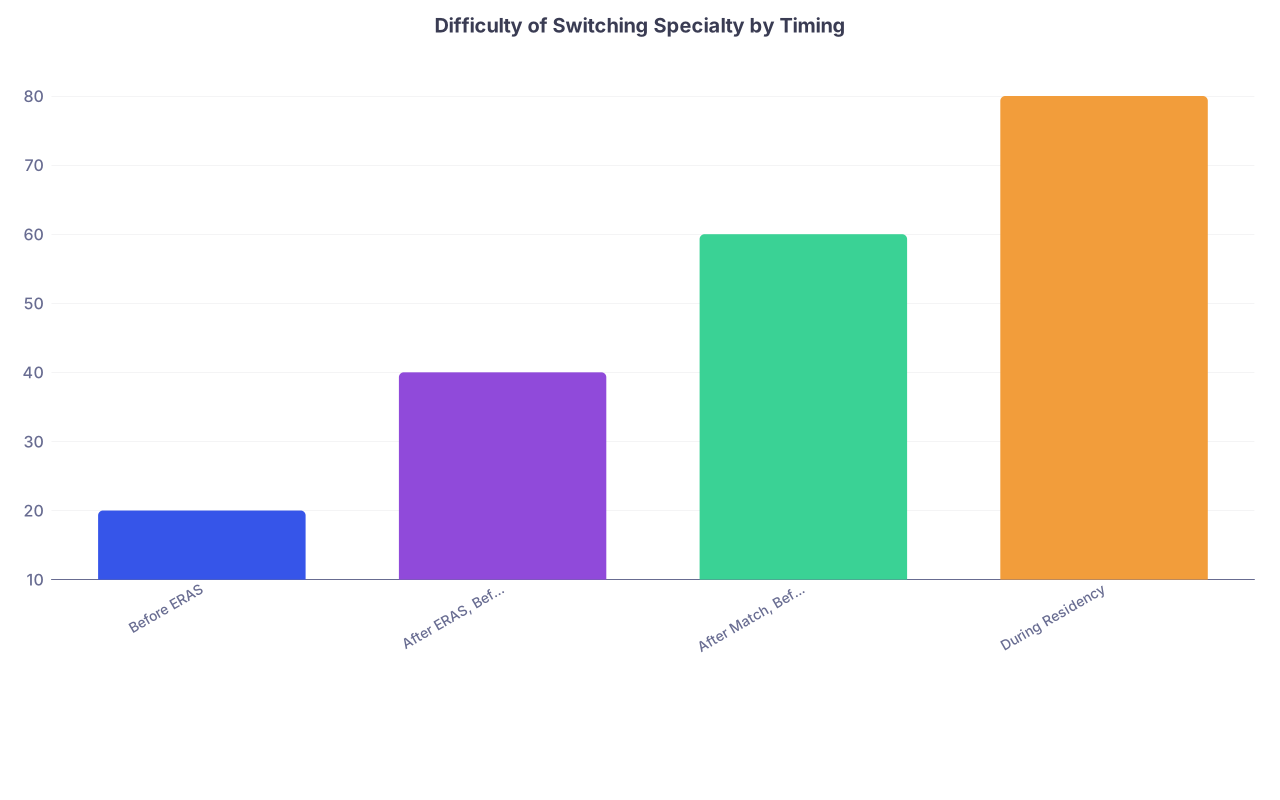
| Category | Value |
|---|---|
| Before ERAS | 20 |
| After ERAS, Before Match | 40 |
| After Match, Before PGY1 | 60 |
| During Residency | 80 |
Interpretation (very roughly):
- Before ERAS: Easiest to shift. Every door is still open.
- After ERAS, before Match: Annoying and messy. Still many options.
- After Match, before PGY1: Harder. Politics, contracts, timing.
- During residency: Possible. Often requires networking, luck, and institutional support.
You are not at 100/100 difficulty. You’re somewhere in the messy middle. That’s survivable.
Do Programs Think You’re Flaky If You Change?
You might be imagining PDs in a dark room saying, “Wow, what a disaster, they changed their mind.” That’s not what’s happening.
What they actually care about:
- Are you going to show up in July?
- Are you likely to quit mid-residency?
- Are you honest about your story?
- Do you understand what the day-to-day of their specialty is actually like?
If, next year, you apply to a different specialty and your narrative is:
“I rushed my decision, committed before I had enough exposure, realized late that [new field] actually matches how I want to work, and then I spent my gap year doing X, Y, Z to make sure it wasn’t a fling.”
Most PDs respect that more than the person who clearly hates the specialty but stayed because they were scared to look uncertain.
What does look flaky?
- Random, unexplained whiplash: “I applied ortho, now it’s derm, next year maybe psych, who knows.”
- No evidence that you actually explored the new field
- Blaming everyone else: “My school forced me,” “My mentor made me,” etc.
You can be scared and still come across as thoughtful and deliberate. That’s the goal.
Communication Strategy: What You Say and To Whom
You don’t need to blast an email saying “I regret everything” to every program. But you do need adults in the room.
People you should talk to:
- A trusted dean/advisor who actually knows the match landscape
- At least one attending in the new field you’re excited about
- Maybe: a resident in both your current applied field and the one you’re now eyeing
Be specific. Say:
“I submitted ERAS to [specialty], but on my [new specialty] rotation I felt more like myself than I have all year. I’m worried I made the wrong call. Can we walk through concrete options?”
You want:
- Reality checks on feasibility
- Tactical advice (“Finish this cycle vs. pull out vs. plan to reapply”)
- Honest expectations (not sugar-coated “you’ll be fine” nonsense)
What you say to interviewers (if you’re still interviewing in your original field)
You do not need to dump your existential crisis on every interviewer.
But if you’re asked about other interests, you can frame it like:
“I had a great experience in [new field], and it clarified for me that I value [specific aspect that overlaps with current specialty]. It actually reinforced that I’m on the right track with [current field], but it’s something I hope to collaborate with in the future.”
If you’re truly planning to jump ship after this year, or you’re close to certain you’ll re-apply, get 1:1 advice — this is where nuance matters. Sometimes you keep your cards close; sometimes transparency helps you avoid a disastrous mismatch.
The Worst-Case Scenarios You’re Scared Of (And What Actually Happens)
Let’s drag the nightmares into daylight.
Nightmare 1: “I’ll match into the wrong specialty and be trapped forever.”
Reality:
- People switch in-residency. It’s not common, but it’s not mythical.
- People finish a residency and then sub-specialize into something that changes their day-to-day drastically.
- Some do a second residency later. Yes, that’s long. But if the choice is 30+ years miserable vs. a few extra years of training, plenty pick the latter.
Nightmare 2: “If I reapply, no one will want me. I’ll look like damaged goods.”
Reality:
Programs look way more favorably on:
- A second-time applicant who clearly grew, gained experience, and tells a coherent story
than on:
- A first-time applicant with generic “I like helping people” vibes and no real alignment
You’ll lose time. You’ll probably lose money. You won’t lose all credibility if you handle it like an adult.
Nightmare 3: “Everyone else has it figured out. I’m the only one lost.”
Reality:
You’re just the only one saying it out loud.
I’ve watched “super confident” classmates quietly change specialties, do prelim years, SOAP into a backup field they later grew to love, or reapply after not matching. Everyone else’s path looks straight only because you’re not seeing the edits.
Tactical Next Steps (So You Don’t Just Spiral)
Here’s a simple flow — not perfect, but better than doomscrolling:

| Step | Description |
|---|---|
| Step 1 | Realize you like a new field |
| Step 2 | Gather more info on new field |
| Step 3 | Talk to dean/advisor ASAP |
| Step 4 | Stay course this cycle, keep open mind |
| Step 5 | Finish this cycle, plan reapplication |
| Step 6 | Consider prelim/TY year |
| Step 7 | Very late switch / rare direct transfer |
| Step 8 | Hate original field? |
| Step 9 | New field clearly better fit? |
| Step 10 | Timing/options review |
If you want something concrete to do this week:
- Book a meeting with your dean/advisor.
- Email one attending in the “new love” field: ask for a 20–30 minute chat about career fit.
- Write down — literally, on paper — what you liked and disliked about each field, day-to-day. Not vibes. Tasks.
- Decide what you’re doing for this cycle (staying the course vs. mentally prepping to reapply) and give yourself permission to stop re-deciding every 48 hours.
You can always revisit in a month. But constant toggling will just fry you.
Quick Reality Check: You’re Allowed to Be Wrong Once
Medicine sells this lie that you need a perfect, linear narrative:
M1 passion → M2 research → M3 confirmation → M4 ERAS → lifelong alignment.
That’s not how real humans work.
You’re allowed to:
- Get it wrong the first time
- Course-correct
- Take a less “impressive” route in order to have a life you don’t dread
You’re not a failure for needing more data. You’re just… human.
FAQs
1. Should I pull or withdraw my ERAS applications if I think I picked the wrong field?
Usually, no — at least not impulsively. Once you pull, those bridges are hard to rebuild. Talk to a dean or advisor first. In many cases, you finish the cycle, see how it plays out, and then decide whether to reapply next year. The only time I’ve seen someone advised to pull apps is when they had a very clear and urgent move to another field with concrete backing (strong new letters, clear plan, timing that actually works).
2. Can I apply to a second specialty now, after ERAS is already submitted?
Technically, yes — you can add another specialty/application set later in the season. Practically, doing this late usually means weak, rushed materials and no letters tailored to that specialty. It can make you look unfocused if not handled carefully. This kind of late dual-app is usually reserved for closely related fields (IM vs. prelim medicine, for example) or when your home institution and advisors are actively on board and helping.
3. Will programs know if I reapply to a different specialty in a future year?
Yes. Your ERAS history doesn’t vanish. But that’s not automatically bad. If your story is: “I applied to [X], realized through real experience and mentorship that [Y] was a much better fit, then spent my gap year doing A/B/C in [Y],” that can actually make you look mature and self-aware. The key is having evidence — rotations, letters, maybe research — that support the switch.
4. What if I fall in love with a field during interviews at a program I wasn’t taking seriously?
This happens more than you’d think. If it’s within your applied specialty, great — rank that program higher. If it’s a whole different specialty you coincidentally encountered there, use that information to guide future decisions, not to panic-react. Let this cycle play out, then seriously consider whether you want to pursue that new field during residency or via reapplication. You don’t need to dismantle this entire cycle mid-interview season.
5. Will I be miserable if I just “stick it out” in the field I applied to?
Not automatically. Sometimes the fear is louder than the reality. M3/M4 rotations are a distorted version of the real job: weird hours, low autonomy, constant evaluation. Many people end up happier as residents in a field they were unsure about as students. Others really are in the wrong place and feel it more over time. If you do end up miserable, switching is still possible. Not easy. But possible. You’re not signing a misery contract you can never break.
6. Is taking a gap year to reapply viewed negatively by programs?
It depends what you do with it. A gap year filled with aligned clinical work, research, or meaningful experience in the new specialty can strengthen your application and make your story compelling. A gap year where you just “waited it out” with no connection to medicine or your new field will raise more questions. But a thoughtful, productive year is absolutely not a red flag — if anything, it can be the thing that makes programs believe your switch is real and not just a panic move.
If you remember nothing else:
- ERAS is not a life sentence; people change specialties at every stage.
- Panic decisions made in October at 2 a.m. are almost always worse than thoughtful decisions made with real advisors.
- One “wrong” step in your path doesn’t ruin your career — staying silent and frozen because you’re scared to look uncertain is the part that actually hurts you.