
The idea that you “must” know your specialty by the end of MS3 is a lie that’s making a lot of perfectly good future doctors miserable.
You’re not broken if you don’t know. You’re not doomed. You’re just in the messy middle that nobody advertises on Instagram.
Let me walk through the ugly, panicky questions you’re probably asking yourself at 1 a.m. and answer them honestly.
The Fear: “Everyone Else Has Decided. I’m Behind.”
Let’s start with the thing that’s eating you alive: that feeling that you’re the only one in your class who hasn’t “found their calling.”
You’re sitting in the workroom, and:
- One classmate can’t shut up about ortho.
- Another already has 3 derm mentors and a spreadsheet of programs.
- Someone else is “100% EM or bust.”
And you’re there like:
“I kind of liked peds. And psych. And IM. And honestly, I didn’t hate OB as much as I thought I would. Does that mean I have no personality? No passion? Am I going to end up in some random specialty I hate because I never had a ‘this is it’ moment?”
Here’s the truth nobody posts about:
- A lot of people “decide” early because they feel pressure to pick a lane, not because they’re sure.
- More people than you realize secretly change their minds during late MS3 / early MS4 and just… don’t broadcast it.
- Some of the most solid, satisfied residents I’ve met didn’t know their specialty until after ERAS opened. Not ideal. But it happens. And they’re fine.
You’re not behind. You’re just not pretending.
What Actually Has to Be Decided When (Not What You Think)
Your anxiety is probably wrapped up in a vague timeline. “End of MS3” sounds like a hard deadline. It isn’t. The real deadlines are more nuanced.
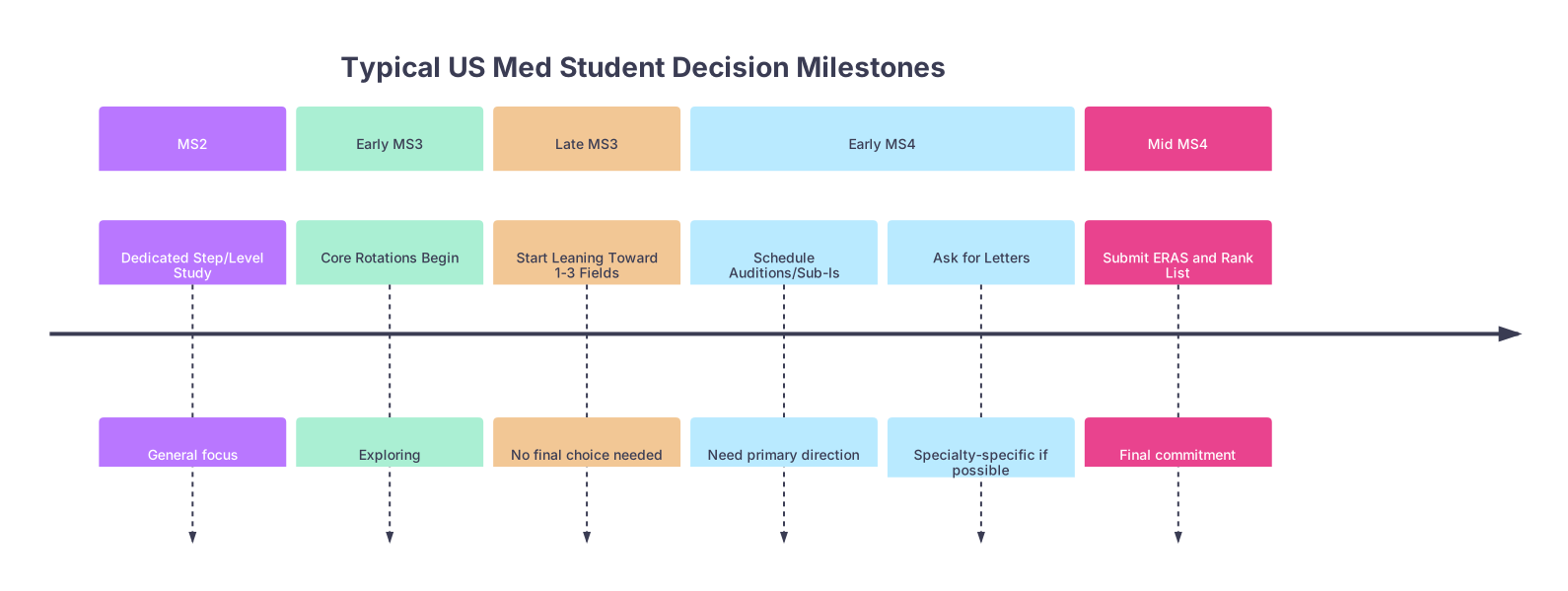
| Period | Event |
|---|---|
| MS2 - Dedicated Step/Level Study | General focus |
| Early MS3 - Core Rotations Begin | Exploring |
| Late MS3 - Start Leaning Toward 1-3 Fields | No final choice needed |
| Early MS4 - Schedule Auditions/Sub-Is | Need primary direction |
| Early MS4 - Ask for Letters | Specialty-specific if possible |
| Mid MS4 - Submit ERAS and Rank List | Final commitment |
Here’s the rough truth:
By the end of MS3, it helps if:
- You’ve narrowed to 1–3 realistic specialties.
- You know whether you’re aiming for “more competitive” vs “less competitive.”
- You have at least some idea what kind of life you want (clinic vs OR, procedures vs talking, inpatient vs outpatient).
You do not need:
- A lifelong, cosmic calling.
- A specialty-specific research empire.
- A perfectly clean, linear narrative of “I’ve wanted to be a [insert specialty] since childhood.”
You just need enough clarity to not sabotage your fourth-year schedule and letters.
So if you’re at: “I could see myself in IM, psych, or peds, but I don’t know which” — you are absolutely still in the game.
The Real Worst-Case Scenarios (And Why They’re Still Not Fatal)
Let’s actually do the worst-case thing your brain is obsessed with.
Worst Case #1: You Start MS4 Still Torn Between 2–3 Fields
Annoying? Yes. Fatal? No.
What this usually means:
- Your schedule may not be perfectly optimized.
- You might end up doing a sub-I in one field and a couple of strong electives in another.
- Your personal statement might be written under time pressure.
But people match every year from this position.
The key is to avoid being vague with programs, even if you feel vague inside. By ERAS time, you want each specialty you apply to thinking they’re your real choice, not your “backup personality.”
Worst Case #2: You Commit “Late” and Don’t Have Tons of Specialty-Specific Stuff
Let’s be realistic: this matters more for super-competitive fields (derm, plastics, ortho, ENT, optho, etc.) than for primary-care-ish or mid-competitive fields.
If you decide on:
- IM, peds, psych, FM, neurology, pathology, anesthesia later in the game
You can usually still build a decent application if your: - Clinical evals are solid
- Step 2/Level 2 is not a disaster
- You hustle for a couple of letters and electives
If you’re trying for:
- Derm, ortho, plastics, ENT, urology, neurosurg
Deciding “for real” at the very end of MS3 with no research, no faculty relationships, and no clear record that you’ve cared about this field? That’s harder. Not necessarily impossible at every program, but uphill.
But even then, the real worst case usually looks like:
- You apply, don’t match, do a research year or prelim year, and try again.
Not “you will never be a doctor” — just “this will hurt and take longer.”
And honestly? If you’re currently undecided between derm and psych, for example, you’re not in a sane place to commit to a hyper-competitive track today anyway. That kind of path demands early, obsessive buy-in. If that’s not you, that’s data — and that’s okay.
How to Actually Use Late MS3 When You’re Still Torn
Here’s where you still have leverage. Late MS3 isn’t pointless limbo; it’s your last big chunk of immersive, varied exposure.
Instead of sitting there paralyzed, do this as deliberately as you can:
Stop waiting for a lightning-bolt moment.
That “I stepped into the OR and everything clicked” story? It’s marketing. Some people have it. Many don’t. If you’re waiting for that to happen on the very last day of MS3… you’re just setting yourself up to feel broken. You’re going to make a choice based on values and tradeoffs, not magic.Pay attention to your bad days, not your best days.
Every rotation has highs. The question is: on the miserable days, could you still see yourself doing this long-term without feeling like you’re slowly rotting?
If even the “normal” days in a specialty make you feel dead inside, that’s a hard no.Notice who your people are.
You don’t have to “vibe” with everyone, but:
- Did you feel more at home with the peds residents or the surgery residents?
- Whose humor made sense to you?
- Did you like how they handled stress, or did it feel toxic?
You’re going to become some version of your co-residents. If that terrifies you in a field, listen to that.
- Log your reactions in real time. Briefly. Brutally.
Use a notes app or Google Doc. Nothing fancy. End of each day, 2–3 bullet points:
- What parts of today gave me energy?
- What parts drained me?
- Could I tolerate this charting/workroom/OR pace forever?
Don’t trust your brain to remember this clearly six months later when nostalgia and fear kick in.
Quick Reality Check: Where You Stand Based on What You Do Know
Use your current level of clarity to see how “behind” you actually are.
| Where You Are Right Now | How Screwed You Actually Are |
|---|---|
| I like 3–4 fields, hate a couple, unsure on the rest | Totally normal |
| I like 2 fields and could list pros/cons of each | Slightly anxious, but fine |
| I don’t like anything I’ve seen yet | Concerning, but fixable |
| I want derm/ortho/etc. but have zero record of it | You’ve got work to do |
| I change my mind every week based on who I talked to | More emotional than factual |
If you’re in the top two rows — you’re not behind, you’re typical.
If you’re in the bottom three — you don’t need shame, you need strategy.
What You Can Still Do Before MS4 Starts
Here’s how to use your remaining time without spiraling.
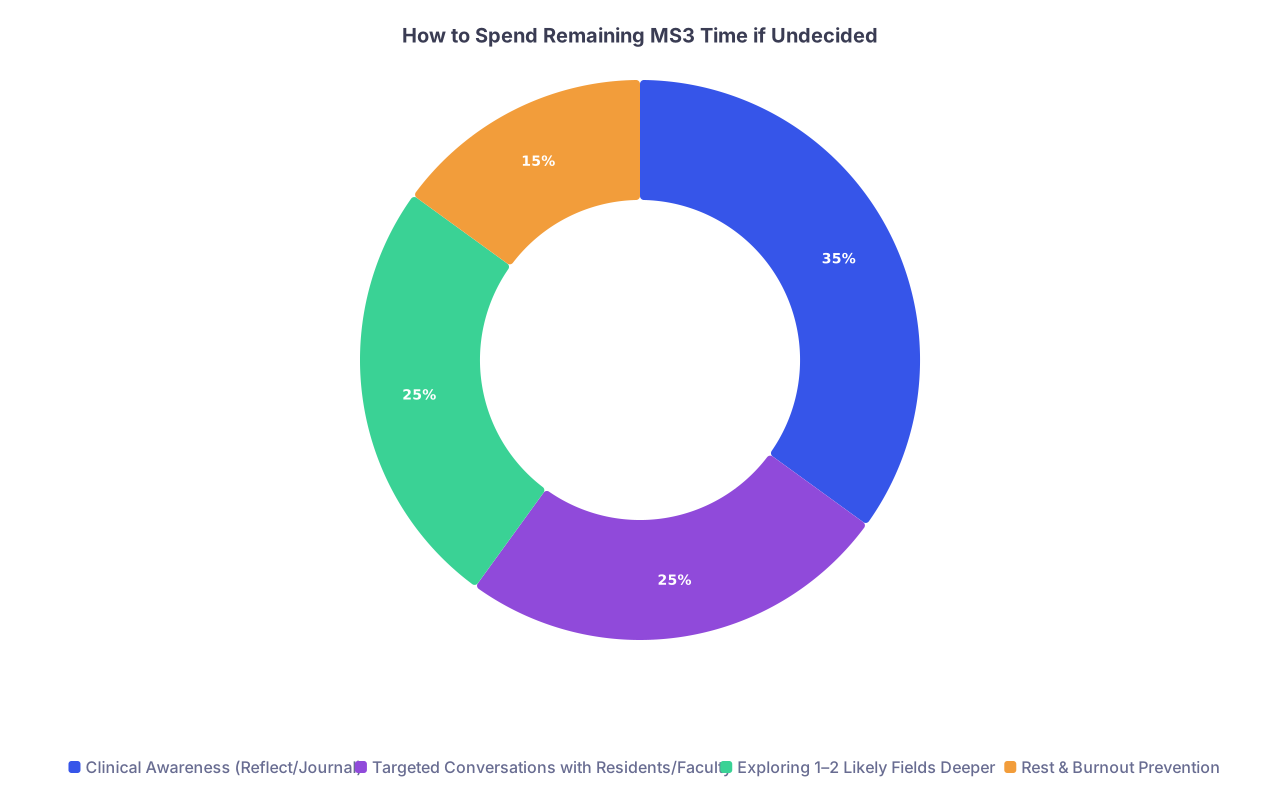
| Category | Value |
|---|---|
| Clinical Awareness (Reflect/Journal) | 35 |
| Targeted Conversations with Residents/Faculty | 25 |
| Exploring 1–2 Likely Fields Deeper | 25 |
| Rest & Burnout Prevention | 15 |
- Have brutally honest 1:1s with people actually in the fields you’re considering.
Not just “tell me about your specialty.” Try:
- “What do you hate about your job but tolerate?”
- “If your kid wanted to do your specialty, what would you warn them about?”
- “Which personalities crash and burn in this field?”
- Ask your attendings and residents how they see you.
Something like:
- “I’m deciding between X and Y. Based on how I work, do you think one fits me better? Please be honest — I won’t be offended.”
You might hate what they say. Or you might realize everyone independently thinks you’d be a great [specialty you were lowkey ignoring].
- Line up at least one early MS4 elective in your top contender.
Even if you’re still torn. Worst case:
- You do a sub-I in IM, realize you hate the inpatient grind, and pivot to outpatient-heavy fields with that knowledge still in time.
- Leave a little flexibility in your MS4 schedule if your school allows it.
Don’t pack your first half of MS4 with 4 sub-Is in 4 different specialties “just in case.” That’s how you burn out and still feel lost. Two focused, high-yield rotations in your main contender is usually better than chaos.
What If You Make the “Wrong” Choice?
Let’s say it. Out loud. The nightmare.
You choose a specialty. You match. You start residency.
And you… hate it.
Everyone acts like that’s The End. Like your whole life is locked in.
That’s not reality.
People:
- Switch from surgery to anesthesia.
- From OB to FM.
- From IM to radiology.
- From EM to psych.
Is it painful? Yes. Does it mean extra training years and awkward conversations? Also yes. But does it happen every single year? Absolutely.
Something else happens every year too: residents who were anxious and unsure in MS3 end up liking their specialty once they’re actually in it. Not obsessed, not “I was born to do this,” but content. Growing. Not miserable.
If you’re the kind of person who reflects, asks questions, and cares this much about choosing… you’re already less likely to sleepwalk into something that’s a complete mismatch.
Don’t Confuse General Misery with Specialty Misfit
This one’s touchy, but I’m going to say it.
If you’re exhausted, demoralized, and numb at the end of MS3, of course every specialty looks bad.
When you’re:
- Post-call too many times to count
- Evaluated nonstop
- Living in constant “am I good enough” mode
It’s very hard to tell whether you dislike medicine or just the current version of training.
Sometimes it’s not:
- “I don’t like any specialty.”
It’s:
- “I’m depressed and burned out, and my brain is trying to solve that by changing my future specialty because that feels like the only leverage I have.”
Changing specialties doesn’t cure burnout. It might help if there’s a genuine misfit, but if what you really need is rest, therapy, boundaries, or support — no choice will feel right until you’re less fried.
So before you conclude, “I must be broken; I don’t belong in any field,” ask yourself:
- When I was less burned out (earlier MS3, preclinical, shadowing), were there things I liked more?
- If I imagine doing this work with more sleep and less evaluation hanging over me, do I still hate it?
If everything is gray, address that too. This is not “weakness.” It’s realism.
A Grounded Way to Decide When You Have to Decide
At some point, yes, you’re going to have to choose. Not now-now, but ERAS-time now.
Here’s a simple decision framework that doesn’t rely on “follow your heart” nonsense:
- List your top 2–3 realistic fields.
- For each, write:
- What I like day-to-day.
- What I dislike but could tolerate.
- What I absolutely could not live with long-term.
- Look at:
- Training length.
- Competitiveness vs your stats.
- Flexibility for future shifts (e.g., IM → cards, heme/onc vs something razor-narrow).
- Ask: “If I woke up Match Day and found out I matched into X — would I be relieved, neutral, or devastated?”
Go with the one where “relieved” feels most real — not the one that impresses your classmates the most.
You’re the one doing the 3 a.m. pages and the charting. Not them.

| Category | Value |
|---|---|
| Decided Early MS3 | 80 |
| Decided Late MS3/Early MS4 | 70 |
(Those numbers aren’t exact, but the pattern is real: late deciders still match. The difference is smaller than your anxiety is telling you.)
FAQ: Exactly 5 Questions
1. Am I screwed if I don’t know my specialty by the end of MS3?
No. You’re not screwed. You’re uncomfortable, which your brain is interpreting as danger. Most schools expect you to still be sorting through options late MS3. You get into real trouble only if you:
- Pretend you’ve decided when you haven’t, and don’t explore honestly, or
- Refuse to decide at all and sabotage your MS4 schedule and letters out of fear.
Uncertainty now is normal. Paralysis later is the real risk.
2. Should I just pick the most competitive specialty I “kind of like” to keep doors open?
That’s how people end up miserable and unmatched. Picking derm, ortho, or ENT because you “sort of liked the rotation and it’s prestigious” is a terrible strategy if you:
- Don’t have the numbers.
- Don’t actually care enough to grind for it.
- Don’t feel drawn to the lifestyle.
You’re better off being a strong, authentic applicant in a moderately competitive field you can actually see yourself in than a half-hearted derm applicant with forced research and weak enthusiasm.
3. What if I liked every rotation? Is that a bad sign?
No, it just means you’re adaptable and can find something to enjoy in most environments. That’s not a flaw; it’s a strength. For people like you, the decision should focus more on:
- Lifestyle you want.
- Where you felt most “yourself.”
- What kinds of patients and problems you’re willing to handle on your worst days.
If you truly liked everything, start by eliminating what you least want (e.g., night-heavy, trauma-heavy, or super-OR-heavy) and work backward.
4. What if I didn’t love any rotation? Does that mean I chose the wrong career?
Not automatically. It might mean:
- You were too exhausted to enjoy anything.
- You had toxic teams that skewed your perception.
- You haven’t seen outpatient versions or different practice settings yet.
But if you consistently feel dread, emptiness, or disgust at the idea of any type of clinical work, then yes — that deserves serious reflection with someone you trust (advisor, therapist, mentor). Lots of people have this scare and still go on to like their eventual specialty once they’re not being graded every second.
5. How late is “too late” to decide my specialty?
The hard line is right before:
- Scheduling key MS4 rotations.
- Asking for letters.
- Submitting ERAS.
In practice, that means you want a solid direction by:
- Late spring / early summer before MS4 for most specialties.
- Earlier if you’re aiming for very competitive fields with away rotations.
But “too late” doesn’t mean “game over.” It just means fewer ideal options and more stress. People decide mid-summer of MS4 and still match — usually into fields that are more flexible and less hyper-competitive.
Years from now, you won’t remember the exact month you “figured it out.” You’ll remember that you were scared, uncertain, and still managed to make a thoughtful choice anyway — and that’s the part that actually predicts the kind of doctor you’ll become.