
Your score report is not a crystal ball that can predict your failure.
It feels like it is. I know. You see that number—your Step 1 pass, your Step 2 score that’s 10–20 points below the “average matched,” your shelf that barely scraped by—and your brain jumps straight to: “I’ll never match derm/ortho/rads/ENT/whatever-I-care-about. It’s over.”
Let’s slow this panic spiral down.
You’re not crazy to be scared. The system really does care about numbers. Programs do screen. Some doors are harder to open now.
But the idea that “my score tanked, so my dream specialty is gone forever” is almost always way too absolute, way too early, and way too harsh.
I’ll walk through what actually gets you blocked, what just makes things harder, and where you still have leverage even with “bad” scores.
First: How Bad Is “Bad” Really? (Your Brain Usually Exaggerates)
Most of us in med school are terrible at interpreting our own stats. We’re used to being top of the class, so “average” feels like failure and “below average” feels like career death.
Here’s the thing: programs don’t think in vibes. They think in cutoffs and distributions.
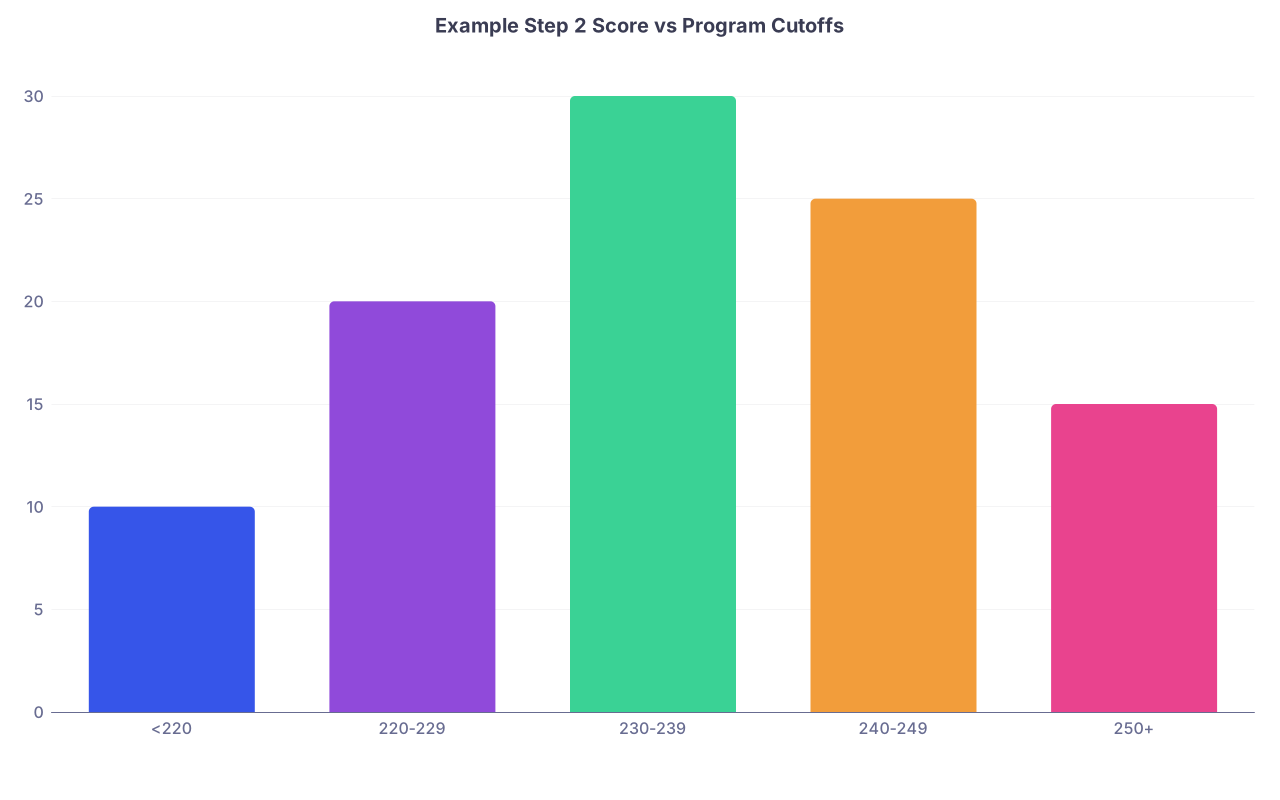
| Category | Value |
|---|---|
| <220 | 10 |
| 220-229 | 20 |
| 230-239 | 30 |
| 240-249 | 25 |
| 250+ | 15 |
Let me translate the common score fears:
- “I’m below the average matched for my specialty.”
- “I’m under the ‘recommended’ score I saw on Reddit.”
- “People say you need 250+ to match competitive fields.”
Here’s what those usually don’t mean:
- They don’t mean every program is screening you out.
- They don’t mean no one with your score ever matches that field.
- They don’t mean your Step score alone decides your future.
Where scores typically fall:
- If you’re:
- 10–15 points below the average matched: that’s a headwind, not a wall.
- 20–25+ points below: that’s where some doors really do close unless you have serious counterweights (amazing research, strong connections, home program, AOA, etc.).
- Above or near average but not “amazing”: you’re fine. You’re just not in the auto-admit fantasy land you imagined.
What actually matters more than the absolute score:
- Is there a hard cutoff? (e.g., some ortho programs won’t even look below 240–245.)
- How many red flags do you stack? (low score + fail + no home program + no research = much harder)
- How coherent is your story? (“I had a rough exam year but everything else screams dedication to this field.”)
The problem is: you’re looking at your score in isolation. Programs almost never do that.
The Harsh Truth: When Scores Really Can Block a Field
Let me be blunt for a second, because sometimes people sugarcoat this and it just wastes your time.
Scores can function like a locked door in certain situations.
Here are the cases where your anxiety is not totally unfounded:
| Situation | What It Often Means |
|---|---|
| Step 1 fail + low Step 2 in competitive specialty | Many top/mid programs off the table, need strong backup plan |
| Very low Step 2 (e.g., <220) for highly competitive field | Majority of programs will auto-screen you out |
| Multiple exam failures (shelves + Steps) | Committees worry about future board pass rates |
| No Step score advantage + weak application elsewhere | Hard to stand out, even in less competitive fields |
| Applying with no geographic ties + low scores | You lose one of the few easy “hooks” programs like |
A few specific scenarios I’ve seen play out badly:
Trying to break into derm with:
- No significant derm research
- No derm home program
- Step 2 in the low 220s
- Mid-class rank
Is it technically possible? Yes. Are the odds brutally low? Also yes.
Ortho with:
- Step 2 in the low 220s
- No away rotations (for whatever reason)
- Little ortho exposure
This is the kind of app where you might get 0–2 interview invites even with a wide net.
An IMG aiming for radiology/ENT/plastics with:
- Step 2 around 220
- No US research or letters
Reality: most programs just won’t risk it.
This isn’t to say “give up.” It’s to say: you deserve honest data before you put all your emotional energy into a lottery with terrible odds.
The Part No One Emphasizes: How Much the Whole Package Can Save You
Here’s where your brain is lying to you: it thinks scores are 90% of the decision.
They’re not. They’re not nothing, but they’re not everything either.
Think of your application like this:
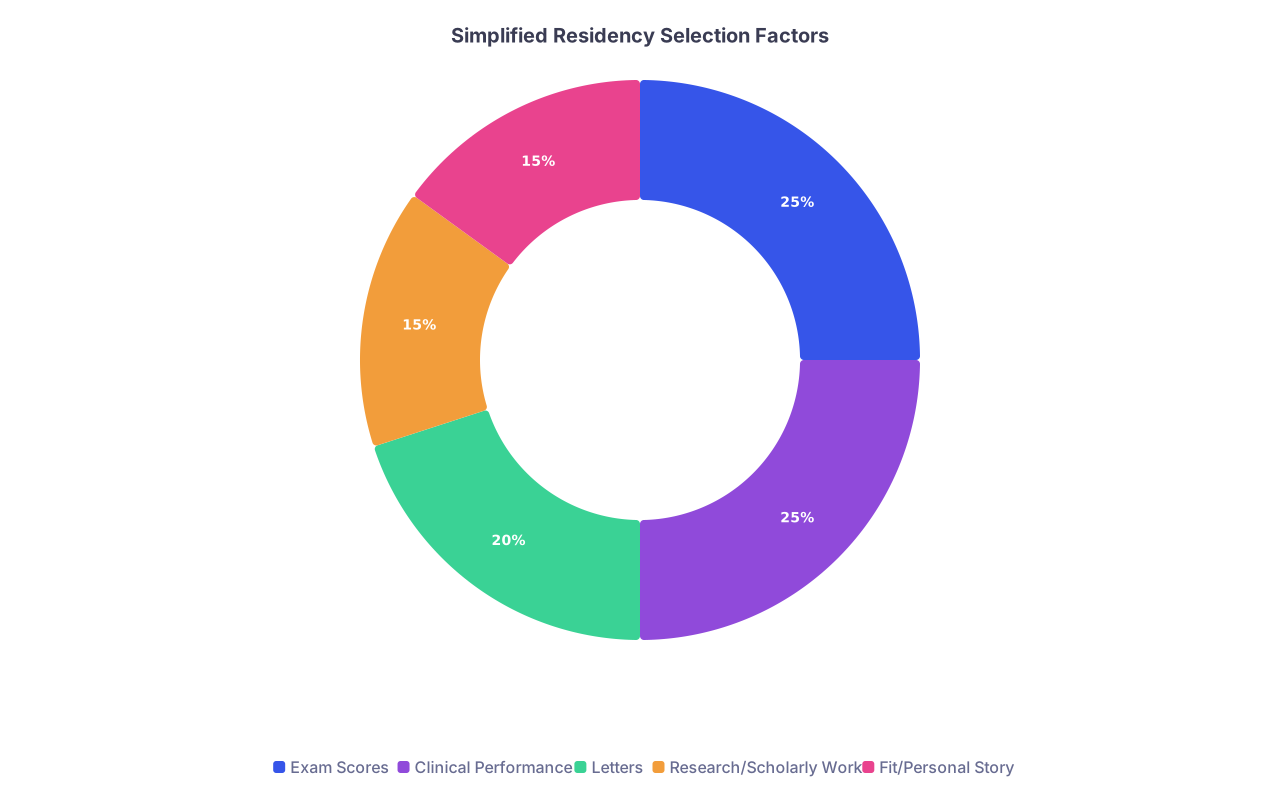
| Category | Value |
|---|---|
| Exam Scores | 25 |
| Clinical Performance | 25 |
| Letters | 20 |
| Research/Scholarly Work | 15 |
| Fit/Personal Story | 15 |
These percentages aren’t exact, but the point stands: a huge chunk of your fate is outside those three digits.
Things that legitimately move the needle:
Clinical grades and narrative comments
Programs read: “Among the top students I’ve worked with in years,” “exceptional work ethic,” “functions at intern level” — that kind of language can soften a mediocre score shock.Letters from known faculty
A strong letter from someone programs trust is worth more than 10–15 Step points in many cases. I’ve seen PDs say, “Their score is weaker, but Dr. X says they’re fantastic, so let’s bring them in.”Real, specialty-specific commitment
Not “I shadowed twice and like the lifestyle.”
I mean:- Multiple rotations in that field
- Longitudinal involvement in clinic, QI projects, or service
- You can talk about the field’s ugly parts and still want it
Research that actually shows up on paper
First- or second-author, poster at a known conference, or any evidence that:- You stuck with a project
- You can finish what you start
- You know this field beyond surface-level
A human story that makes sense
“I bombed Step 1 during a year when I had a death in the family, but since then my shelves and Step 2 are on an upward trend, my clinical comments are strong, and I’ve taken responsibility for changing how I study.”
That’s very different from, “I just don’t test well” with nothing else to show for it.
Your score isn’t a death sentence by itself. It’s a risk factor that needs context. You can build that context.
Competitive vs Less Competitive: Your Odds Aren’t Binary
One of the worst mental traps: assuming the whole world is either “I match my dream” or “I’ve failed my career.”
That’s not how this works. Your odds shift by specialty category and by how smart you are about applying.
Here’s a rough spectrum (yes, this changes a bit year to year, but the pattern stays):
| Category | Example Fields | Score Sensitivity |
|---|---|---|
| Ultra-competitive | Derm, Plastics, Ortho, ENT | Extremely high |
| Highly competitive | Rad Onc, Neurosurg, IR, some Rads | Very high |
| Moderately competitive | EM, Anes, Gen Surg, Neuro, PM&R | Moderate |
| Less competitive | IM, Peds, FM, Psych, Path | Lower |
| Very low fill risk | Some community IM/FM/Psych | Lowest |
What that means for you if your scores are “meh” or low:
Ultra-competitive:
You need:- Serious research
- Strong mentor advocacy
- Home program support
- Realistic backup
If you don’t have those, your “true odds” are honestly low.
Highly competitive:
Moderate chances if:- You apply early, broadly
- You show real commitment
- You pick programs that’ve historically taken people like you
Moderate / less competitive:
Your scores hurt within that field (i.e., fewer academic/top-tier options), but they rarely shut you out of the field entirely.
And then there’s this unsexy truth: sometimes the best move is to:
- Still apply to the dream field, and
- Also have a strong, well-chosen backup where your scores are an asset, not a liability.
That’s not “giving up.” That’s not pathetic. That’s you hedging your life.
Step Failures, Shelf Disasters, and Other Nightmares
Let’s address the worst stuff your brain replays at 3 a.m.
Step 1 Fail (Especially Now That It’s Pass/Fail)
Programs hate failures. That’s not fair given all the context behind them, but they’re scared of:
- Board pass rates stats
- Accreditation consequences
BUT:
If you failed once and then:
- Passed on retake
- Did solidly on Step 2 (ideally 230+; higher helps)
- Have strong clerkship comments
you still have a path. It’s narrower, but it exists. It may change what’s realistic (like making neuro surg much harder), but it doesn’t mean you’re doomed to a field you hate.
Low Step 2 (below ~220–225)
This is where fields that care deeply about boards (surg subs, derm, ortho, rads, ENT) start to become genuinely tough.
Salvage factors:
- Upward trend from shelves to Step 2 (not always, but it helps)
- Ridiculously good clinical performance
- Strong, known letter writers
- Geographical ties to places that are more forgiving (often smaller, community-heavy programs)
Multiple Shelf Exam Struggles
Programs do see these. But they also weigh:
- Narrative comments (do attendings actually like working with you?)
- Trend over time (did you figure it out by later rotations?)
- Explanation (burnout, illness, major life events—without making excuses)
You don’t need a perfect story. You need a story where a faculty member can look a PD in the eye and say, “Yes, they struggled with tests, but I’d still absolutely trust them with my patients.”
What You Can Actually Do This Year To Shift Your Odds
If your brain is screaming, “My score ruined everything,” you need a list of moves, not just platitudes.
Here’s what actually changes things:

| Step | Description |
|---|---|
| Step 1 | Disappointing Score |
| Step 2 | Talk to PD/Mentor in Field |
| Step 3 | Strengthen Application |
| Step 4 | Primary vs Backup Strategy |
| Step 5 | Clinicals: Honors & Comments |
| Step 6 | Research in Target Field |
| Step 7 | Network with Faculty |
| Step 8 | Apply Broadly & Early |
| Step 9 | Reassess Specialty? |
Concrete steps:
Get brutally honest specialty-specific feedback
Not from Reddit. Not from that one loud classmate.
From:- Your school’s advising dean
- A faculty member in your dream field
- If possible, a program director or assistant PD who will actually tell you the truth
Ask them directly:
- “With my scores and current CV, would you encourage me to apply in [field]?”
- “What would you need to see change in the next 6–12 months to feel better about my chances?”
- “If I were your kid, would you tell me to have a backup plan? Which one?”
Double down on clinical performance
You can’t change yesterday’s score. You can absolutely change today’s eval:- Show up early, leave late
- Volunteer to write notes, call consults, follow up labs
- Ask for mid-rotation feedback and actually adjust Often, students with mediocre scores underestimate how much a stellar clinical reputation can reshape their narrative.
Stack wins in your chosen field
Even little ones:- One or two small papers/posters
- A QI project that turns into a talk
- Continuous involvement with a faculty mentor’s clinic
It’s about building a pattern: “Despite their scores, this person keeps showing up and producing.”
Be intentional with geography
Your odds are not the same everywhere.
You’ll usually do better where you have:- A home program in that field
- Regional ties (grew up there, family nearby)
- Schools/programs that have previously matched people with similar stats
Be strategic, not delusional, about your reach
I’m not telling you not to try for your dream. I’m telling you to:- Apply to a range of program types (university + community + hybrid)
- Avoid putting 90% of your eggs in top-20 baskets that screen you out sight unseen
- Seriously consider a parallel plan if a faculty member you trust says your odds are slim
The Psychological Part: Your Score Is Not Your Worth
You’re in danger of doing something worse than not matching: letting one number define what you think you deserve.
I’ve watched good, caring students:
- Talk themselves out of trying for a field they actually could have matched in
- Self-sabotage interviews because they’re so ashamed of their scores
- Settle for a specialty they actively dislike because they assumed “people like me can’t do X”
Yes, the match is cruel. Yes, numbers matter. But your anxiety is not an accurate career counselor.
You need actual data, real feedback, and a plan—not just a loop in your head saying, “I blew it.”
FAQs
1. Be honest—if my Step 2 is below 230, is derm/ortho/rads basically impossible?
Not automatically, but your odds drop hard unless you have major advantages. For derm and ortho especially, you typically need:
- Strong research (often multiple projects, ideally in the field)
- Supportive mentors who will pick up the phone for you
- A home program or aways where you absolutely crush it
If you’re under 230 with none of that, the realistic move is:
Apply if you must for closure, but build a serious backup plan where your odds are genuinely decent.
2. I failed Step 1 but passed on the second try. Can I still do something semi-competitive?
Yes, depending on the field and everything else in your app. I’ve seen people with a Step 1 fail match into:
- Anesthesiology
- EM (varies by year)
- Mid-tier general surgery
- Even radiology in certain circumstances
The key is:
- Strong Step 2 score
- Great clinical skills and comments
- Advisors who can help steer you toward programs that are historically more forgiving
3. How many low scores/red flags is too many for a competitive field?
When you start stacking more than two major hits, it gets rough:
- Step 1 fail + low Step 2 + failed shelf in core rotation = very tough for competitive fields
- Low Step 2 + no research + no home program = tough for ultra-competitive subspecialties
You’re not “banned,” but at that point you should:
- Get direct specialty-specific guidance
- Assume you need a strong backup plan
- Consider whether the stress tradeoff is worth it to you
4. My school’s advising is useless and just says “apply broadly.” How do I get real odds?
You piece together data:
- Talk to residents in that specialty at your institution or nearby programs
- Ask: “What kind of applicants match here? Any idea what scores, research, or backgrounds they tend to have?”
- Look at your school’s match list and see who matched in your field; ask upperclassmen what their stats roughly were
- Find specialty-specific advising videos or talks from PDs (many do webinars with honest commentary)
Is it perfect? No. But it’s better than letting Reddit or your panic be your only guide.
5. What should I do today if I’m panicking about my score and dream specialty?
One concrete thing:
Email one faculty member in your dream field and ask for a 20-minute meeting to discuss your competitiveness and options.
Literally today.
Keep it simple:
“Hi Dr. X, I’m a [MS3/MS4] interested in [specialty]. My recent exam scores weren’t as strong as I’d hoped, and I’d really value your honest perspective on what this means for my chances in this field and what I can still do to strengthen my application.”
Then open your calendar and block 30 minutes to prepare questions. Don’t just sit with the fear. Force it into the light where someone who’s actually on the other side of the interview table can look at it with you.