
The way most medical students “find a mentor” is broken. One overburdened attending, same specialty, vague guidance, minimal follow-up—and then disappointment when that single person cannot answer everything or advocate effectively.
If you want real career traction, you do not need a mentor. You need a mentor panel. Deliberately built. Strategically maintained. Used like a high-yield consult service for your career.
Here is how to build it, step by step, while you are still in medical school—especially during the exam-heavy, specialty-confusion phase when you actually need it most.
Step 1: Define What Your Mentor Panel Must Cover
Before you chase people, you need a blueprint. Otherwise you end up with five cardiologists and nobody who can help you with research or wellness or “how do I not hate my life on surgery rotation.”
Your mentor panel should cover 4 domains:
- Clinical specialty insight
- Career strategy and competitiveness
- Research and academic advancement
- Personal/wellness and identity alignment
You are not looking for one superhero. You are assembling a small “board of directors” where each person brings a different expertise.
Here is a simple target structure:
| Role Type | Ideal Count |
|---|---|
| Core clinical mentors | 2–3 |
| Research/academic mentor | 1–2 |
| Wellness / life mentor | 1 |
| “Stretch” / high-level mentor | 1 |
Let me translate that into something actually usable:
Core clinical mentors (2–3)
People in the specialties you are seriously considering (or in adjacent ones). For example: IM, EM, Anesthesia if you are not sure yet where you land but know you like acute care.Research/academic mentor (1–2)
Someone who can plug you into projects, publications, and letters. Not necessarily in your final specialty, but at least not irrelevant (e.g., peds research is fine if you think peds or FM).Wellness / life mentor (1)
Usually a resident or junior attending who is honest about burnout, scheduling, relationships, kids, finances. They help you avoid being that PGY-2 on the verge of quitting.“Stretch” mentor (1)
A more senior, impressive person: PD, division chief, big-name researcher, or highly respected clinician. They are not for weekly check-ins. They are for strategic moves, letters, and long-term perspective.
If you graduate without at least 4 distinct humans covering these buckets, you are handicapping yourself. Fix that now.
Step 2: List Your “Coverage Gaps” Before You Ask Anyone
You cannot fix what you have not diagnosed.
Grab a sheet of paper (or a notes app) and brutally answer:
- What specialties am I genuinely considering?
Do not write ten. Force yourself to 2–4. - Who currently gives me honest feedback on:
- My performance?
- My competitiveness for those fields?
- Who can realistically write me strong letters in the next 12–18 months?
- Who talks to me about non-career stuff (energy, relationships, burnout)?
Now create a simple grid like this:
| Domain | Current Mentor(s) | Strength (1–5) | Gap? (Yes/No) |
|---|---|---|---|
| Clinical insight | Dr. A (IM) | 3 | Yes – need more |
| Career strategy | None | 1 | Yes |
| Research | Dr. B (Peds) | 4 | Partial |
| Wellness/life | Senior student | 2 | Yes |
Anywhere you see “Yes” or a strength of 3 or less, that is where you target your next mentor.
Do this before you send a single email. Otherwise you will waste months collecting “cool attendings” who do not move the needle for what you actually need.
Step 3: Identify Mentor Candidates Across Specialties (Without Being Creepy)
You are surrounded by potential mentors, but you are probably only seeing the obvious ones: your current attendings and whoever gave the last lecture.
You need a wider net:
Where to find strong mentor candidates
-
- Attendings who:
- Give specific feedback (not just “good job”)
- Let you do more when you show initiative
- Talk about their field realistically (pros and cons)
- Senior residents who:
- Teach without being prompted
- Remember your name and level
- Seem organized and not completely burned out
- Attendings who:
Departmental / student interest groups
- Faculty advisors for EMIG, SURGIG, IMIG, etc.
- People who show up repeatedly to student events, not one-off cameos.
Research structures
- PIs on existing student-friendly projects.
- Residents with ongoing QI or retrospective chart reviews looking for help.
Formal programs
- Your school’s “advisory college” system, career advising office, or DEI/First-Gen initiatives. These often quietly maintain lists of “good mentors” by specialty and identity.
Alumni and near-peers
- Recent grads from your school in the specialties you are considering.
- PGY-2/3 who matched into your “reach” programs.
Here is the filter: if interacting with them during one shift or one meeting leaves you with more clarity, they are a candidate. If you leave more confused, dismissed, or invisible, move on.
Step 4: Make the Ask the Right Way (And Avoid the Cringe)
Most students botch the initial contact. Either they send a vague “Will you be my mentor?” email or they try to force a long-term relationship in the first conversation.
Do this instead: ask for one specific, time-limited interaction. Then build from there if it works.
Example outreach email (attending you worked with)
Subject: Following up and quick career advice request
Dear Dr. Lopez,
I was on your wards team last month on Gen Med. I really appreciated your feedback on my presentations and how you explained your path into academic hospital medicine.
I am a MS2/MS3 currently deciding between internal medicine and emergency medicine. Would you be open to a 20–30 minute meeting in the next few weeks for some advice on building a strong IM application from my current stage? I would especially value your perspective on:
- How to use my upcoming rotations strategically
- Whether my current CV aligns with IM programs you work with
I am happy to send my CV beforehand if helpful and to work around your schedule.
Best regards,
[Name]
[Class Year]
Specific. Respectful. Bounded. You are not asking them to adopt you; you are asking for a consult.
Example outreach email (cold email to faculty you have not worked with)
Subject: MS2 interested in [Specialty] – brief meeting request
Dear Dr. Chen,
I am a second-year medical student at [School]. I attended your recent talk on [topic] through the [specialty interest group], and your description of your work in [subfield] resonated with me.
I am exploring [Specialty] as a possible career path alongside [other specialty if applicable] and would be grateful for 20–30 minutes of your time for advice. Specifically, I would like to ask about:
- How students at our school typically get involved in [Specialty]-related projects
- What experiences are most helpful by the end of third year for a competitive application
If you are open to this, I can send a brief CV and a few times that work with your schedule.
Sincerely,
[Name]
[Class Year]
You are signaling you are organized and you know what you want. That alone sets you above half your class.
Step 5: Run the First Meeting Like a Professional, Not a Lost Student
This is where most people lose mentors. They show up unprepared and turn the meeting into a therapy session or a generic “tell me your story” chat.
You want your mentor to leave thinking: “That student is serious. I am happy to help them again.”
Before the meeting
Send:
- Brief CV (1–2 pages)
- 2–3 sentence summary of what you are deciding between
- 3–5 bullet questions you want to cover
Do 10–15 minutes of homework:
- Read their faculty profile.
- Skim 1–2 of their recent publications or talks, if relevant.
- Note their roles (PD? Clerkship director? Division chief?).
During the meeting: use a clear structure
Aim for 20–30 minutes:
1–2 minutes: Context
- Who you are, year, where you are clinically.
- What specialties you are considering.
5–10 minutes: Questions about the specialty / their path
- “What made you choose X over Y?”
- “What do you see as the most common mismatch between students’ expectations and the reality of this field?”
10–15 minutes: You-focused strategy
- “Here is my current CV in brief. What do you see as my major strengths and weaknesses for this specialty?”
- “If you were me, what would you prioritize in the next 6–12 months?”
2–3 minutes: Next steps
- “Would you be comfortable if I checked in again after [Step exam / core rotation / research project] to get your feedback on my progress?”
- If the vibe is good: “Are there 1–2 other people you would recommend I talk to, given my interests?”
You are doing three things:
- Getting insight
- Getting practical advice
- Getting connected to their network
That last one is where your mentor panel multiplies.
Step 6: Deliberately Diversify Across Specialties
Your category is “CHOOSING A SPECIALTY.” That means you should not build a mentor panel entirely inside one field. You need perspective.
If you are torn between IM, EM, and anesthesia, your panel should not be:
- 3 hospitalists
- 1 cardiologist
- 1 rheumatologist
That is an echo chamber.
Instead, explicitly design cross-specialty alignment. For example:
If you like procedures + acute care:
- EM attending
- Anesthesia attending
- Crit care–oriented IM attending
- A PGY-2 in EM or surgery who is honest about lifestyle
If you like longitudinal care + thinking:
- IM attending (clinic-heavy)
- FM attending (community practice)
- Outpatient subspecialist (endo, rheum, ID)
- A hospitalist for contrast
If you are between “ROAD” and non-ROAD:
- One mentor in a lifestyle-friendly field (Rads, Optho, Anesthesia, Derm)
- One in a more intense field you are considering (Gen Surg, IM subspecialty)
- One resident in each who can give “what my weeks really look like” detail
Use your mentor meetings for comparative questions, not just “tell me about your field”:
- “If a student values X and Y but is less concerned about Z, which students do better in your field vs [other field]?”
- “What types of students do you see burn out or switch out of your specialty?”
You will not get unbiased answers. That is fine. The differences in bias are useful data.
Step 7: Turn Advisors into Advocates
Having people who “know you” is not the same as having people who will go to bat for you.
You want at least 2–3 panel members to become true advocates:
- Write strong, detailed letters.
- Email colleagues about you.
- Mention you in faculty meetings when opportunities arise.
How to get there:
Show longitudinal growth
- Email an update every 3–4 months:
- What rotations you completed and how it went
- New roles, projects, scores (if relevant)
- 1–2 focused questions or a short reflection
- Example:
Since we last spoke in March, I completed my surgery and IM rotations. I found I especially enjoyed the ICU and wards structure, which shifted me more firmly towards IM/CC. Attached is a brief updated CV; I would value any feedback on whether I am on the right track for [type of programs].
- Email an update every 3–4 months:
Make their investment pay off
- If they connect you to a project, finish your part.
- If they introduce you to someone, follow through quickly and professionally.
- Say explicitly: “I want to make sure this reflects well on you.”
Ask directly when appropriate After 6–12 months of intermittent contact and real work:
- “I am starting to think about letters of recommendation. Do you feel you know me and my work well enough to write a strong letter for [specialty]?”
If they hesitate or soften the word “strong,” thank them and do not use that letter. You want people who are enthusiastic, or not at all.
Step 8: Manage the Panel Without Burning Yourself Out
You are a full-time med student. You do not have time to maintain 10 relationships at a high level. You also have exams, rotations, maybe a life.
So structure this.
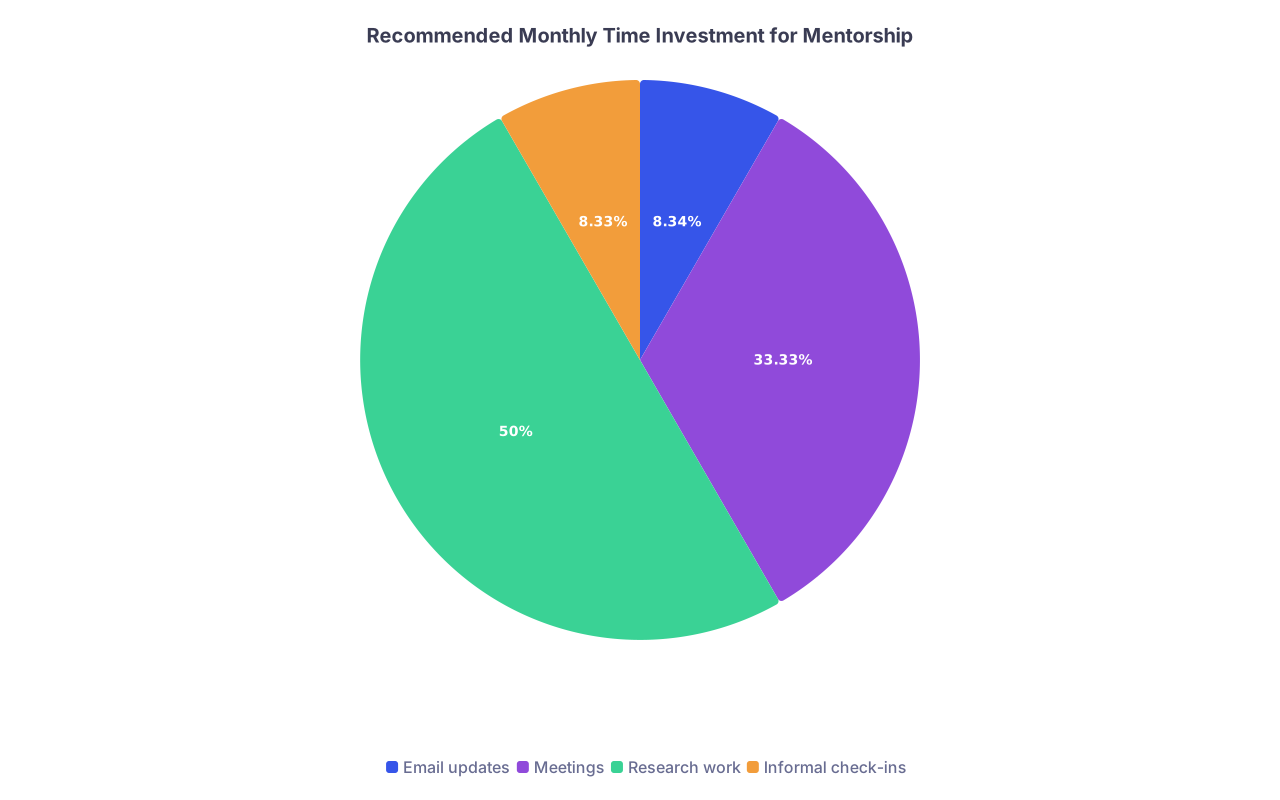
| Category | Value |
|---|---|
| Email updates | 15 |
| Meetings | 60 |
| Research work | 90 |
| Informal check-ins | 15 |
That is about 3–4 hours a month, max. Manageable if you are intentional.
Simple system to keep it sane
Create a basic mentor tracker (spreadsheet or note):
- Name, specialty, role (clinical/research/wellness/stretch)
- Last contact date
- Next planned contact
- Notes (interests, advice they gave)
Tier your mentors
- Tier 1 (2–3 people): Update every 2–3 months; meet 2–4 times a year.
- Tier 2 (3–5 people): Update 2–3 times a year; meet once a year or ad hoc.
- Tier 3 (occasional contacts): Email only when you have specific questions or to share major milestones.
Combine outreach with natural milestones
- After each core rotation
- After Step/Level exams
- After new leadership role or publication
- 6–9 months before ERAS submission
You are building a long game. You are not spamming them after every quiz.
Step 9: Use the Panel to Handle Conflicting Advice
You will get conflicting recommendations. One surgeon tells you to apply broad, one says apply narrow. One EM doc says scores matter less, another says they matter a lot. Residents contradict attendings. It gets noisy fast.
Here is how you handle it like an adult instead of spiraling:
Tag advice by who gave it
- PDs → program selection, application strategy
- Residents → daily life, culture, hidden curriculum
- Researchers → CV, academic path, project selection
- Wellness mentors → sustainability, personal fit
Convert conflicting advice into explicit questions
- Example: PD says Step 2 must be >240. Resident says “We take people 230–235 all the time.”
- Your internal translation:
- PD is telling you the safe zone.
- Resident is telling you the real distribution.
Create your own “consensus”
- If 2–3 mentors in a field say the same thing independently, treat it as high-probability truth.
- If one person’s advice is an outlier, value it less unless they are uniquely positioned (e.g., chair of the department).
And remember: mentors are not gods. Your job is to synthesize, not obey.
Step 10: Protect Yourself From Bad or Misaligned Mentors
Some faculty are charismatic but terrible mentors. Some are brilliant clinically but dismissive or biased. Some are well-meaning but clueless about current match realities.
Red flags you should not rationalize away:
- Never remembers your name or interests after multiple meetings.
- Talks more about themselves than about your questions.
- Dismisses your concerns about lifestyle, family, identity, or discrimination.
- Offers “opportunities” that are essentially free labor with no credit.
- Makes you feel smaller or less capable each time you interact.
If this is one of your current main advisors, you need to quietly demote them in your panel. That means:
- Stop going to them first for big decisions.
- Do not rely on them for critical letters.
- Maintain only minimal contact if politically necessary.
And then intentionally add someone better to cover that role.
Your mentor panel is not permanent. It is a living system. People move up, down, or off it as you learn who actually helps you thrive.
Step 11: Example Mentor Panel by MS Year
To make this concrete, here is how a functional mentor panel might look in different phases.
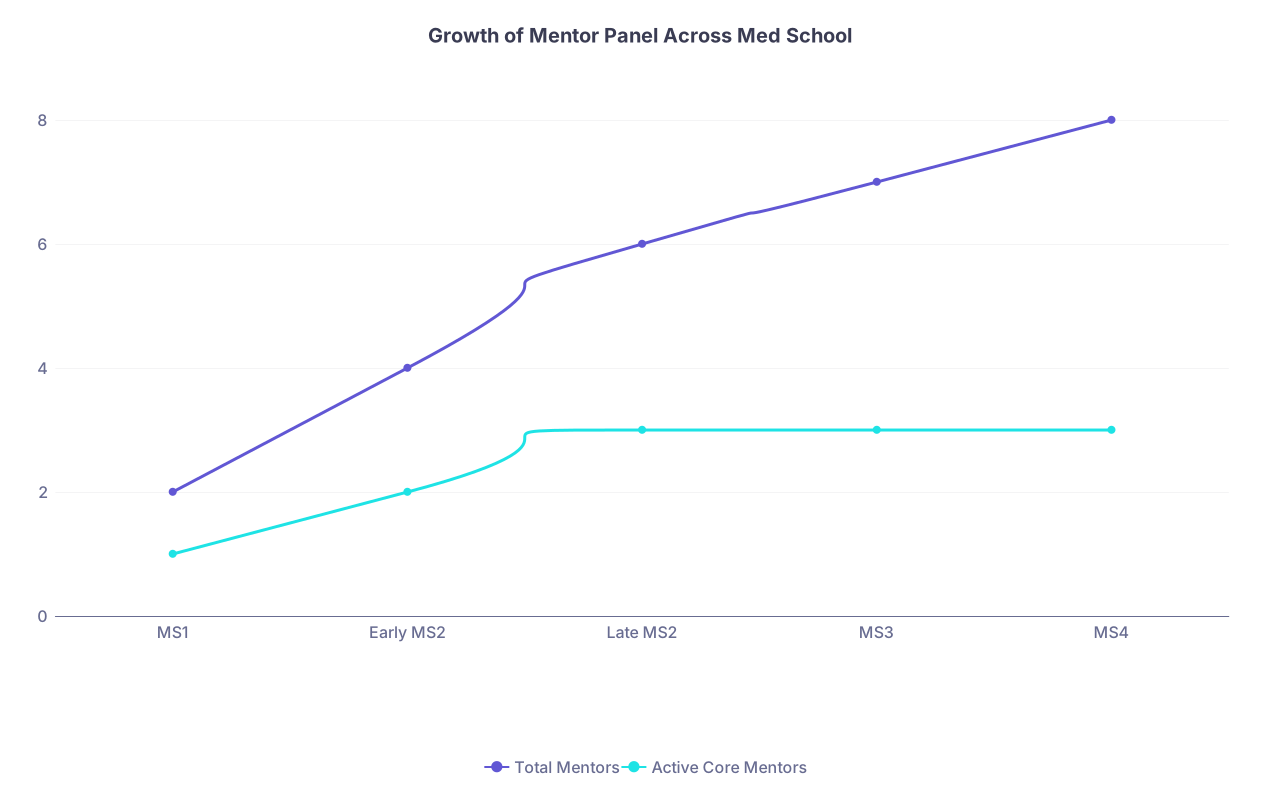
| Category | Total Mentors | Active Core Mentors |
|---|---|---|
| MS1 | 2 | 1 |
| Early MS2 | 4 | 2 |
| Late MS2 | 6 | 3 |
| MS3 | 7 | 3 |
| MS4 | 8 | 3 |
MS1 – Early MS2
- 1 generalist school advisor
- 1 research mentor
- Maybe 1 senior student / resident you trust
Goal: build habits, get some projects, not choose a specialty.
Late MS2 – Early MS3 (you are here, probably)
- 2–3 clinical mentors in your top 2–3 specialties
- 1–2 research mentors (maybe one overlapping with a clinical field of interest)
- 1 wellness / honest resident
- 1 stretch mentor (PD or big academic)
Goal: clarify specialty fit, start planning for strong application.
MS3 – MS4
- 2 strong letter writers in your chosen specialty
- 1–2 mentors in adjacent specialties (for Plan B or subspecialty planning)
- 1 research mentor who can help with late-cycle projects or abstracts
- 1 wellness/life mentor to guard against “I am trapped” thinking
Goal: execute match strategy, not panic blindly.
Quick Implementation Checklist (Next 30–60 Days)
If you want this to be real and not just an article you read, here is the exact sequence:
This week
- Map your current mentors and gaps.
- Decide on 2–3 specialties you are truly considering.
Next 2 weeks
- Identify 5–7 candidate mentors (different roles and specialties).
- Send 3–4 specific, respectful meeting requests.
Next 4–6 weeks
- Hold 3–5 focused meetings.
- After each, write down:
- What did I learn about that specialty?
- Did this person seem like a potential ongoing mentor or just a one-off consult?
By 2 months from now
- Lock in:
- 2–3 core clinical mentors (across your main interests)
- 1 research mentor
- 1 wellness / real-talk mentor
- Create your mentor tracker.
- Lock in:
If you do this, you will be ahead of 80–90% of your class in terms of actual professional guidance. That matters when the match clock starts.
FAQ (Exactly 4 Questions)
1. How many mentors is “too many”?
Once you are trying to keep up with more than 8–10 people, you are usually collecting names, not mentors. Focus on 3–5 core relationships you actively maintain and another 2–4 you touch base with occasionally. Any more and your follow-up gets sloppy, which makes you look disorganized. Quality over volume, especially for letter writers and advocates.
2. What if I feel like I have nothing impressive to show a potential mentor yet?
Then your “ask” should match your stage. You are not asking for a letter or a huge opportunity. You are asking for:
- 20–30 minutes to understand a specialty
- Advice on how to build from where you are now
Be honest about your starting point: “I am early in my clinical training and do not have much research yet, but I want to be intentional.” Many mentors actually prefer shaping someone early rather than inheriting a chaotic CV later. The key is showing that you act on feedback.
3. How do I bring up identity-related concerns (gender, race, parenting, LGBTQ+, etc.) without making it awkward?
Be direct but contained. For example:
- “As a [woman / Black student / future parent / etc.], I am thinking about how that plays out in [Specialty]. Are there specific challenges or supports I should be aware of?”
Or: - “Do you know faculty or residents with [identity] in this field you would recommend I talk to?”
If they shut this down or hand-wave it, that tells you something about both them and sometimes the local culture. You deserve at least one mentor who takes this seriously.
4. What if a mentor gives me advice that feels completely wrong for me?
Then treat it as data, not a commandment. Ask yourself:
- Is this advice based on their personality and career, or on current match realities?
- Do other mentors say something similar?
You can also reality-check with them directly:
“I appreciate that perspective. Given that I value [X] and am less focused on [Y], would you still recommend that path, or would you adjust it?”
If they cannot or will not adjust their advice to your stated values, they may still be useful as a content expert, but probably not as a core career mentor. Adjust their role on your panel accordingly.
Key takeaways:
You do not need one perfect mentor. You need a deliberately built panel that covers clinical insight, research, career strategy, and personal sustainability.
Treat mentoring like a real professional process: targeted outreach, structured meetings, periodic updates, and pruning of bad fits.
If you do the unglamorous work of building this now, choosing a specialty and surviving the match will feel like executing a plan, not gambling your future.