
The right number of shadowing experiences is not a magic number. It’s the point where your decision stops changing.
That sounds vague, so let me give you actual numbers and a clear framework.
The Short Answer: Targets, Not Absolutes
You do not need to shadow 10 specialties to “do it right.” You need enough exposure to:
- Truly understand your top 1–3 specialties
- Sanity-check your choice against a few realistic alternatives
- See both good and bad days in at least one field
For most medical students, this usually looks like:
- 2–4 deep shadowing experiences (half-day to full-day, repeated)
- Across 2–3 serious specialty contenders
- Plus broad exposure via your core clerkships
In concrete terms, a solid minimum:
- Around 20–40 total hours of intentional, focused shadowing in your likely specialty
- Exposure to at least one alternative you genuinely might have chosen (another 10–20 hours)
You can absolutely decide with less if your clerkship experience was rich and you paid attention. But if you need a number to anchor to: most decisive students I’ve seen land somewhere around 3–5 separate shadowing blocks (different attendings, different settings) before they feel truly confident.
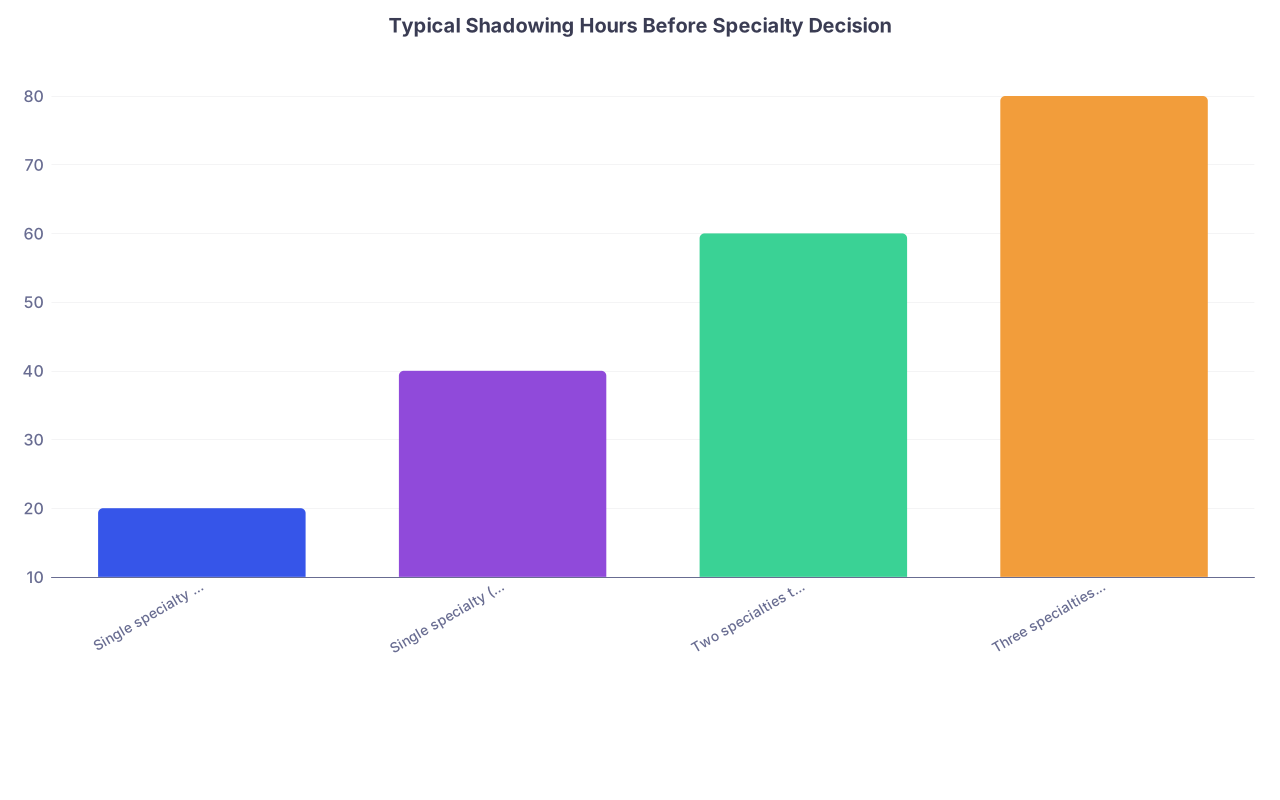
| Category | Value |
|---|---|
| Single specialty (min) | 20 |
| Single specialty (common) | 40 |
| Two specialties total | 60 |
| Three specialties total | 80 |
Now let’s make this practical.
What “Enough” Shadowing Actually Looks Like
The mistake students make is counting specialties instead of quality of exposure.
You don’t need:
- One day in derm
- One day in ortho
- One half-day in psych
- One clinic in cards
- One night in EM
That’s a menu tasting, not a decision-making process.
You do need enough experience in a given specialty to answer 5 blunt questions:
- Can I tolerate the bread-and-butter cases, day after day?
- Do I like the patient population more often than not?
- Is the lifestyle (hours, nights, call, emotional load) something I can realistically live with?
- Do I like how this specialty interacts with the rest of the team? (Power dynamics, consult culture, OR vs floor vs clinic)
- On a bad day in this field, would I still rather be here than in most other areas?
If you can answer those with some confidence for one specialty—and have at least a decent idea of the same for an alternative—you’re close to “enough.”
A Concrete Structure That Works
For a specialty you’re seriously considering, a practical minimum pattern:
- Clinic exposure: 1–2 days
See follow-ups, chronic disease management, notes, interruptions, phone calls, results review. - Procedure/OR exposure (if relevant): 1–2 days
See workflow, staff dynamics, time in the OR vs waiting, turnover, stress level. - Different attendings: at least 2
One great mentor can distort reality; you need to see a “normal” version too.
Total: ~3–5 days of purposeful, varied shadowing for a single field can already tell you more than 10 random half-days in 10 different specialties.
Shadowing vs Rotations: What Actually Matters
Here’s the hierarchy most students ignore:
Core clerkships > Sub-Is/AI > Longitudinal clinics > Shadowing > One-off “cool cases”
If you’re in clinical years, your clerkships are already “shadowing plus responsibility.” You’re not starting from zero. For most people, the combination of:
- 6+ weeks of medicine
- 6+ weeks of surgery
- 4–6 weeks of peds, OB/GYN, psych, family med
…is already enough to eliminate 60–70% of specialties. That’s good. Your shadowing then becomes about comparing the finalists, not trying to see every option on the menu.
Where shadowing really helps is:
- Before you start clerkships: rough orientation, ruling out obvious bad fits
- Between M3 and M4: confirming your top choice and one backup
- During M4: clarifying subspecialties (cards vs GI vs pulm within IM, etc.)
If you’ve done a full medicine rotation and a sub-I in medicine, and you’re still trying to “shadow more IM to decide,” the issue is not lack of hours. It’s lack of a decision framework.
A Simple Decision Framework: When to Stop Shadowing
Let’s make “enough” concrete. Stop aggressively seeking new shadowing experiences when:
- You can clearly describe:
- A typical clinic day for your specialty
- A typical inpatient/OR day
- What a bad day looks like for them
- You’ve:
- Seen at least two different attendings in the field
- Seen different practice settings if relevant (academic vs community, clinic vs OR, etc.)
- You can honestly finish this sentence:
- “If I ended up in [Specialty A] or [Specialty B], I’d be okay. But I prefer [A/B] because of _____.”
Notice what I did not say:
I didn’t say “once you’ve hit 100 hours.” Because I’ve seen students who did 100+ hours of shadowing and still had no idea what they wanted—they never asked hard questions, never reflected, just collected “experiences” like stickers.
On the other side, I’ve seen students decide confidently after:
- A standard clerkship
- 2–3 extra clinic days with a second attending
- One honest conversation with a senior resident who didn’t sugarcoat the lifestyle
The difference was not time. It was intention.

| Step | Description |
|---|---|
| Step 1 | Initial Interest in Specialty |
| Step 2 | Core Clerkship or Intro Exposure |
| Step 3 | Move on, no more shadowing |
| Step 4 | Targeted Shadowing 3-5 Days |
| Step 5 | Compare With 1-2 Alternatives |
| Step 6 | More Focused Questions/Shadowing |
| Step 7 | Make Provisional Decision |
| Step 8 | Confirm With Sub-I/AI or Elective |
| Step 9 | Still Seriously Considering? |
| Step 10 | Can Describe Typical & Bad Days? |
How Many Different Specialties Should You Shadow?
Most students wildly overshoot this in pre-clinical years.
If you’re pre-clinical (M1/M2):
- Aim for 3–5 specialties total, not 10–15
- 1–2 casual exposures to “high-interest” fields (e.g., one evening in EM, one OR day in ortho)
- 1–2 more intentional experiences in areas you suspect you might actually choose
If you’re in or after core clerkships:
- Focus on depth, not breadth
- Usually:
- 1 primary specialty you’re leaning toward → more depth
- 1 serious alternative for comparison
- Maybe 1 “I’m curious but probably not” field if you genuinely need to see it
More than 3–4 different specialties of shadowing during M3/M4 usually means you’re procrastinating on making a choice.

How Many Hours Matter for Residency Applications?
Let’s be blunt: program directors care far more about:
- Clinical grades
- Step/COMLEX scores
- Letters of recommendation
- Sub-I performance
- Research (for some fields)
Shadowing is mainly for you, not for them.
A few specialty-specific realities:
- Primary care (FM, IM, peds):
Shadowing helps, but a strong sub-I and a good letter carry far more weight. - Competitive fields (ortho, derm, ENT, plastics, neurosurg):
They care more about research, letters, and audition rotations than generic shadowing hours. - EM:
EM-specific clinical rotations are far more important than how many EM shifts you watched as an M1.
Where shadowing can matter on paper:
- Showing sustained interest over time in one field
- Filling in gaps if your school doesn’t offer a strong rotation in that specialty
- Building relationships that turn into letters or advocacy
If you’re gunning for a competitive specialty, don’t obsess over “Do I need 100+ shadowing hours?” Focus instead on:
- One or two longitudinal experiences (e.g., weekly half-day clinic over a semester)
- One or more away rotations/AIs
- Strong mentorship and research
| Specialty Type | Shadowing Importance | What Matters More |
|---|---|---|
| Primary Care | Moderate | Sub-I performance, continuity |
| Hospital-Based (IM) | Low–Moderate | Clerkship grades, letters |
| Procedural, Competitive | Low for selection | Research, away rotations, letters |
| EM | Low–Moderate | EM rotations, SLOEs |
| Lifestyle Fields (Derm, PM&R) | Moderate for fit | Research, strong faculty support |
Signs You’re Over-Shadowing (And Avoiding a Decision)
There’s a point where more shadowing just means you’re scared to commit.
Red flags:
- You keep saying “I’ll decide after I see one more specialty”
- You’ve shadowed 6+ specialties but can’t list specific pros/cons of your top two
- You’re repeating the same type of day (e.g., clinic only) over and over in the same field, hoping for clarity to magically appear
- You leave shadowing days with no notes, no questions, and no change in your thinking—just “that was interesting”
If that’s you, stop collecting hours and start doing the harder work:
- Journal after each day:
What did I like? What drained me? Could I see myself in that attending’s shoes in 10–15 years? - Talk to residents at different stages, not just attendings
- Compare your top 2–3 fields head-to-head on:
- Lifestyle (hours, call)
- Training length
- Procedural vs cognitive balance
- Patient population
How to Make Each Shadowing Experience Count
If you’re going to spend the time, squeeze value out of it. A few moves that separate serious students from tourists:
Before you go:
- Know roughly what the specialty actually does
- Have 3–4 questions ready that go beyond “Do you like your job?”
- “What do you wish you’d known as a med student about this field?”
- “On your worst days, what makes you think about quitting—if anything?”
- “What kind of personality does poorly in this field?”
During:
- Watch what they do outside the exam room or OR:
- How many hours on the computer?
- Pace of the day?
- Interruptions, consult calls, pager chaos?
- Notice their mood at 8am vs 4pm
- Pay attention to team culture: How residents are treated, how nurses respond, how consults go
After:
- Take 10 minutes to write a few bullet points:
- 3 things you liked
- 3 things you really did not
- 1 moment that stuck with you (good or bad)
Students who do this for 3–5 experiences often end up with a choice that feels solid, not random.
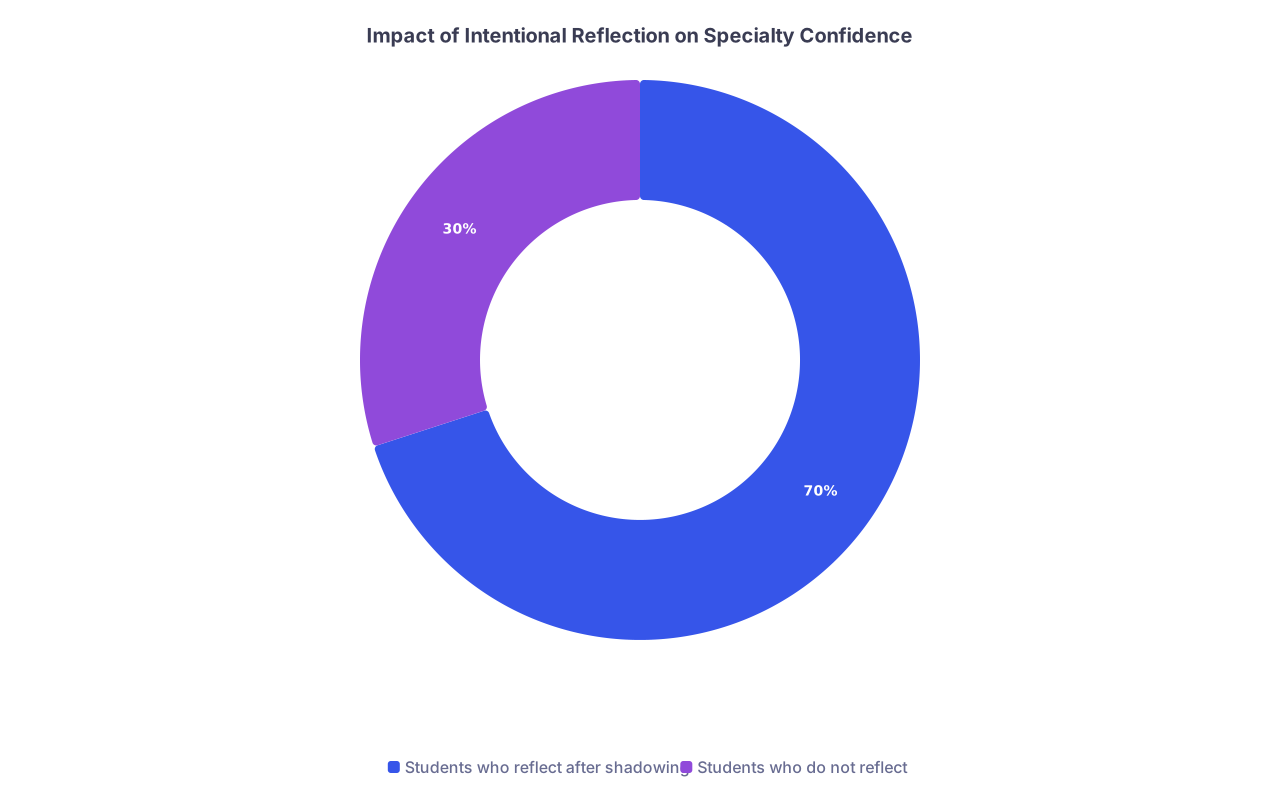
| Category | Value |
|---|---|
| Students who reflect after shadowing | 70 |
| Students who do not reflect | 30 |
A Realistic Example Path
Let me sketch a typical, sane path through med school for someone deciding between IM, EM, and anesthesia:
M2:
- One EM evening shift, one OR morning watching anesthesia
→ Quick sense of environment, nothing more.
M3:
- Medicine rotation: takes it seriously, pays attention to lifestyle, cases, and team.
- Surgery rotation: notes that OR is interesting, but the surgeons’ lifestyle is a no.
- EM elective: likes the pace, but notices the chaos, nights, and boarding stress.
Between M3 and M4:
- 2 extra days with inpatient cards (IM flavor)
- 2 days shadowing anesthesia:
- 1 OR day, 1 pre-op clinic day
- 1 day of EM again to compare now that they’ve seen more
Total “extra” shadowing: maybe 5–7 days.
They then:
- Journal after each experience
- Talk with:
- One IM attending
- One cards fellow
- One EM senior
- One anesthesia CA-2 resident
By the time ERAS opens, they do not need 10 more shadowing days. They choose IM, do a cards-heavy sub-I, and feel at peace with it, knowing they’d have also been okay in EM—but they prefer longitudinal care and less night-heavy life.
That’s enough.

The Bottom Line
Here’s the distilled version:
- You don’t need a magic number of shadowing experiences. You need enough depth in 1–2 realistic specialties to describe a typical and a bad day, and to compare them honestly.
- For most students, that looks like:
- 3–5 purposeful shadowing days in a leading specialty
- 1–3 days in at least one serious alternative
- Built on top of your core clerkships and, ideally, a sub-I
- When you notice more shadowing isn’t changing your thinking—just delaying a decision—you’ve hit “enough.” Stop collecting hours and commit to a choice, knowing you’ve seen both the shiny and the ugly sides of the field.