The advice that you must “pick a specialty early or you’ll ruin your match” is garbage.
You can absolutely say you’re undecided on specialty during clerkships and still match well. Many students do. The key is how you’re undecided and how you talk about it.
Let’s break this down like someone who’s been on both sides of this—coaching students and listening to what attendings quietly complain about in workrooms.
The Short Answer: Yes, You Can Be Undecided — But Not Directionless
Here’s the real rule:
You can be undecided on a specialty as long as you’re:
- Acting like every rotation might be your future field, and
- Talking about your uncertainty in a thoughtful, forward-moving way.
Where students get into trouble isn’t the word “undecided.” It’s when “undecided” really means:
- “I haven’t thought about this seriously.”
- “I’m just floating and hoping the universe decides for me.”
- “I don’t want to commit to working hard on this clerkship because I won’t do this specialty.”
Attendings notice that. Residents notice that. Program directors read it between the lines in your letters and MSPE.
If instead you sound like:
“I’m exploring a few fields seriously and here’s what I’m doing about it,”
you’re fine. Often better than fine.
What Attendings Actually Hear When You Say “Undecided”
Let me translate some common phrases for you. This is how they often land with evaluators:
| What You Say | What They Hear |
|---|---|
| “I’m undecided.” | Maybe fine… depends what comes next. |
| “I have no idea what I want to do.” | Passive, hasn’t reflected much. |
| “I’m keeping my options open.” | Non-committal, may not work as hard. |
| “I’m torn between IM and EM right now.” | Thoughtful, at least considering fit. |
| “I like everything.” | Hasn’t dug below the surface. |
The follow-up matters more than the initial label.
Example of a bad answer when an attending asks, “What are you thinking specialty-wise?”:
“Oh I don’t know. I’m just kind of keeping an open mind and seeing what happens.”
That tells them you haven’t organized your thinking and may not be deeply invested.
Example of a good answer, still undecided:
“I’m still undecided, but I’m seriously considering internal medicine and anesthesia. I’m trying to pay attention this month to how much I enjoy longitudinal thinking versus acute problem-solving, and how I like the team structure. That’s helping me sort it out.”
Totally different vibe. Same “undecided” status. One sounds engaged and reflective; the other sounds adrift.
How Long Is It “Safe” To Stay Undecided?
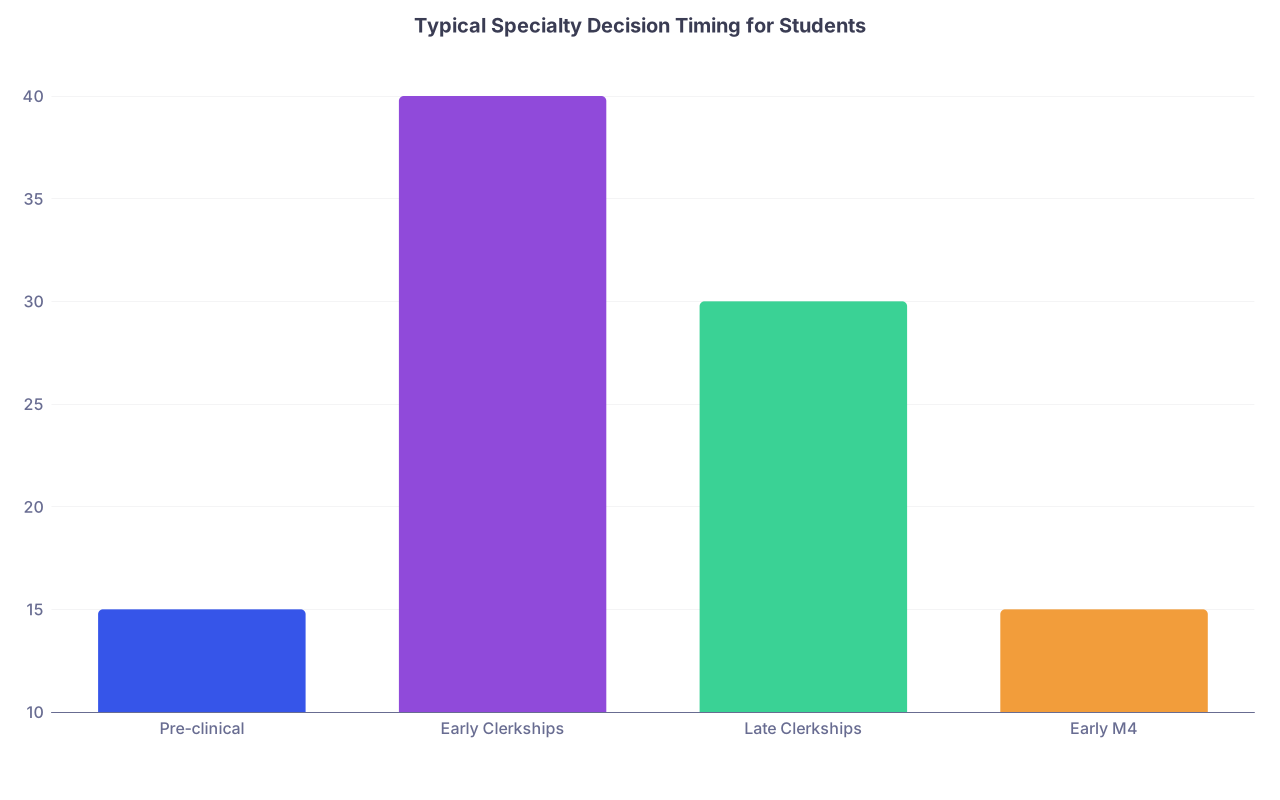
Here’s a realistic timeline for most U.S. MD/DO students:
| Category | Value |
|---|---|
| Pre-clinical | 15 |
| Early Clerkships | 40 |
| Late Clerkships | 30 |
| Early M4 | 15 |
That bar chart roughly mirrors reality:
- Pre-clinical: ~15% are actually decided in a meaningful way.
- Early clerkships: A big chunk choose here, often after IM, surgery, or peds.
- Late clerkships: Another big chunk decide on psych, EM, OB, neuro, etc.
- Early M4: You still see people making final pivots, especially between related fields.
You’re totally fine being undecided:
- All through M2
- Through most core clerkships (M3)
- Even into early M4, as long as your actions and schedule still let you build a competitive application
Where it becomes risky is:
- Late M3 with no real front-runner and no plan
- Early M4 with no home rotation scheduled in any field
- August–September of M4 without a clear specialty when ERAS opens
That’s not “undecided.” That’s “behind.”
How To Talk About Being Undecided (Without Looking Lost)
Let’s get practical. Here are specific scripts you can steal.
When an attending asks: “So what are you thinking for specialty?”
Instead of:
“I’m undecided.”
Use one of these:
Option 1 – Focused uncertainty
“I’m still deciding between internal medicine and pediatrics. I like complex problem solving and continuity, so I’m using these rotations to see where I fit best.”
Option 2 – Early exploration
“I’m early in my rotations, so I’m intentionally staying open. Right now I’m paying attention to what kind of day-to-day work energizes me and what kind of patients I connect with most.”
Option 3 – Honest plus proactive
“I don’t have a final decision yet, but I’m leaning toward EM or anesthesia. I’ve talked with advisors and I’m planning my fourth-year rotations to get more exposure in both before committing.”
Notice the pattern: undecided + direction + process.
When you’re on a rotation you’re certain you won’t choose
This is dangerous territory. The second you say:
“Oh, I know I don’t want to do surgery, so I’m just trying to get through this,”
people mentally drop you a notch. They worry your effort will be half-hearted.
Instead, both for your own development and your evals, think:
- “I won’t be a surgeon, but I will be calling surgeons.”
- “I won’t do psych, but I will treat patients with psych issues.”
Say something like:
“I don’t think I’ll end up in surgery long term, but I really want to get comfortable managing post-op patients and understanding when to call you. So I’m trying to soak up as much as I can this month.”
That shows maturity. You still might not get a glowing “future surgeon” line, but you won’t get the “disengaged and disinterested” comment that kills letters.
How Being Undecided Affects Your Letters and MSPE
Program directors don’t care if you were undecided at the start of M3. They care if your evaluations suggest:
- You didn’t fully engage in rotations
- You only “turned it on” for one specialty
- You seemed flaky, non-committal, or unwilling to own responsibilities
I’ve heard attendings say things like:
- “Once she knew she wanted derm, she checked out of wards.”
- “He said he didn’t care about OB and it showed.”
- “Great when interested, but effort seemed variable.”
Those comments hurt you no matter what you’re applying to.
What helps you regardless of specialty:
- “Treated this rotation as if it were his chosen field.”
- “Even though she’s planning on neurology, she worked extremely hard on her medicine rotation.”
- “Would be an asset to any residency.”
Those are the phrases that show up in MSPEs and LORs. You earn them by acting like a professional, not a tourist, on each rotation.
Undecided Students Who Match Well Do These 5 Things
Here’s the actual playbook of students who stay flexible but still crush the match.
1. They commit fully to every clerkship
On a rotation, they behave as if:
“This might be my specialty, and even if it’s not, this is my only chance to really learn this stuff.”
That means:
- Showing up early
- Reading about their patients
- Owning tasks
- Asking for feedback and actually using it
Not performative “I love this field!” nonsense. Just solid work ethic.
2. They’re intentional about what they’re testing on each rotation
Instead of just vibing through the month, they ask:
- Do I like this pace?
- Do I like this kind of thinking (procedural vs cognitive vs acute vs longitudinal)?
- How do I feel about the patient population?
- Do I enjoy the team culture?
They’ll literally say to me: “Surgery confirmed I want procedural work but not that lifestyle. I loved OB’s clinic/OR mix but not the hours. EM gave me the acuity and variety I wanted.”
That’s someone who used indecision productively.
3. They talk to people early and often
They don’t wait until August of M4 to finally meet with:
- The dean of students
- Specialty advisors
- Residents in fields they’re considering
They do 15–30 minute reality-check conversations:
- “If I end up liking X, what should I be doing now?”
- “What red flags should I avoid?”
- “What’s a realistic Step score / eval profile for this specialty?”

| Step | Description |
|---|---|
| Step 1 | Start Core Clerkships |
| Step 2 | Reflect on Each Rotation |
| Step 3 | Meet Advisors in Each Field |
| Step 4 | Plan M4 Rotations |
| Step 5 | Commit to Final Specialty |
| Step 6 | Narrowed to 2-3 Fields? |
That’s the basic loop. You can be undecided, but you still have to run the loop.
4. They keep options that actually exist
Being “open” to neurosurgery, plastics, derm, ortho, and EM all at once with a 220 Step 2 and mediocre evals? That’s not open-minded, that’s delusional.
But being undecided between:
- IM vs EM
- Peds vs FM
- Anesthesia vs EM vs CCM (long-term)
That’s normal and workable. And advisors can help you build a plan A and plan B that are both realistic.
5. They lock in enough by early M4
Undecided students who still match well do one critical thing right: they make the decision early enough to:
- Schedule at least one home or away rotation in that field
- Ask the right letter writers (ideally 2+ in the chosen specialty)
- Tailor their personal statement and ERAS to a coherent story
They are not writing “I’ve always wanted to be a pediatrician” at 2 a.m. the night before ERAS opens when they decided peds last week. They’ve done the thinking.
What If You’re Late M3 And Still Very Undecided?
This is common. It’s also fixable if you don’t hide from it.
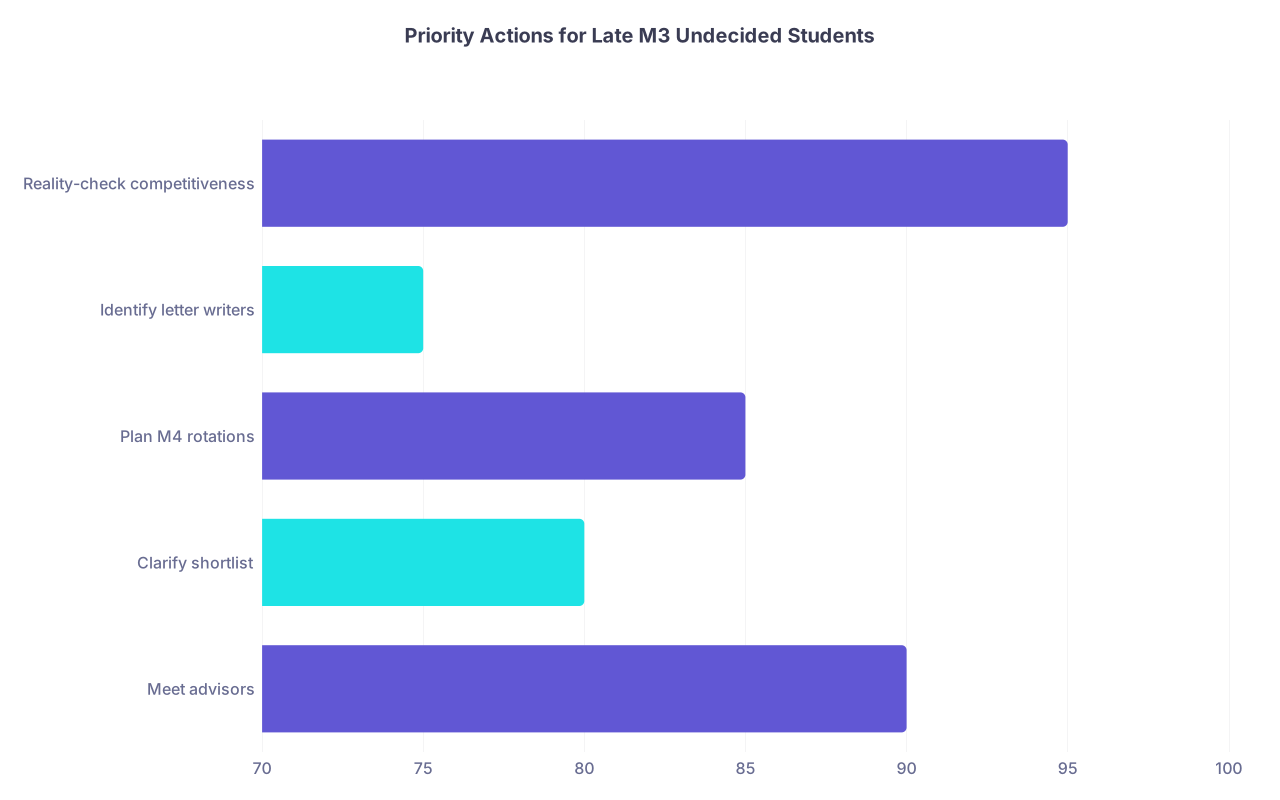
Here’s what to do in the next 2–4 weeks:
- Write down your real short list: 2–4 specialties max
- List what you like and don’t like about each (brutally honest, no “shoulds”)
- Book meetings with:
- Your dean/student affairs
- One advisor or resident in each of those specialties
- Ask them directly:
- “Given my grades/Step/evals, how realistic is each option?”
- “What would you do over the next 6–9 months if you were me?”
- Sketch your M4 schedule with them:
- Month 1–2: home rotation in top choice
- Month 3: backup or related field
- Month 4+: audition/away or sub-I in main field
| Category | Value |
|---|---|
| Meet advisors | 90 |
| Clarify shortlist | 80 |
| Plan M4 rotations | 85 |
| Identify letter writers | 75 |
| Reality-check competitiveness | 95 |
Yes, it’s uncomfortable. But every student I’ve seen handle this early and honestly has landed in a reasonable spot. The ones who insist “I’ll figure it out later” are the ones scrambling.
Will Saying “Undecided” Hurt Me on Evaluations?
Only if it’s code for: “I’m not really invested in learning here.”
If your actions show:
- Strong work ethic
- Genuine curiosity
- Respect for the team and field
- Improvement over the rotation
Then being undecided is a non-issue. Many attendings don’t care what specialty you choose. They care if you’re a pain to work with.
If you’re worried, here’s a simple script for day 1 of a rotation:
“I’m still deciding on a specialty, but I really want to get as much as I can out of this month. If there are any particular skills or habits you think are essential in this field that I should focus on, I’d love your feedback.”
That line signals: “I’m undecided, but not aimless.” It also invites teaching, which most good attendings appreciate.
A Quick Reality Check: Specialty vs. Performance
One last thing people don’t say clearly enough: your day-to-day performance and professionalism matter more than the exact timing of your decision.
Plenty of students:
- Decide on a specialty early, then coast
- Only work hard on one rotation
- Treat other fields as irrelevant
- End up with mixed evals and tepid letters
They technically “decided early,” but their application still looks mediocre.
On the flip side, I’ve seen students decide between EM and IM in July of M4, apply EM with a coherent story, and match well—because their clerkships, letters, and reputation were strong.
Being undecided isn’t the problem. Acting like your future doesn’t depend on your behavior right now is the problem.
FAQ: “Can I Say I’m ‘Undecided’ on Specialty During Clerkships and Still Match Well?”
Will saying I’m undecided on rounds hurt my grade?
Not automatically. It hurts if you act uninterested or disengaged. If you say you’re undecided but you show up prepared, work hard, and respond to feedback, most attendings won’t penalize you. Some actually appreciate the honesty, especially if you pair it with a plan: “I’m undecided but I’m really focusing on learning X and Y this month.”When do I absolutely need to have a specialty chosen by?
You should have a solid decision by early M4, ideally by June–July. That gives you time to schedule a home rotation or away rotation in that field, secure letters from that specialty, and tailor your ERAS. Being “truly undecided” past August of M4 makes it much harder, but not always impossible in less competitive fields if you move quickly and get good advising.What if I decide late between two related specialties (like IM vs FM)?
This is usually manageable. Internal medicine and family medicine share a lot of overlap in letters, rotations, and even personal narrative. Many students apply to both, especially if they’re geographically constrained. Just be thoughtful about your personal statement and how you frame your interests to each specialty.Can I tell different attendings different “top choices” depending on the rotation?
Don’t lie. But it’s fine for your thinking to evolve. On pediatrics you might say, “I’m leaning toward peds or FM.” On IM you might say, “I’m torn between IM and EM.” Those can both be true as you refine what you want. What backfires is saying, “Peds has always been my dream” to one attending and “I’ve always wanted to do ortho” to someone else in the same department. People do talk.How do I sound thoughtful instead of clueless when I say I’m undecided?
Pair your undecided status with specifics. For example: “I’m undecided, but I’ve realized I like acute care, team-based environments, and procedures, so I’m considering EM and anesthesia. I’m paying attention on this rotation to how I like the pace and decision-making.” That tells people you’re actually thinking, not just drifting.Is it a red flag to program directors if my application shows I was undecided for a long time?
Not if your final application is coherent. PDs mostly see your M4 sub-I, your letters, your personal statement, and your MSPE summaries. As long as those align and show consistent interest and performance in your chosen field, they don’t care that you were torn in M3. What is a red flag is a scattered application with mismatched letters, vague interest, and weak performance.What should I do this week if I’m in M3 and honestly have no idea what I want?
Do two things. First, pick one rotation you’re currently on (or about to start) and commit to treating it like it could be your field—go all-in for that month. Second, schedule a 30-minute meeting with your dean or advisor and tell them plainly: “I’m completely undecided and I don’t want to stay that way. Can we map out a plan for the rest of M3/M4 to help me narrow things down?” Then follow through.
Open your calendar right now and book a 30-minute meeting with an advisor or dean to talk honestly about your specialty uncertainty—and commit to going all-in on your current rotation as if it might be your future field.