
The honest answer: you can keep two specialty options open through MS3—but only if you’re deliberate and a little ruthless about how you structure your year.
Most students don’t struggle with “Can I?”
They struggle with “How do I keep two doors open without doing a mediocre job in both?”
Let’s walk through a clear, practical way to do this without frying your brain or your chances.
The Real Constraint: Time, Not Talent
You’re not limited by interest. You’re limited by calendar.
Third year has three big demands that compete with your “two specialties” idea:
- Core clerkships (grades, evals, shelf exams)
- Step 2 / Level 2 preparation
- Early specialty exploration and relationship building
Trying to keep three or four specialties open? That’s chaos.
Two? Completely doable if you:
- Decide your “Tier 1” and “Tier 2” specialty early enough
- Stack your schedule and extracurriculars in a smart way
- Accept that one option will be better developed than the other (and that’s okay)
If you’re hoping to be equally competitive for two ultra-competitive specialties with zero prioritization, you’re in fantasy land. But keeping a strong primary choice and a real backup? That’s realistic.
Step 1: Decide What “Two Options” Actually Means
Most people mess this up at definition stage.
There are three main patterns that actually work:
Competitive + Less-Competitive Backup
- Example: Derm + IM, Ortho + FM, ENT + IM
- This is the most realistic and the easiest to execute.
- You push hard in MS3 as if you’re going for the competitive option, but quietly keep your backup warm.
Two Moderately Competitive Fields
- Example: IM + EM, Peds + FM, Psych + Neuro
- Here, you can genuinely stay open to both through most of MS3 and even early MS4.
- Research and letters are often somewhat transferable, depending on the pair.
Two Very Competitive Fields
- Example: Ortho + Plastics, Derm + ENT, Ortho + Neurosurgery
- Possible on paper, but you’re going to feel like you’re running two separate full applications.
- High risk of doing “okay” for both instead of excellent for one. Only makes sense if your Step 2 is strong and your school has great support.
If you’re early MS3 and you still have 3–4 ideas floating around, fine. But by the end of your first 2–3 clerkships, you should be able to say:
Primary: X
Secondary (realistic backup): Y
If you can’t name them, you’re not “keeping options open.” You’re just avoiding a decision.
Step 2: Use Rotations to Test, Not To Drift
Rotations are your lab. Treat them that way.
Here’s the mistake: drifting through core clerkships just trying to “honor everything” and then deciding what you like. By then, prime research and letter windows are gone.
Better approach:
- By the end of IM or Surgery, force yourself to rank your interests:
- Green light (top 1–2)
- Yellow light (maybe, but unlikely)
- Red light (no)
You’re allowed to change your mind later, but you’re not allowed to pretend all six core specialties are equal forever. That’s how people end up in September of MS4 trying to build an application in 4 weeks.
Also—pay attention to:
- Whose problems you enjoy solving (not just whose procedures look cool)
- The lifestyle you actually handle on inpatient weeks
- The attendings/residents whose lives you’d trade for, not just whose personality you like
Step 3: Build a Minimal Viable Application for Both
You don’t need two perfect applications. You need one strong primary app and one backup that’s actually viable.
Here’s what a “minimal viable” setup for each specialty looks like:
- At least 1 strong letter from that field
- Something that shows genuine interest (project, elective, talk, QI, etc.)
- Evidence you can function on that team (clerkship evals, narrative comments)
You can absolutely share some components:
- A strong IM clerkship eval helps you for Cards, GI, Pulm, Hospitalist, etc.
- A Surgery rotation plus a good letter may help for Ortho, ENT, Urology, etc. (not ideal, but it’s something)
- Generic “hard worker, great with patients” comments help anywhere
But there are non-negotiables. A backup in EM with zero EM exposure and no EM letter? That’s not a backup. That’s a fantasy.
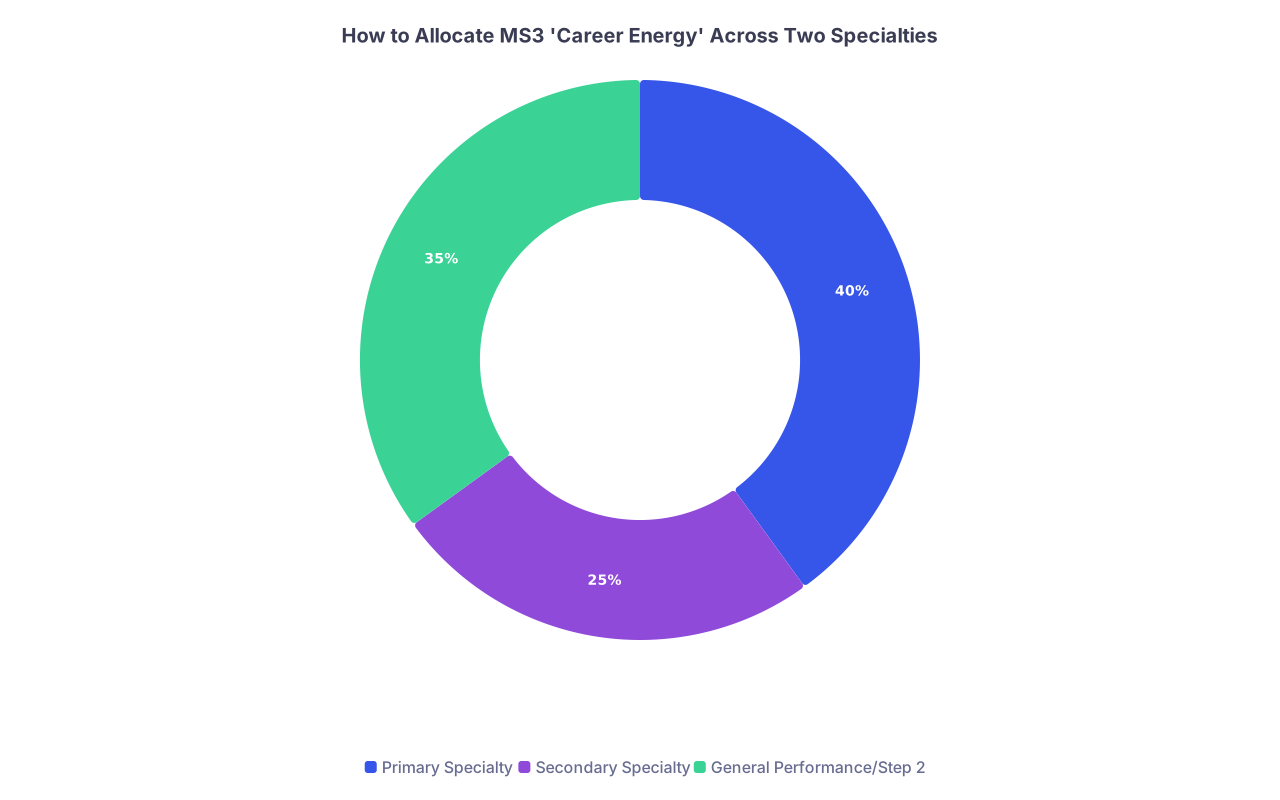
| Category | Value |
|---|---|
| Primary Specialty | 40 |
| Secondary Specialty | 25 |
| General Performance/Step 2 | 35 |
Rough breakdown that actually works:
- 40% effort: building a strong case for your primary choice
- 25% effort: keeping your secondary choice real, not theoretical
- 35% effort: generic excellence—shelf scores, Step 2, solid evals
If your Step 2 is weak, everything gets harder. Don’t sacrifice exam performance to chase a second option.
Step 4: Be Strategic With Scheduling and Electives
You don’t have to control everything about your MS3 schedule. But you can usually nudge it.
Ideal layout if you’re keeping two options open:
Try to get at least one of your interest areas in the first half of MS3.
- Example: IM in fall if you’re considering IM/EM, or Surgery early if you’re considering Ortho/ENT.
Use your first few rotations to:
- Test your tolerance for inpatient medicine
- Gauge how you handle consult services vs primary teams
- Watch resident lifestyles up close
Front-load Step 2 basics:
- UWorld or equivalent as you go
- Treat each shelf like Step 2 mini-prep
- Aim for at least “solid” scores, not barely passing, so you’re not playing catch up later
Then, when you hit scheduling for early MS4:
- Request at least 1 audition/AI/sub-I in your primary specialty
- Request 1 shorter elective or sub-I in your backup specialty
- Leave a bit of buffer before ERAS opens so you’re not writing PS drafts during 80-hour weeks

| Step | Description |
|---|---|
| Step 1 | Start MS3 |
| Step 2 | First 2-3 Clerkships |
| Step 3 | Pick Primary & Backup |
| Step 4 | Reflect & Seek Mentorship |
| Step 5 | Targeted Rotations & Research |
| Step 6 | Step 2 Prep Ongoing |
| Step 7 | Early MS4 Electives in Both |
| Step 8 | Finalize One Main and One Backup App |
| Step 9 | Narrow to 2-3 Interests |
Step 5: Letters of Recommendation—The Real Bottleneck
This is usually where people get burned trying to keep two options open: they don’t plan their letters.
Reality check:
- You want 2–3 strong letters in your primary specialty
- You need at least 1 good letter in your backup
- And at least 1 “core” letter (IM or Surgery) is often expected
You cannot get there by accident.
Here’s how to play it:
During rotations in your primary/backup fields:
- Show up early, be prepared, be normal (not a sycophant)
- Ask for feedback before mid-rotation, then implement it
- Request letters while you’re still fresh in their minds, not months later
Tell letter writers the truth (with framing):
- “I’m strongly considering IM as my primary specialty, but also exploring EM as a backup. I’d be grateful if your letter could speak to my fit for internal medicine specifically.”
- Then do the reverse in your EM rotation.
They know students hedge. Being upfront but focused is better than acting like you’re soulmates with every field.
Step 6: Research and “Stuff” – Don’t Split Yourself in Half
You don’t need separate, big research portfolios for both specialties.
Minimum effective dose:
- Aim for 1–2 decent projects in your primary field (poster, case report, QI, retrospective chart review).
- For backup: 0–1 smaller project or something broadly applicable (clinical reasoning, education, QI, population health) that you can credibly spin for either.
Programs aren’t counting papers; they’re reading whether your story makes sense.
What they don’t like:
- A totally scattered CV: Derm case report, then Ortho abstract, then EM QI, then GI poster, with a personal statement screaming “lifelong passion for pediatrics.”
Your application should read like: “I mostly prepared for X, but I’ve also tested and prepared for Y in a thoughtful way.”
| Primary Specialty | Backup Specialty | Realistic With Strong Planning? |
|---|---|---|
| Dermatology | Internal Med | Yes |
| Orthopedics | Family Med | Yes |
| EM | Internal Med | Yes |
| General Surgery | Anesthesia | Yes |
| Plastic Surgery | ENT | Borderline, very demanding |
Red Flags: When Two Options Is Actually Sabotage
Keeping two specialties open is not a good idea if:
- You’re already struggling to pass shelves or maintain baseline performance
- You have zero bandwidth for extra stuff (family crisis, health issues, financial stress)
- You’re talking about two hyper-competitive fields without a strong Step 2, strong school support, or any research
In those cases, the smart move is to pick one direction and go all-in. You will match into something if you’re focused and competent. You might match into nothing if your whole year is scattered.
How to Actually Decide Between the Two (When the Time Comes)
By late MS3 / early MS4, you should stop “keeping options open” as a lifestyle.
You need to decide which application will be primary.
Here’s a ruthless, useful checklist:
Choose Specialty A if:
- You can see yourself doing it on your worst day and not hating life
- You have at least 2 good letters and 1–2 tangible projects in it
- Your Step 2 and clerkship profile fit the typical matched applicant
Keep Specialty B as the true backup if:
- You’ve done at least 1 rotation or sub-I in it
- You’ve got at least 1 letter and some evidence of interest
- You would genuinely be okay training and practicing in it (not just, “I guess I’ll survive”)
If you wouldn’t be okay with your “backup” life, it’s not a backup. It’s emotional cushioning.
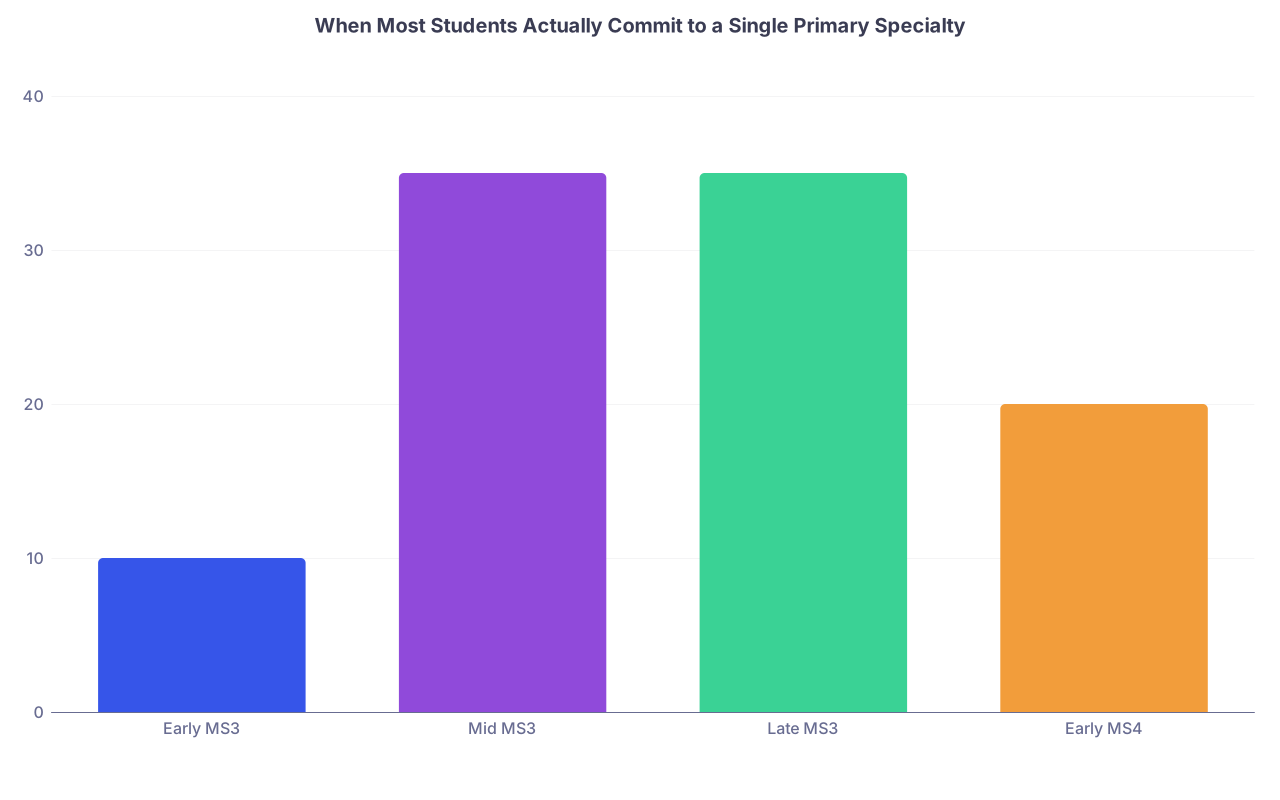
| Category | Value |
|---|---|
| Early MS3 | 10 |
| Mid MS3 | 35 |
| Late MS3 | 35 |
| Early MS4 | 20 |
You’re not “behind” if you’re still open mid-MS3. But if you’re late MS3 and you have no primary direction, you’re playing with fire.
A Simple, Realistic Game Plan
Here’s what I’d tell a smart MS2/MS3 asking me this in a hallway:
- Go into MS3 with 2–3 loose ideas, not 1 or 6.
- After your first 2–3 rotations, force yourself to name: primary, backup.
- Protect Step 2/Level 2 and clerkship grades. Those keep all doors open.
- Make sure each of your two specialties gets:
- 1 rotation
- 1 letter
- 1 concrete sign of interest
- By early MS4, commit to which one is your primary app. The other is your safety net, not an equal partner.
Yes, you can realistically keep two specialties open through MS3.
No, you cannot do it passively or “vibe” your way through it.
Do it on purpose or don’t bother.

FAQ: Two Specialty Options Through MS3
1. Is it a bad sign if I still don’t know my specialty by the end of MS3?
Not automatically. A lot of normal, competent people decide late. What is a problem is if you’ve done nothing to explore or prepare for any path—no mentors, no letters, no electives lined up. If you’re late MS3 with no groundwork for anything, you need to urgently pick one or two directions and start building.
2. Can I write two different personal statements for two specialties?
Yes. People do this all the time. You can submit different personal statements, different letter sets, and even different program lists in ERAS. Just don’t send a confused story: each specialty should see a coherent narrative that makes sense for that field.
3. What if I fall in love with a new specialty late in MS3?
Then you have a triage problem, not a disaster. Ask: Can I get a rotation, a letter, and some evidence of interest in time? If yes, you can pivot. You might need to downgrade something else from “option” to “fantasy” and focus hard on the new direction plus one backup that’s still realistic.
4. How many specialties can I apply to without looking unfocused?
Most sane people land between 1–3. One primary, maybe one true backup, and occasionally a close cousin field. Once you start spraying out applications to 4–5 unrelated specialties, programs can smell the desperation. Two thoughtful, well-prepared options is fine. Five is panic.
5. Who should I talk to when deciding between two specialties?
Three groups: residents in those fields (for real life), program directors or clerkship directors (for competitiveness and fit), and one or two trusted faculty who know you as a person. Don’t crowdsource this on Reddit. Ten anonymous opinions won’t beat one honest conversation with someone who’s seen your work and knows your strengths.
Key takeaways:
- Yes, you can realistically keep two specialties open through MS3—but only with deliberate planning.
- Each option needs at least one rotation, one letter, and one clear sign of interest to be real.
- Protect Step 2 and core clerkship performance above all; that’s what actually keeps your doors open.