
What happens if you spend two years on cardiology research and then decide you want ortho—or vice versa? Did you waste your time or does any research still help?
Let me answer the core question first, clearly:
- For competitive specialties: specialty-specific research is strongly preferred and often functionally required.
- For less competitive specialties: any solid research is usually enough, as long as you can talk about it intelligently and it shows real commitment and productivity.
- For everyone: the quality and role you played matter more than the exact topic, until you’re aiming at the very top tier of a competitive field.
Now let’s break that down in a way that’s actually useful for your decisions.
The Short Answer: It Depends on How Competitive Your Target Is
Here’s the real hierarchy programs use—whether they say it out loud or not.
| Specialty Tier | Examples | Ideal Research Type | Is Any Research Enough? |
|---|---|---|---|
| Ultra-Competitive | Derm, Ortho, Plastics, ENT, Ophtho | Specialty-specific, multiple outputs | Usually no |
| Competitive | EM, Anesthesia, Rad, OB/GYN, General Surgery | Mix of specialty-specific + general | Sometimes |
| Moderately Competitive | Internal Med, Peds, Psych | Any research with depth | Often yes |
| Less Competitive | FM, PM&R (depending), Path (varies) | Any meaningful research | Usually yes |
Let me put it bluntly:
- Applying to dermatology with only bench basic science in cardiology and zero derm involvement? You’re handicapped.
- Applying to internal medicine with 2 solid years of cardiology lab work and a poster? You’re fine.
- Applying to orthopedics with only medical education research and no ortho connection? Tough road, unless other parts of your application are exceptional and you fix that early.
So yes, specialty matters. But it’s not the only thing that matters.
What Program Directors Actually Look For in Your Research
Most students over-focus on “Is this the right subspecialty?” and under-focus on how the work itself looks.
Here’s what PDs care about more than topic:
- Did you stick with something long enough to produce anything?
- Were you more than just “data entry” or “chart puller”?
- Can you clearly explain the question, methods, results, and limitations?
- Does your research activity match your claimed interest in the specialty?
Now, specialty-specific vs. any research:
Specialty-specific research does three things:
- Signals genuine, long-term interest.
- Gives you talking points that sound like their world.
- Often comes with mentors who can actually call programs in that field.
Any good research still:
- Shows you understand academic medicine.
- Demonstrates persistence, curiosity, and follow-through.
- Gives you skills (reading papers, basic stats, presentations) you can apply anywhere.
Programs aren’t stupid. They know a third-year who “found derm” 6 months ago didn’t do 10 derm publications in high school. But they do expect you to align your research somewhat with where you say you’re headed, especially if it’s competitive.
Matching Research Strategy to Your Situation
Let’s walk through common scenarios, because that’s where students get stuck.
Scenario 1: You Know Your Target Early (M1–M2)
Example: You’re an M1 who’s 80% sure you want neurosurgery, ortho, derm, ENT, etc.
Here’s what you should do:
- Prioritize specialty-specific research as soon as possible.
- Get into one lab or group where:
- The PI is in your target specialty.
- Residents in that specialty are involved.
- There’s a realistic path to an abstract or publication in 1–2 years.
Still worth doing “any research”? Yes, if:
- It gets you started quickly while you wait for specialty-specific opportunities.
- It’s with a strong mentor who can actually help you meet people later.
But if you’re truly serious about a very competitive field, a full 2 years of unrelated research with zero eventual pivot to that specialty is just poor strategy.
Scenario 2: You Have Research, Then Change Your Mind (Very Common)
Example: You did a year of nephrology research M1–M2. Then on rotations you fall hard for anesthesia.
Did you waste your time? No. But you do need to adjust.
Here’s the play:
- Keep the prior research on your CV. It still counts as scholarly work.
- Pick up at least one project in your new specialty as early as possible:
- A QI project with the anesthesia department.
- A case report with an attending you worked with.
- A small retrospective chart review with an anesthesia resident.
- Reframe your story:
- “Initially I was very interested in nephrology and worked on X. On rotations I realized how much I value procedural, acute-care environments, which is why I moved toward anesthesia. I’ve now gotten involved in [specific anesthesia project].”
Programs don’t punish exploration. They punish a fake, last-minute interest with zero specialty-specific investment.
Scenario 3: You’re Late (End of M3) With No Research
This is where people panic.
If you’re targeting:
- Less competitive fields (FM, IM, psych, peds): one or two late, simple projects are still helpful. QI, case reports, quick retrospective studies. “Any research” is better than “no research.”
- Competitive fields (EM, OB, gen surg, anesthesia): start something now, even if it’s small. Case reports and QI with your target department can at least create letters and show effort.
- Ultra-competitive fields (derm, ortho, plastics, ENT, ophtho): no research + late interest = uphill battle. You may need:
- A research year, or
- A backup specialty strategy.
You’re not doomed. But you’re not beating people with 3–4 years of specialty-specific work and strong mentors if you start at the last second.
How Much Does Specialty-Specific Research Actually Move the Needle?
For ultra-competitive fields, quite a lot.
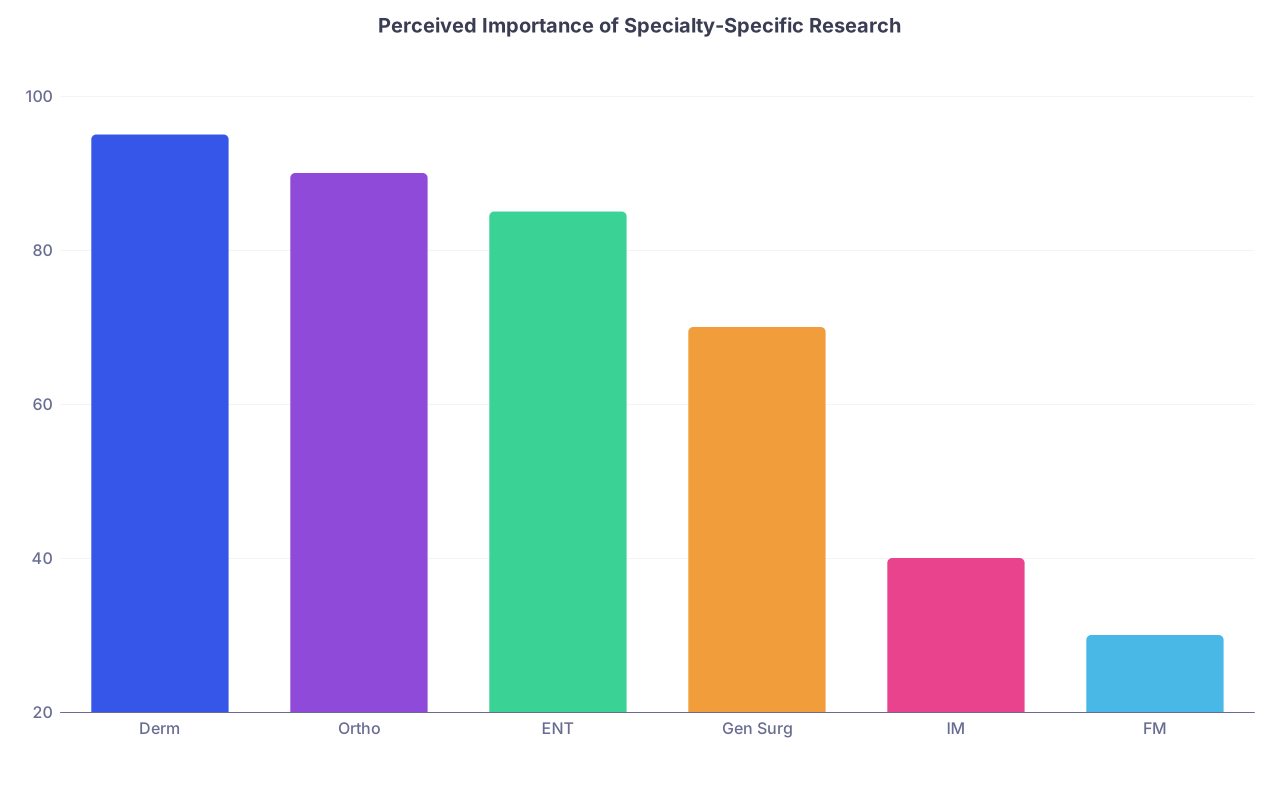
| Category | Value |
|---|---|
| Derm | 95 |
| Ortho | 90 |
| ENT | 85 |
| Gen Surg | 70 |
| IM | 40 |
| FM | 30 |
This is not official NRMP data. This is the reality I’ve seen from chairs, PDs, and residents sitting in ranking meetings:
- In derm, ortho, ENT, plastics, ophtho: Specialty-specific research is basically standard among serious applicants.
- In general surgery, EM, anesthesia, OB: Specialty research helps, but a strong non-specialty research track record is still very respectable.
- In IM, peds, psych, FM: Depth, productivity, and mentorship matter more than matching the exact specialty. A strong cardiology or heme-onc research record is gold for IM even if it’s not “general internal medicine.”
So no, you don’t always “need” research in your target specialty. But if you’re aiming high in a cutthroat field, you’d be foolish to ignore it.
Quality vs. Quantity: What Actually Looks Good
Programs don’t have time to micromanage your CV. They scan for a few things:
- Did you produce anything tangible?
- Does your story make sense?
- Are people in their specialty vouching for you?
Here’s how different profiles look:
| Profile | How It Looks | Competitive for Ultra-Comp Fields? |
|---|---|---|
| 1 derm paper + 5 posters in cardiology | Broad but a bit unfocused | Maybe, if mentorship is strong |
| 0 specialty papers + 4 strong IM papers, first-author | Serious academic applicant | Weak for derm/ortho, strong for IM |
| 6 derm papers, multiple first-authors, derm mentor | Laser-focused | Very strong |
| 1 case report in target specialty, nothing else | Minimal effort | Weak, unless everything else is stellar |
If you have to choose between:
- A high-impact, well-mentored project in a non-target field, and
- A flimsy, token “I did one poster in my target specialty” project
Go with quality and depth first. Then layer in specialty-specific work as you can.
Smart Ways to Pivot Your Existing Research
Let’s say you’ve already invested in “off-specialty” work. You can still salvage and spin it intelligently.
A few moves that actually work:
Find the overlap.
Example: You did sleep medicine research and now want psychiatry. Great. There’s huge overlap in depression, anxiety, insomnia, and psych meds’ impact on sleep.Add one bridging project.
Even a small project in your new specialty reframes your old work as “the background” not “the entire story.”Tell a coherent timeline.
Interview answer level:“I started med school interested in cardiology, which led to my work on heart failure patients and device therapy. On my third-year surgery and vascular rotations, I realized I really enjoyed the procedural side and longitudinal follow-up in the OR, which is why I’ve shifted toward vascular surgery. I’ve since started a project on outcomes after endovascular repair with Dr. X.”
Notice: the research itself didn’t disappear. The narrative matured.
If You’re Early: How to Plan Research Before You Pick a Specialty
A lot of M1s/M2s feel paralyzed: “What if I choose the wrong lab?”
Here’s the move:
Pick something that:
- Has a reliable, responsive mentor.
- Has a track record of student publications.
- Teaches you methods and critical reading.
Prefer clinical or outcomes research over ultra-niche bench work unless you’re sure about a physician-scientist path. It generalizes better.
Avoid “mystery” projects where:
- No one has ever published in under 2–3 years.
- Your role is unclear.
- You can’t see a path to product.
Then, as rotation experiences shape your interests, you do one of two things:
- Double down in that field with more targeted projects, or
- Pivot by adding new specialty-specific work while still claiming the foundational skills from your early research.
Practical Decision Framework
You want a clear answer. Use this:

| Step | Description |
|---|---|
| Step 1 | Do you know your target specialty? |
| Step 2 | Prioritize specialty-specific research |
| Step 3 | Choose any solid research with strong mentor |
| Step 4 | Keep it, add specialty projects |
| Step 5 | Start with small, fast specialty projects |
| Step 6 | Build skills, publications, and flexibility |
| Step 7 | Is it highly competitive? |
| Step 8 | Already have other research? |
And another quick checkpoint:
- If you’re M1–early M2: Any good research with a solid mentor is fine. Just don’t ignore opportunities in specialties you’re leaning toward.
- If you’re late M2–M3 and leaning competitive: You need at least some specialty-specific work.
- If you’re M4 applying this cycle: Stop philosophizing and get any realistic project with your target department; case reports and QI count more than you think when you’re out of time.
Visual: How Students Typically Accumulate Research
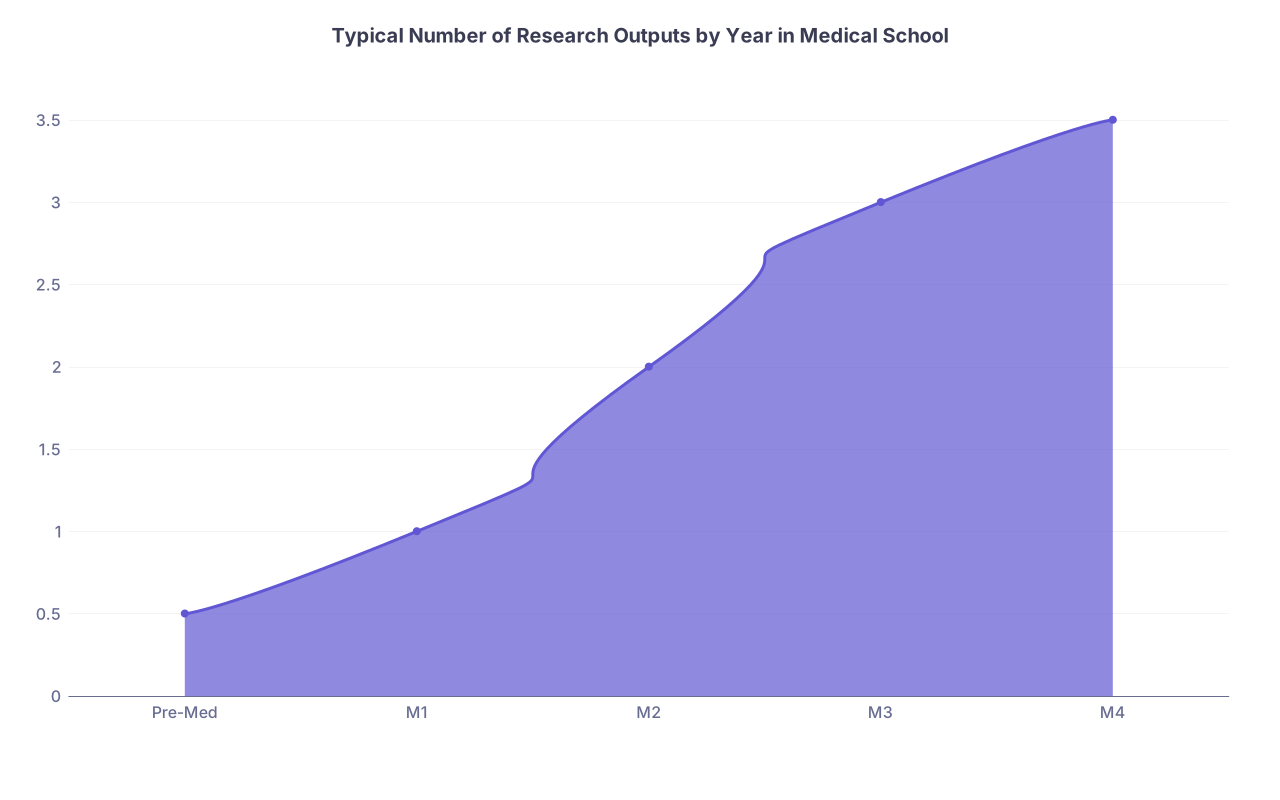
| Category | Value |
|---|---|
| Pre-Med | 0.5 |
| M1 | 1 |
| M2 | 2 |
| M3 | 3 |
| M4 | 3.5 |
The point here isn’t the exact numbers. It’s that most students build gradually. You don’t need 10 publications by M2. But if you’re aiming big, you do want an upward trajectory and at least some of those outputs in your chosen field.
FAQs
1. If I’m applying internal medicine, is specialty-specific research (like cards, heme-onc) important?
It helps, but it’s not strictly required. For IM, “any strong research” is usually enough, especially if you’re productive and can discuss it well. That said, if you already know you love cardiology, GI, or heme-onc, doing research in those areas will help you later for fellowship. Programs like to see that you can plug into academic subspecialty work.
2. How many specialty-specific projects do I need for derm/ortho/ENT/plastics?
There’s no magic number, but here’s what I actually see among solid matches: at least 2–3 projects in the specialty, with some combination of posters, abstracts, and ideally 1+ publications. More matters less than impact and mentorship. A first-author paper with a known faculty member in the field is worth more than five low-effort posters with no real involvement.
3. Does basic science research count less than clinical research?
For clinical-facing specialties, yes, a bit. Not because basic science isn’t respected, but because clinical research is more obviously aligned with residency and patient care. If you’re doing serious bench work, you want to either:
- Tie it clearly to your specialty of interest, or
- Be prepared to explain how that foundation prepared you for academic medicine (hypothesis formation, data analysis, persistence, etc.).
4. Is a single case report in my target specialty enough to “check the box”?
It’s better than nothing, but it’s more like “half a check.” Programs know case reports can be relatively quick and low-depth. On its own, one case report won’t make you a “research applicant” in derm, ortho, or ENT. As part of a broader portfolio—especially if you were the primary writer—it helps.
5. I have 3 publications in a different field. Should I still try to do research in my target specialty?
Yes, especially if your target is competitive. The publications in another field show you can produce. One or two targeted projects in your new specialty, even if they’re smaller (like QI or retrospective reviews), solve the “alignment” problem and give you better letters and talking points.
6. Does it look bad if my research and specialty don’t match at all?
It looks incomplete, not bad. If you’re applying psych with only orthopedic biomechanics research and zero psych-related anything, it raises a question: “When did this interest start and why is there no corresponding activity?” You fix that by either adding at least one psych-related project or by clearly, convincingly explaining your evolution and your clinical experiences in that field.
7. If I can only choose one: better to have more total research or less research but directly in my specialty?
For competitive specialties, I’d take fewer, higher-quality, specialty-aligned projects over a large pile of unrelated, low-impact work. For less competitive fields, I’d choose fewer, higher-quality projects regardless of specialty. Volume impresses students more than it impresses program directors. Depth, responsibility, and a coherent story win.
Key points to walk away with:
- For ultra-competitive specialties, you should aim for at least some meaningful, specialty-specific research; “any research” alone is usually not enough.
- For most other specialties, strong, well-mentored research of any type is valuable—as long as you can explain it clearly and tie it into your path.
- Whatever you’ve already done is not wasted; you can pivot by adding targeted projects and telling a coherent, honest story of how your interests evolved.