
The fantasy that “a great personal statement can overcome any Step score” is dangerous. When your scores do not match your dream specialty, denial is the fastest path to a disastrous Match.
You need an adjustment plan. Not vague “we’ll see what happens.” A concrete, data-driven, deadline-based plan.
This is exactly how you build one.
Step 1: Face the Numbers Like a Program Director Would
Let me be blunt: most students misjudge what “competitive” means. They either catastrophize a perfectly fine score or wildly underestimate how far off they are.
You fix that by looking at your situation the way a residency program actually does.
1. Know your real position, not your feelings
Pull up your actual data:
- Step 1: Pass/Fail (if you have a numeric score, keep it handy)
- Step 2 CK: Numeric score
- Class rank/quartile (if available)
- Any fails/remediations
- Any leaves of absence
Now benchmark those numbers against your target specialty using recent NRMP Charting Outcomes or specialty-specific data.
| Specialty Type | Typical Competitive Range | Risk Zone Range* |
|---|---|---|
| Ultra-competitive (Derm, PRS, Ortho, ENT) | 250+ | < 240 |
| Competitive (EM, Anesthesia, Rads, Neuro) | 240–250 | < 235 |
| Mid-range (IM, Gen Surg, OB/GYN) | 235–245 | < 230 |
| Less competitive (FM, Peds, Psych, Path) | 225–235 | < 220 |
*“Risk zone” does not mean “impossible.” It means “you must compensate with strategy, connections, and realism.”
If your dream is dermatology and you are sitting at a 233 with no serious research, you are not “borderline.” You are outside the usual range. That does not have to be the end of the story, but it absolutely changes the story.
2. Identify which of these you are
Be honest and pick one:
Slightly below average for your dream specialty
Example: EM hopeful with 233–236, solid clinicals, no red flags.Significantly below typical range but not catastrophic
Example: Ortho hopeful with 232, one failed shelf, minimal research.-
- Step failure
- Multiple course failures or LOA for academic reasons
- Very low Step 2 (<215–220)
Your adjustment plan depends heavily on which bucket you are in. Do not skip this classification.
Now that the emotional part has hit, we move to the part you can actually control.
Step 2: Clarify What You Want vs. What You Need
Scores are only one axis. You still need to know:
- How attached you are to the field
- How attached you are to the lifestyle
- How attached you are to geography
1. Untangle “dream specialty” from “dream life”
I have seen students say “I want ortho” when what they mean is:
- High income
- Shorter training than neurosurgery
- Procedural work
- Strong “team sport” culture
That same cluster exists in:
- Interventional radiology
- Interventional cardiology (later via IM)
- Anesthesiology with a procedural focus
- Even sports medicine via FM or PM&R
So before you panic:
- List 5 things you actually like about your dream specialty:
- Example for Derm: outpatient, procedures, limited emergencies, aesthetics, visual diagnosis.
- Then ask: are those available in other paths that are more aligned with your current scores?
You might discover you want a certain day-to-day reality, not a specific title on a badge.
2. Decide your non-negotiables vs. flexibles
Make three short lists:
Non-negotiable:
- “I need meaningful patient contact”
- “I cannot tolerate heavy overnight call long-term”
Strong preference:
- “I prefer outpatient-heavy”
- “I like procedures but do not need 90% of my day being OR”
Flexible:
- Specific city or region
- Top-20 name vs solid mid-tier program
This prevents you from getting locked into false choices like “Derm or bust” when derm-like lives exist in other fields.
Step 3: Reality Check By Specialty – Are You Actually Out?
You need to translate your numbers into concrete likelihood, not vibes.
Here is how I think about practical thresholds in the Step 2 era (these are directional, not gospel):
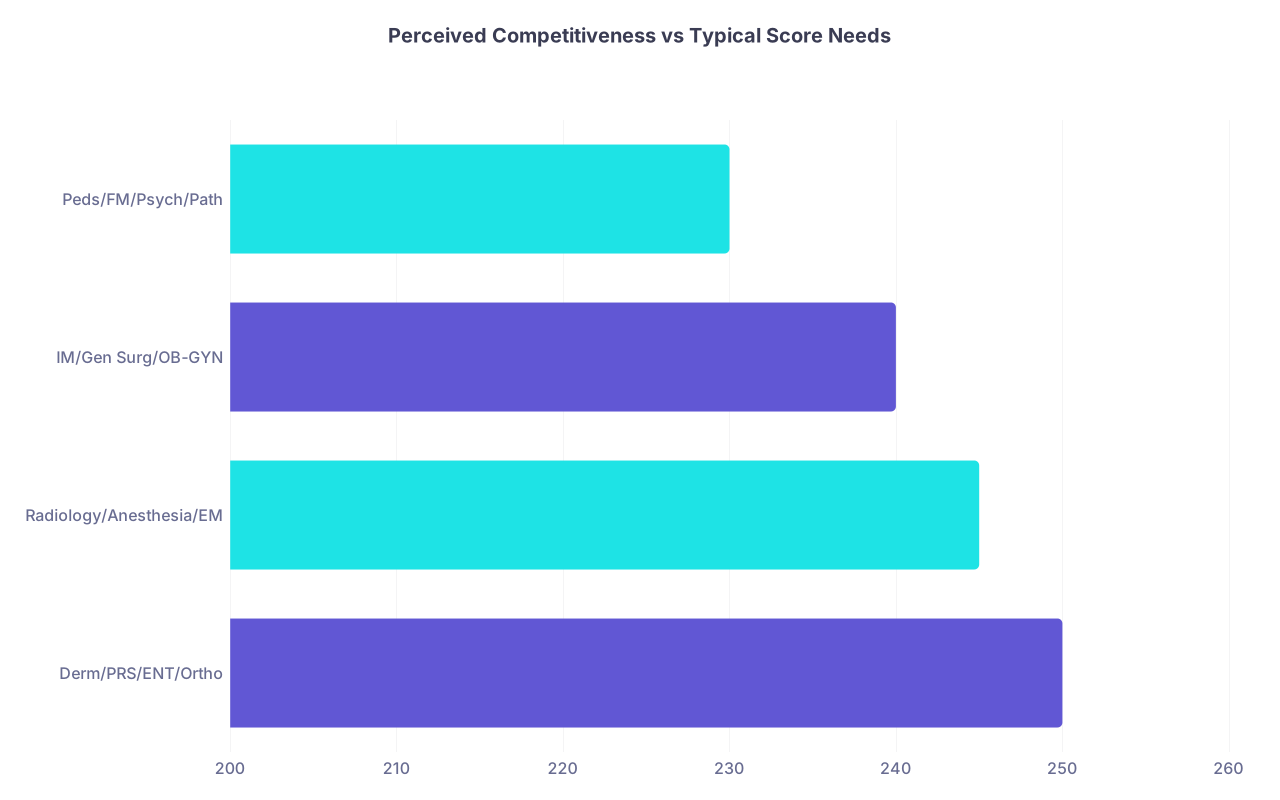
| Category | Value |
|---|---|
| Derm/PRS/ENT/Ortho | 250 |
| Radiology/Anesthesia/EM | 245 |
| IM/Gen Surg/OB-GYN | 240 |
| Peds/FM/Psych/Path | 230 |
1. If you are chasing an ultra-competitive specialty
Dermatology, plastic surgery, orthopedic surgery, ENT, neurosurgery.
You must ask 3 brutal questions:
- Are you at or above ~245–250 on Step 2?
- Do you have meaningful research in that field? (Posters, publications, dedicated projects)
- Are your clinical evaluations and letters consistently excellent?
If two or more answers are “no,” you have three rational options:
Option A: Double down with a structured rescue year
- Dedicated research year with a well-known mentor
- Away rotations at realistic programs
- Apply very broadly and be willing to match anywhere
- Accept a chance of not matching on first try
Option B: Pivot to a related but less competitive field
- Ortho → PM&R, anesthesia
- ENT → general surgery, radiology
- Derm → IM with allergy/immunology or rheum in mind, pathology with dermpath focus
Option C: Apply dual-specialty from day one
- Example: Apply to both Ortho and PM&R
- You need two full-strength applications, not a “real one” and a throwaway backup
Anyone telling you “just go for it, you never know” without a backup plan is not the person you should be listening to.
2. If you are targeting a competitive but not extreme field
Emergency medicine, anesthesia, radiology, neurology.
Here, a mid-230s score is not a death sentence. You can compensate with:
- Strong letters from respected faculty
- Rotations at realistic programs
- Clear evidence of commitment to the field
- No professionalism or academic red flags
But you still need a plan B variant:
- EM → FM or IM with plans for urgent care, hospitalist life, or critical care
- Radiology → IM with eventual imaging/heme-onc overlap; pathology for the diagnostician angle
- Anesthesia → IM or EM with procedures and ICU time
3. If your dream is mid-range or less competitive
Internal medicine, general surgery, OB/GYN, pediatrics, family medicine, psychiatry, pathology.
A sub-230 Step 2 with no fails is usually survivable with:
- Well-timed Step 2 (score in before applications)
- Enthusiastic letters
- Good interview skills
- A realistic list of programs (academic + community, not all reach)
Where you run into trouble:
- Multiple fails
- Late Step 2
- Poor MS3 evaluations or professionalism concerns
This is where your adjustment plan is less about changing specialty and more about maximizing your application quality and using backup lists intelligently.
Step 4: Build a Three-Tier Specialty Strategy
You cannot control your scores now. You can absolutely control how you structure your application strategy.
I like a 3-tier system.
Tier 1: Reach (but not fantasy)
- Your original “dream” or something very close to it
- You are weaker on scores but have or can build some strengths:
- Research in the field
- Strong mentorship
- Excellent narrative fit (personal story, long-term interest)
Example: 236 Step 2, loves EM, has an EM SLOE from a home rotation. EM is Tier 1.
Tier 2: Realistic primary target
- Specialty where your Step 2 is at or near the mean
- You can realistically match with smart school/program selection
- You are willing—actually willing—to do this for your career
Example: Same 236 Step 2 student lists FM or IM as Tier 2, focusing on hospitalist trajectory for acute care feel.
Tier 3: Safety/insurance options
- Specialty(ies) that reliably match students with your profile
- Lower risk of going unmatched if you rank a healthy number of programs
- Still clinically acceptable to you
Example: 220–225 with a Step failure, multiple issues: FM, psych, or pathology can become Tier 3 depending on interest.
Now you answer this question honestly:
“If my Tier 1 fails and I go unmatched, am I willing to repeat this entire process, possibly with a new specialty, or do I prefer a higher probability of matching in Tier 2 or 3 this year?”
Your answer drives how aggressively you split your ERAS applications.
Step 5: Tactical Moves to Upgrade Your Application Fast
Even with fixed scores, you can change your odds materially in 6–12 months. Here is how.
1. Maximize clinical performance and letters
Programs will forgive a borderline score faster than they forgive a bland letter.
Your playbook:
Identify 2–3 attendings in your target specialty (or realistic backup) who:
- See you consistently
- Have an academic role or title
- Are known to write strong letters
On those rotations:
- Be early. Every day.
- Know your patients cold.
- Volunteer for presentations, mini-teaching, follow-up calls.
- Tell them directly, “I am very interested in [specialty]; I would really value feedback on how I can perform at a residency level.”
Then actually ask for feedback and implement it. People remember that.
When evaluation time comes, tell them (politely) you would be honored if they would consider writing a strong letter for your residency application.
2. Fix obvious narrative contradictions
If your CV screams “I have done ortho things for 6 years,” and now you pivot to anesthesia or PM&R because of scores, you cannot hand-wave that.
You must connect the dots:
- “Working closely with orthopedic surgeons made me realize I am most alive in the OR… but I am drawn to anesthesia’s focus on physiology and perioperative care.”
- Or, “Over time, I noticed I was more curious about functional recovery and long-term outcomes, which led me to PM&R.”
Program directors smell “score-induced pivot” from a mile away. You do not hide it. You show you reflected on it and landed somewhere logically.
Step 6: Decide – Pivot, Double Down, or Dual Approach
Here is the key decision flow you should actually walk through.

| Step | Description |
|---|---|
| Step 1 | Review Step Scores & Specialty Data |
| Step 2 | Stay with Dream Specialty |
| Step 3 | Strengthen App Within Specialty |
| Step 4 | Dual-Apply or Research Year |
| Step 5 | Pivot to Related Specialty |
| Step 6 | Align Story & Mentors |
| Step 7 | Build Two Full Applications |
| Step 8 | Targeted Program List & Aways |
| Step 9 | Gap is Minor or Major? |
| Step 10 | Willing to Risk Unmatched? |
If the gap is minor
- Stay with your dream specialty.
- Shore up weaknesses:
- Early Step 2 score release
- A strong away rotation
- Extra research if possible
- Make your program list more realistic (more community and mid-tier, broad geography).
If the gap is major and you are risk-tolerant
- Consider:
- A research year with a big-name mentor
- Or dual-applying from the start
You must:
- Be honest with mentors.
Example script:
“I am very interested in Ortho, but my Step 2 is 233. I am considering dual applying to PM&R. How realistic do you think my Ortho chances are, and at what kind of programs?”
Good mentors will not sugarcoat this.
If the gap is major and you are risk-averse
- Pivot more fully to a related but less competitive specialty.
- Pour your energy into being outstanding in that field, not a resentful transplant.
I have seen former neurosurgery hopefuls become excellent neurointensivists via IM + critical care. Former derm hopefuls thriving in allergy/immunology or rheumatology. Lives turned out more than fine.
Step 7: Program List Strategy – Where People Quietly Blow It
I have seen good candidates go unmatched because their program list was delusional.
You need to design your list like this:
| Program Type | % of List | Example Count (60 total) |
|---|---|---|
| Reach Academic | 20–30% | 12–18 |
| Mid-range Academic/Hybrid | 40–50% | 24–30 |
| Community / Safety | 20–30% | 12–18 |
Key rules:
- Do not apply only to big coastal cities and top-20 programs if you are below their usual range.
- Add:
- Community programs
- Newer programs
- Less glamorous locations
Programs cannot rank you if you never apply.
If you dual-apply:
- Each specialty needs its own:
- Personal statement
- Letters (minimum 2–3 specialty-specific)
- Program list structured like the table above
Do not make your backup list a last-minute dump of 5 random programs. That is not a safety plan.
Step 8: Psychological Reset – How Not to Carry Bitterness Into Interviews
Here is something people underestimate: program directors can feel bitterness. It leaks out.
You must process your disappointment before interview season.
A few practical steps:
- Write down, very clearly:
- “My initial dream was X.”
- “My scores and situation make X higher risk.”
- “I am now choosing Y/Z for reasons A, B, and C.”
Notice the phrase: “I am now choosing.” Not “I am being forced into.”
Then ask yourself:
- “What specific opportunities does this new field give me that my original dream did not?”
- More continuity with patients?
- More geographic flexibility?
- Shorter training?
- Better fit for your personality?
You need at least two genuine positives you can talk about without sounding like you are reciting a hostage note.
Step 9: Concrete Timeline for Your Adjustment Plan
Do not leave this open-ended. Attach everything to months.
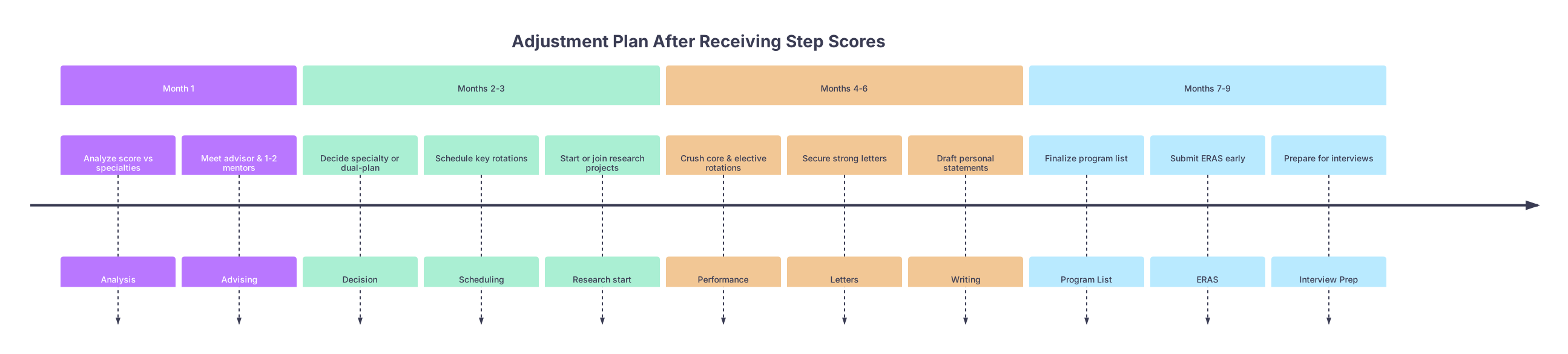
| Period | Event |
|---|---|
| Month 1 - Analyze score vs specialties | Analysis |
| Month 1 - Meet advisor & 1-2 mentors | Advising |
| Months 2-3 - Decide specialty or dual-plan | Decision |
| Months 2-3 - Schedule key rotations | Scheduling |
| Months 2-3 - Start or join research projects | Research start |
| Months 4-6 - Crush core & elective rotations | Performance |
| Months 4-6 - Secure strong letters | Letters |
| Months 4-6 - Draft personal statements | Writing |
| Months 7-9 - Finalize program list | Program List |
| Months 7-9 - Submit ERAS early | ERAS |
| Months 7-9 - Prepare for interviews | Interview Prep |
If you are past some of these months already, compress but keep the sequence:
- Analyze honestly
- Get advice from people who match residents
- Choose a plan (single specialty / pivot / dual)
- Execute on rotations + letters + research
- Build a sane program list
- Prepare emotionally and practically for interviews
Quick Scenario Workups (So You Can See This in Action)
Scenario 1: 231 Step 2, wants EM
- Reality: Slightly below many EM programs’ recent averages, but not hopeless.
- Plan:
- EM remains Tier 1.
- Dual-apply EM + FM or IM (Tier 2).
- Get at least 2 strong EM SLOEs.
- Apply to a broad set of EM programs including community-heavy sites.
- Show genuine interest in acute care in both EM and FM/IM applications.
Scenario 2: 238 Step 2, wants Ortho, no research
Reality: Significantly below typical Ortho range. Very risky, especially without research.
Plan A (risk-tolerant):
- Dedicated Ortho research year.
- Away rotations at realistic programs afterward.
- Possibly dual-apply Ortho + PM&R.
Plan B (risk-averse):
- Pivot to PM&R or Anesthesia now.
- Use Ortho background to tell a focused story about function, rehab, or procedural interest.
Scenario 3: 219 Step 2 with one fail, unsure of specialty
- Reality: Ultra-competitive fields are essentially out. Many mid-tier IM or gen surg programs will be cautious.
- Plan:
- Aggressively explore FM, Psych, Path, Peds.
- Identify what daily work feels most sustainable.
- Stack rotations and letters in that field.
- Build a very broad program list with many community and smaller programs.
- Consider an extra year only if you discover a deep passion that requires it.
FAQs
1. Should I even bother applying to my dream specialty if my scores are low?
Yes, if:
- You truly love it.
- You can name realistic programs where you might be competitive (often community or mid-tier).
- You are willing to build a real backup (another specialty or a large safety list).
No, if:
- You are not willing to risk going unmatched.
- You refuse to apply broadly or realistically.
- Your mentors consistently tell you your odds are extremely low and you ignore all of them.
2. Is a research year always the right move to rescue a low score?
No. A research year makes sense when:
- The specialty is extremely research-sensitive (Derm, PRS, Ortho at certain institutions).
- You can secure a position with a well-connected mentor who regularly helps students match.
- You are emotionally and financially able to accept another year of training delay.
It is a bad idea when you use it as a way to avoid facing that you might prefer, or be better suited for, another field.
3. How many specialties can I realistically dual-apply to?
Most people can dual-apply to two if they plan early. More than two usually leads to thin, generic applications in each.
To dual-apply effectively, you need:
- Separate, well-written personal statements
- At least 2–3 strong letters specific to each specialty
- Program lists that make sense for your competitiveness in each
If you are thinking about three or more, that is usually a sign you need to step back and clarify what you actually want.
4. Can strong letters and great interviews overcome weak scores?
They can soften the impact but rarely erase it entirely, especially in highly competitive fields.
Where they help most:
- Borderline applicants at mid-tier or community programs
- Less competitive specialties where “fit” and work ethic matter a lot
Where they will not magically fix things:
- Ultra-competitive specialties with strict cutoffs and massive applicant pools
- Programs that auto-screen below certain score thresholds
Your next move is not to read another article. It is to open your score report, pick your dream specialty, and write down three columns: “Keep chasing,” “Pivot targets,” and “Backup options.” Fill each with at least two concrete specialties or strategies. If any column stays blank, that is the column you need to work on this week.