

Primary care is not uniquely doomed to burnout. The story you hear in the lounge—“FM and IM outpatient are burnout factories, everyone’s miserable, avoid at all costs”—is badly distorted by half-read studies, gossip, and survivorship bias.
If you’re in medical school trying to choose a specialty, you’re probably getting two contradictory messages:
- “Follow your passion, you’ll be fine.”
- “Whatever you do, don’t go into primary care, everyone burns out.”
Both are wrong in their pure form. Passion does not immunize you against soul-crushing workflow, and “primary care = burnout” is a lazy oversimplification that ignores the data.
Let’s rip this apart properly.
What the Burnout Data Actually Shows
First, numbers. Not vibes, not that one bitter attending. Real survey data.
Multiple big surveys track physician burnout: Medscape’s annual reports, Mayo/AMA studies published in JAMA and other journals, specialty society surveys. They use slightly different questions, but the pattern is consistent.
Recent Medscape Physician Burnout & Depression Reports (2022–2024 range) typically show:
- Burnout rates across all specialties: ~45–55%.
- Several primary care-adjacent fields are high, but they’re not alone at the top.
Here’s a simplified comparison using pooled recent trends (exact numbers fluctuate year to year, but the relative pattern is stable):
| Category / Field | Approximate Burnout Rate |
|---|---|
| Emergency Medicine | ~55–60% |
| Ob/Gyn | ~50–55% |
| Family Medicine | ~50–55% |
| Internal Medicine (general) | ~45–55% |
| Pediatrics (general) | ~45–50% |
| Neurology | ~45–55% |
| General Surgery | ~40–50% |
And to visualize how primary care stacks up against a few “non-primary” fields:
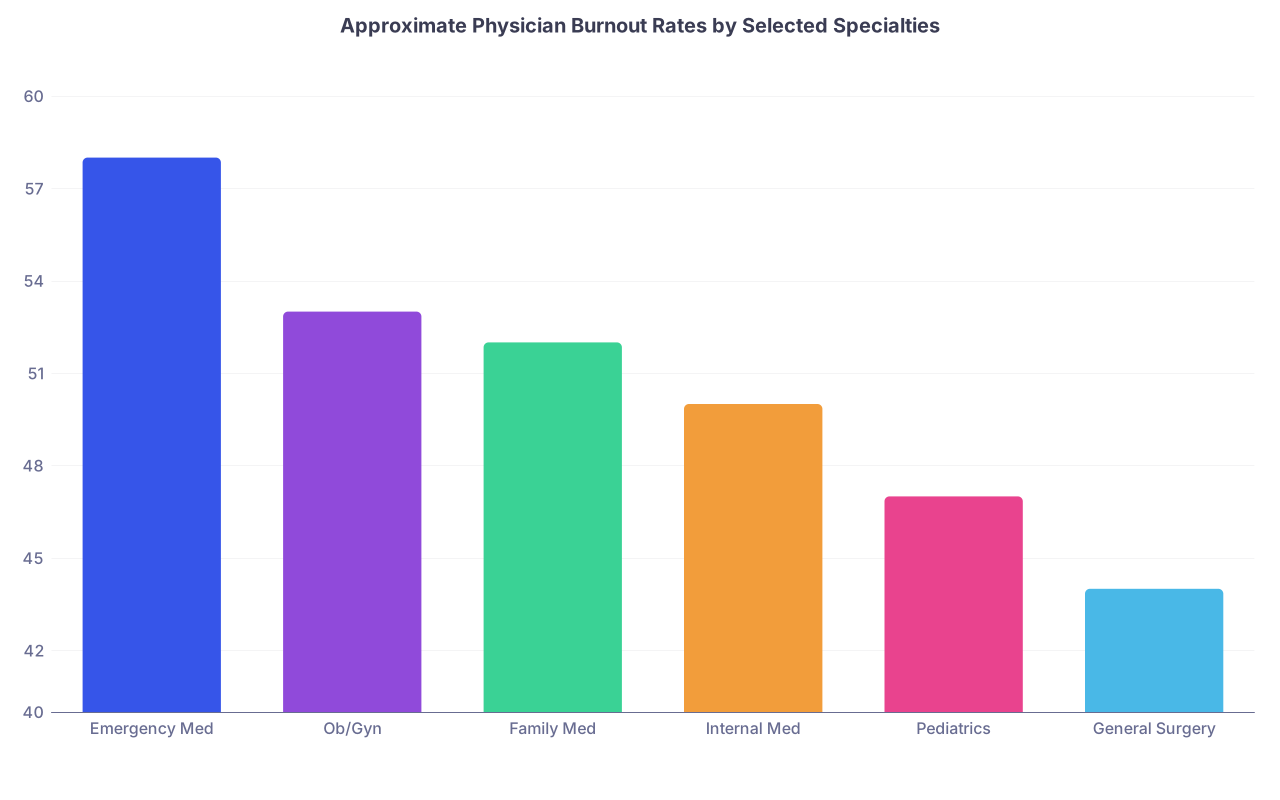
| Category | Value |
|---|---|
| Emergency Med | 58 |
| Ob/Gyn | 53 |
| Family Med | 52 |
| Internal Med | 50 |
| Pediatrics | 47 |
| General Surgery | 44 |
Two key realities:
- Yes, family medicine, general internal medicine, and pediatrics are often in the higher tier of burnout rates.
- No, they are not uniquely awful. Emergency medicine, Ob/Gyn, neurology, and others are right there with them or worse.
The myth is this: “Primary care is where burnout lives; specialties are where you escape.” The data does not support that.
The Real Drivers of Burnout (Spoiler: It’s Not Just Field Choice)
Primary care gets blamed for problems that aren’t actually about discipline—they’re about system design.
When you look at rigorous burnout research (Mayo Clinic, AMA, JAMA papers), a few themes repeat:
- Workload and time pressure
- Lack of control over schedule and work content
- EHR burden and documentation overload
- Conflicting demands (quality metrics, prior auths, inbox)
- Organizational culture and leadership
These are not “primary care only” problems. They’re system problems that just happen to be highly visible in primary care because PCPs act as the front door and the catch-all for everything insurance, society, and other specialties drop.
So what actually makes primary care feel worse in many settings?
- Panel sizes that are absurd relative to visit lengths
- 15-minute slots for complex, multimorbidity patients
- Endless inbox: lab results, patient messages, refill requests, prior auths
- Metric mania: A1c targets, blood pressure targets, vaccination rates, screening completion rates—each with its own reminder pop-ups
- Often weaker negotiating power in large systems compared to procedural fields
If you set up any specialty with those conditions, burnout will skyrocket. Imagine doing inpatient neurology with 25 patients, solo, plus 60 chart messages a day. It would implode too.
The field isn’t cursed. The job configuration often is.
Primary Care vs Primary Care: The Part No One Tells You
This is where the simplistic “primary care = burnout” narrative really falls apart.
There isn’t one “primary care lifestyle.” There are at least four:
- High-volume corporate clinic
- Academic primary care
- Concierge / direct primary care (DPC)
- Hybrid / niche primary care (sports, HIV, addiction, geriatrics, etc.)
Burnout varies dramatically across these, even though they all count as “primary care.”
Let’s compare, roughly:
| Model | Typical Panel Size | Visit Length | Admin Burden | Autonomy Level |
|---|---|---|---|---|
| Corporate, RVU-driven | 2,000–3,000+ | 15–20 min | Very High | Low |
| Academic clinic | 1,500–2,000 | 20–30 min | High | Moderate |
| Concierge / DPC | 400–800 | 30–60 min | Low–Moderate | High |
| Hybrid / niche (e.g. HIV) | 800–1,500 | 20–40 min | Moderate | Moderate–High |
Same specialty board certification. Totally different day-to-day experience and burnout risk.
I’ve seen two family physicians one floor apart in the same building:
One in a hospital-owned, RVU-driven clinic, 22–24 patients/day, constant double-booking, charting at home, inbox chaos. Burned out, talking seriously about leaving medicine.
One down the hall in a quasi-DPC hybrid model with a smaller panel, 30-minute standard visits, protected admin time, and good MA support. Enjoys the work, knows their patients, goes home with charts mostly done.
If you simply look at “family medicine” in the survey data, both of these people are one data point. The nuance gets obliterated.
Comparing Primary Care to “Lifestyle” Specialties: Less Clear Than You Think
There’s another persistent myth: if you want to avoid burnout, choose a so-called “lifestyle” or cognitive subspecialty. Derm, radiology, PM&R, ophtho. That kind of thing.
Some of those do, on average, have lower burnout rates. But the gap is not as enormous as people like to believe, and it’s closing as bureaucratic weight spreads.
A rough pattern from recent Medscape reports:
- Dermatology, pathology, ophthalmology, allergy/immunology: tend to be in the lower burnout tier (30–40%).
- Radiology and anesthesiology: middle-ish (40–50%), sometimes higher depending on year.
- EM, Ob/Gyn, FM, neuro: frequent flyers in the top group.
So yes, pure outpatient derm in a sane group practice is generally less burnout-prone than high-volume primary care in a broken system. But that’s not a function of “primary care is cursed.” It’s a function of:
- Procedure-heavy fields having more revenue per unit time → more leverage, more staff support.
- More control over schedule and fewer direct consumer expectations (patients rarely message their pathologist at 2am on the portal).
You can absolutely torch yourself in a so-called lifestyle field by joining the wrong group or chasing RVUs relentlessly. And you can absolutely have a sustainable career in primary care by being extremely selective about practice model.
Here’s the other twist: meaning in work is strongly protective against burnout in multiple studies. Primary care, when not buried under admin sludge, scores very high on “sense of meaning” and longitudinal connection. Many procedure-heavy fields rank lower there.
So the trade isn’t “primary care = misery” vs “specialty = happiness.” It’s:
- Higher meaning + higher system friction (primary care, some hospital-based specialties)
- Lower friction + often less longitudinal meaning (some procedural/lifestyle fields)
You get to decide which poison—and which antidote—you prefer.
Medical Student Myth #1: “If I Care About Patients, Primary Care Will Destroy Me”
I hear this indirectly all the time: MS2s saying some version of, “I love longitudinal relationships and complex chronic care, but I don’t want to be miserable like my clinic attendings, so I’m thinking anesthesia.”
Understandable. But incomplete.
Here’s what you’re actually up against if you love primary care–type work:
- You will need to be ruthless about practice setting. The default large-system, high-RVU clinic is where a lot of the worst stories come from.
- You will need to negotiate hard for:
- Panel size
- Visit length
- Protected admin time
- MA/RN support and inbox expectations
- You may need to move once or twice early in your career to find a group that isn’t just milking you for throughput.
What you’re not up against is some intrinsic psychological toll of “too much patient contact.” That’s nonsense. Plenty of psychiatrists have massive emotional exposure and moderate burnout rates. The problem is not caring too much. The problem is caring too much in an environment that punishes you for it.
Medical Student Myth #2: “I’ll Just Do a Specialty and Moonlight in Primary Care If I Miss It”
I’ve heard residents say this in radiology and anesthesia: “If I miss clinic or continuity, I’ll just do some primary care hours on the side.”
Reality check: most of them never do. And the ones who try quickly rediscover the same structural headaches that scared them away in the first place.
You can’t “dabble” your way around systemic dysfunction. A broken primary care system burns out moonlighters too; it just does it one urgent-care shift at a time instead of full-time.
If what you actually want is:
- Longitudinal patient relationships
- Chronic disease management
- Preventive care and counseling
Then yes, you should be looking at primary care or fields that let you carve out that niche (e.g., endocrine clinic, rheum clinic, HIV medicine). Pretending you’ll bolt that on later as a hobby usually leads to regret or inertia.
What Predicts Burnout Better Than Specialty: Control and Support
Let’s pull this out of the abstract and into something you can actually use.
Across specialties, the predictors of lower burnout (backed by multiple large surveys and organizational studies) are things like:
- Schedule control: Can you say no to extra shifts? Adjust clinic templates? Take real vacations without three weeks of inbox catch-up?
- Documentation support: Do you have scribes, good MAs, efficient EHR workflows, or is every visit 12 hidden clicks?
- Leadership: Does your department care about physician well-being beyond pizza and mindfulness emails? Do they adjust panel sizes, hire more staff, or strip useless clicks from the EHR?
- Culture: Is it acceptable to set boundaries, or are you shamed for “not being a team player” if you don’t answer portal messages at 11pm?
These factors vary more within a specialty than between specialties. That’s the part preclinical students rarely see.
I’ve met a happily practicing community internist who sees 14–16 patients/day, has 30-minute new visits, a scribe, and an MA who preps everything. Loves the job.
I’ve also met a radiologist who reads studies at an insane pace for a private equity–owned group, feels like a machine, and is trying to exit clinical work entirely.
Guess which one the average MS2 thinks is “the burnout-proof field”?
The Subspecialty Trap: You Can’t Subspecialize Your Way Out of Dysfunction
A lot of students frame it like this: “I like broad medicine, but I’ll just do cards or GI to get out of primary care burnout.”
Be careful.
Yes, those fields often have higher pay and more leverage. They also inherit a lot of the same mess, plus:
- Call (interventional, cath lab, emergencies)
- Procedural pressure to fill lab time
- Sometimes brutal fellowship and early-career schedules
Burnout in internal medicine subspecialties is not rare. Surveys often show substantial burnout in cardiology, GI, and hospitalist medicine. It’s not like people subspecialize and magically float above the EHR.
And if what you actually want is clinic-based chronic disease care and strong relationships, you can get that in a well-structured primary care practice without signing up for 3 extra years of fellowship and heavy call.
How to Use This Information as a Student
You’re not picking “burnout vs no burnout.” You’re picking a set of trade-offs you’ll carry into a system that’s currently rough on almost everyone.
Here’s how to approach it more intelligently:
Stop asking “Which specialty has the lowest burnout?”
Start asking: “In this field, what practice models exist, and what are their burnout profiles?”During rotations, interrogate the job, not just the specialty.
Ask attendings:- How many patients do you see a day?
- Do you chart at home?
- How many hours a week do you work, actually?
- What percentage of your time is non-clinical/admin?
- If you could redesign your job, what’s the first thing you’d change?
Actually shadow different types of primary care.
Hospital-owned clinic vs FQHC vs academic vs DPC. They are not interchangeable.Be honest about what energizes you.
Some people genuinely love procedures and hate counseling. Others light up in a complex 4-problem visit and die a little inside doing yet another scope. Play to your actual temperament, not what Reddit says is prestigious.Understand that your first job is not your last job.
Burnout data often reflects people trapped in misfit jobs. A bad first practice doesn’t mean you chose the wrong field—it might just mean you picked the wrong employer.
The Bottom Line on Primary Care Burnout
Here’s the actual truth, stripped of myth:
- Primary care does have relatively high burnout rates, but it’s not an outlier—EM, Ob/Gyn, and several others are just as bad or worse.
- The main drivers of burnout are system and practice-model factors (panel size, EHR burden, schedule control), not the inherent nature of primary care itself.
- Within primary care, your burnout risk can swing massively depending on whether you’re in a high-volume corporate clinic or a well-structured, lower-panel, team-based model.
If you love the kind of work primary care offers, don’t let scare stories push you into a specialty you’ll hate. Instead, learn to be ruthless about how and where you practice.
The specialty isn’t the whole story. The job is.


