

The idea that you’re supposed to find your “one true calling” in medicine is not just wrong. It’s actively harmful.
It makes medical students anxious, paralyzed, and weirdly superstitious about routine career decisions. You’re not choosing a soulmate. You’re picking a job description under high uncertainty, with incomplete information, based on who you are right now—and who you’re likely to become.
Let’s kill this myth properly and talk about what actually tracks with long‑term satisfaction and burnout risk. Spoiler: it’s not the magical Aha moment on some third‑year rotation.
The “One True Calling” Story Is a Romantic Lie
You know the script. I’ve heard it in so many dean’s talks and residency panels it could be a drinking game.
“I walked into the OR and knew instantly: I was home.”
“On my first peds rotation, I realized these were my people.”
“I could never imagine doing anything but neurosurgery.”
It sounds great. It photographs well for alumni magazines. But it massively misrepresents how most doctors actually end up where they are.
Here’s what the data and real-life behavior show:
- A large portion of residents switch intended specialties during medical school.
- Many attendings will privately admit they could have been happy in 2–3 different fields.
- Long-term satisfaction is only moderately correlated with initial “passion” and much more correlated with things like autonomy, schedule control, and workplace culture.
The romantic origin story gets told at conferences. The messy, iterative, “I thought I wanted derm, then anesthesia, then ended up in EM because that’s where I liked the people and hours” story is how it really works.
What the numbers actually say
No, there isn’t one master database of “calling scores,” but we do have some relevant signals:
- Surveys consistently show 20–40% of med students change their intended specialty during school.
- Roughly 10–20% of residents (varies by country and specialty) strongly consider switching or leave their original specialty within training or soon after.
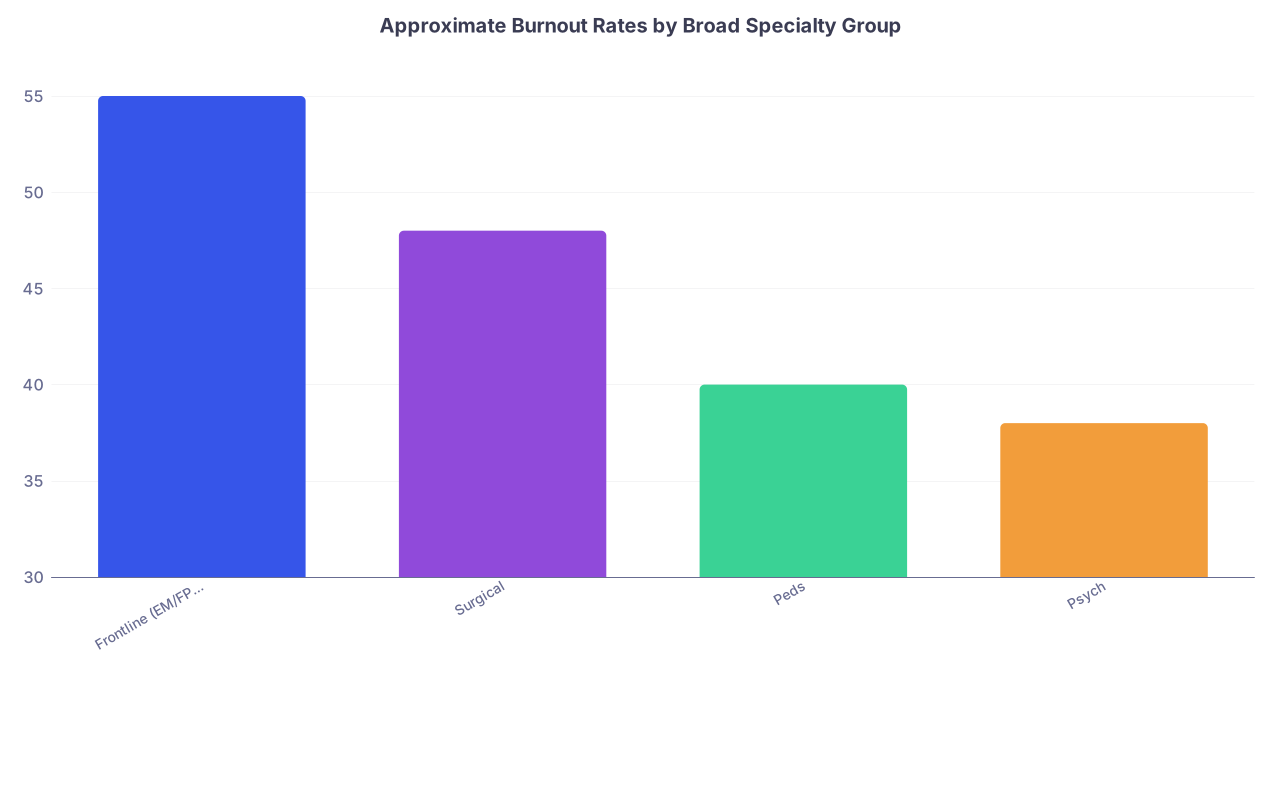
- Burnout rates are high across the board, but they cluster heavily where work conditions are worst, not where “calling” is absent.
| Category | Value |
|---|---|
| Frontline (EM/FP/IM) | 55 |
| Surgical | 48 |
| Peds | 40 |
| Psych | 38 |
(These ranges are pulled from recurring Medscape and national surveys—not perfect, but consistently show that workload and environment dominate.)
If “one true calling” was the magic shield, you’d expect people in their supposed dream fields to be dramatically protected. They’re not.
Why the Calling Myth Is So Sticky (and So Toxic)
Let me be blunt: the myth persists because it sells.
It gives deans and advisors a warm, sentimental story. It gives students a fantasy that if they just “find their calling,” everything else will slot into place. It also lets older physicians retrospectively justify their path with a clean narrative instead of “I made a reasonable choice with limited info and then made it work.”
The side effects on you are ugly:
- Paralysis – Students feel like they can’t pick anything until they feel lightning-bolt certainty. So they wait. And wait. Then panic in late third year.
- Shame – If you don’t have an obvious calling, you think you’re somehow less committed or less suited to medicine.
- Ignoring red flags – “But I love the heart!” isn’t a good enough reason to ignore the lifestyle and call burden of CT surgery if you care about family time.
- Self-flagellation after matching – PGY-1s thinking, “If this was really my calling, why am I miserable post-call?” Answer: because you’re sleep-deprived and overworked, not because you picked wrong.
The worst part? This narrative makes you look inward for an emotional lightning strike instead of outward at the variables that actually predict whether you’ll like your life.
What Actually Matters: The Boring Predictors That Work
Let’s talk about the unsexy stuff that actually moves the needle on long-term satisfaction. This is where the evidence and thousands of real careers converge.
1. Daily task profile (what you’re physically doing all day)
You probably think in labels: “surgery,” “psych,” “cards.” That’s not how your brain will experience your job. It will experience tasks.
Roughly, specialties group into patterns like:
- Procedure-heavy (ortho, gen surg, GI, IR)
- Cognitive/diagnostic (IM, nephro, rheum, heme/onc)
- Longitudinal relationship-focused (FM, peds, psych, outpatient IM)
- Acute, shift-based resuscitation (EM, ICU)
If you mismatch your task preference, no “calling” will save you. I’ve seen students who swoon over the idea of surgery but are miserable standing for 8 hours, doing repetitive fine-motor work, and tolerating long, hierarchical OR days.
Do this instead:
On each core rotation, write down for a week:
- How many hours did I spend:
- talking to patients/families?
- in front of a computer?
- doing procedures?
- coordinating care and logistics?
- reading/thinking/diagnosing?
That log will predict your fit far better than any inspirational story. If you hate long family meetings and ambiguity, you’ll suffer in fields where that’s the bread and butter no matter how “interesting” the diseases are.
2. Work hours, control, and call structure
This is where the idealists roll their eyes and say, “But I don’t care about hours if I love what I do.” They usually stop saying that somewhere around the middle of residency.
Your life satisfaction is heavily tied to:
- How predictable your schedule is
- How often work obliterates your evenings and weekends
- How much control you have over when and how you work
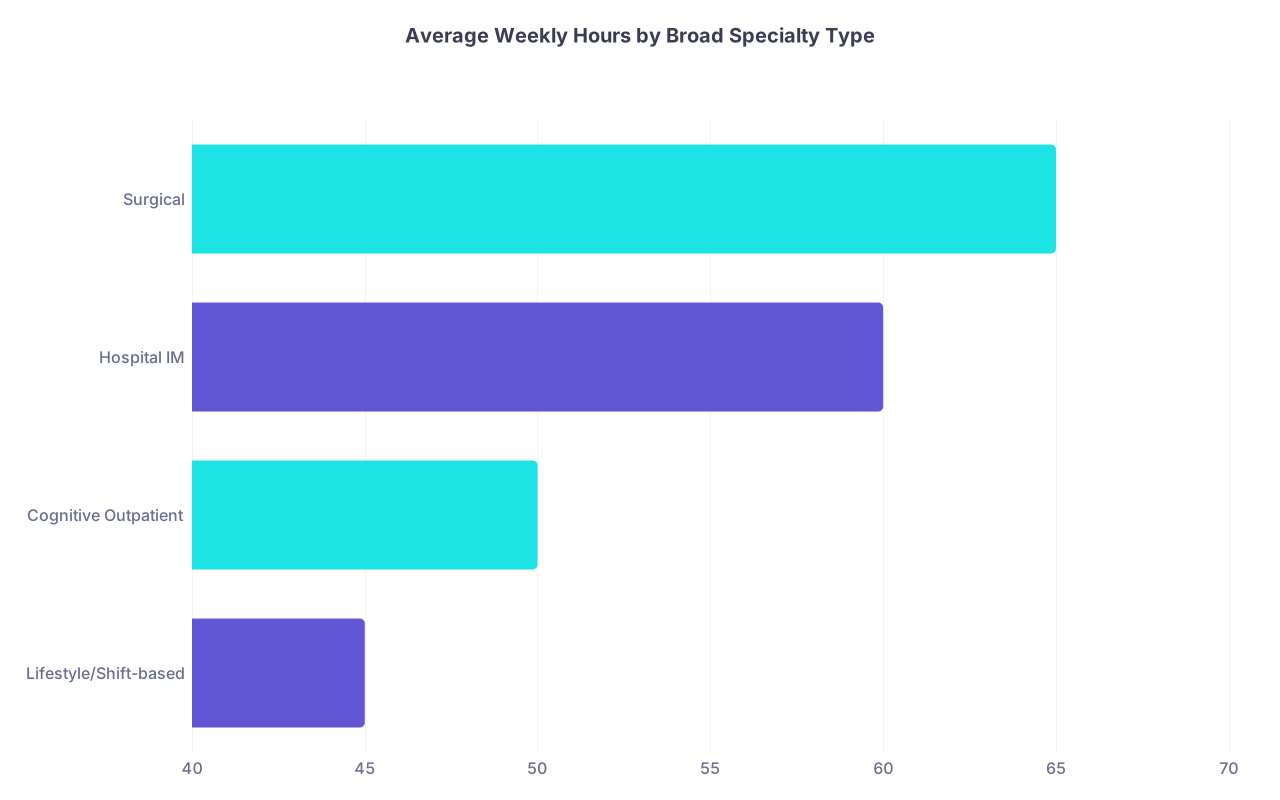
No, not everyone needs a 9–5. But acting like workload is some shallow concern is delusional. Burnout data is brutal on this.
| Category | Value |
|---|---|
| Lifestyle/Shift-based | 45 |
| Cognitive Outpatient | 50 |
| Hospital IM | 60 |
| Surgical | 65 |
Rough pattern:
- Shift-based fields (EM, urgent care, many hospitalist gigs): more control, intensity packed into discrete shifts.
- Outpatient cognitive/relationships (psych, FM, many subspecialty clinics): variable, but can be made reasonable with boundaries.
- Inpatient IM and surgical: higher hours, more call, more weekend erosion. Less predictability, especially early on.
I’m not telling you to avoid hard specialties. I’m telling you to pick with open eyes. Repeating “But I’m passionate!” at 3 a.m. in your 9th hour of a call shift doesn’t magically refill your dopamine.
3. Personality–culture fit (a massively underrated factor)
Every specialty has a culture. Yes, there are exceptions in every field. No, you are not likely to land in one of the magical pockets that are completely different from the broad stereotype.
Rough personality pulls:
- Surgery: decisive, competitive, tolerance for hierarchy and conflict.
- EM: high stimulus tolerance, tolerance for chaos and incomplete follow-up.
- Psych: high verbal stamina, comfort with ambiguity and slow change.
- IM subspecialties: analytical, detail-oriented, comfortable with guidelines and complex regimens.
- FM/peds: patience, communication-heavy, willing to handle context and social issues.
You don’t need a “calling.” You need a place where your default operating system doesn’t constantly clash with how everyone else works and talks.
Watch for this during rotations:
- Do you like how attendings argue and resolve conflicts?
- Could you imagine being like your favorite senior resident in 10 years?
- Do the jokes and gripes in the workroom make sense to you, or do they feel alien?
When students say, “These are my people,” what they’re usually reacting to is cultural fit, not destiny.
4. Training path length and your tolerance for delayed gratification
The calling myth conveniently ignores how different the training timelines are.
| Path | Years of Residency/Fellowship (Typical) |
|---|---|
| Family Medicine | 3 |
| Psychiatry | 4 |
| Emergency Medicine | 3–4 |
| Internal Medicine → Cardiology | 6–7 |
| General Surgery → Vascular/CT | 7–8+ |
You’re not just choosing a job. You’re choosing:
- How long you’ll earn resident salary
- How many more exams and board certifications you’ll take
- How many relocations you may need for residency + fellowship
Some people genuinely do not mind an 8–10-year path. Some do. It’s not weak or “less committed” to say, “I’d rather be an attending at 31 than 39.” That’s an entirely rational preference.
Passion doesn’t erase training length. Your 38-year-old self with daycare bills will not care how spiritual your 25-year-old “calling” experience was on that one rotation.
5. Geographic and job market reality
Nobody wants to talk about this because it punctures the romance.
Some specialties are geographically flexible and in high demand everywhere: FM, psych, general IM, EM in many regions. Others are more tied to urban centers, tertiary hospitals, or specific markets: certain surgical subspecialties, competitive fellowships.
If you have a partner’s career, kids, or strong geographic ties, this matters a lot.
You don’t need to over-optimize for future job trends (they change), but ignoring them completely is just willful blindness. Talk to attendings 5–10 years out, not just the star fellowship-bound chief resident.
How to Actually Choose Without the “Calling” Crutch
Let me give you a more honest framework. It’s not romantic. It works.
Step 1: Rank your non-negotiables
Make a ruthless list. Not the version you’d say to an admissions committee. The real one.
Things like:
- “I’m okay working 55–60 hours, but not 80 routinely.”
- “I need to live in or near a major city long-term.”
- “I want more procedures than clinic, or vice versa.”
- “I don’t want to be on overnight call after age 40.”
Those constraints don’t make you weak. They reflect your actual life.

| Step | Description |
|---|---|
| Step 1 | List Non-negotiables |
| Step 2 | Assess Daily Task Preferences |
| Step 3 | Match with 3-5 Candidate Specialties |
| Step 4 | Reality Check Hours & Training Length |
| Step 5 | Narrow to 2-3 Options |
| Step 6 | Do Electives/Sub-Is in Top Choices |
| Step 7 | Decide & Commit |
Step 2: Match your task profile
Using your rotation logs and gut reactions, ask:
- Do I feel energized or drained by long patient conversations?
- Do I like procedures enough to tolerate the lifestyle attached to them?
- Do I prefer depth in one system (cardio, neuro) or breadth (FM, EM, hospitalist)?
This will narrow the list more reliably than, “What diseases did I find coolest?”
Step 3: Use electives strategically, not romantically
Electives are not a scavenger hunt for The Moment. They’re test drives.
On each elective or sub‑I, assess:
- Could I tolerate this on my worst day?
- Do I like the senior residents’ lives, not just the attending’s theoretical lifestyle?
- How often do people here talk about leaving the field?
Ask blunt questions in private:
- “If you were matching again today, would you pick this specialty again?”
- “What’s the part of your job that makes you most think about quitting medicine?”
- “What jobs are people 5–10 years ahead of you actually taking?”
You’ll learn more from one honest conversation with a burned‑out hospitalist than from 10 glossy specialty info nights.
Step 4: Accept there is more than one “right” answer
This is where the myth really poisons people. They think picking IM over EM (or psych over FM) is some irreversible branching of fate.
Reality: many people could legitimately be happy in:
- 2–3 different cognitive fields
- A couple of procedure-based options
- Multiple outpatient specialties
The question is not, “What is my One True Calling?”
The question is, “Which of these good-enough options best fits my constraints, temperament, and preferred daily work for the next decade?”
You’re stacking probabilities, not decoding a soulmate.
Step 5: Notice when fear is dressing up as “calling”
Sometimes students insist, “I’m called to dermatology” in a way that sounds suspiciously like, “I want high pay, low hours, and status.” Nothing wrong with those goals—just be honest about them.
Likewise, “I’m called to surgery” has occasionally meant, “I’m terrified of regretting not choosing the most ‘hardcore’ path.” Also not a calling. That’s status anxiety.
If you strip away prestige, pay fantasies, and fear of judgment, what’s left? That’s closer to your real preference.
Your Future Self Won’t Care About the Story—Only the Life
Ten years from now, you won’t be reciting your “how I chose” anecdote very often. You’ll be:
- Waking up at a certain time
- Driving (or not) to a certain kind of workplace
- Seeing a certain volume and type of patient
- Dealing with a certain administrative burden
- Coming home with a certain amount of energy left
Your nervous system will not care whether you once cried on OB because you thought you’d found your destiny. It will care how often you’re chronically sleep-deprived, how much autonomy you have, and whether your day-to-day work aligns reasonably well with what you’re good at and what you can tolerate.
Calling is a nice story. Fit is a better predictor.

A Few Ground Rules That Actually Help
Let me boil this down to some hard lines I’ve seen hold up again and again.
- If you absolutely hate the training for a specialty, do not bank on loving the career. Training is not everything, but it’s a big chunk of your 20s–30s.
- If your top reason is money or prestige, admit it to yourself. Then ask if you’d still pick it at half the pay and zero clout. If no, be careful.
- If three different rotations made you say “I could see myself doing this,” that’s normal, not a sign you’re broken.
- If every attending in a field gives you some version of “I’d tell my kid not to go into this,” believe them more than the match data.
| Category | Value |
|---|---|
| Lifestyle/Hours | 30 |
| Interest in Content | 25 |
| Mentors/Role Models | 20 |
| Income | 15 |
| Job Market | 10 |
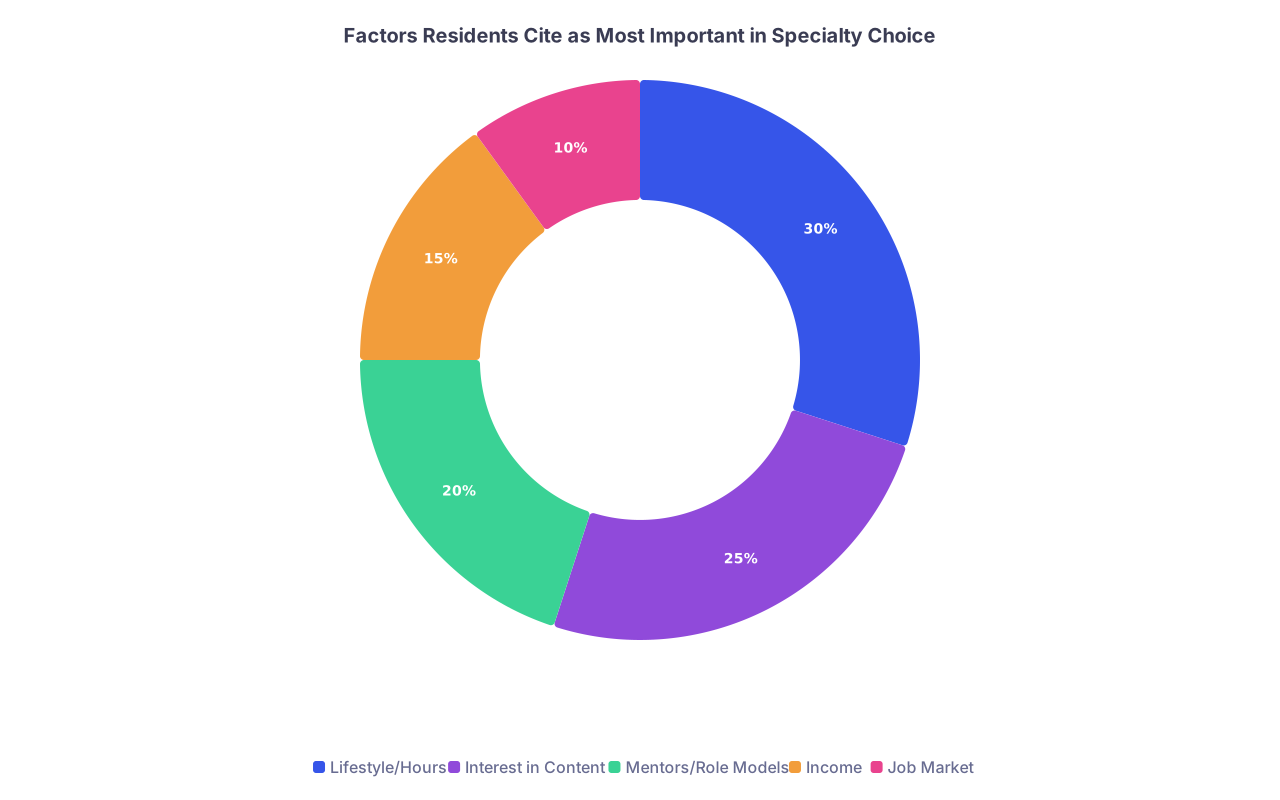
Notice that “mystical calling” isn’t on that list. Because when forced to pick, residents talk about hours, content, mentors, income, and market—actual variables they can observe—not destiny.

The One Thing You Actually Need
You don’t need a calling. You need:
- A good-enough fit among several reasonable options
- A honest look at your priorities and limits
- The humility to accept uncertainty and adjust later if needed
Physicians change practice types, shift to admin, do locums, pivot to outpatient or inpatient, get extra training, or even leave clinical medicine altogether. Very few careers are truly locked in cement.

Bottom Line
- The “one true calling” in medicine is a myth. Most doctors could have been reasonably happy in multiple specialties, and burnout doesn’t spare the “called.”
- What actually matters long-term is task profile, workload and control, culture fit, training length, and job market—not a dramatic emotional moment on a third-year rotation.
- You’re not decoding destiny. You’re making a high-stakes but ultimately revisable choice under uncertainty. Aim for solid fit, not perfection, and you’ll be miles ahead of your classmates still waiting for lightning to strike.


