

The idea that “only surgeons don’t have a life” is lazy, wrong, and dangerous for how you choose a specialty.
You’re being sold cartoon versions of specialties:
Derm = 9–3 and Pilates.
Surgery = misery and divorce.
Psych = vibes and coffee.
EM = three shifts a week and then surfing.
That is not how medicine works in 2025. And if you buy these myths when you’re an M2 or M3, you’re setting yourself up to be blindsided later.
Let’s tear this apart with data, not hallway gossip.
The Lifestyle Myth: What Med Students Think Is True
Here’s the script I hear from students on literally every campus:
- “I want a life, so I’m going into derm, ophtho, or rads.”
- “I love cards but I don’t want that call schedule.”
- “Anesthesia seems chill, they just sit there and read.”
- “Hospitalists work 7-on/7-off, that’s the dream.”
- “At least I didn’t pick surgery, they don’t have lives.”
Notice the pattern? People talk in specialty stereotypes, not in actual numbers: hours, call burden, burnout rates, control over schedule, how things change after training.
Let’s ground this in what we actually know.
What the Data Actually Shows About Hours and Burnout
Multiple surveys (Medscape, ACGME data summaries, specialty society reports) all tell roughly the same story, year after year:
Residents across many specialties work similar total hours.
Surgery is on the high side, yes. But IM, EM, OB/GYN, anesthesia, peds, and some subspecialties all live in the 55–70+ hours/week band in residency.Burnout is not a “surgery-only” problem.
Burnout rates are disturbingly high in:- Emergency medicine
- Internal medicine
- OB/GYN
- Critical care
- Family medicine in some settings
Meanwhile, some surgical subspecialties (e.g., plastics, certain ortho practices) report better lifestyle satisfaction after early career.
Outpatient-focused ≠ easy life.
Dermatology and outpatient psych can be great, but:- Private practice productivity pressure
- Prior authorizations and documentation
- RVU-based compensation
all erode the “easy life” narrative quickly.
To make this more concrete, here’s a rough, typical resident-hours picture from survey data and program reporting. This is not universal, but it’s a good reality check.
| Specialty | Typical Resident Hours/Week |
|---|---|
| General Surgery | 65–80 |
| OB/GYN | 60–75 |
| Internal Med | 60–70 |
| Emergency Med | 50–60 |
| Pediatrics | 55–65 |
| Psychiatry | 50–60 |
So no, surgeons are not the only ones trading free time for training. They’re just the ones everyone likes to point at.
The Real Variables That Define “Having a Life”
“Lifestyle” is a garbage word if you don’t dissect it. What most students actually care about are:
- Predictability of schedule
- Control over nights/weekends
- Work intensity while on duty
- Flexibility for family/childcare
- Ability to work part-time or shift-based
- Geographic control
- Emotional energy left after work
Different specialties stress different parts of this list. You’re not choosing lifestyle vs. no lifestyle. You’re choosing which headaches you’re willing to live with.
Let’s go specialty by specialty, but from a grown-up, post-hype perspective.
Surgery: Hard, Yes. Singularly Miserable, No.
Surgeons do work a lot. Call is real. OR days can be brutal. There are 4 a.m. alarms and notes written half-asleep.
But the myth that “surgeons don’t have lives” misses three key points:
Training is not the same as career.
The surgical resident who lives in the hospital is not the private-practice surgeon 10 years out doing:- 2–3 OR days a week
- 1–2 clinic days
- 1 in 4 or 1 in 5 call
- Protected OR block time, some admin support
Are there academic trauma surgeons still destroyed by nights and weekends? Yes. Are there elective ortho or plastics surgeons with excellent schedules and incomes that allow for real time off? Also yes.
Procedural dopamine is not fake.
Many surgeons are willing to tolerate higher hours because:- The work is concrete and episodic.
- You fix something, you move on.
- There’s less chronic-disease limbo and less “I can’t do anything more for you” helplessness.
I’ve seen plenty of medicine residents more emotionally drained from nonstop complex comorbidities than a tired but satisfied surgeon after a long case list.
Surgery has more controllable niches than you think.
Things like:- Outpatient-focused subspecialties (some plastics, hand, certain ENT practices)
- Bariatrics/hernia-focused practices
- Group setups with good call sharing
These can end up with a more “normal” life than a hospitalist stuck doing nights every third week forever.
The honest statement is this: if you hate the OR and you hate early mornings, do not pick surgery. But if you love it, you’re not automatically sacrificing your family and happiness on an altar. That narrative is outdated and selectively told.
Medicine, Hospitalist, and Subspecialties: The Hidden Grind
Internal medicine is where many students run when they want to avoid “surgical hours.” Reality check: early-career IM and subspecialists are not living in a rom-com.
Common pitfalls:
- Call-heavy cardiology, GI, heme/onc, pulm/crit
- 12–14 patient caps that turn into 18–20 “on a busy day”
- 7-on/7-off hospitalist schedules that sound great in theory and wreck circadian rhythm in practice
That 7-on/7-off schedule you hear hyped constantly? I’ve watched it turn into:
- 7 days of 11–12 hour shifts
- Charting at home
- Two “off” days burned just recovering and re-entering normal sleep patterns
Lifestyle is better than many surgical residencies, sure. But it is not guaranteed serenity.
EM, Anesthesia, and Radiology: Shift Work and Its Fine Print
These are the “lifestyle shift” specialties students love to name-drop. Let’s be fair and also honest.
Emergency Medicine
Upside:
- True shifts. When you’re done, you’re done.
- Part-time and 0.8 FTE options are real.
- Clear episodic work.
But:
- Nights, evenings, and weekends forever. The hospital does not close.
- Volume pressure, boarding, angry patients, violence concerns in some EDs.
- Burnout and moral injury rates in EM are among the highest reported.
A lot of EM docs in their 40s start looking for exit ramps: admin roles, urgent care, telehealth. Not because EM is “bad,” but because long-term nights/weekends do add up.
Anesthesiology
Upside:
- Predictable OR lists in many settings.
- Shift frameworks (e.g., early vs late shifts).
- Less longitudinal baggage—patient leaves the OR, you move on.
The fine print:
- Early starts. You’re there before the surgeon.
- Call can be very real, especially in trauma centers or OB-heavy hospitals.
- Case unpredictability: that “quick lap chole” becomes a 3 a.m. bookend if it goes wrong.
Radiology
Upside:
- Fewer patient confrontations.
- Often highly paid with potential for remote/hybrid work.
- More standard daytime hours in many groups.
But:
- Telerads night coverage still means someone is up all night reading scans. Sometimes that’s you.
- Productivity pressure: RVUs and endless imaging volume aren’t exactly meditative.
Again: these can be excellent choices. But it’s lazy to pretend they’re universally “chill”.
The Outpatient Fantasy: Derm, Psych, and Friends
Dermatology and outpatient psychiatry are the poster children for “great lifestyle.” There’s some truth there, but students only hear the highlight reel.
Dermatology
Real pros:
- Mostly daytime, outpatient, elective.
- Procedures plus clinic; many derms genuinely like their day-to-day.
- Very little night call in many practices.
Reality checks:
- Insane competitiveness to match.
- High-volume clinics to maintain income in some markets.
- Cosmetic vs medical derm mix can dramatically change your day and your stress.
Psychiatry
Upside:
- Schedule can be quite controllable in outpatient.
- Telepsychiatry and private practice flexibility.
- Often 40–50 hour weeks if set up well.
But:
- Inpatient psych and consult-liaison can be intense.
- Emotional burden can be higher than the “talk to people all day” stereotype suggests.
- Documentation, prior auths, and system failings (no beds, poor social resources) grind people down.
The message: outpatient-focused specialties can absolutely offer excellent lifestyles. They’re not automatically effortless, and they come with their own brand of fatigue.
The Actual Pattern: Specialty Explains Less Than You Think
Lifestyle is not just “what specialty you picked.” Once you get past the blunt differences (trauma surgery vs derm, for example), your life is shaped more by:
Practice setting
Academic vs private vs hybrid. Rural vs urban. Big system vs small group.Job design
Shift work vs clinic-based. Procedure-heavy vs cognitive. Inpatient vs outpatient mix.Call structure
In-house vs home call. Frequency of weekends. Backup coverage when things get busy.Your own boundaries
Saying no to endless extra shifts. Not letting “just one more patient” become eight more.
Here’s the uncomfortable truth: I’ve seen cardiologists with happier, more stable lives than some derm residents crushed by toxic programs. I’ve seen general surgeons with structured practices and more free time than burnt-out EM docs stuck on nights.
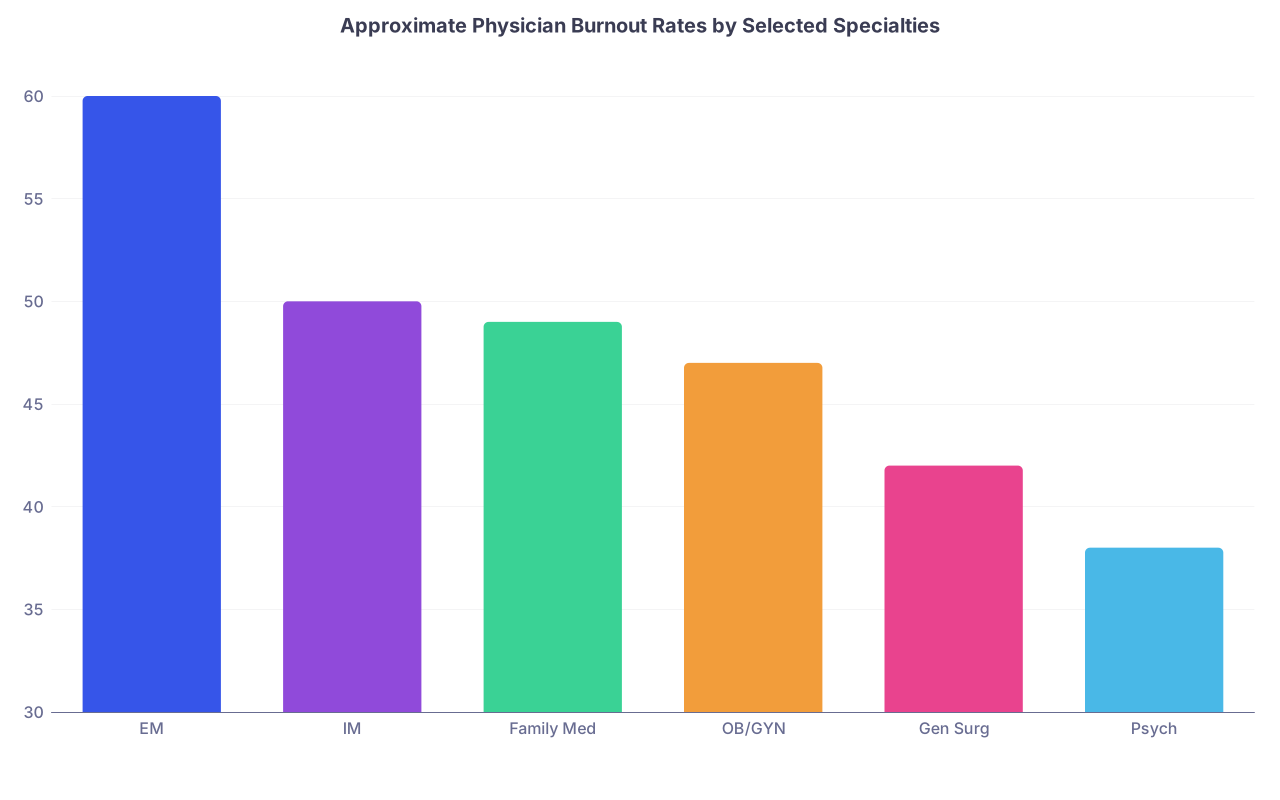
One more data snapshot to drive this home—burnout is spread all over the map, not clustered solely in “bad lifestyle” fields:
| Category | Value |
|---|---|
| EM | 60 |
| IM | 50 |
| Family Med | 49 |
| OB/GYN | 47 |
| Gen Surg | 42 |
| Psych | 38 |
(Percentages rounded from multiple survey years; the exact number is less important than the pattern: suffering is democratically distributed.)
You’re Asking the Wrong Question
The most common question I get from M2s and M3s:
“Which specialties have the best lifestyle?”
Wrong question.
Better questions:
- What kind of day do you want? (OR, clinic, procedures, team structures)
- How do you feel about nights/weekends permanently?
- Do you want longitudinal relationships or episodic care?
- How do you handle acute stress vs slow-burn emotional load?
- Do you want geographic flexibility? (Some fields lock you into academic centers or big cities.)
And then: What practice structures in that field create the life I actually want?
Because a hospitalist, outpatient internist, and ICU doc technically all came out of internal medicine—but their lives do not look alike. Same for a trauma surgeon vs a mostly-elective ortho sports surgeon.
How to Get Real Data Instead of Folklore
Stop making specialty decisions based on what other stressed M3s say in the workroom at 2 a.m.
Do this instead:

| Step | Description |
|---|---|
| Step 1 | Identify 2-4 specialties you like |
| Step 2 | Shadow attendings in each |
| Step 3 | Ask about typical week and call |
| Step 4 | Talk to mid-career and late-career docs |
| Step 5 | Compare practice settings within specialty |
| Step 6 | Decide what tradeoffs you accept |
Concrete moves you can make as a student:
- Ask attendings: “What does your typical week look like in hours and call?”
- Ask: “If you could redesign your job for better balance, what would you change?”
- Ask residents off the record: “What do grads from this program usually end up doing, schedule-wise?”
You’ll hear the truth a lot more often than on Reddit.
The Bottom Line
Let’s cut through the mythology.
No, surgeons are not the only ones without a life.
Many specialties have heavy hours, high burnout, and serious call. Surgery is just the stereotype people like to repeat.“Lifestyle specialty” is a half-truth.
Within every field, practice setting and job design matter as much as—sometimes more than—the specialty label.You’re choosing tradeoffs, not escaping work.
Nights vs early mornings. Emotional exhaustion vs physical fatigue. High-intensity bursts vs chronic grind. Pick the problems you can live with, in a field you actually like.
If you choose your specialty to avoid being “one of those surgeons with no life,” you’re using the wrong compass. Choose the work you can see yourself doing on your best and worst days—and then be very intentional about how you practice it.


