
Competitive specialties are not reserved for the mythical “top 5% genius” tier. They’re mostly reserved for the top 5% of planners.
Let me be blunt: the way people talk about derm, ortho, plastics, ENT, rad onc, neurosurgery, and ophtho on Reddit and in student lounges is wildly disconnected from actual match data. “If you’re not 250+,” “If you’re not AOA,” “If you’re not at a top-10 school” – I’ve heard all of it. And most of it is garbage simplification.
You do need to be strong. You do not need to be a unicorn. And many “average” med students who treated this like a multi‑year project, not a last‑minute lottery ticket, matched just fine.
Let’s walk through what the data and real-world patterns actually show.
The Myth: Competitive = Only the Top 5%
Here’s the story you’ve probably absorbed by osmosis:
- Only the top 5–10% by class rank / scores can match derm, ortho, plastics, ENT, neurosurg, ophtho, rad onc, IR.
- Step 1 pass/fail “killed your chances” unless you were already elite.
- If you’re at a non‑name school or a DO program, forget it.
- One misstep (a shelf failure, a low Step, a LOA) = door permanently closed.
Strong story. Terrible accuracy.
The truth is more annoying and more hopeful at the same time:
- Competitive specialties draw heavily from the top quartile academically, not strictly the top 5–10%.
- Within that quartile, strategy, timing, and fit with programs matter as much as raw numbers.
- Many people in the “good but not superstar” range match each year, while some “superstars” still don’t.
Let’s anchor this with data instead of rumors.
What the Match Data Actually Shows
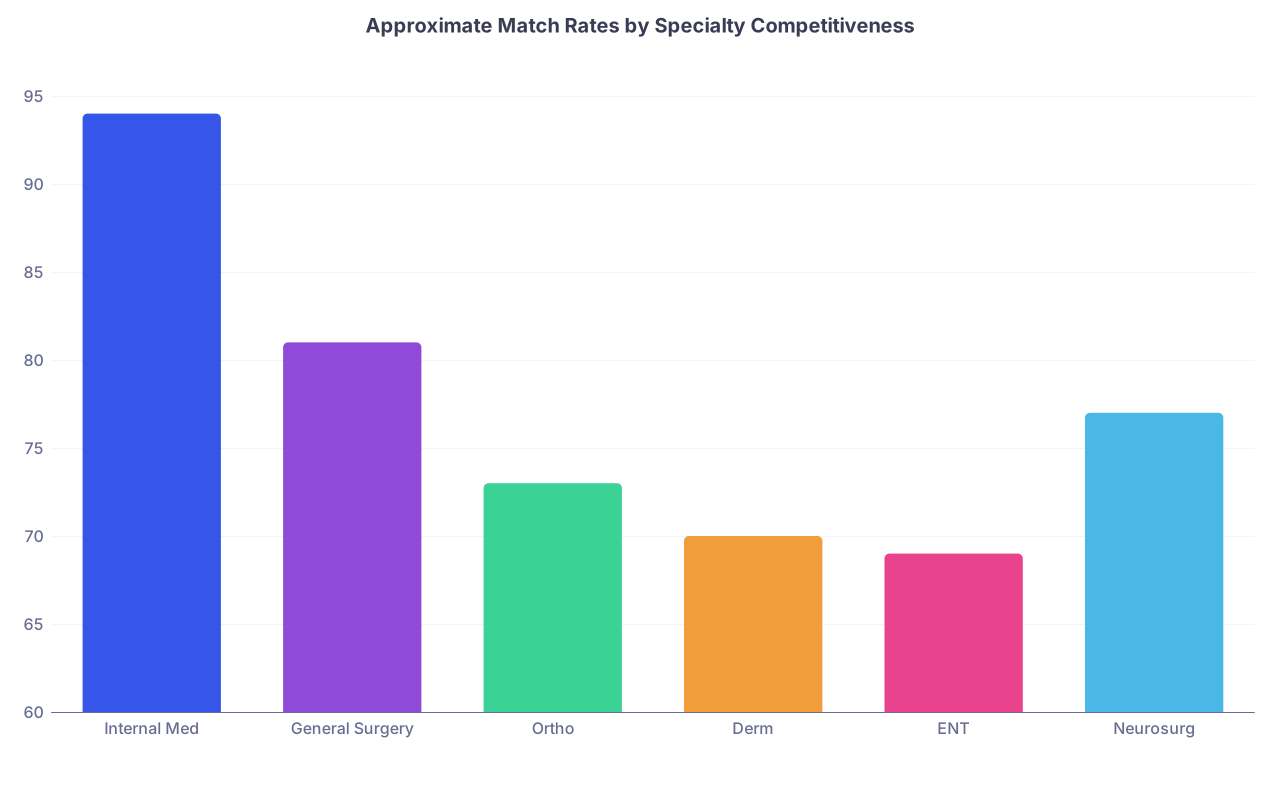
NRMP data pulls the mask off a lot of this mythology. No, it doesn’t give you every detail you’d want, but it’s enough to see the patterns.
| Category | Value |
|---|---|
| Internal Med | 94 |
| General Surgery | 81 |
| Ortho | 73 |
| Derm | 70 |
| ENT | 69 |
| Neurosurg | 77 |
These numbers (rounded, representative of recent NRMP trends for US MD seniors) tell you a few things:
- Even in “elite” fields, most applicants match.
- That alone kills the “only the top 5%” narrative. You can’t have 70–77% match rates if only the 95th–100th percentile are viable.
Now, score distributions. Using Step 2 CK as the main numeric filter now that Step 1 is pass/fail:
- Median Step 2 CK for matched US MD in:
- Dermatology / Ortho / ENT / Plastics / Neurosurg: typically mid‑250s to low‑260s.
- Internal medicine, pediatrics, family: usually mid‑240s or lower.
So yes, the bar is higher. But notice what that implies. If the median matched applicant in derm is ~255, that means:
- A large chunk were below 255 and still matched.
- Some people with 260+ did not match.
Competitive fields skew upward, but they’re not exclusively 270‑bots.
And no, these numbers don’t align neatly with “top 5%” of a typical med school class. On many clerkships I’ve seen, the orthos and derm people were often “top 20–25% with a clear plan,” not “only the #1–5 in the class.”
Where People Get This Wrong
There are a few consistent distortions I see:
1. Confusing “average matched” with “minimum possible”
Students look at NRMP’s “Matched applicant Step 2 mean: 255” and read it as: “You need 255+ to have a shot.”
That’s false. Means hide distribution. There’s a tail below that mean. People in the 240s match into very competitive fields every year when:
- They have strong clinical grades (especially in key rotations).
- Their letters are excellent and specialty‑specific.
- Their application narrative actually matches the specialty.
2. Ignoring program-level differences
Not all programs care equally about the same things. There’s a huge difference between trying to match:
- Dermatology at UCSF, MG, or Penn
vs - Dermatology at a solid, mid‑tier, clinically heavy program in the Midwest or South.
One program might quietly screen below 255. Another might be more flexible if you’ve done multiple away rotations with strong evaluations and clear commitment. Lumping everything together as “derm” or “ortho” is lazy thinking.
3. Overestimating how much school name protects you
Yes, being at a top‑tier academic school opens doors:
- Home departments with big reputations.
- Easier access to high‑impact research.
- Brand name that serves as a shortcut for some PDs.
But I’ve seen this repeatedly: a top‑10 MD student with shiny scores and shallow specialty involvement loses out to:
- A state‑school student with a slightly lower score,
- 2 solid specialty projects,
- And letters saying “this person is already performing at intern level in our field.”
Prestige helps. It doesn’t erase laziness or lack of fit.
Who Actually Matches Competitive Specialties?
Let’s break down the typical successful profile. Not the rare genius. The more common pattern that actually fills most spots.

You tend to see:
- Step 2 CK: Often 245–265+, but not uniformly superhuman.
- Clerkship grades: Honors (or near-honors) in relevant core rotations.
- Research: A few focused projects or abstracts in the specialty, not necessarily dozens of first-author papers.
- Letters: At least 2 strong letters from people in the field who actually know the applicant’s work and day-to-day behavior.
- Longitudinal involvement: Consistent specialty interest over 1–3 years (interest group, shadowing, elective time, maybe some QI).
In other words, competent + consistent + visible.
Not: 280 + solved cancer in undergrad + triple-board potential.
Is there self-selection? Absolutely. Most students with 220s don’t even apply to derm. That’s why averages look high. But “high average” is not the same as “only rarified 95th percentile allowed.”
The Real Gatekeepers: Timing, Signals, and Strategy
If it’s not “top 5% or bust,” what actually gates people out?
1. Late, vague commitment
I’ve lost count of how many times I’ve heard this:
“I decided on ortho in late third year, but my application didn’t come together in time so I panicked and dual-applied.”
Competitive specialties are logistically competitive. Away rotations, letters from specific people, research cycles – these move on 6–18 month timelines, not 6 weeks.
If you decide:
End of M3: “Maybe I’ll try ENT or derm”
You’re behind.Early M2: “I’m leaning derm or rads but not sure”
You have time to quietly position yourself: find mentors, get on a small project, schedule electives.
A lot of successful “mid‑tier” academic applicants simply committed earlier while stronger classmates were still “keeping an open mind” into eternity.
2. Poor school-specific planning
Here’s the part no one tells you: your school’s culture and strengths matter more than your raw percentile.
If you’re at:
- A school with a big ortho department, tons of faculty, strong home program
- But a tiny, overstretched derm department with no home residency
Then you deciding “I’m a derm person now” in late M3 is objectively a harder road than “I’m going all‑in on ortho” with strong local infrastructure.
The smartest students I’ve seen pick competitive specialties they actually like and that their school can realistically support with:
- Home rotations
- Letters from well‑known faculty
- Access to research or QI
3. No coherent narrative
Program directors care about coherence much more than you think.
They’re not asking: “Is this the highest Step 2 score we can get?”
They’re asking: “If we spend hundreds of thousands of dollars training this person, what’s the chance they thrive, finish, and represent our program well?”
Scattered rotations, generic personal statements, and random research in 3 unrelated fields scream “I like prestige and money, please pick me.”
A moderate Step 2 with a laser-focused, believable derm story beats a superstar who looks like they threw darts at the NRMP list.
DO vs MD, Step 1 Pass/Fail, and “Realistic” Chances
You also asked, implicitly, the more cynical question: is this all just MD‑top‑school‑Step‑1‑era nostalgia?
Short answer: no. The landscape shifted, but the basic patterns stayed.
| Factor | High Impact? | Can You Influence It in Med School? |
|---|---|---|
| Step 2 CK Score | Yes | Yes |
| School Prestige | Moderate | No (but can offset with other parts) |
| Research in Specialty | Moderate | Yes |
| Clinical Evaluations | High | Yes |
| Letters from Specialists | Very High | Yes |
DO vs MD
Reality check:
- US MD applicants have higher match rates in competitive specialties.
- DOs and IMGs are underrepresented in derm, plastics, ENT, etc.
But “underrepresented” is not “nonexistent.” I’ve worked with DOs in ortho and ENT who got there by:
- Targeting programs historically open to DOs.
- Doing away rotations at DO-friendly places and absolutely crushing them.
- Having relentless consistency – research, electives, letters – all tightly aligned.
The “top 5% only” myth is especially damaging here, because it convinces DO students to self‑reject before they ever seriously explore their chances.
Step 1 Pass/Fail
Step 1 going pass/fail didn’t magically democratize competitive specialties. It just shifted emphasis:
- Step 2 CK became the new hard filter.
- Clinical performance, letters, and school reputation got more weight.
- Research and clear specialty interest matter more when the quant floor is fuzzy.
Does that favor certain groups? Yes: students at more academic schools with well‑structured advising probably do better. But again, that’s not “scores only, top 5% or die.”
How to Decide If a Competitive Specialty Is Realistically Open to You
Here’s the part you actually care about: what to do with this information.

| Step | Description |
|---|---|
| Step 1 | Interested in Competitive Specialty |
| Step 2 | Talk to Specialty Advisor |
| Step 3 | Proceed with Strong Plan |
| Step 4 | Proceed, Tighten Strategy |
| Step 5 | Very Selective Targeting or Backup Plan |
| Step 6 | Get Specialty Mentor |
| Step 7 | Discuss Backup & Hybrid Strategies |
| Step 8 | Plan Research & Rotations |
| Step 9 | Step 2 Projected Range? |
A rough, honest framework:
Look at your trajectory, not just today’s numbers.
- Are pre-clinical exams and practice Step questions trending up?
- Have you been able to turn weaknesses into strengths with targeted work? If yes, you’re not locked out, even if your current test average doesn’t scream “derm.”
Compare yourself to matched, not mythical applicants.
- Talk to recent grads from your school who matched into the field.
- Ask them bluntly: scores, research, timeline, how many interviews, what almost derailed them.
Get evaluated by someone in the specialty, early.
- Show up prepared on shadowing or early elective.
- Ask: “If I continue performing like this, do you think I’m a realistic candidate in this field? What would you want to see from me by application time?”
Have a Plan A, Plan B, and Plan A‑optimized.
- Plan A: All‑in on orthopedic surgery.
- Plan B: General surgery or PM&R or radiology, depending on your real interests.
- Plan A‑optimized: Choose research, rotations, and mentors that keep B viable without sabotaging A.
Students who do this early end up with options. Students who wait and then blame the “top 5%” secret club usually didn’t have a strategy until it was too late.
Where the “Only Top 5%” Idea Does Contain a Grain of Truth
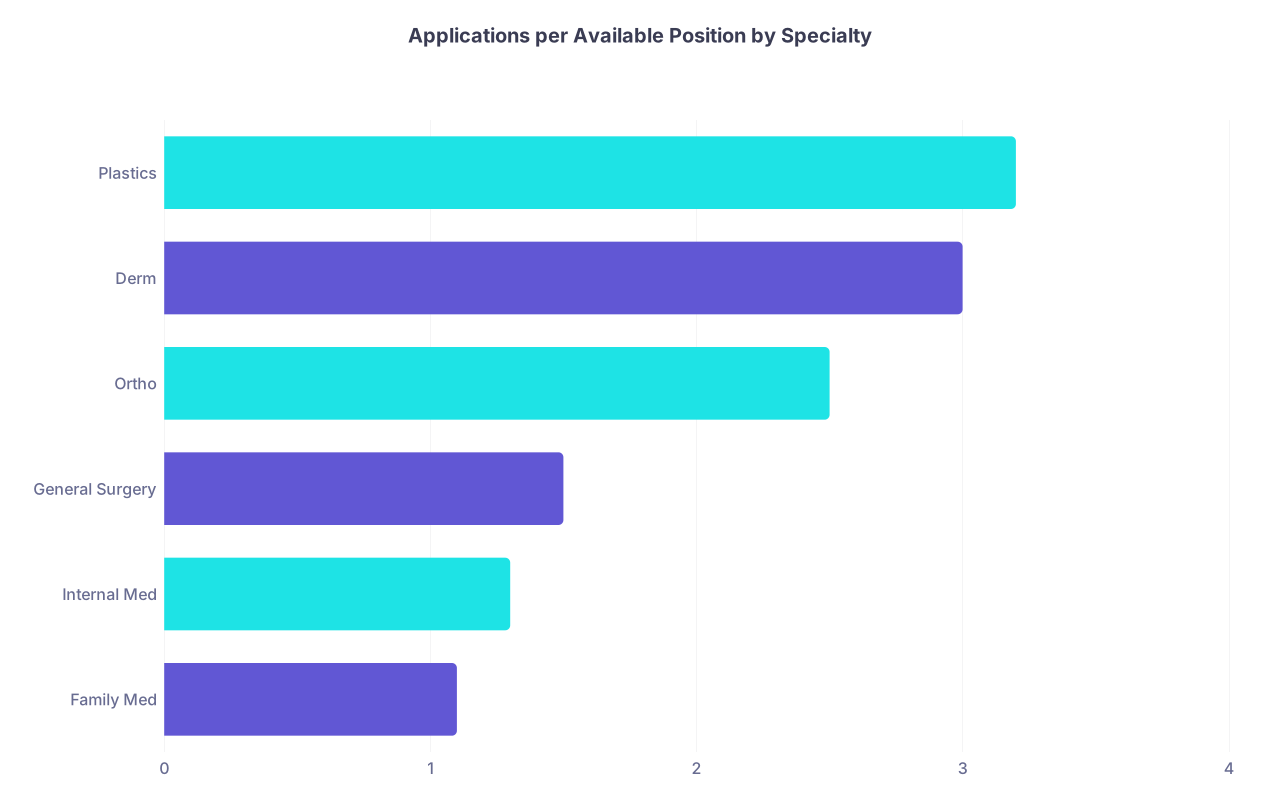
There’s one place where the myth points to a real issue: supply vs demand.
| Category | Value |
|---|---|
| Family Med | 1.1 |
| Internal Med | 1.3 |
| General Surgery | 1.5 |
| Ortho | 2.5 |
| Derm | 3 |
| Plastics | 3.2 |
Competitive specialties have many more applications per spot. That means:
- Programs can be picky.
- Noise and luck play a bigger role in who gets interviews and where.
So yes, on the aggregate, it feels like only the top of the class matches because:
- The weaker and mid-level candidates often get filtered out early.
- The ones you hear about are usually the shining examples who matched big-name programs.
But the right conclusion isn’t “only the top 5–10% need apply.” It’s:
- “The bar is higher, the margins are thinner, and you can’t bluff your way through this.”
Quick Reality Check: If This Is You, You Still Have a Shot
You’re probably in one of these buckets:

“Solid but not superstar” M2/M3
- Pre‑clinical: mostly B+/A‑, trending up.
- Practice board scores: average–slightly above average.
- You like a competitive field (ortho, derm, ENT, ophtho).
You are exactly the type of person who should not self‑eliminate. You need a deliberate 18–24 month plan, not vibes and last-minute panic.
Mid‑M3 “late decider” with okay but not stellar scores
- Harder road. Not impossible.
- You’ll probably need:
- A focused research project you can actually finish.
- Stellar home or away rotations.
- Very precise program targeting (not just “blanket prestige”).
DO or at a lesser-known MD school, very motivated
- You must be more surgical about:
- Where you do aways.
- Which programs have a history of taking DOs or community-school applicants.
- You cannot afford vague involvement. Everything you do has to scream “this field, this person, this is obvious.”
- You must be more surgical about:
FAQs
1. What Step 2 CK score do I “need” for a competitive specialty?
There is no universal cutoff, and anyone who tells you a single number is being lazy. Roughly:
- 250+ puts you in a comfortable range for many competitive fields if the rest of your app lines up.
- 240–249 is workable with strong clinical performance, letters, and commitment.
- <240 makes it harder but not categorically impossible, especially for less saturated competitive fields or at programs that really value clinical ability and fit.
Programs vary. A 243 with AOA, strong letters, and specialty research can easily be more competitive than a 255 with generic everything.
2. Does not being AOA kill my chances?
No. AOA is nice window dressing; it’s not the gate itself. I’ve seen plenty of non‑AOA students match into derm, ortho, and ENT. Strong clinical evaluations, trusted letters, and a convincing specialty story carry more weight than a line on your transcript.
3. How much research do I actually need?
Enough that your involvement in the specialty is credible and verifiable. For many applicants, that means:
- 1–3 real projects (poster, abstract, or paper) in that field,
- With at least one faculty member who can write you a letter describing your work ethic and contribution.
You do not need 15 publications. You do need evidence that you can think like someone in that specialty and stick with non-glamorous work over time.
4. If I’m “average,” should I just give up on competitive specialties?
No. You should give up on fantasy and commit to precision. “Average” with a clear plan, early advising, selective program list, and a realistic backup can absolutely end up in a competitive specialty. “Average” with denial, vague goals, and late scrambling usually does not.
Key points:
- Competitive specialties are not reserved for the mythical top 5%; they favor strong, strategic applicants with coherent stories and early planning.
- Match data shows high match rates and wide score distributions, not a locked club of perfect scores and top‑10 schools only.
- Your odds depend far more on timing, mentorship, and targeted effort than your current percentile rank alone.