

Only 18–25% of the variance in specialty choice is explained by personality traits in most published studies.
Yet if you listen to the hallway chatter in any medical school, you’d think the whole Match is one big Myers-Briggs sorting ceremony.
“You’re too nice for surgery.”
“You’re way too Type A for family med.”
“You’re an introvert; you’ll love radiology.”
I’ve heard every version of this nonsense. I’ve watched MS2s take online “What specialty are you?” quizzes and actually feel boxed in by the result. Which would be funny if it wasn’t quietly steering people away from careers they might actually enjoy.
Let’s pull this apart. Because the data on personality and specialty choice is not what most students think it is.
The Myth: “Personality Tests Can Tell Me My Perfect Specialty”
There’s an unspoken belief in med school that:
- Big Five = your future field
- MBTI = which residency you “fit”
- “Surgical personality,” “radiology personality,” “psychiatry personality” = real, fixed things
Programs lean into this too. I’ve heard attendings say with a straight face: “If you’re not naturally aggressive, you’ll be miserable in ortho.” Or “If you need closure, psych will destroy you.”
Here’s the problem: when researchers actually measure this stuff with proper psychometrics and real outcomes, the story is a lot weaker.
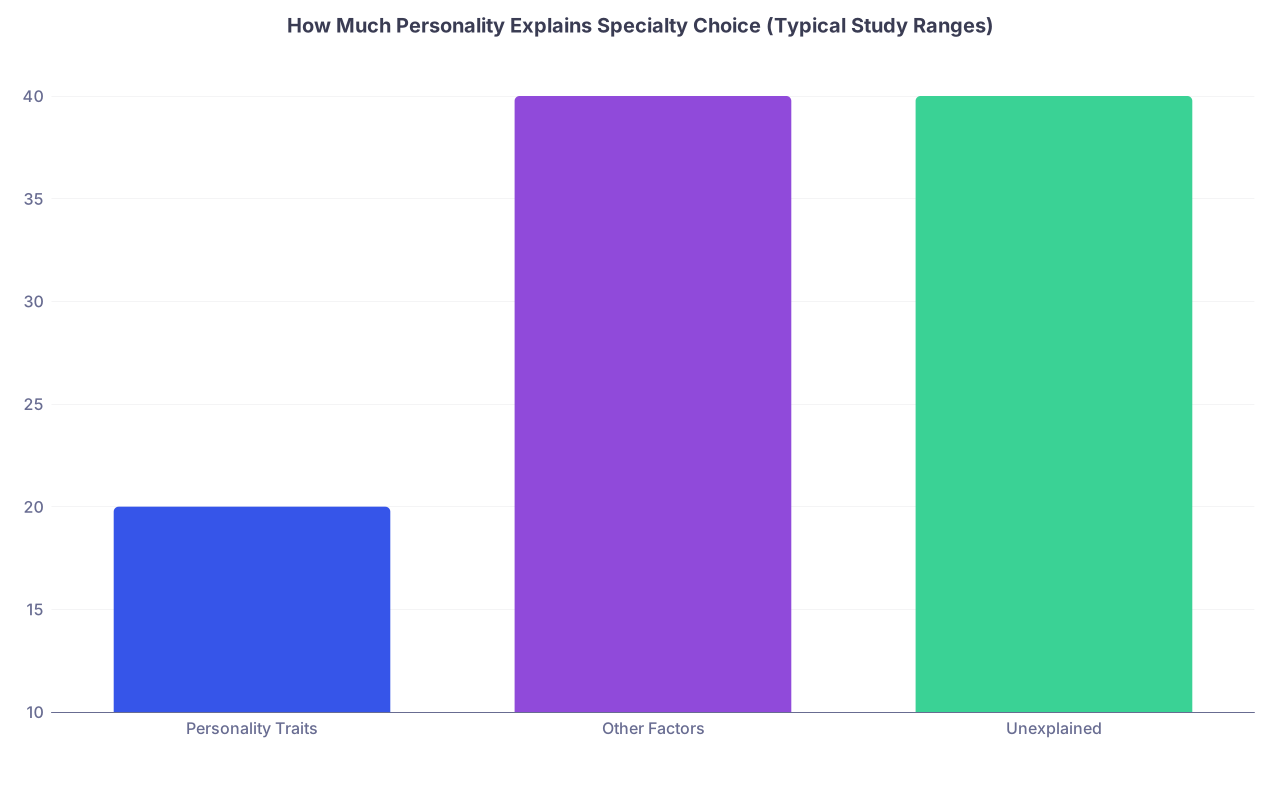
| Category | Value |
|---|---|
| Personality Traits | 20 |
| Other Factors | 40 |
| Unexplained | 40 |
Most large studies show something like:
- Personality traits explain about 15–25% of variability in specialty choice.
- Lifestyle, workload, training length, income expectations, geography, mentoring, and simple exposure explain as much or more.
- A huge chunk remains unexplained by any measured factor.
Translation: personality is a weak signal, not a destiny.
When you see those clickbait “This specialty is for extroverts” articles, they’re usually cherry-picking tiny effect sizes and pretending they’re fate.
What the Research Actually Shows (When You Read Past the Abstract)
Let’s walk through the main findings from real data instead of hallway mythology.
1. Yes, there are average personality differences. No, they’re not huge.
Meta-analyses looking at Big Five traits across specialties consistently find the same thing:
- Surgeons: slightly higher extraversion, slightly lower agreeableness, slightly higher conscientiousness.
- Psychiatrists: a bit higher openness, sometimes slightly higher agreeableness.
- Radiologists: marginally higher introversion.
- Primary care: a bit higher agreeableness and empathy scores.
Sounds dramatic? It’s not. These are small effect sizes. Cohen’s d in the 0.2–0.3 range in many cases. That’s “you’d notice with a big sample and stats software” territory, not “you can spot it in the cafeteria” territory.
In plain language:
There are trends in large groups. But individuals are all over the map.
I’ve seen:
- Wildly extroverted radiologists who love teaching and case conferences.
- Quiet, meticulous orthopedic surgeons who completely break the “bro in lead” stereotype.
- Blunt, not-especially-warm pediatricians who still deliver excellent care.
You can’t back‑solve an individual’s “right” specialty from these tiny average differences.
2. Personality tests are terrible crystal balls for real careers
A lot of students cling to MBTI or Enneagram for reassurance. Let me be direct: those tools are basically astrology for educated people.
They’re:
- Poorly predictive of job satisfaction.
- Unstable over time (people get different types on different days).
- Not validated as career decision tools.
The Big Five is more scientifically sound, but even then:
- Being high in extraversion doesn’t mean you’ll hate path.
- Being high in introversion doesn’t mean you’ll hate EM.
- Being low in agreeableness doesn’t automatically put you in surgery.
And the really damning part? Longitudinal studies show that personality itself shifts during medical training. You don’t just bring a fixed personality to a field; the field and training environment reshape how you show up.
So that personality snapshot you took as an MS1? It may not even apply to you as a PGY3.
The Factors That Actually Move the Needle (And They’re Not on a Personality Quiz)
When researchers build multivariate models of specialty choice—controlling for personality, demographics, and everything else—personality usually gets outmuscled by much more boring variables:
- Debt level
- Perceived lifestyle and hours
- Length of training
- Income potential
- Role models and mentors
- Clinical experiences and timing
- Geographic/family constraints
| Factor | Typical Impact Level |
|---|---|
| Lifestyle/work hours | High |
| Mentors/role models | High |
| Income expectations | Moderate–High |
| Length of training | Moderate |
| Personality traits | Low–Moderate |
And there’s another big one people do not like to admit out loud: competitiveness and exam performance.
I’ve seen this play out repeatedly:
- MS2 certain they’re going into derm → Step scores come back → “Actually I really love anesthesia.”
- Someone “born to be a surgeon” → doesn’t match general surgery → winds up in EM and ends up loving it.
Was their “surgical personality” fake? No. It just wasn’t the main determinant of what they eventually did.
The hidden driver: exposure and timing
There’s good evidence that when you experience a field changes your odds of picking it. Early, positive exposure massively increases the chance you’ll choose that specialty. Negative or absent exposure kills it.
You don’t choose what you can’t see.
You don’t stick with what repeatedly burns you.
I’ve watched med schools that shove primary care early and glamor specialties late and then act surprised when fewer grads choose surgery, or vice versa. It’s not personality. It’s programming.
The Real Danger: Self‑Fulfilling Prophecies and Stereotypes
Here’s where the personality–specialty myth goes from “mildly wrong” to actively harmful.
1. Students start opt‑out thinking way too early
“I’m not decisive enough for EM.”
“I’m too sensitive for oncology.”
“I’m not detail‑oriented enough for anesthesia.”
So they stop exploring. Stop seeking mentors in those fields. Stop asking questions.
All based on an internal story that, frankly, wouldn’t survive a basic data check.
I’ve worked with anxious EM docs, reserved surgeons, and deeply emotional oncologists who’ve built great careers by leaning into their supposed misfit traits. The job flexed around them more than they “fixed” themselves.
2. Faculty pigeonhole students quickly
You know the line: “You’re such a medicine person,” or “You’re obviously a surgeon.” That’s not feedback. That’s a projection.
Once a student hears that 3–4 times, their mental algorithm updates: “These are my lanes. Those are not.” I’ve literally seen people not rank a specialty they liked because “everyone says I’m more of a ___ person.”
This is the sunk cost fallacy dressed up in white coat language.
3. Personality myths mask toxic culture
“Only a certain type survives in our field” is often code for “We don’t want to change our culture.”
It lets specialties avoid the harder questions:
- Why can’t a parent with real family responsibilities thrive here?
- Why do we still valorize 80-hour martyrdom weeks?
- Why do people have to armor up emotionally to function on this service?
Some of what gets labeled as “surgical personality” is just coping mechanisms for a chaotic, punishing environment. That’s not biology. That’s architecture.

What Actually Matters More Than Your Native Personality
Let’s talk about the traits that actually predict thriving in a specialty—and spoiler: a lot of them are skills, not fixed traits.
1. Tolerance for uncertainty (and how you build it)
People obsess about “I need closure, so I can’t do X.” Reality: every field has deep uncertainty, just in different flavors.
- EM: uncertainty about diagnosis, but you get disposition decisions quickly.
- Rheumatology: diagnostic puzzles that unfold over weeks to months.
- Psychiatry: uncertainty about etiology, prognosis, and adherence.
- Surgery: uncertainty about complications and long-term outcomes.
Your baseline tolerance for uncertainty is real, but it’s trainable. Good supervision, repeated exposures, and seeing cases resolve all stretch that muscle. You can dislike uncertainty in M2 and handle it fine as an attending.
2. How you handle fatigue and stress (not whether you “like” them)
Every specialty will stretch your sleep, patience, and bandwidth during training. Yes, even derm and radiology. Call exists. Crises exist.
What actually matters:
- Your recovery habits (sleep, exercise, actual downtime, not “scrolling until 2 a.m.”)
- Your ability to ask for help before you implode
- Your boundaries around work creep once you have any control
Personality tests don’t predict that. Behavior does.
3. Values and trade-offs, not traits
You should be asking:
- Do I care more about procedure volume or longitudinal relationships?
- Am I okay with more years of training for more autonomy or pay?
- Do I want mostly outpatient, mostly inpatient, or a mix?
- How much does schedule predictability matter to me in practice, not just in fantasy?
These are value judgments, not personality categories.
And they’re often clearer to you after you’ve done real rotations, not before.
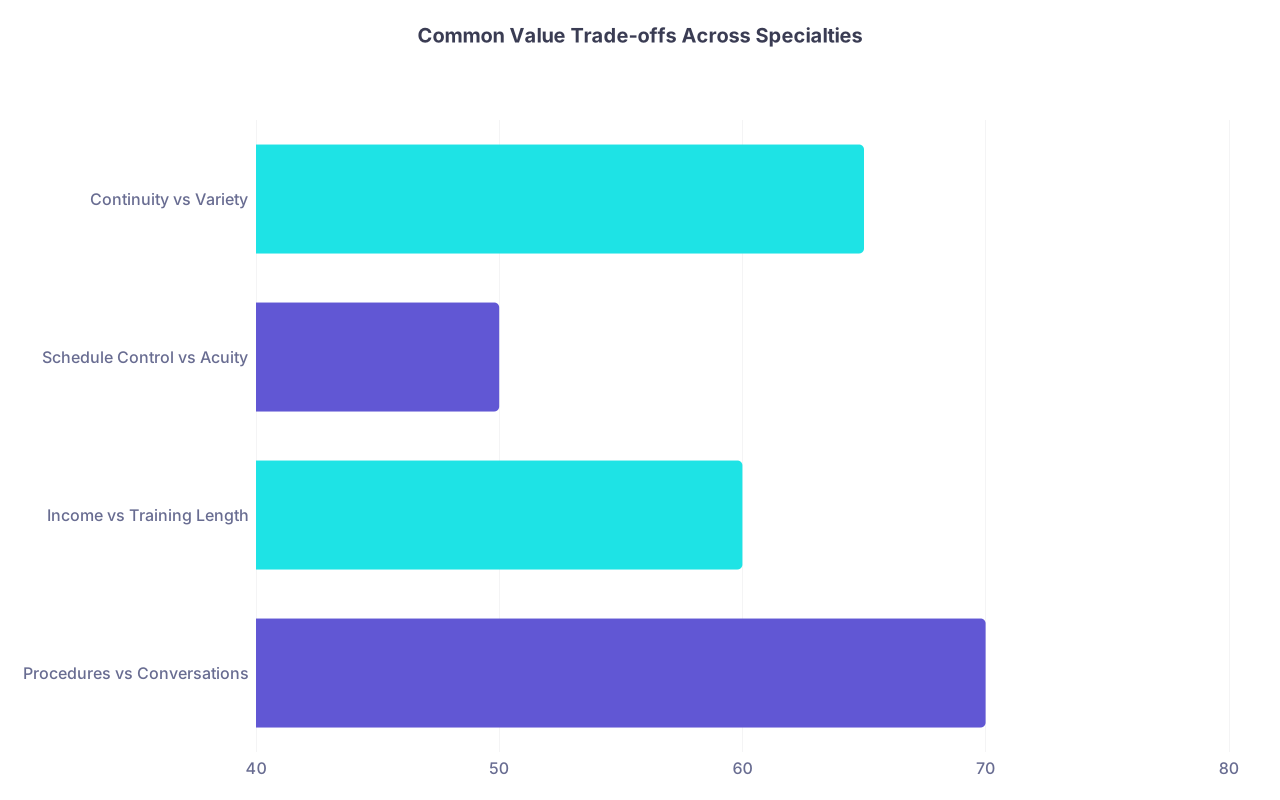
| Category | Value |
|---|---|
| Procedures vs Conversations | 70 |
| Income vs Training Length | 60 |
| Schedule Control vs Acuity | 50 |
| Continuity vs Variety | 65 |
(Think of each as a slider you personally set, rather than a box you have to fit into.)
How to Use “Personality” Without Letting It Cage You
I’m not saying ignore personality entirely. I’m saying use it like weather data, not a religious text.
Step 1: Notice patterns, but keep them provisional
Maybe you genuinely feel drained after a day of nonstop social interaction. That suggests you might prefer less patient volume or more focused encounters.
Fine. That’s a hypothesis. Now test it on rotations.
- Do you feel better after a day in clinic or a day in the OR?
- Do you enjoy call nights where it’s just you and the cross-cover pager, or do you miss the team chaos of the ED?
Track how you feel at the end of different days. Not how you’re “supposed” to feel for that specialty. What you actually feel.
Step 2: Ask better questions of residents and attendings
Stop asking, “What kind of personality do you need for this field?” That question bakes in the myth.
Ask:
- “What kinds of people fail or burn out here—and why?”
- “What do people think you need to be like to do this specialty, and how is that wrong?”
- “If someone is more [introverted/anxious/etc.], what adjustments have you seen work?”
You’ll hear way more nuance than the cartoon stereotypes ever acknowledge.

| Step | Description |
|---|---|
| Step 1 | Initial Interest |
| Step 2 | Check Values & Lifestyle Fit |
| Step 3 | Test on Rotations |
| Step 4 | Seek Mentors |
| Step 5 | Reassess Options |
| Step 6 | Consider Competitiveness & Logistics |
| Step 7 | Build Rank List |
| Step 8 | Enjoy Day-to-Day? |
Step 3: Separate training culture from the actual job
Some specialties are miserable during residency and pretty reasonable as an attending. Others flip that pattern. Some are bad both times—but those are surprisingly rare.
Don’t let a single malignant rotation convince you “I don’t have the personality for this.” You might just not have the stomach for unnecessary cruelty. Good. That’s not a flaw.
Find out how people feel:
- 5 years out of residency
- With kids or caregiving responsibilities
- In non-academic vs academic environments
You’re not signing up for residency as your permanent way of life.

The Bottom Line: You’re Not a Personality Type, You’re a Person
Let me strip this down.
- Personality explains a small slice of specialty choice. Not nothing, but nowhere near destiny.
- Culture, exposure, mentors, lifestyle, and exam scores routinely override “personality fit” in real careers.
- Using personality labels as hard boundaries is a fast way to cut yourself off from specialties you might actually enjoy.
So stop asking, “What specialty fits my personality type?”
Start asking, “In what kind of work—and with what trade-offs—do I see myself willing to grow?”


