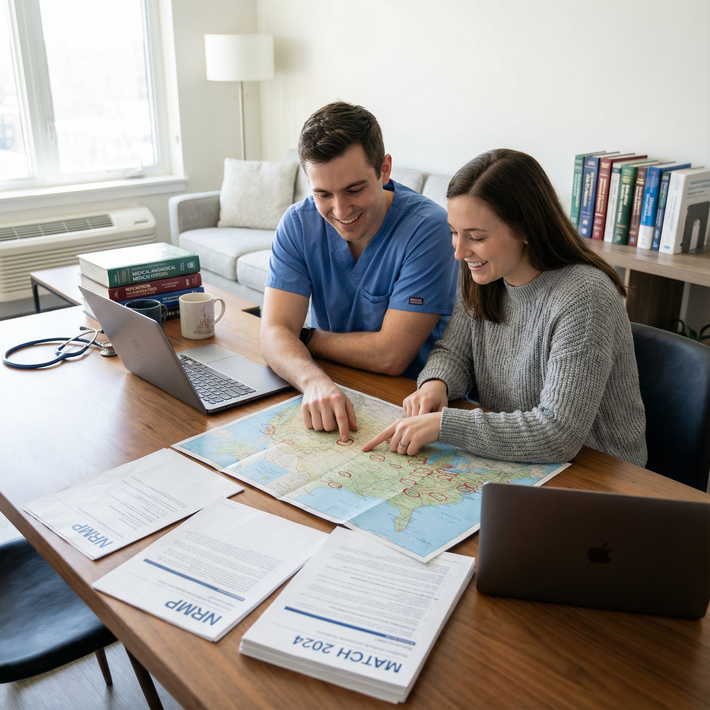
You're sitting at the kitchen table with two laptops open, ERAS half-filled, and your partner just said the sentence that changes the whole match strategy: "I need accommodations. Real ones. Not the kind you can hide."
Maybe it's a chronic illness that flares under night-float. Maybe it's a mobility issue, a mental health condition that requires specific schedule structures, a pregnancy complication, or something that makes 28-hour calls physically impossible. Whatever it is, the Couples Match just got more complicated than "rank the same cities."
I've walked couples through this exact mess. The ones who treat it like a last-minute paperwork problem usually scramble, disclose to the wrong person, or build a rank list that looks good on paper and fails in real life. The ones who treat it like a joint operational plan, early, specific, and slightly ruthless about geography, usually land somewhere both of them can actually work.
Here's what to do when you're in it.
The Reality Check: This Is Not Optional Transparency
First truth: programs are legally required to provide reasonable accommodations under the ADA (and related state rules). Hiding a genuine need because you're scared of "looking weak" is a terrible strategy. I've seen residents match into programs that couldn't support them, then crash out of a rotation, go on leave, or get non-renewed. That's worse than a tough conversation in September.
Second truth: your partner's condition is not just their application problem. In a Couples Match, it reshapes your list too. If they need programs with strong employee health offices, predictable call schedules, or proximity to a specialty clinic, your "dream reach" in a city with zero support infrastructure just became a liability for both of you.
You're not being dramatic. You're being realistic. Couples who pretend otherwise end up ranked into places that look perfect on Match Day and miserable by October.
Sit down, together, and write the non-negotiables in plain language. Not "I might need some flexibility." Write: "I cannot do traditional q3 overnight call without a documented accommodation for X." Or "I need elevator-accessible housing within Y miles of the hospital." Or "I require protected time for infusion therapy every other Thursday." Specific beats vague every time.
The Timeline: Start Six Months Before ERAS, Not Six Weeks
If you're reading this in July of application year, you're already behind. Ideal start is at least six months before ERAS opens for submission. Why? Because accommodation documentation is slow, institutional, and occasionally bureaucratic in ways that will make you want to scream.
Here's the sequence that actually works:
- Get the clinical documentation locked. A current letter from the treating physician that states functional limitations and recommended accommodations, not a diagnosis dump. Programs don't need your entire chart. They need what you can and cannot do in a residency environment.
- Contact your medical school's disability/student affairs office. They've seen this before. They can help you frame the request and often have template language that doesn't overshare.
- Identify the right contact at target programs early. More on that below. Do not wait until after you submit the application to figure out who handles accommodations.
- Build your program list with the constraint baked in. Don't make a "dream list" and then prune. Start from "places that can actually support this" and expand outward.
I've watched couples try to reverse-engineer this in October. They end up emailing coordinators in a panic, sounding disorganized, and sometimes disclosing to the wrong inbox. Don't be them.

The Disclosure Decision: Coordinator, Not Director
This is where people mess up.
You disclose health-related accommodation needs directly to the program coordinator (or the designated disability/accommodations officer if the program lists one), not the program director.
Why? Because the PD is evaluating you as a future resident. Mixing your accommodation request into the same channel as your application materials creates noise, potential bias (even unconscious), and a paper trail that doesn't belong in the selection file. The coordinator is the operational person. They route the request to the right institutional office, GME, HR, employee health, without turning it into a "fitness for duty" audition in front of the people ranking you.
How to do it cleanly:
- After you've submitted ERAS (or once interviews are offered, depending on timing and school advice), send a concise, professional email to the coordinator.
- Subject line something like: "Accommodation Inquiry, [Your Name], ERAS AAMC ID."
- Body: brief statement that you have a documented need for reasonable accommodations related to [category, not full diagnosis if you prefer], you are prepared to provide documentation through the appropriate channel, and you are inquiring about their process.
- Attach nothing sensitive in the first email unless they ask. Offer to follow their formal process.
Do not put accommodation details in your personal statement. Do not volunteer them unprompted in interviews unless the conversation naturally turns to schedule structure and you choose to. Do not have your partner "casually mention it" at a dinner. Keep the lane clean.
Your partner does not see the accommodation request. It is a confidential institutional process. They only see standard ERAS materials. Protect that boundary. Couples sometimes assume everything is shared. It isn't, and it shouldn't be.
The Ranking Game: Build a Joint List That Survives Reality
The Couples Match algorithm does not penalize you for needing accommodations. It tries to maximize the number of couples who match. What it will do is match you to the highest pair on your list that both get offered. If your list is full of programs that can't support one of you, you either match into a bad fit or you don't match as a couple.
So build the list like this:
Step 1: Separate "can support" from "prestige." For every program, ask: Does this place have a track record (or at least a functional process) for resident accommodations? Are schedules rigid or flexible? Is there a real GME wellness/disability pathway? Geography that works for ongoing care?
Step 2: Create paired ranks that reflect both constraints. If Partner A needs a large academic center with strong employee health and Partner B is more flexible, you don't rank Partner B's dream community program in a city with no specialists. You rank pairs where both can function.
Step 3: Be willing to go deeper on the list than your ego wants. I've seen couples match at their 8th or 11th pair and thrive because the place could actually accommodate. I've also seen couples hold out for only top-3 "name" programs and go unmatched as a couple. Name recognition does not write your accommodation plan.
Step 4: Use the algorithm's strength. Rank more pairs than you think you need, in true preference order, with the health constraint already baked into what "preference" means. A lower-ranked pair that works beats an unmatched "perfect" list.
Here's a simple decision flow you can run together:
One more hard call: if the condition severely limits specialty options or geography for one partner, you may need to confront whether Couples Match is still the right vehicle, or whether one of you should reassess specialty or timeline. That conversation sucks. Having it in March after a failed match sucks more.
The Contingency Plan: When Match Day Goes Sideways
Worst case happens. You don't match as a couple, and health needs were part of the constraint set. You're not broken. You're in a known failure mode with two main paths:
Path 1: Enter the Main Residency Match (or SOAP) as individuals. This is harder if you were counting on Couples Match to force a shared city. Be ready to live apart for a year if that's what it takes, or to scramble for prelim/TY spots in the same region. Decide before Match Week what distance and time apart you can tolerate.
Path 2: Take a deliberate gap year with a plan. Research year, additional clinical experience, stronger documentation and a tighter program list next cycle, or addressing the health situation more aggressively if treatment options exist. A gap year without a plan is just delay. A gap year with updated letters, clearer accommodation language, and a realistic geography strategy is a reset.
Also prepare the emotional piece. One partner often feels guilty ("my health cost us the match"). The other often feels trapped or resentful. Name it early. Couples who pretend it's "fine" while quietly blaming each other make worse rank lists the next year.
Talk to your student affairs dean and a trusted advisor who has seen couples scramble. Do not rely only on Reddit horror stories at 2 a.m.
What Good Looks Like When This Works
I've seen this go right. Partner with a documented autoimmune condition that required infusion scheduling and modified overnight call. They started documentation in winter of third year, disclosed only through coordinators after applications were in, built a couples list of 14 viable pairs (not 4 dream pairs), and matched at their sixth pair, in a city with the right specialty clinic and a GME office that already had a process. Both finished residency. No heroics. Just early, boring, correct process.
That's the goal. Not a perfect story. A workable life.
Key takeaways if you're in this right now:
- Start the accommodation process at least 6 months before ERAS submission. Documentation and institutional routing are slow.
- Disclose health needs directly to the program coordinator (or designated accommodations contact), not the program director. Protect the integrity of your application file.
- Use the Couples Match algorithm to your advantage by creating a deep, realistic paired rank list that already accounts for both partners' functional needs, not a prestige list you hope will magically work.
- Specific, documented limitations beat vague "flexibility" language every time.
- Build a written contingency (individual match vs. planned gap) before Match Week so panic doesn't make the decision for you.
You're not asking programs for a favor. You're asking whether they can do the job of training you safely. Programs that can will show you. Programs that can't will reveal themselves too, sometimes by silence, sometimes by chaos. Either way, you get information.
Looking ahead: the couples who come out of this intact are the ones who treated health needs as a design constraint, not a secret. They matched into places that could hold them. They started residency already knowing the employee health number and the call-schedule adjustment process. That's not weakness. That's how you stay in the profession without burning out your body or your relationship in year one.
Do the unglamorous work now. Rank like your real life depends on it, because it does. Then walk into the next phase with a plan that both of you can actually live inside.