

The worst time to decide on a Couples Match is while you’re entering programs into ERAS.
By then, you’re already behind.
If you’re a rising MS3 and you might want to Couples Match, you need a calendar, not vibes. So here’s your timeline: month-by-month through third year, with hard checkpoints where you either move the ball forward—or admit you are not actually serious about Couples Matching.
Big Picture Timeline: Third Year to ERAS Opening
Let’s anchor the whole year first.
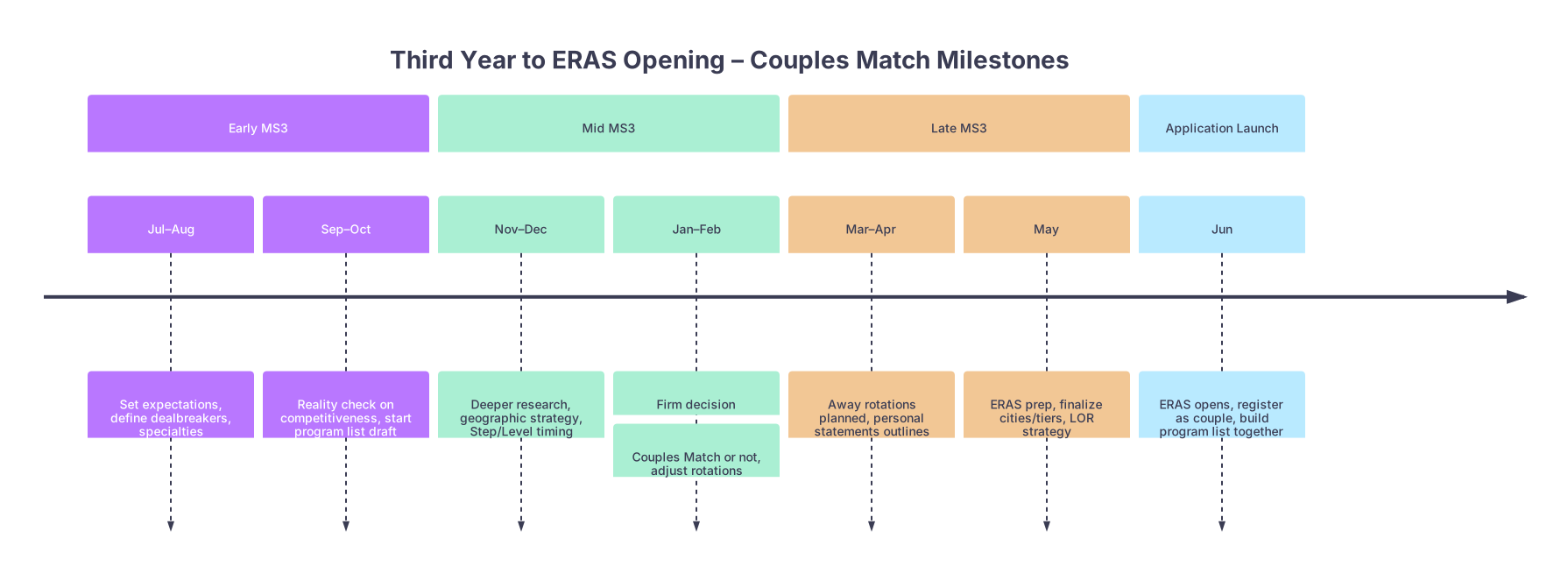
| Period | Event |
|---|---|
| Early MS3 - Jul–Aug | Set expectations, define dealbreakers, specialties |
| Early MS3 - Sep–Oct | Reality check on competitiveness, start program list draft |
| Mid MS3 - Nov–Dec | Deeper research, geographic strategy, Step/Level timing |
| Mid MS3 - Jan–Feb | Firm decision |
| Late MS3 - Mar–Apr | Away rotations planned, personal statements outlines |
| Late MS3 - May | ERAS prep, finalize cities/tiers, LOR strategy |
| Application Launch - Jun | ERAS opens, register as couple, build program list together |
At each of these points, you should be doing something very specific. Let’s walk it chronologically.
July–August of MS3: Stop Pretending It’ll “Work Itself Out”
At this point you should be:
- Having the uncomfortable conversation about the future.
- Getting honest about specialties and competitiveness.
- Sketching out what “together” actually means for both of you.
Week 1–2 of MS3: Define Whether You’re Actually a Couples Match
If you’re starting third year and you’re in a serious relationship with another med student (or DO, or MD/PhD, or even a different health profession planning to apply to overlapping residencies), your first milestone is clarity.
By the end of July, you and your partner should have, in writing:
Relationship reality:
- Are you both committed to being in the same metro area for residency?
- Are you willing to do long-distance if the Match goes badly?
- Is marriage/engagement relevant to how hard you push the Couples Match?
Specialty intentions:
- What is each of you currently planning? (e.g., IM vs Derm, EM vs OB/GYN)
- Are you early in deciding (family med vs peds vs psych), or locked in?
Risk tolerance:
- Would you rather:
- A) Be guaranteed in the same city in less competitive programs, or
- B) Maximize program “quality” even if it risks different cities?
- Would you rather:
If you can’t answer those questions, you’re not ready to Couples Match. You’re just talking about it.
By Late August: Basic Competitiveness Snapshot
You need a blunt early look at reality. I’ve watched couples implode because they waited until December to realize one partner was aiming for ENT with a 220 and no research. Too late.
By August 31, you should:
Compare stats to specialty norms:
- Step 1 (if scored) / Level 1
- Shelf performance so far (or preclinical grades if early)
- Research output if relevant (especially Derm, Rad Onc, Ortho, ENT)
Roughly categorize each of you:
- Highly competitive (top quartile scores + strong CV)
- Solid / average
- Below-average / red flags (failures, big gaps, poor scores)
You’re not locking anything in yet. You’re just getting honest so you can plan.
September–October: Decide If a Couples Match Is Plausible, Not Romantic
By this point you should move from fuzzy “we’ll see” to a preliminary yes/no leaning on Couples Match.
September: Geographic and Specialty Reality Check
By mid-September, sit down one evening and do this on paper (not just talking on the couch):
List your top 10 cities/regions
- Examples: “Boston,” “NYC Metro,” “Midwest large academic center,” “SoCal,” “Texas generally.”
- Mark each city:
- “Must-have,” “Nice-to-have,” or “Only if we have to.”
Overlay specialties on those areas
- Pull up program lists for each specialty from FREIDA/VSLO/EMRA Match/etc.
- Count roughly: how many programs per city for each of your specialties?
Flag problem pairings
Some combos are naturally harder:- Neurosurgery + anything
- ENT + anything
- Derm + anything
- Rad Onc + anything
Multiple big programs in the same city? Good. One tiny program in the whole state? That’s a red flag.
By the end of September, you should know:
- Are there at least 3–4 metro areas that have multiple programs in both of your fields?
- Does your geographic preference align with that, or are you in fantasy land?
October: Preliminary Decision Point #1
By October 31, you should be able to answer, with a straight face:
“If our grades and scores stay on the same trajectory, we are likely / unlikely to Couples Match without seriously hurting one or both of our careers.”
If the answer is “unlikely,” you don’t immediately bail. But you do:
- Start discussing alternatives:
- One couples, one applies solo but coordinates regionally.
- One does a preliminary/transitional year nearby.
- You apply normally now and revisit Couples Match for fellowship.
If the answer is “likely,” proceed. You’re now a provisional Couples Match.
November–December: Turn Talk into Strategy
At this point you should be converting vague intention into actual planning—rotations, aways, timing of exams.
November: Map Out Rotations With the Couples Match in Mind
By mid-November, meet with your advisors. Separately. Then together.
Your goals:
Confirm competitiveness:
- Show your scores, grades, research.
- Ask: “With these numbers, in my specialty, how limited is a Couples Match?”
Adjust fourth-year schedules:
- Away rotation timing (ESPECIALLY for competitive specialties).
- Ensure you both can be in the same city for aways where possible.
- Make sure neither of you overloads with aways while the other has zero flexibility.
Concrete output for end of November:
- Draft of your 4th-year schedule for each of you.
- List of 3–5 likely cities for away rotations that support both specialties.
December: Commit to a Working Couples Match Plan (Not Yet Final)
By December 31, you should:
- Decide if your aways will be:
- Same institution, same city, or just same region.
- Identify:
- 1–2 “reach” cities (e.g., Boston, NYC, Bay Area)
- 2–3 “reasonable” metros with several programs for both of you
- 1–2 “safety” regions (often midwest/south, more community programs)
This is also the time to plan Step 2/Level 2 timing strategically:
- If one partner has shaky Step 1/Level 1:
- Plan for an early Step 2 (June/July) so scores can rescue the application.
- If both are strong:
- You can be slightly more flexible, but don’t punt it to October.
January–February: The Real Decision Deadline (Not June)
Everyone thinks you can “decide later.” That’s how couples end up in late-May chaos.
By February, you should make a real yes/no decision about Couples Matching.
January: Brutally Honest Mid-Year Review
By end of January, sit down with:
- Your updated clinical evals
- Shelf scores to date
- Any new research / leadership updates
- Your most recent conversations with faculty/mentors
Each of you answers:
- Am I on track for my intended specialty, yes or no?
- If no, would switching to a less competitive specialty save our Couples Match options?
- Am I willing to change specialties for the sake of geography / being together?
Here’s where it gets uncomfortable. If you would not change specialties under almost any circumstance, you must acknowledge that your Couples Match is conditional, not absolute.
February: Hard Yes or Hard No
By February 28, you should:
EITHER:
- Commit to Couples Match as your primary plan:
- You will register as a couple in NRMP.
- You will build a unified program list strategy.
- You accept you may need more applications, more “safety” programs, and more flexible geography.
OR:
- Decide not to formally Couples Match:
- You still coordinate regions and cities.
- You share program lists and try to align.
- But you do not tie your NRMP ranks together.
If you’re telling yourself “we’ll see how things look in May,” you are procrastinating, not optimizing.
March–April: Lock Geography, Start Program Tiers
Now you’re past the hypothetical stage. At this point you should be building the actual structure of your future ERAS list.
March: Build Your Three-Tier City Strategy
By mid-March, create a shared spreadsheet and build three columns:
| Tier | Description | Example Cities |
|---|---|---|
| Tier 1 | Dream metros | Boston, NYC, San Diego |
| Tier 2 | Realistic, desirable | Denver, Dallas, Atlanta |
| Tier 3 | Safety / broad options | Midwest/South regions |
For each city/region, list:
- Number of programs in Partner A’s specialty
- Number of programs in Partner B’s specialty
- Mix of academic vs community programs
By end of March, you should have:
- At least:
- 2–3 Tier 1 areas
- 3–4 Tier 2 areas
- 2–3 Tier 3 areas
If you cannot find any Tier 3 regions where both specialties exist in reasonable numbers, that’s a sign you’ll need to:
- Apply even more broadly
- Consider nearby-but-not-same-city options
- Or revisit whether full Couples Match is viable
April: Plan Away Rotations & LOR Strategy Around Couples Match
By April 30, you should:
Finalize away rotation applications:
- Prioritize cities where you both can benefit.
- Avoid one partner doing an away in a city where the other has zero programs.
Lock your LOR plan:
- Each of you should identify:
- 1–2 strong home letters in your specialty.
- 1 letter from an away if in a competitive field.
- 1–2 additional letters (subspecialty, research, or strong generalist).
- Each of you should identify:
The question you should be able to answer by the end of April:
“If ERAS opened tomorrow, could we already name:
- our top 3 metros,
- our ‘mid-tier’ regions,
- and our safety regions as a couple?”
If not, you’re behind.
May: ERAS Prep and Final Couples Match Confirmation
ERAS doesn’t open in your mind when it opens online. It opens in May.
At this point you should be:
- Translating your city strategy into a rough program list.
- Outlining your personal statements with the couples story in mind (even if you don’t make it the focus).
Early May: Draft the Shared Program Universe
By May 15, take that city-tier spreadsheet and:
- Pull FREIDA/VSLO/EMRA Match/AAFP / specialty-specific directories.
- For each city/region, list every residency program for each specialty.
- Mark:
- Green = strong fit
- Yellow = acceptable but not ideal
- Red = apply only if absolutely necessary (for safety)
You’re not assigning ERAS applications yet. You’re building the universe.
Late May: Process, Not Panic
By May 31, you should:
Reconfirm: Are we 100% Couples Matching?
- If one partner is wavering, you talk now, not while dragging programs into NRMP rank lists.
Align personal narratives:
- You do NOT need cheesy matching essays.
- But you should be consistent about:
- Long-term goals (academics vs community vs rural).
- Geographic preferences.
- General priorities (training quality vs location vs family needs).
If you’re the couple that only mentions each other in a panicked ERAS addendum email in October, programs will see right through that.
June: ERAS Opens – This Is Execution, Not Ideation
If you’ve done the earlier work, June is straightforward. If you haven’t, it’s chaos.
At this point you should:
- Register appropriately in NRMP when the time comes (couple designation).
- Start building your actual program lists in ERAS based on the universe you prepared.
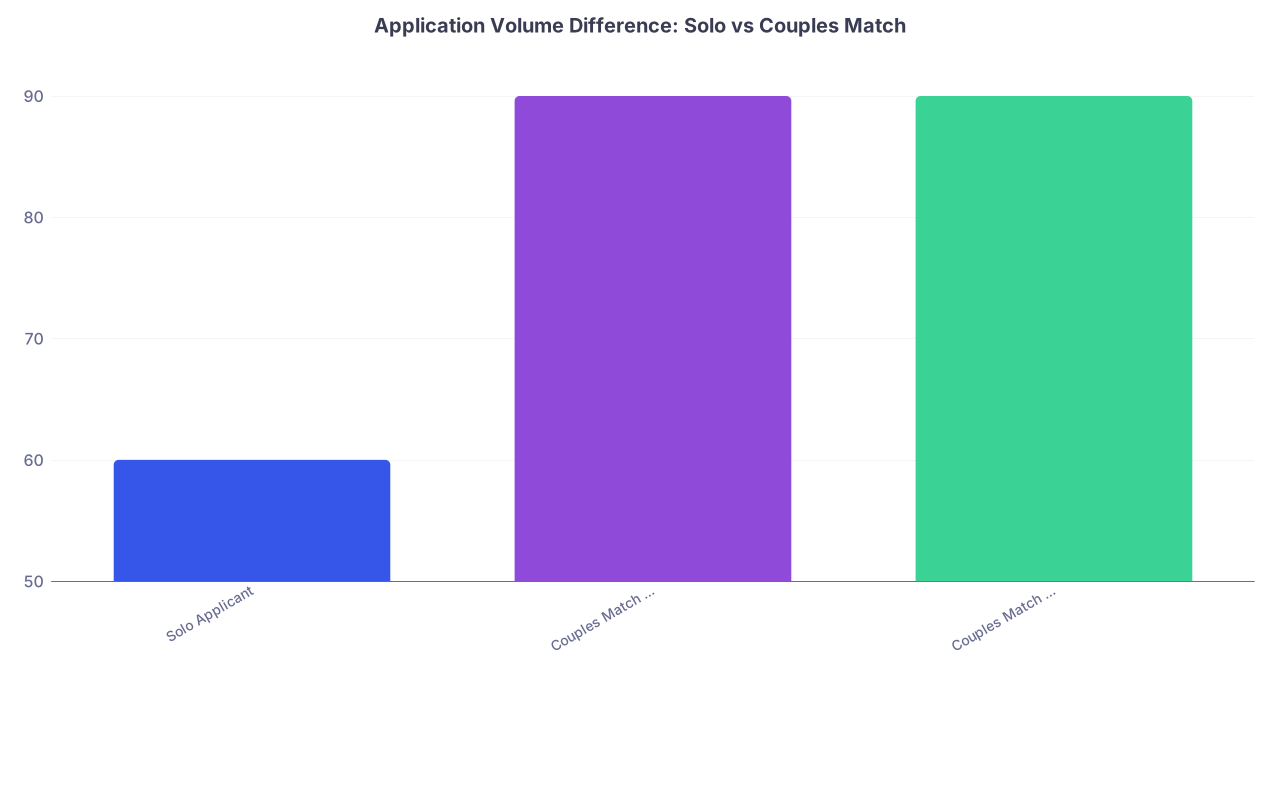
| Category | Value |
|---|---|
| Solo Applicant | 60 |
| Couples Match Partner A | 90 |
| Couples Match Partner B | 90 |
Typical pattern I see:
- Solo IM applicant: ~50–60 programs
- Each partner in a Couples Match: 70–100+ programs
(because you’re not just applying to “your” dream places; you’re applying to “our” realistic overlap.)
Early June: Administrative Setup
Within the first 1–2 weeks of ERAS opening, you should:
- Create / update ERAS accounts and CVs.
- Start your personal statements with the timelines and choices you’ve already mapped.
- Decide:
- Are you explicitly mentioning your partner in your PS?
- For some couples it’s helpful (especially with family/location reasons).
- For some, it’s unnecessary and can feel forced.
- Are you explicitly mentioning your partner in your PS?
Late June: Program Filters and Reality Pass
By end of June, your ERAS filters should be:
- Reflecting your three-tier city strategy.
- Weighted like this (roughly, for most couples):
| Tier | Approximate Percentage of Apps |
|---|---|
| Tier 1 (Dream) | 20–30% |
| Tier 2 (Realistic) | 40–50% |
| Tier 3 (Safety/Broad) | 25–35% |
You should also:
- Verify that for any city you’re heavily stacking, there is a plausible pairing of programs:
- Example: Partner A IM at Community A + Partner B FM at University B in same metro.
- Not just “we’ll somehow both get into the one elite university program here.”
Red Flags and Course-Corrections Along the Way
Throughout this entire MS3 timeline, there are signs you should seriously reconsider formal Couples Matching:
- One partner fails Step 1/2 or Level 1/2.
- One partner decides to pivot to a hyper-competitive specialty mid-year.
- Your geographic preferences never converge despite multiple conversations.
- You consistently avoid concrete planning and stay in vague, fantasy-level discussion.
If any of those show up, you don’t automatically abandon ship—but you do revisit your February decision and talk honestly about whether tying your applications together will hurt more than it helps.
What You Should Do Today
Do not wait for ERAS to “feel close.”
Today, before you forget this, sit down with your partner and create a one-page document that answers three things:
- Are we aiming to formally Couples Match? Yes / No / Unsure
- What are our top 5 cities or regions right now?
- What’s our risk tolerance: together-at-all-costs, balanced, or career-first?
If you cannot fill that out in 30 minutes, you’re not ready for a Couples Match decision.
Open a blank page, title it “Couples Match Plan – MS3,” and write those three answers today. That’s your first real milestone.


