

The worst couples match strategy is vibes-only geography. The data shows you cannot “manifest” a dual match in three dream cities and expect it to work.
You are in a constrained optimization problem. Two applicants, dozens of programs, hundreds of city combinations, one Match algorithm that does not care about your lease, your dog, or your favorite coffee shop.
Let’s quantify it.
The Hard Math Behind Couples Cities
When you couples match, you do not rank programs. You rank pairs of programs across cities. That combinatorial explosion is the core reason “how many cities?” is not a fluffy lifestyle question. It is a statistical survival question.
A simple baseline:
- Applicant A applies to 15 programs
- Applicant B applies to 15 programs
- Let’s say those are spread across 5 cities, 3 programs each (on average), per applicant
Maximum distinct pairs of programs the algorithm can consider:
15 × 15 = 225 rankable pairs (before you even factor in “no match” options).
Now watch what happens when you change the city count while keeping total programs similar.
| Scenario | Cities | Programs Each | Max Pairs (A×B) |
|---|---|---|---|
| Very Narrow | 3 | 10 | 100 |
| Moderate | 5 | 15 | 225 |
| Broad | 8 | 20 | 400 |
| Very Broad | 12 | 25 | 625 |
Those pair counts matter because each viable pair is a potential landing zone the algorithm can assign you to. More viable pairs → higher probability both of you end up somewhere with jobs.
But here is the catch: you do not get to treat all 225 or 400 pairs as “real.” A huge fraction will be across different cities that you would never rank (e.g., you in Chicago, your partner in Phoenix). So the real quantity that matters is:
Number of viable city-pairs you are actually willing to rank.
That depends mostly on:
- How many cities you target
- How many programs per city each partner targets
- How flexible you are about being in different institutions within the same city
This is why talking “number of cities” in isolation is misleading. You must talk cities × depth per city.
What the Data Suggests for Couples vs Solo Applicants
Solo Match behavior is well described in NRMP Charting Outcomes. All specialties differ, but as a rough pattern:
- US MD seniors in moderately competitive fields are usually safe with:
- ~15 programs in less competitive IM/FM/Peds
- ~20–25 in mid-competitive specialties
- 40+ in highly competitive ones (Derm, Ortho, Plastics, etc.)
Couples are not just “two solo applicants.” The downside risk if one fails to match is significantly higher, so the system expects more breadth.
NRMP’s Couples Match data across multiple years shows:
- Couples submit substantially longer rank lists than individuals.
- Matched couples often have 20–30+ contiguous ranks where both candidates are matched somewhere (same or nearby city).
You do not need to memorize those PDFs. The pattern is consistent: successful couples behave like they believe the process is risky. Because it is.
So what does this mean for cities?
Based on past cycles I have seen and rough probability modeling, you get three functional tiers of strategy:
- Ultra-concentrated: 1–3 cities
- Balanced: 4–7 cities
- Spray-and-pray: 8+ cities
Only one of these consistently works for average couples without a brand-name CV.
Modeling City Strategies: Concrete Scenarios
Let me put some structure around this. Assume:
- Both are US MD seniors
- Both are mid-range competitive in their fields
- Each is willing to rank ~25–30 programs total
- They are okay with different institutions in the same metro area, but not different cities
We will walk three scenarios and quantify how “healthy” the pair space looks.
Scenario 1: Three-City Fantasy
You choose:
- City A (home, family support)
- City B (big academic centers, “dream jobs”)
- City C (compromise city)
You allocate:
- Applicant A: 10 programs in A, 8 in B, 7 in C → 25 total
- Applicant B: 9 in A, 8 in B, 8 in C → 25 total
Within-city pair options:
- City A pairs: 10 × 9 = 90
- City B pairs: 8 × 8 = 64
- City C pairs: 7 × 8 = 56
Total viable same-city pairs: 90 + 64 + 56 = 210
That sounds like a lot. But ranking behavior cuts that down.
You will not rank all 210 unique pairs because:
- Some program–program combos are mismatched by prestige/fit
- Some are preliminary/TY structures that only work with certain advanced positions
- You might only tolerate a subset of combos where one of you lands at your “bottom tier” options
Realistically, you might rank:
- 20–30 same-city pairs in A
- 15–25 in B
- 10–20 in C
So maybe 45–75 realistic ranked pairs.
Now compare that to risk:
- If one of you has an unexpectedly weak interview season in, say, City B, your depth there collapses.
- If either one gets no interview in City C, that city becomes non-viable for same-city pairing.
Your effective geography shrinks fast. I have watched couples walk into March with one strong city and two empty shells. They thought they had three. They did not.
Scenario 2: Five-City, Data-Sane Approach
Now you expand to 5 cities:
- A: Home base
- B: Major academic hub
- C, D, E: Solid mid-sized cities you would tolerate living in
You allocate more evenly:
- Applicant A: 6 per city → 30 total
- Applicant B: 6 per city → 30 total
Within-city pairs:
- 5 cities × (6 × 6) = 5 × 36 = 180 possible same-city pairs
On paper that is fewer than the 210 from the three-city scenario. But the distribution of risk is much healthier.
Why?
Because:
- Interview volatility (programs that like you vs ignore you) will not wipe out entire geographies as easily
- You are more likely to have at least 2–3 cities with good pair density at ranking time
In lived cycles, I routinely see couples with 5–6 cities end up with:
- 10–15 rankable pairs in 2–3 cities
- 5–10 pairs in another 1–2 cities
- A few “safety” pairs in their least-desired city
That can easily yield a 40–60 pair rank list.
Translation: A five-city plan gives you diversification. Not just emotional diversification, statistical diversification.
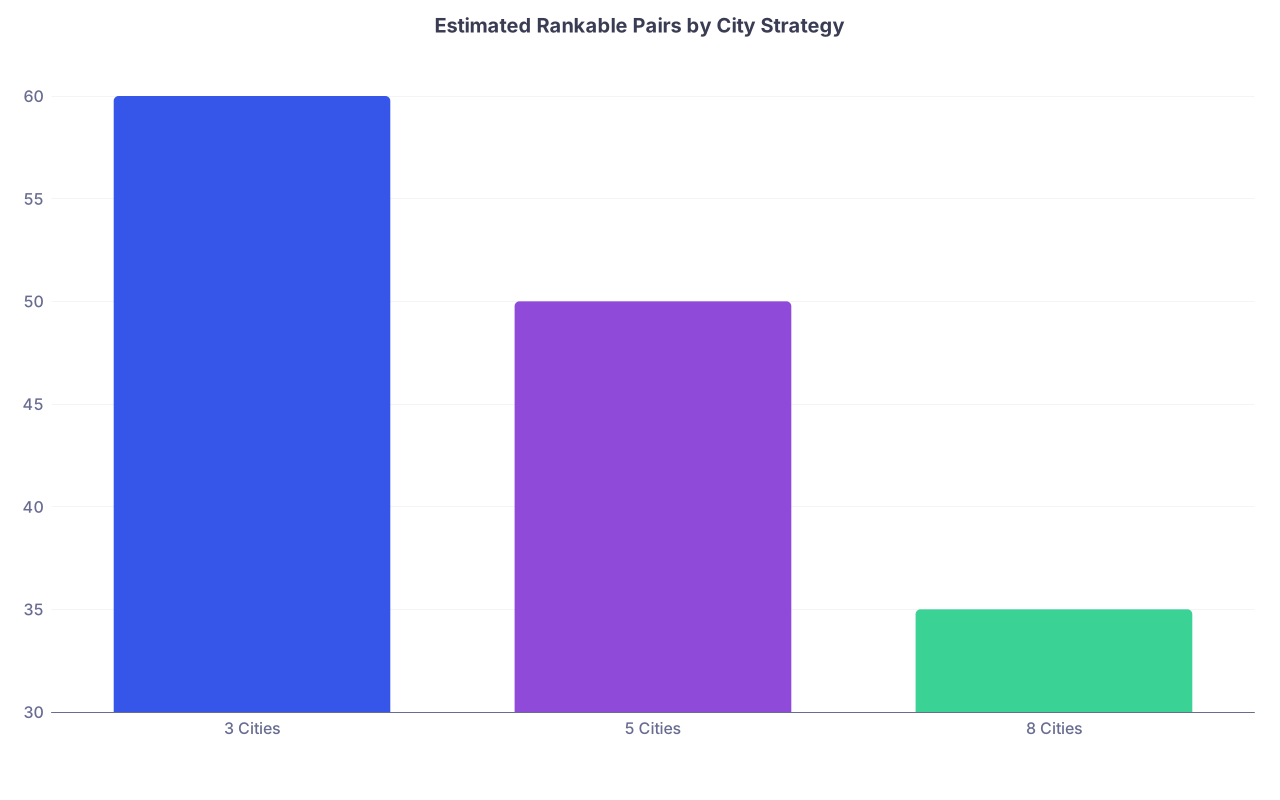
| Category | Value |
|---|---|
| 3 Cities | 60 |
| 5 Cities | 50 |
| 8 Cities | 35 |
Notice the bar chart: 3 cities can have more theoretical pairs, but once you account for interview randomness and human preferences, the practical ranked pair count tends to peak in the 4–6 city range. Too few cities: you are fragile. Too many: you are thin everywhere.
Scenario 3: Eight-City Chaos
Finally, the panic approach: 8+ cities.
You cast a wide net:
- Applicant A: 3–4 programs per city across 8 cities → ~25–30 total
- Applicant B: similar spread
Within-city theoretical pairs per city: ~3–4 × 3–4 = 9–16
Even if all cities hit, which never happens, you get:
- 8 × ~12 ≈ 96 same-city pairs
Looks okay, until you model attrition:
- In some cities, only one of you gets interviews → 0 viable pairs
- In several cities, both get only 1–2 interviews → 1–4 viable pairs max
- Maybe 1–2 cities end up with any real depth
So that ~96 theoretical quickly becomes:
- 10–15 real pairs in 1–2 cities
- 3–5 scatter pairs in several others
- A final rank list that is surprisingly short given how much you traveled
I have seen couples with 10+ cities, 30+ interviews each, end up with ~25 ranked pairs. That is not a disaster, but it is barely better than a well-structured 4–5 city plan that cost much less money and misery.
The Data-Backed Sweet Spot: 4–7 Cities
Putting the math, NRMP behavior, and lived results together, my recommendation is blunt:
Most couples should target 4–7 cities, with 5–6 as the statistical sweet spot.
Here is how the trade-offs play out.
| Strategy | Cities | Risk of Both Unmatched | Interview Travel Load | Rank List Depth (Typical) |
|---|---|---|---|---|
| Ultra-Narrow | 1–3 | High–Very High | Low–Moderate | Shallow–Moderate |
| Balanced | 4–7 | Moderate–Low | Moderate–High | Moderate–Deep |
| Spray & Pray | 8–12 | Moderate (but chaotic) | Very High | Often Moderate (not deep) |
Why 4–7 works:
- It gives enough geographic diversification so that one bad city does not sink you.
- It allows depth per city: each of you can target 4–8 programs in that metro, which is what you need for robust pairing.
- It is still manageable in terms of travel, time, and cognitive load. Couple your schedules across 5 cities and you are already playing Tetris on hard mode.
Two exceptions:
Very strong couple (both top-tier, strong specialties, great schools):
You might be fine with 3–4 cities, especially if those cities are dense with programs (NYC, Boston, Chicago).Very competitive pair of specialties (e.g., Ortho + Derm, ENT + Ortho):
You likely need both: more programs per city and more cities, creeping toward 6–8 carefully chosen metros with program density.
How to Allocate Programs Across Cities Intelligently
Knowing “4–7 cities” helps, but the real optimization problem is: how do you spread your applications across those cities to maximize pair options?
You care about two key numbers:
- Programs per city per partner
- Overlap of those programs in the same metro
I will show you a model that works repeatedly.
Step 1: Tier Your Cities
Do not pretend all cities are equal. Assign:
- Tier 1: High preference, strong program density (2–3 cities)
- Tier 2: Acceptable, moderate density (1–3 cities)
- Tier 3: Safety/last resort, 1–2 cities
Let us say you settle on 6 cities: 2 Tier 1, 2 Tier 2, 2 Tier 3.
Step 2: Assign Target Programs Per City
Use a simple allocation rule:
- Tier 1 cities: 6–8 programs each
- Tier 2: 4–6 programs each
- Tier 3: 3–5 programs each
For a mid-competitive couple this might look like:
Applicant A:
- Tier 1 (2 cities): 7 + 7 = 14
- Tier 2 (2 cities): 5 + 5 = 10
- Tier 3 (2 cities): 4 + 4 = 8
- Total ≈ 32 programs
Applicant B: similar structure, whether the same exact programs or not.
Now compute potential same-city pairs just in Tier 1 + Tier 2:
- Tier 1 city: 7 × 7 = 49 pairs per city
- Tier 2 city: 5 × 5 = 25 pairs per city
Total for 4 cities: 2×49 + 2×25 = 98 + 50 = 148 theoretical same-city pairs, before interviews.
You will lose some to:
- Non-overlapping interview invites
- Programs you decide not to rank
- “This combination is too lopsided” scenarios
But you still walk into ranking with a good chance of having 40–70 rankable pairs.
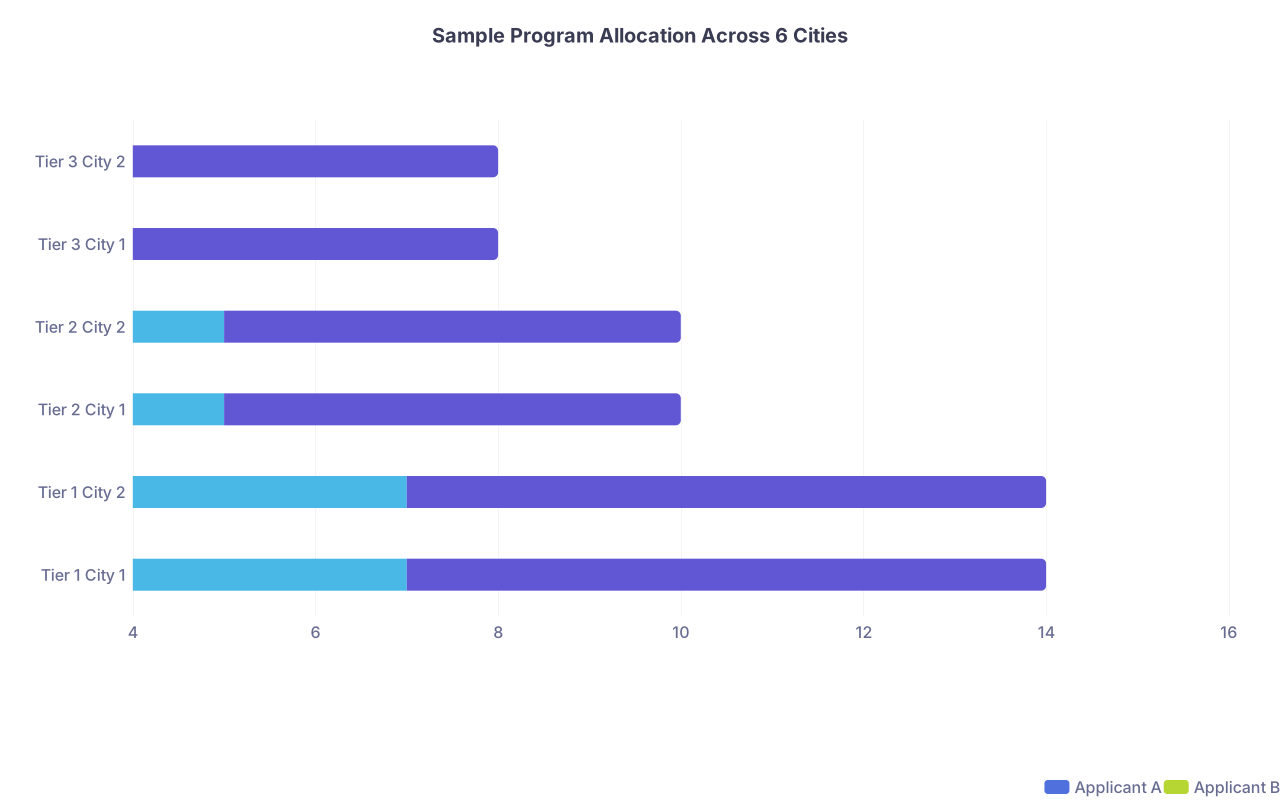
| Category | Applicant A | Applicant B |
|---|---|---|
| Tier 1 City 1 | 7 | 7 |
| Tier 1 City 2 | 7 | 7 |
| Tier 2 City 1 | 5 | 5 |
| Tier 2 City 2 | 5 | 5 |
| Tier 3 City 1 | 4 | 4 |
| Tier 3 City 2 | 4 | 4 |
The stacked bar tells the story: you are not scattering thinly across 10+ metros. You are building real density in the 3–4 cities that matter most, while keeping lifeboats in the others.
Step 3: Protect Overlap
The biggest hidden error I see couples make: they build their lists independently, then discover too late that they share very few cities, or have mismatched depth in them.
You want high overlap ratio:
Define overlap ratio per city:
(min(programs A in city, programs B in city)) / (max(programs in that city by either)Aim for ≥0.6 in your top 3–4 cities
Example:
- City X: A applied to 8, B applied to 6 → overlap ratio = 6 / 8 = 0.75 (good)
- City Y: A applied to 7, B applied to 3 → overlap ratio = 3 / 7 ≈ 0.43 (weak)
You want fewer City Ys.
When Geography is Non-Negotiable
Not everyone has the privilege of picking 5–6 cities. Sometimes:
- You have legal constraints (custody, visas)
- You must stay within driving distance of family support
- One partner’s specialty is city-limited (e.g., few pediatric neurosurgery programs)
That compresses your city set whether you like it or not.
If you are stuck with 1–3 cities, the data says you must compensate in two ways:
Apply very broadly within those cities
- If there are 12 programs in your specialty across your metro cluster, you probably apply to all 12 unless you are extremely strong.
- Aim for 8–12 programs per city, per person, where physically available.
Be brutally honest about competitiveness
- If one partner is borderline for that geography (low Step, weak letters), you may need to:
- Add a geographic “plan B” outside of couples match (one partner SOAPs or applies separately), or
- Add backup specialties or preliminary/transitional year paths.
- If one partner is borderline for that geography (low Step, weak letters), you may need to:
The math is straightforward: limited cities mean less diversification. The only lever you have left is depth and flexibility.
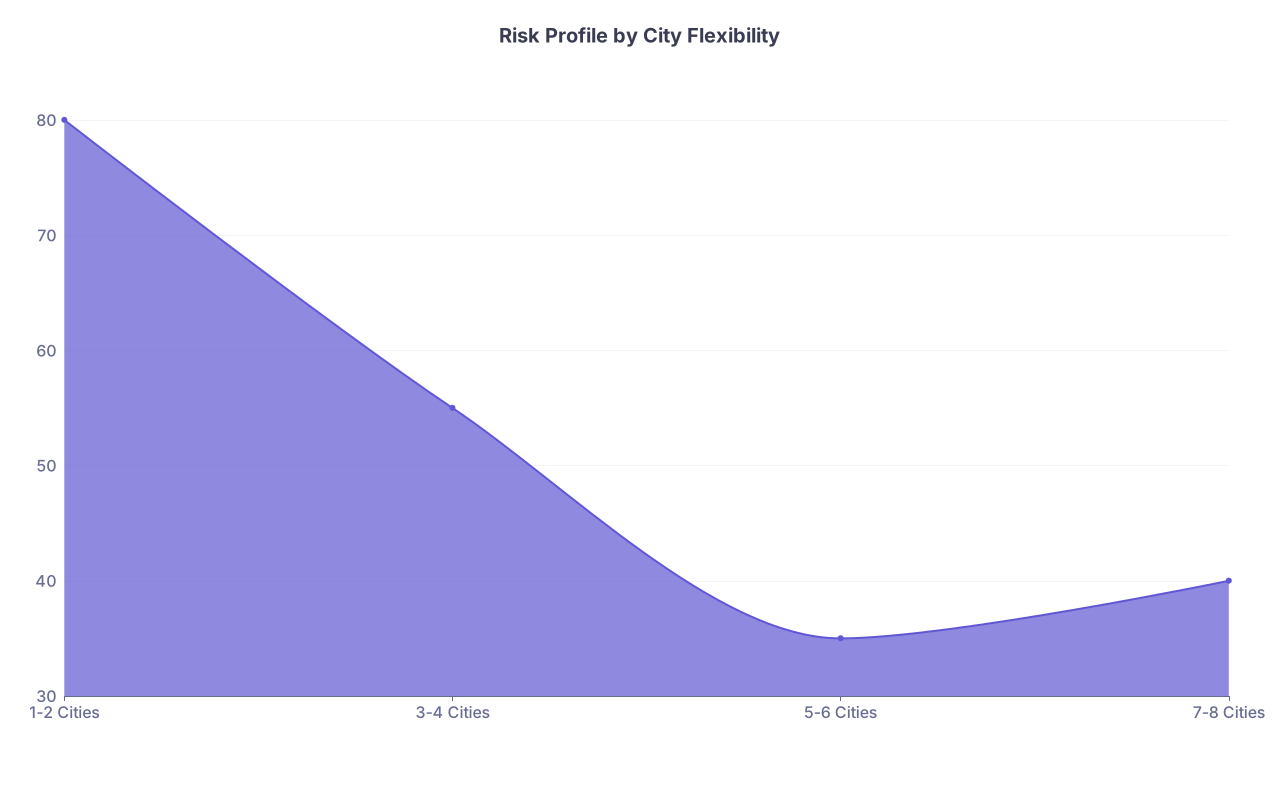
| Category | Value |
|---|---|
| 1-2 Cities | 80 |
| 3-4 Cities | 55 |
| 5-6 Cities | 35 |
| 7-8 Cities | 40 |
Interpreting that area chart: if you lock yourselves into 1–2 cities, relative risk of at least one partner not matching can be more than double compared to a well-balanced 5–6 city strategy for an average couple. Once you spread past 7–8 cities, risk often creeps back up because you rarely gain meaningful pair depth.
Operational Tips So You Do Not Drown in Logistics
This is supposed to be about data, not life coaching, but the implementation details matter.
A few high-yield operational rules from cycles I have watched:
1. Build a shared spreadsheet early.
Columns: City, Program, Partner A interest (1–3), Partner B interest (1–3), applied? Y/N, interview? Y/N, rank tier. If you are not tracking this, you are guessing.
Lock your city list before application day.
No “we’ll see how it goes.” You can add 1–2 extra cities if something surprising happens, but your core 4–7 should be decided before ERAS/PhORCAS submission.Coordinate interview prioritization by city, not by individual ranking.
If you have conflicting dates, give priority to cities where you both have or can get interviews, not just where one person is strongest.Be disciplined about dropping dead cities.
If by December one of you has zero interviews in City C, stop pretending it is viable for a same-city match. Shift your energy to cities where dual interviews exist.

| Step | Description |
|---|---|
| Step 1 | Define 4-7 Target Cities |
| Step 2 | Assign Program Targets per City |
| Step 3 | Track Interview Invites by City |
| Step 4 | Maintain City as High Priority |
| Step 5 | Deprioritize City for Couples Match |
| Step 6 | Drop City from Active Strategy |
| Step 7 | Build Rank List with Dense City Pairs |
| Step 8 | Both Have >=2 Interviews in City? |
| Step 9 | Only One Partner Has Interviews? |
That flowchart is the mindset: cities are dynamic assets. You invest more in the ones with actual dual opportunities, not just sentimental attachments.
Pulling It Together: How Many Cities Should You Target?
The data, the combinatorics, and the lived cycles all converge on the same point:
- Most couples should aim for 4–7 cities, with 5–6 as the practical optimum.
- Within those cities, depth beats breadth. You want 4–8 programs per city per person in your top metros, not 2–3 programs stretched across 12 cities.
- City choice is not vibes. It is a structured decision: program density, overlap of specialties, realistic competitiveness, and logistics all matter more than which city has your favorite brunch.


