

You are here
You are both on the couch. One laptop open to the score report. The number you did not want to see is staring back.
One of you just failed a board exam. Step 2 / Level 2 / specialty board – does not matter. You were planning to couples match this cycle. You probably have VSAS/ERAS spreadsheets, personal statement drafts, maybe even LORs already promised.
Now it feels like the entire plan just blew up.
Let me be blunt: this is bad, but it is not automatically fatal to a couples match. I have seen couples still match together with a fail on the record. I have also watched couples blow up their chances by reacting chaotically in the first two weeks after a failure.
You cannot afford that.
Here is how to approach this like an adult, like a clinician, and like two people who actually want to end up in the same city.
Step 1: Stabilize – What Just Happened and What It Really Means
You need facts. Not vibes. Not catastrophizing.
1. Get the real story behind the failure
Within 24–72 hours:
Pull the full score report.
- Look at section scores, not just the overall fail.
- Compare to any NBME/UWorld/self-assessment data you have.
Identify the pattern.
Common patterns I see:- “Red across the board” – global knowledge gap / poor prep.
- One or two disaster sections – often timing or misreading stems.
- Ran out of time on multiple blocks – pacing, anxiety, or bad test-day management.
- Major life event (illness, death, breakup, moving, rotation from hell) right before the exam – non-academic.
Talk to the right person at your school/program.
- Med student: academic advisor / dean of students / learning specialist.
- Resident: program director or APD.
Ask directly: - “How does this affect my standing?”
- “Do I have to disclose this to programs?”
- “Is there a mandated waiting period before I can retake?”
Do not email them a novel. Two paragraphs, clear and calm, requesting a short meeting. Panic in your personal life is fine. Panic in institutional communication is not.
2. Understand the technical constraints
You are trying to couples match with one partner who now has:
- A failed attempt on record, and
- A clock ticking on when they can retake.
You must know:
- Earliest allowed retake date.
NBME/COMLEX rules + your school’s policies. - Latest reasonable retake date if you still want scores back before:
- ERAS submission
- Interview season
- Rank list deadline
| Scenario | Impact on Applications |
|---|---|
| Retake before ERAS opens | Clean narrative, strongest position |
| Retake between ERAS and interviews | Some uncertainty, explain in PS/MSPE |
| Retake after interviews but before rank lists | Risky; some programs may not rank until pass shown |
| Retake after rank lists | Very risky; can lose spots if unsatisfied exam requirements |
You are not deciding what to do yet. You are mapping the battlefield.
Step 2: Decide the Big Fork – Same Year vs. Staggered Match
There are really only three viable strategies for couples when one partner fails a major exam pre-match:
- Both still apply this year, and the failing partner retakes ASAP.
- Both delay and apply together next cycle.
- One applies this year, the other delays; try to end up near each other later.
Let me run through them without sugarcoating.
Option 1: Both apply this year
This only makes sense if:
- The failed partner can:
- Retake before or early in interview season, and
- Has a realistic shot at passing on that attempt.
- They are not trying to match into an ultra-competitive specialty with marginal stats already (e.g., derm, plastics, ortho, ENT, ophtho with average scores and minimal research).
Who this works for:
- IM, FM, psych, peds, OB in most regions, if:
- You fix the exam story,
- You have honest advising,
- You are willing to cast a wide geographic net.
Risks:
- Some programs will screen out automatically after a fail, especially in competitive institutions or regions.
- A few will accept you but then say, “We need a passing score before we can rank you.” That can kill otherwise strong interviews if you cut timing too close.
Bottom line: This is doable but you must be strategic and aggressive. Sloppy planning sinks this path.
Option 2: Both delay and apply together next year
This is the most stable path for the relationship and the couples match, but it comes with logistical and emotional costs.
When I recommend this:
- The failed partner’s prep wasn’t just “oops, bad day” – it was a systematic mess.
- There is not enough time to meaningfully remediate and retake before interview season.
- The applying specialties/locations are competitive enough that a mid-cycle pass will not fix the initial negative filter.
Costs:
- Extra year of tuition or low-paid research / gap-year work.
- Visa issues for internationals can complicate this severely.
- Relationship strain from “we are stuck in limbo for a year.”
But if you choose this, you typically get:
- A cleaner narrative: “I failed, I fixed it, here is the improvement and what changed.”
- More time to build the weaker partner’s application: research, letters, rotations in realistic programs.
Option 3: One matches now, the other catches up later
I only like this option in specific cases:
- One partner is extremely competitive in a competitive specialty already (e.g., 260 Step 2 derm applicant with publications).
- The failed partner is in a very different or less competitive pathway.
- There is a good chance of the delayed partner later finding a spot in the same city/region (FM, IM, psych, peds positions often open off-cycle).
This is basically: sacrifice the first year together to protect one partner’s career trajectory, then regroup.
The couple that does this successfully is honest about it:
- The non-failing partner acknowledges they are accepting at least 1–2 years of long-distance.
- They both agree on a primary metro area target (for SOAP / off-cycle positions for the delayed partner).
Step 3: Build the Academic Recovery Plan (For the Partner Who Failed)
You cannot couples match your way out of a knowledge problem. Programs are not dumb. They will ask.
You need a concrete, documented, different study and exam plan.
1. Diagnose what actually failed
Make a written list:
- Knowledge gaps (specific content areas)
- Process errors (timing, misreading, second-guessing, etc.)
- Behavioral problems (procrastination, burnout, poor schedule adherence)
- Life disruption (family crisis, health, work schedule chaos)
Do this with someone objective: advisor, tutor, PD, faculty mentor. Not just your partner. They are emotionally biased.
2. Design a new study structure
If you restudy the way you did the first time, you will fail again. And then you are in real trouble.
Core elements that must change:
Schedule with non-negotiable protected time
- Daily blocks for:
- New questions
- Review of missed questions
- Content reinforcement
- Hard boundaries around sleep and days off.
- Daily blocks for:
Question-based learning as the backbone
- At least 40–80 quality questions per day (depending on timeline).
- Timed blocks that mimic real testing, not endless untimed “reviewing.”
Weekly system checks
- One NBME / COMSAE / practice exam every 2–3 weeks.
- Data-driven adjustments, not vibes-driven.
Accountability
- One person (not your romantic partner) who knows your schedule and checks in weekly.
- Could be: school learning specialist, hired tutor, upperclassman who crushed the exam.
If you are post-fail, I am biased toward formal help. A decent tutor or learning specialist pays for themselves in saved time and corrected direction.
3. Formal documentation of the fix
Keep records:
- Initial failed exam report.
- Study plan changes: dates, resources, support used.
- Subsequent NBME/COMLEX practice scores showing upward trend.
This later becomes the skeleton of your “here is what happened and what I changed” explanation in interviews and personal statements.
Step 4: Rebuild the Couples Match Strategy with New Reality
Now combine the academic plan with the couples match mechanics.
1. Reset expectations together
You both need to say out loud:
- “Our priorities in order are:
- Both match.
- Match in the same metro region.
- Match in our first-choice specialties.
- Match at prestigious / dream programs.”
If your list starts with “we must both match in Manhattan at brand-name programs,” you are in fantasy land after a fail.
The most successful couples I have worked with after a board failure are ruthlessly pragmatic. They drop prestige obsession immediately.
2. Expand geographic range
Assuming you are proceeding with this year’s couples match:
You need a much broader list:
- Multiple tiers of cities:
- Tier A: places you love.
- Tier B: places you like enough to be happy.
- Tier C: places you can tolerate for 3–5 years.
- Multiple program tiers within each city:
- Academic big-name
- Mid-tier community / university-affiliated
- Smaller community programs
You are not building two separate rank lists. You are building a matrix of combinations that get both of you employed in the same place.
| Tier | Program Type | Realistic Expectation |
|---|---|---|
| 1 | Big academic flagships | Harder with a fail; still possible in less competitive specialties with strong story |
| 2 | University-affiliated / large community | Main target zone; where you should invest networking and aways |
| 3 | Smaller community / regional | Safety net; critical for couples match security |
3. Adjust specialty strategy if needed
If the failing partner is in a highly competitive specialty and does not have top-tier stats otherwise, you may need:
- A backup specialty explicitly included on their ERAS, or
- A full pivot to a less competitive specialty this cycle.
That is not fun. But couples matching with:
- One partner: average stats, plus
- One partner: failed boards and competitive specialty dream…
…is how you end up unmatched together.
You can stagger careers. You cannot fix unmatched.
Step 5: Craft the Narrative – How You Explain the Failure
Programs care much less about the fail itself and much more about:
- Your insight into why it happened.
- Evidence that you changed behavior and can sustain it.
- Your attitude – defensive and externalizing vs. accountable and forward-looking.
1. Where this gets addressed
You will usually touch the failure in:
- Personal statement (short paragraph) – for the partner who failed.
- MSPE/Dean’s letter – schools often mention exam failures; review and, if grossly misrepresentative, discuss with your dean.
- Interviews – almost guaranteed for the person who failed.
2. The structure of a good explanation
Keep it tight:
One sentence: acknowledge the fail.
“During my first attempt at Step 2 CK, I did not pass.”Two to three sentences: real cause, owned.
- Not: “The test was unfair” or “I am just bad at standardized tests.”
- Yes: “I misjudged the volume of content and relied too heavily on passive review; I also allowed clinical duties to significantly cut into my dedicated study schedule.”
Three to four sentences: specific changes.
- Concrete shifts: resources, schedule, tutoring, accommodations if appropriate.
- Data: “My practice NBME scores improved from X to Y over Z weeks prior to my second attempt.”
One sentence: result and what it means now.
“I passed comfortably on my second attempt, and the process forced me to build consistent study habits I have since used on rotations and in-service exams.”
The wrong way: dramatize, blame, or overshare personal trauma with no clear academic tie-in. You are not writing for a therapist. You are showing program directors you will not be a repeated problem.
Step 6: Communication Protocol Between Partners
This is where couples either grow up or implode.
You are not just dealing with an exam; you are dealing with:
- Shame
- Resentment (“your failure might tank my career location options”)
- Fear of long-distance
- Guilt (“I am holding you back”)
Set some rules early.
1. Have one explicit “hard talk” about priorities
Sit down, no phones, no multitasking. Draft answers to:
- “If one of us has to compromise more on location, who is it and why?”
- “Are we okay doing long-distance for one year if it protects one person’s specialty choice?”
- “Under what circumstances would we both rather match separately than not match at all?”
This sounds cold. It is not. It is the opposite: it prevents resentment later.
2. Divide decision roles
Decide who has final say on:
- Academic recovery details – the failing partner, guided by advisor/PD.
- Primary geographic boundaries – both together (with reality check from advisors).
- Specialty-level shifts/pivots – the individual whose career it is, with real listening from the other.
What you must not do: have the partner who passed suddenly become the “coach” of the failing partner. That tends to go badly. You can support. You should not micromanage.
Step 7: Tactical Changes to the Application Itself
Now the nuts and bolts.
1. Program list building
For the partner who failed:
- Increase the number of programs you apply to. Yes, it costs more. No, this is not the time to be cheap.
- Prioritize:
- Home programs.
- Places where you have rotated or have faculty connections.
- Regions known to be more forgiving / less board-cutoff-obsessed.
For the partner who passed:
- Accept that you may need to apply more broadly and include programs slightly below what your scores alone would justify.
2. Letters of recommendation
The failing partner needs at least one letter that clearly, implicitly or explicitly, vouches for:
- Clinical competence
- Reliability and professionalism
- Improvement / resilience after the exam event (if the writer knows about it)
You want someone who can write, “This student is exactly the kind of resident you want, and the exam result does not reflect their actual capabilities.” They do not need to detail the fail; they need to counterbalance it.
3. Away rotations and networking
If there is time:
- The failing partner should strongly consider an away rotation at a realistic program in a city you both would accept.
- Aim: crush the rotation, get a strong letter, get on the PD’s radar.
- The other partner can often also apply to a program in the same city to increase your couples match options.
Big mistake: using away rotations for prestige flexing instead of realistic landing spots.
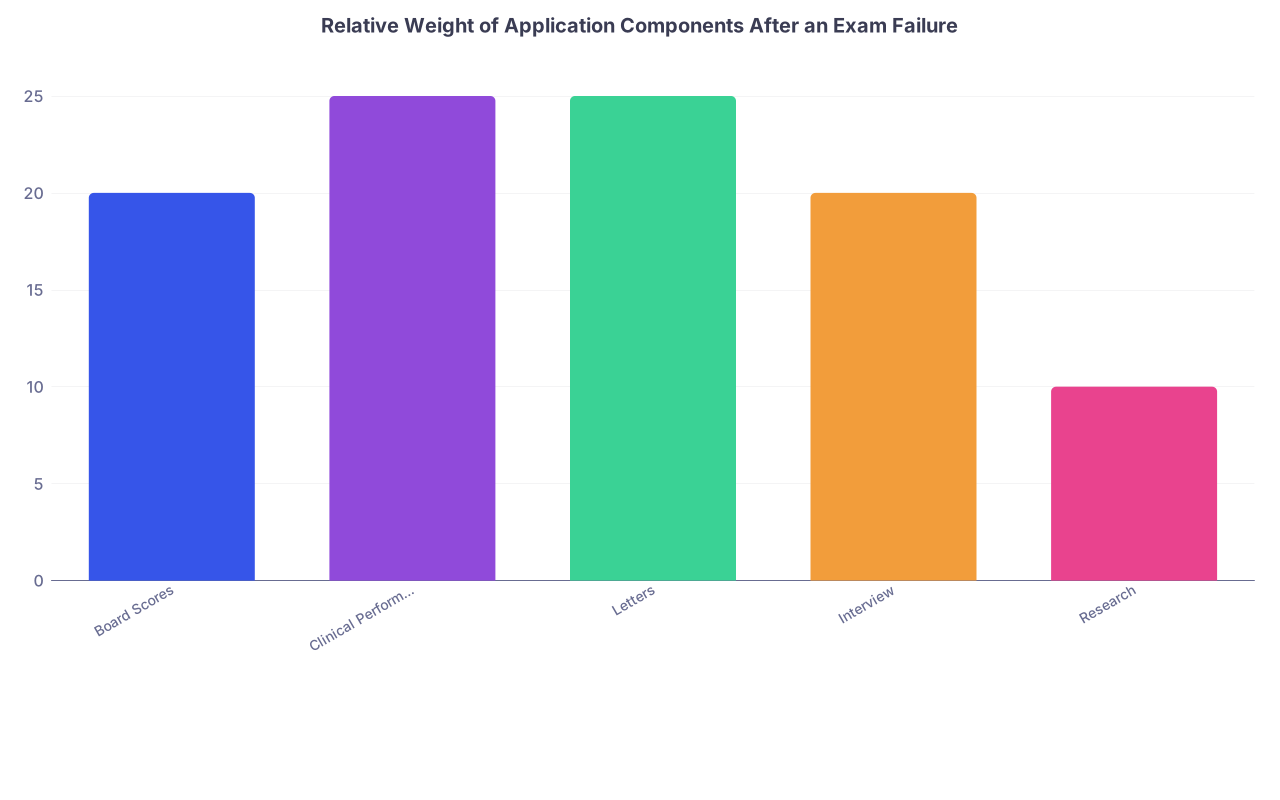
| Category | Value |
|---|---|
| Board Scores | 20 |
| Clinical Performance | 25 |
| Letters | 25 |
| Interview | 20 |
| Research | 10 |
Step 8: Interview Season – How to Play It
Assuming the failing partner has retaken (or is scheduled to), you will hit interviews with one of three situations:
- Fail + pass already on record.
- Fail + retake scheduled before rank lists, but score pending.
- Fail + retake scheduled after rank list (bad, but sometimes unavoidable).
1. Be consistent but brief in your explanation
You do not need a different story for every program. You need a clean, rehearsed 60–90 second explanation that:
- Acknowledges the fail.
- States the cause and changes.
- Ends confidently with your passed score and current performance.
Practice this out loud. Record yourself. If you sound defensive or like you are still in shock, fix that before interview day.
2. Couples match specifics
When asked, “Why couples match?” your answer cannot be:
- “So we can stay together, obviously.”
It needs a professional spin:
- “We are both deeply committed to our relationship and also to being fully present for residency. Couples matching allows us to support each other in a way that makes us more stable and effective as trainees. We are applying broadly and realistically, and our priority is for both of us to match into programs where we will be solid residents.”
If the board failure comes up in the context of couples match, the other partner can say something like:
- “Watching them go through that and then systematically fix their approach actually increased my confidence in them as a future colleague. They took full ownership and have been performing very strongly on rotations since.”
You are not hiding the issue. You are showing you are not fragile.
Step 9: Rank List Strategy with a Red Flag in the Mix
This is where many couples self-sabotage.
Principles:
Prioritize matching over prestige.
Your rank list should start with combinations where:- Both match in acceptable programs
- In the same region Even if they are not your absolute dream programs.
Include enough “safe” combinations.
These are:- Lower-tier programs
- Less desirable cities But they are same-city pairings that would give both of you a job and a life together.
Avoid fantasy top-heavy lists.
If 70% of your couples combinations are both of you at top-tier programs in coastal cities, you are asking to go unmatched. With a prior fail, that is reckless.
Rank list construction is where an experienced advisor who has seen hundreds of couples match outcomes is invaluable. Use them.

| Step | Description |
|---|---|
| Step 1 | Exam Failure |
| Step 2 | Both apply this year |
| Step 3 | Apply together next year |
| Step 4 | One matches now, one later |
| Step 5 | Build broad couples list |
| Step 6 | Target same region later |
| Step 7 | Retake before interviews? |
| Step 8 | Delay apps? |
Step 10: When You Should Strongly Consider Delaying a Year
Let me spell this out clearly. If any three of the following are true, you should seriously consider both delaying a year and applying next cycle together:
- The failing partner’s baseline practice scores were low for months, not just a bad week.
- They are entering a competitive specialty with no standout strengths (research, letters, etc.).
- The retake date, realistically, would land close to or after main interview season.
- Your geographic flexibility is low (must be near family, immigration constraints, partner’s job, etc.).
- Both of you are already somewhat average in your respective applicant pools.
Trying to force a couples match through that situation with a fresh fail is how you end up:
- Unmatched x2, or
- Only one matched, far from home, and the other stuck in limbo.
Taking a year hurts in the short term. But it often preserves both careers and the relationship.
During that year, you do not just “wait.” You:
- Fix the exam.
- Build research or clinical credentials.
- Strengthen your narrative.
- Save money and plan for the next application cycle like adults, not panicked kids.
Key Takeaways
- A board exam failure before couples matching is serious but not automatically fatal. The damage comes from denial and disorganized reaction, not the score report alone.
- You must build two plans in parallel: a rigorous academic recovery for the failing partner and a ruthlessly realistic couples match strategy that prioritizes both of you matching over prestige or perfect geography.
- Strong communication between partners, honest advising, and willingness to broaden your options (geography, program tier, sometimes specialty) are what keep both your careers and your relationship intact.


