

The couples match after one of you has already gone unmatched is a different game—and most people are getting terrible advice about it.
You’re not playing “two equal applicants optimizing for lifestyle.” You’re playing “one higher‑risk candidate + one leverage candidate trying to secure two spots in a system that just watched one of you not fill a single one.”
If that’s your situation, here’s how to handle it like an adult and not a wishful thinker.
1. First: Get Brutally Clear On Your Starting Point
You cannot plan a sane couples match until you both understand exactly why the unmatched partner didn’t match the first time. Vibes are not enough. You need evidence.
Sit down and answer, in writing, for the previously unmatched partner:
- What specialty did you apply to?
- How many programs did you apply to?
- How many interviews did you receive?
- How many did you attend?
- Did you go through SOAP? What happened there?
- What was your Step 1/2 or COMLEX 1/2 situation (scores, pass/fail, failures)?
- Any red flags? LOA, professionalism concerns, failed rotations, obvious weak letters?
If your answers sound like these, you’re in familiar territory:
- “Applied EM, 60 programs, got 4 interviews, ranked 4, didn’t match.”
- “FM, 40 programs, 3 interviews, no SOAP spot.”
- “Step 1 fail, Step 2 226, applied IM, 80 programs, 5 interviews.”
Now, classify the unmatched partner into one of three reality buckets:
| Category | Typical Profile | Couples Match Outlook |
|---|---|---|
| Mild risk | Decent scores, slightly low apps/interviews | Good with smart list |
| Moderate risk | Borderline scores or red flag, few interviews | Possible but needs concessions |
| High risk | Multiple red flags or very low interest | Very tough, may need solo match first |
If you’re “high risk” and pretending you’re “mild risk,” you will design a fantasy rank list. That’s how couples go 0/0 and end up in separate cities anyway, just without jobs.
You both need to agree on: is the primary goal to:
- Match together at all costs, even if it’s in less desirable locations and/or a backup specialty, or
- Maximize individual specialty goals, even if that means a real chance of ending up apart?
If you don’t answer that first, everything else is chaos.
2. Decide If Couples Match Is Actually The Right Move This Time
Dirty little secret: sometimes the best way to end up together long term is not to couples match right now.
Scenarios where I’d strongly question doing couples match after one partner went unmatched:
- Unmatched partner is trying to reapply to a very competitive specialty (Derm, Ortho, ENT, Plastics, Urology, IR-preferred pathways) with a weak profile.
- There’s a significant professionalism issue or multiple exam failures and no meaningful repair yet.
- They had essentially no interviews last cycle (<3) in a moderately competitive field despite broad applications.
Why? Because as a couple you now need:
- A program that wants applicant A
- A program (same hospital/system/region) that wants applicant B
- And they have to want you both enough compared with solo applicants.
You multiply risk, not add it.
In those “very high risk” cases, I’d seriously consider:
- Stronger partner matches this year solo (maybe in a flexible or larger specialty like IM, FM, Peds, Psych).
- Unmatched partner spends a year or two:
- In a prelim/TY spot
- In a research position with a clear pipeline to a program
- Rebuilding their application (retaking Step 2 if allowed by their situation, new letters, local rotations)
- Then later you try to get geographically closer via transfers, fellowships, or second matches.
Is that ideal? No. But it’s often more realistic than trying to convince a program to take a clearly risky reapplicant and tie their hands by needing a second spot for the stronger partner in the same place.
If you decide: “No, we are couples matching now,” accept that you will need to be aggressive, pragmatic, and occasionally a little cold about prestige, location, and pride.
3. Choosing Specialties Strategically As A Couple
Here’s where most couples screw this up: they treat their specialty choices independently and just “link them in ERAS.”
Do not do that.
You need to ask: what combination of specialties gives us the highest probability that:
- Programs have both specialties
- Programs have multiple spots in each specialty
- Programs are used to taking couples and may have wiggle room
Broadly:
- Easiest pairings for a previously unmatched partner:
- FM + IM
- IM + Psych
- IM + Peds
- FM + Psych
- Any of the above + TY/prelim (if someone is willing)
- Harder but still doable:
- Competitive-ish + broad (e.g., Anesthesia + IM, EM + FM) if the competitive person is reasonably strong
- Miserable combinations when one partner is risky:
- Risky reapplicant in competitive field + any competitive partner (EM/Anesthesia/Ortho/ENT/etc.)
- Niche specialties with very few programs (PM&R in certain regions, MedGen, etc.) + something else
If the previously unmatched partner is trying to reapply to the same competitive specialty, I’d strongly suggest:
- Adding a genuinely serious backup specialty. Not “I clicked Psych programs but don’t actually want to go.” Real backup. Real PS. Real letters. Real interviews.
- And aligning that backup with the stronger partner’s field so you have more dual-program institutions to rank.
Example:
- Last year: Partner A (unmatched) applied EM only, 4 interviews, no match. Partner B wants IM.
- This year, rational move:
- Partner A: EM + IM (with a serious, fully built IM application).
- Partner B: IM.
- You couples match: EM/IM combos where possible, IM/IM combos widely, and only a few EM/something where partner B would be in something undesirable alone.
4. Building A Program List For Two People When One Is Risky
Your program list is now a risk‑management tool, not a wish list.
You want a large, layered list that roughly looks like this conceptually:
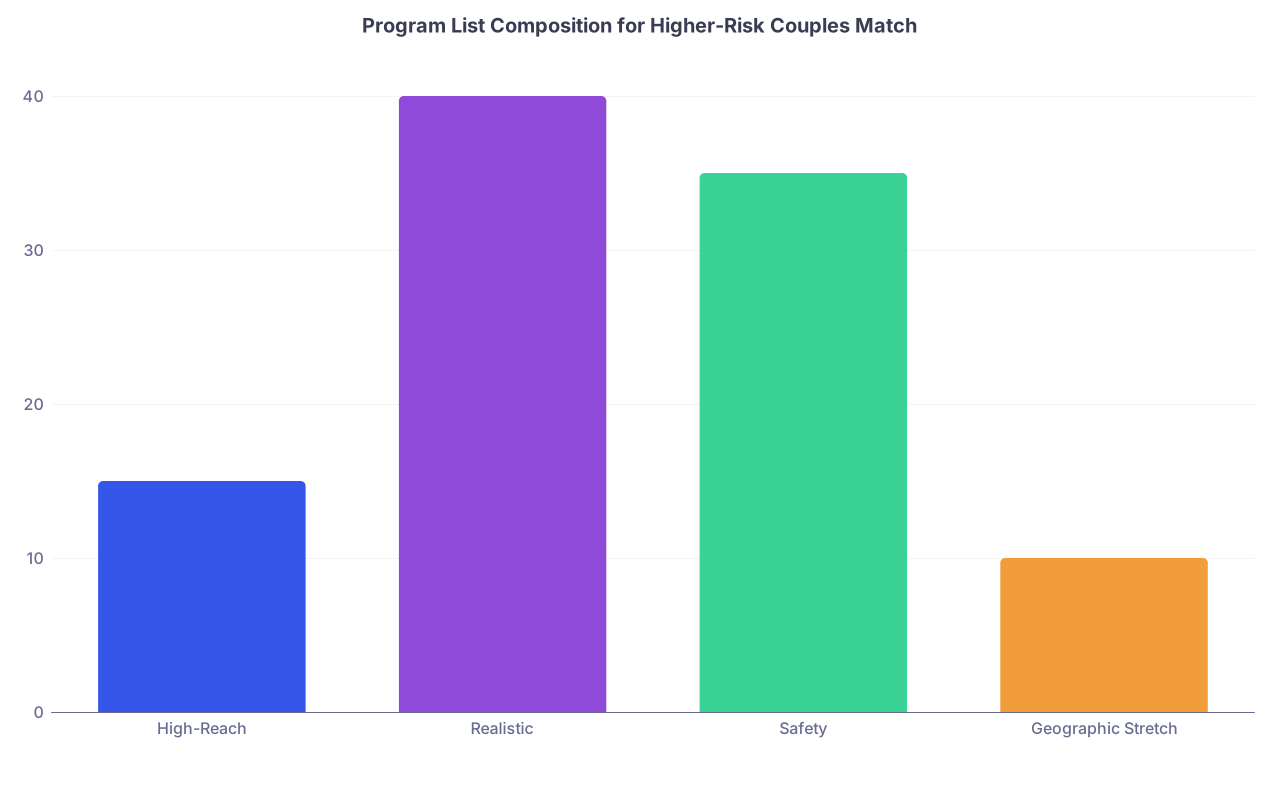
| Category | Value |
|---|---|
| High-Reach | 15 |
| Realistic | 40 |
| Safety | 35 |
| Geographic Stretch | 10 |
Where:
- High-reach: dream cities, big-name programs, tougher to get for the weaker partner.
- Realistic: solid mid-tier university and strong community programs in less sexy locations.
- Safety: community-heavy, less popular geographic areas, programs known to take IMGs or lower scores.
- Geographic stretch: places one or both of you aren’t thrilled about but would accept not being unemployed.
If the previously unmatched partner:
- Got ≤5 interviews last cycle → you need a lot of realistic + safety this time. Think 60-80+ programs in many specialties, depending on field and their stats.
- Had a Step failure → you should favor programs and specialties known to consider applicants with red flags. This often means more community-heavy, Midwest/South, and less coastal elite.
You also need to be honest about visas, DO/IMG status, and school reputation. Those are multipliers on risk.
5. How To Talk To Programs As A Couple With One Unmatched Partner
You can’t pretend the previous non-match didn’t happen. It’s going to come up. Sometimes directly: “So, why do you think you didn’t match last year?”
For the previously unmatched partner, your story needs to be:
- Specific
- Accountable
- Forward-looking
Something like:
“Last year I applied to EM only. I limited my applications geographically and overestimated my competitiveness given my Step 1 failure. I had four interviews but in hindsight my list was too top-heavy and too narrow. Since then I’ve passed Step 2 with a 238, completed two strong sub-I’s with excellent evaluations, and expanded my application this year to include IM programs where I’ve had great feedback on rotations. I’ve learned to be much more realistic and flexible, and I’m genuinely excited about both EM and IM as careers.”
You do not say: “The match is broken” or “I just got unlucky.” That sounds like you learned nothing.
For the stronger partner, you don’t act like a martyr. You present it as a mature joint decision:
“We decided to couples match this year because we both value being in the same place long term. I’m fully committed to my own training and I’d be thrilled to train here, independent of my partner. At the same time, we’ve built a balanced rank list that gives us a realistic chance to end up together.”
If the PD or interviewer hints concern that they’d be “forced” to take both of you, you emphasize:
- You understand couples match doesn’t obligate a program to rank you as a pair.
- You know they can rank you independently and your algorithm does the coupling.
You are trying to prevent them from mentally labeling you as “extra work + limited flexibility.”
6. Ranking As A Couple After One Of You Didn’t Match Before
This is where people break their own match.
Couples ranking is not “let’s make 10 cute rows of cities we love.” It is an algorithmic strategy problem. And it’s more complicated now, because:
- The weaker partner needs a very long tail of realistic options.
- The stronger partner has to decide how far down they’re willing to go to stay together.
Here’s the mental model I use with couples in your situation:
Build three mental buckets for each partner:
- “Absolutely want”
- “Would be fine”
- “Only if the alternative is unmatched”
Overlay those buckets:
- Where both are “absolutely want” → rank those high as paired combos.
- Where one is “absolutely want” and the other is “would be fine” → still rank pretty high.
- Where one is “would be fine” and the other is “only if unmatched” → middle to lower.
- Where both are “only if unmatched” → way down, but still above 0/0.
Then deliberately build singletons (only one partner matches there, the other unmatched) at the very bottom if and only if you both agree that “one matched + one unmatched” is better than “both unmatched.”
The couples algorithm lets you do things like:
- (Partner A: Program 1, Partner B: Program 1)
- (A: Program 1, B: Program 2)
- (A: Program 3, B: Program 3)
- …
- (A: Program 40, B: no match)
- (A: no match, B: Program 55)
A lot of couples mistakenly stop their list when “together” options run out. That’s how you get 0/0 when you could have had at least one person employed, possibly setting up future transfers.
If this partner went unmatched once before, be very conservative about ending the list early. You already know “0/0” is not fun.
7. Repairing And Strengthening The Previously Unmatched Application
If you’re doing couples match after an unmatched cycle, the reapplicant does not get to recycle last year’s application with a new paragraph in the personal statement. Programs will see that and roll their eyes.
You want to show movement in at least 3 of these areas:
Clinical performance / letters
- New sub-I’s in the target specialty with clear, strong letters.
- At least one letter from a PD or APD if humanly possible.
- If you’re switching specialties (e.g., EM → IM), you need fresh letters from that field, not just “generic good doctor” letters.
Exams
- Step/COMLEX 2 completed, with a clear pass and ideally solid score.
- Address any previous failures head-on in your MSPE addendum/PS if needed, but don’t make your whole application about the failure.
Commitment to specialty
- Targeted experiences: research, QI, local presentations, leadership in clubs or interest groups.
- If switching from a “hot” field to a “less sexy” one (e.g., EM → IM), you must convincingly explain why this is genuine, not just desperation.
Geographic/Program Fit Signals
- Away rotations or sub-I’s at places you’re actually applying.
- Emailing programs judiciously if it makes sense (e.g., you did a rotation there, you’re from that town, your spouse has a job offer there).
- Not the spam “I love your program, please rank me.”
8. Managing The Emotional Side So It Doesn’t Blow Up Your Strategy
I’ve watched couples in this situation explode over rank lists, especially when one partner is still carrying shame from not matching.
Patterns I’ve seen:
- The unmatched partner overcompensates—“No, you should rank your dream programs high, don’t worry about me”—and then secretly resents ending up apart.
- The matched-previously partner feels guilty and pushes too hard for prestige downgrades, then burns out in a program they didn’t actually want.
- They never explicitly say: “Is being together more important than you getting X specialty?”
You two have to talk like actual adults before you even open the couples ranking interface:
- “If our choice is: you get your #1 IM program and I go unmatched again, or we both match at a solid but less shiny place—what do we pick?”
- “Are we okay with one of us matching and the other being unmatched, or is it 2-or-zero?”
Decide your tie‑breakers before the NRMP opens ranking. Otherwise you fight about each individual line instead of following a shared rule.
9. A Concrete Example: How A Real Couple Handled This
Here’s a realistic composite of situations I’ve seen:
- Partner A: US MD, Step 1 fail then pass, Step 2 232, EM applicant last year, 5 EM interviews → unmatched, SOAP’d into nothing.
- Partner B: US MD, solid stats (Step 2 247), wants IM, no red flags.
What they did the next cycle:
Partner A:
- Switched to IM as primary specialty, EM as stretch.
- Did two IM sub-I’s at mid-tier university and large community program, both with strong letters.
- New PS focused on IM, with one short paragraph acknowledging previous EM interest and why IM fit better now.
Partner B:
- IM only, very broad list (100+ programs) including community-heavy and Midwest/South.
Applications:
- Both applied to ~120 IM programs with big overlap.
- Partner A applied to ~35 EM programs; B applied to the IM programs at those same institutions.
Interview outcomes:
- Partner A: 10 IM interviews, 2 EM.
- Partner B: 18 IM interviews.
Rank strategy:
- Ranked EM/IM pairs first where both felt good (maybe 5-6 combos).
- Then a long stretch of IM/IM pairs in realistic and safety programs (30+ combos).
- At the bottom: a couple of singletons where B matched IM at a strong program and A unmatched (they both agreed that was still better than 0/0).
Outcome:
- They matched together at a solid but non-famous university IM program, midwest city they wouldn’t have chosen on vacation but are fine living in.
- A never got EM. But they are now both PGY-2 IM, and A is eyeing cards fellowship, B is considering hospitalist.
Would they have gotten something “better” by pretending the previous unmatched cycle didn’t matter and shooting only for coastal university programs? Highly unlikely.
FAQ (Exactly 4 Questions)
1. Should the previously unmatched partner disclose that history in their personal statement?
Yes, briefly and strategically, especially if they’re reapplying to the same specialty or totally switching fields. One short, accountable paragraph is enough: acknowledge what happened, explain what changed (more realistic list, broader specialties, improved scores, new letters), and show insight. Do not turn your entire personal statement into a saga about the unmatched year. Programs want to see growth, not a diary entry.
2. Is it ever smart to not couples match after one partner went unmatched?
Sometimes it’s not just smart—it’s the only sane move. If the unmatched partner has multiple exam failures, very few interviews last cycle, and is still trying for a very competitive specialty, tying the stronger partner to that risk can sink both. In that case, the stronger partner may match solo somewhere with good training, while the other focuses on remediation: prelim year, research, local networking, score improvement. Later you try to converge via transfers or fellowship, instead of both going 0/0 now.
3. How many programs should we apply to as a couple with one high-risk partner?
More than you want to. For broad fields (IM, FM, Psych, Peds), I’m comfortable seeing 80–120 applications for the higher-risk partner, with substantial overlap with the stronger partner’s list. For more competitive or location-constrained situations, you may go higher. The key is not just raw number but distribution: lots of realistic and safety programs, not 60% reach in three coastal cities. If the unmatched partner got fewer than ~5 interviews last time, your default should be “cast wider, including less popular locations.”
4. If we have to choose, should we prioritize being together or each getting our ideal specialty?
You have to decide that yourselves—and you have to decide before the ranking window opens. There’s no universal right answer. But be honest: the partner who already went unmatched usually has less leverage to insist on an ultra-competitive specialty and staying together in a top city. Many couples in your situation choose: “We’d rather both match in acceptable places, maybe with one person compromising on specialty or prestige, than risk another unmatched year.” Whatever you decide, bake that priority into your rank-list rules so you aren’t renegotiating your values at line 27 of the couples list.
Key points, stripped down:
- Diagnose why the first non‑match happened, honestly, and adjust both specialty choice and program list around that reality.
- Use the couples match to manage risk, not chase fantasy—build long, layered rank lists with backups and singletons if necessary.
- Communicate like adults about your real priority: staying together vs. specialty prestige, and lock that in before you touch the rank order list.


