

What do you do when you’re halfway through ERAS season, your calendars are full of interviews…and one of you opens your score report and sees the word “Fail”?
This is the nightmare version of the Couples Match. Not theoretical. It happens every year. Two people lined up to match together, and suddenly one partner’s application takes a direct hit while the train is already moving.
You do not have time to be philosophical. You need a plan. Fast.
Let’s build it.
Step 1: First 48–72 Hours – Contain the Damage
The first mistake I see couples make here is pretending nothing changed. It did. Programs noticed. Your dean’s office noticed. And if you do nothing, you both get hurt.
Here’s what the first few days should look like.
1. Stop and separate three issues
You and your partner need one blunt conversation ASAP. Not five half-conversations between rounds of UWorld.
Sit down, no phones, and draw three columns on a page:
- Column 1: Emotional
- Column 2: Logistics
- Column 3: Strategy
You’re going to park things where they belong:
- Emotional: shame, fear, “I ruined everything,” “maybe I’m not cut out for this.”
- Logistics: retake timing, graduation requirements, visa issues, financial constraints.
- Strategy: how to salvage this match cycle; whether to stay coupled; specialty/program targeting.
The point: you’re allowed to fall apart emotionally, but your logistics and strategy cannot be driven by panic. They need their own space.
2. Get the facts from your school. Immediately.
Within 24–48 hours, the partner who failed should email or call:
- Dean of Student Affairs or equivalent
- Academic advising / promotions committee contact (if there is one)
- Your school’s residency advising person (often a separate office)
You want straight answers to:
- Are there graduation delays if I retake?
- What are the earliest retake windows available through Prometric?
- Does the school have any policy about applying for residency with a fail?
- Will the MSPE (Dean’s Letter) be updated or amended?
- Are there any internal rules about Step 2 CK timing for ranking?
Write these answers down. Do not rely on “I think they said…” Your entire couples strategy depends on this timeline.
3. Decide: are you still in this cycle or effectively out?
For Step 1 failure:
- If Step 1 is now pass/fail for your year, this is still bad but not always fatal. Some programs will auto-screen you out; others will care more about Step 2 CK.
- If Step 1 was scored and you failed, that’s a bigger hit, but again, Step 2 CK becomes your lifeline.
For Step 2 CK failure mid-cycle:
- If you’re applying in a competitive specialty, many programs will quietly move you to the “no” pile.
- But some community and mid-tier academic programs will still consider you, especially if you have strong other factors and a plan to retake quickly.
The clearest questions to answer:
- Will my retake results definitely be back before rank list certification?
- If yes, you’re still in this cycle, but your approach needs to change.
- If no, you’re basically applying with an unresolved fail. That changes everything.
You cannot answer couples strategy until you know that.
Step 2: Immediate Communication Plan – Who Needs to Know, When, and How
This is where people either recover or sink. Silence is usually interpreted as “they’re hiding something.”
1. Your school letter-writer / dean
If your MSPE is already out, you still want your dean aware:
- They may get calls from programs.
- They can advocate for you if something borderline comes up.
- They sometimes add an addendum later emphasizing improvement after a retake.
How to say it (rough outline):
“I wanted to let you know I received a failing score on Step 2 CK. I’m already working with [advisor/tutor] and have registered to retake on [date]. My practice scores prior to the exam were [brief context if helpful], and I believe I mismanaged [time / fatigue / fill in honestly]. I’m fully committed to addressing this and am happy to provide updates as I prepare to retake.”
You are not writing a confession letter. You’re showing you’re taking this seriously and doing something about it.
2. Programs you’ve already interviewed at
Do not blast an email to every program 5 minutes after you see your score. Think first.
There are 3 buckets of programs:
- Programs you genuinely care about, where the interview felt positive
- Programs that are reach-y but not delusional
- Programs you barely care about / backup of backup
You prioritize bucket 1. For them, a short, proactive email is reasonable—especially if your retake will post before rank list deadlines.
Something like:
Dear Dr. [PD Name],
I wanted to update you regarding a recent development in my application. I unfortunately did not pass Step 2 CK on my first attempt. I’ve already registered to retake the exam on [date], and I am working closely with [advisor/tutor/etc.] to address the areas of weakness that led to this result.
I remain very interested in [Program Name], in large part because of [1 specific reason from your interview day]. I hope to demonstrate my readiness for residency with an improved Step 2 CK performance, and I’m happy to provide an updated score report as soon as it’s available.
Thank you for your consideration,
[Name, AAMC ID]
You’re not begging. You’re explaining, owning, and showing a corrective path.
For bucket 2, you can selectively do this if you have some connection or genuine interest. Bucket 3? If they care, they’ll ask.
3. Programs you haven’t heard from yet
Do not email cold to say “I failed an exam.” That’s just pushing your problem into their inbox.
Instead:
- Update ERAS when you have a passing retake.
- If you’re doing a late-wave application to community / less competitive programs, you can include a short sentence in your PS or email:
“I experienced a setback with Step 2 CK on my initial attempt, but I subsequently passed with a score of [XXX] after focused remediation.”
Leak the information with the fix, not the wound.
Step 3: Couples Match Decision Tree – Stay Coupled or Split?
This is the part nobody prepared you for when they told you Couples Match was “romantic.”
You now have to make a hard, adult decision that affects both careers.
Let’s draw the fork in the road.

| Step | Description |
|---|---|
| Step 1 | Exam failure mid-cycle |
| Step 2 | High risk: delayed match |
| Step 3 | Stay coupled, broaden list |
| Step 4 | Consider decoupling or backup specialty |
| Step 5 | Consider decoupling this cycle |
| Step 6 | Discuss long-distance or reapplying |
| Step 7 | Retake before rank list? |
| Step 8 | Specialty flexible? |
When it makes sense to stay coupled
You probably stay coupled if:
- The failing partner can retake and (likely) pass before rank lists.
- The stronger partner is in a less-cutthroat specialty (FM, IM, peds, psych), with room in a wide range of program tiers.
- Both of you are willing to rank a lot of community or mid-tier programs and widen the geography.
Staying coupled means:
- You accept a higher chance that the stronger partner will match “below” what they might have gotten solo.
- You prioritize being together over chasing prestige.
If that’s your shared value, own it. Don’t half-commit.
When you should seriously consider decoupling
You should at least talk about decoupling if:
- The failing partner’s retake will not come back before rank list certification.
- The failing partner is now extremely unlikely to match this cycle (e.g., IMG with Step 2 failure, competitive specialty, no backup).
- The strong partner is in a very competitive specialty (derm, ortho, ENT, neurosurg, plastics, ophtho via SF, etc.) where even minor dings matter.
Decoupling doesn’t mean breaking up. It means:
- One matches this year, the other regroups and applies next year, possibly to a different or less competitive specialty or in a different geographic spread.
- You accept likely long-distance for a period.
- You’re protecting both careers from a double-disaster: both going unmatched.
Harsh truth: two people unmatched with one exam failure between them is far worse than one person matching and one needing a rebuild year.
Step 4: Rebuilding the Failing Partner’s Application – Rapid Triage
You cannot control how PDs feel about a fail. You can control what the rest of the story looks like.
1. Nail the retake timing and plan
Fast is not always better. Passing is better.
You need:
- Enough time to fix the reasons you failed (content gaps, test-taking, burnout).
- A scheduled retake date that yields score release before rank lists, if possible.
| Exam | Usual Score Delay | Notes |
|---|---|---|
| Step 1 | 2–4 weeks | Sometimes faster |
| Step 2 CK | 2–4 weeks | Holiday periods slower |
| COMLEX Level 2 | 4–6 weeks | Longer delays common |
Back-calculate. If rank lists lock in late February/early March, and score release is ~3 weeks, you probably need to retake by mid-to-late January at the latest.
If your readiness is nowhere near that? Better to push the date, pass later, and accept a likely unmatched year than rush and fail twice. Two fails is brutally hard to come back from.
2. Put visible structure around remediation
Programs like to see:
- You’re not studying “harder,” you’re studying smarter.
- You’ve changed something tangible.
That means:
- Formal exam remediation plan from your school (if offered)
- A tutor or structured course (Kaplan, Boards & Beyond, AMBOSS, whatever you’ll actually use)
- Regular NBME / UWSA practice with documented improvement
This is not just for optics. You actually need it. But framing it as a concrete plan matters.
When you talk to advisors or, later, PDs, you want to be able to say:
“I worked with an academic advisor to analyze my previous performance, and I’ve been following a structured remediation plan with [resources] and serial NBME practice exams, where my scores have improved from [XX] to [YY].”
That sounds like a person who learns from failure, not one who got unlucky and hopes for the best.
Step 5: Restructuring Your Joint Rank List
You’re in Couples Match, so every rank is a pair. That constraint is now much more dangerous.
You cannot pretend your applications are unchanged. Programs will not.
1. Widen geographic and program-type filters. Aggressively.
If, before the fail, your joint list was:
- 10 big-city university programs
- 5 “backup” mid-tier city programs
You’re under-ranked even in the best of times. With a fail? You’re delusional.
You need to add:
- Community programs in less popular locations (Midwest, South, smaller cities)
- University-affiliated but less “name-brand” hospitals
- Programs in states that historically struggle to fill all spots (think certain parts of the Midwest, rural regions, etc.)
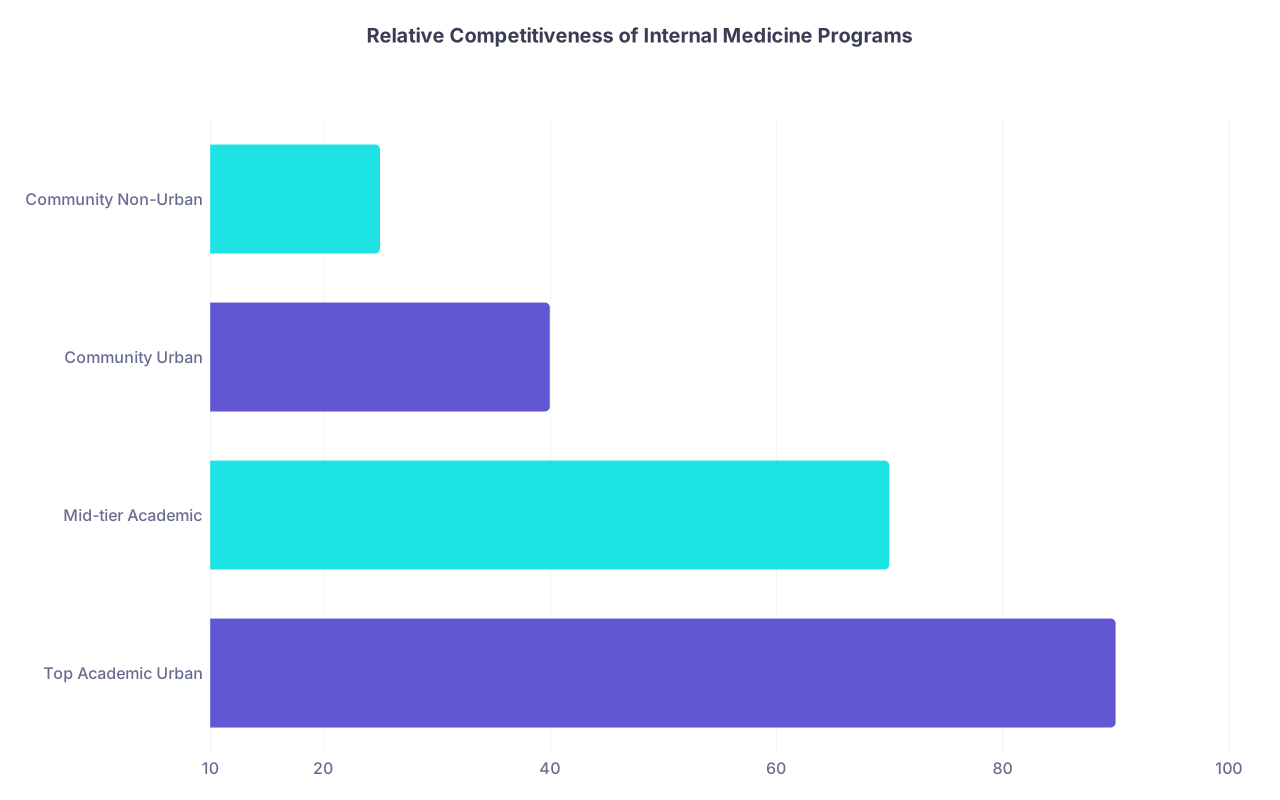
| Category | Value |
|---|---|
| Top Academic Urban | 90 |
| Mid-tier Academic | 70 |
| Community Urban | 40 |
| Community Non-Urban | 25 |
(The numbers here are relative difficulty scale, not exact stats, but you get the point: non-urban community is usually more forgiving.)
2. Protect the stronger partner smartly
If the stronger partner has:
- Great scores
- Strong letters
- Decent research
You don’t throw away every reach. You rebalance.
Strategy:
- Keep a handful of strong programs where both of you have at least a theoretical shot.
- Add a lot more realistic pairings where the failing partner’s profile won’t be an automatic rejection (community-heavy, less hyper-selective regions).
Remember: Couples Match algorithm tries to honor your top pair choice. If you have 10 “dream” pairs and only 3 realistic safety pairs, you did this backwards.
You want:
- A few ambition pairs at the top.
- A dense middle full of realistic, matchable combinations.
- Then some “we really don’t want to go here but we’d rather match than not” pairs near the bottom.
And yes, you may need that last category. Matching together in an unsexy city beats SOAPing apart.
Step 6: What If You Decouple? How to Do It Without Blowing Up Your Relationship
Some couples quietly destroy their relationship by never saying what they’re actually afraid of: “If I stay coupled, will I tank my own career?” and “If you decouple, are you choosing prestige over me?”
You have to say those things out loud.
1. Have one brutally honest talk, not twelve vague ones
Questions you both answer honestly:
- If we match in different cities for 3–4 years, are we willing to do long-distance?
- Is there a realistic chance to transfer later (in either specialty)?
- Are either of us willing to switch specialty next year to increase the chance of co-location?
Some people discover here that one partner cares far more about geography than the other. That needs to be known now, not when rank lists are in.
2. If you decouple this cycle, be clear on the story
Inside your relationship, the story is:
- “We’re protecting both of our chances to practice at all.”
- “One of us will establish, the other will rebuild and follow next year.”
Externally, you don’t owe anyone details. If asked:
“We initially considered Couples Match, but after [exam / timing] issues, we decided it was better to submit individual rank lists this year so we can both optimize our chances of matching.”
You’re not testifying in court. Keep it simple.
Step 7: If the Failing Partner Goes Unmatched – Damage Control Year Plan
Let’s be blunt. With a mid-cycle fail, the odds of going unmatched for that partner go up. Not guaranteed. Just higher.
If that happens, you need a 1-year plan that doesn’t look like “I panicked and did nothing.”
1. Priority goals for the “gap” year
You need to:
- Pass the failed exam with a solid score (non-negotiable).
- Show clinical engagement (not vanish from medicine).
- Generate at least one new strong letter.
Better options:
- A prelim year (IM, surgery) if you get one through SOAP or post-Match.
- A research year with real clinical exposure in the specialty you’ll reapply to.
- A structured role like “clinical research coordinator” with clear physician oversight.
Worse options:
- Random non-medical jobs with no clinical or academic tie-in.
- Aimless “studying for Step” for 12 months with nothing else on your CV.

You’re selling this year later as:
“I had a setback, and here’s how I turned it into structured growth.”
If your gap year is just “I was sad and studied,” that’s a hard sell.
Step 8: Emotional Survival as a Couple
Last piece. Underestimated but lethal if you ignore it.
One of you failed an exam. The other didn’t. That’s loaded.
Patterns I’ve seen destroy couples in this situation:
- Resentment: “You’re ruining my career” vs. “You don’t understand how awful this feels.”
- Martyrdom: The strong partner insists on destroying their own match prospects as “proof” of loyalty.
- Silence: Both pretend everything is fine, then explode when SOAP hits.
1. Divide roles consciously
For a few weeks:
- Failing partner’s primary job: remediate, study, show effort, communicate honestly.
- Strong partner’s primary job: hold the logistical frame—track deadlines, help with email wording, gently force the “rank list reality check” conversations.
You’re supporting each other, but you’re not both doing all three jobs (emotion, study, admin) at once. That’s how people burn out and start fighting.
2. Set boundaries on “study talk”
Agree on:
- Specific windows where you’ll talk about exams, applications, strategy.
- Specific times you will not talk about any of it (dinner, one night a week, etc.)
Otherwise, this situation eats your entire relationship and leaves nothing else.
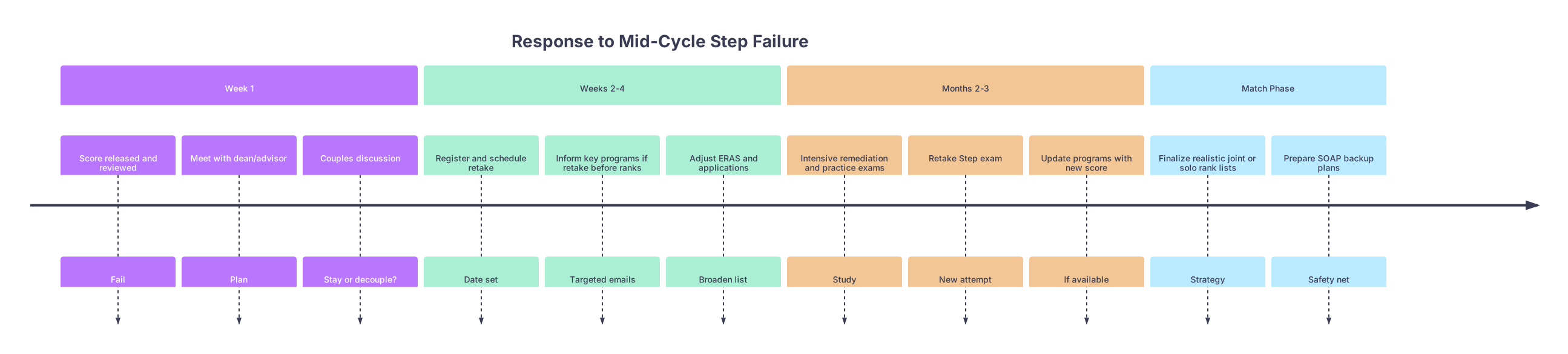
Visual: Simplified Couples Response Timeline
| Period | Event |
|---|---|
| Week 1 - Score released and reviewed | Fail |
| Week 1 - Meet with dean/advisor | Plan |
| Week 1 - Couples discussion | Stay or decouple? |
| Weeks 2-4 - Register and schedule retake | Date set |
| Weeks 2-4 - Inform key programs if retake before ranks | Targeted emails |
| Weeks 2-4 - Adjust ERAS and applications | Broaden list |
| Months 2-3 - Intensive remediation and practice exams | Study |
| Months 2-3 - Retake Step exam | New attempt |
| Months 2-3 - Update programs with new score | If available |
| Match Phase - Finalize realistic joint or solo rank lists | Strategy |
| Match Phase - Prepare SOAP backup plans | Safety net |
Quick Reality Check: Specialty-Specific Flexibility
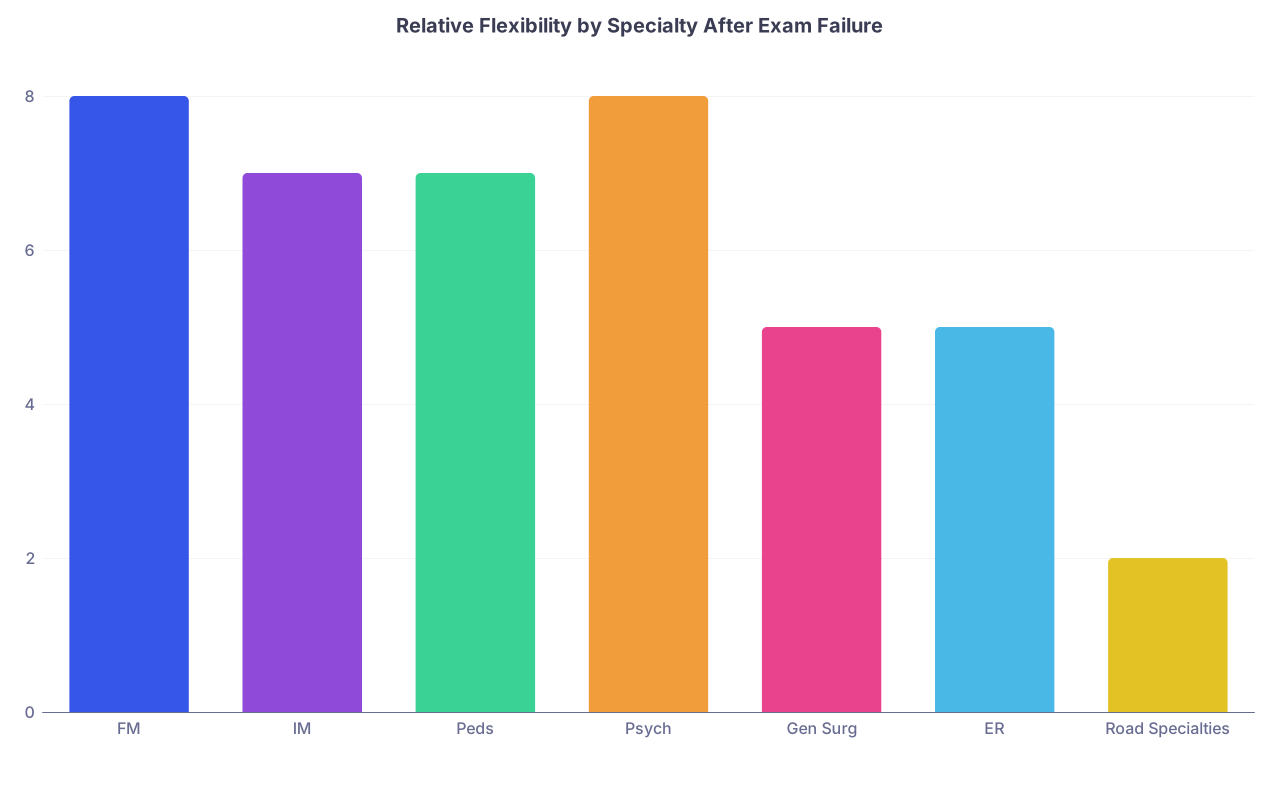
Some specialties will forgive an exam failure more readily than others, especially if you retake with a strong score.
| Category | Value |
|---|---|
| FM | 8 |
| IM | 7 |
| Peds | 7 |
| Psych | 8 |
| Gen Surg | 5 |
| ER | 5 |
| Road Specialties | 2 |
Scale 1–10, higher = more flexible on exam missteps (not scientific, but very close to how PDs talk about this behind closed doors).
If the failing partner is in FM, IM, peds, psych, you have more leeway to stay coupled and widen your list. If they’re chasing derm, ortho, ENT, plastics with a fail mid-cycle, that’s fantasy territory now—pivot discussions should be on the table.
Final Notes: What Actually Matters Most
Let me strip this down.
When one partner fails Step 1 or Step 2 CK mid-cycle in Couples Match, there are only a few things that truly decide how bad the damage is:
- How fast you face reality and adjust your plan
- Whether you protect at least one of your careers from going completely off the rails
- Whether you can talk to each other like teammates instead of adversaries
Everything else—prestige, city, program “vibe”—is secondary. You can recover prestige later. You cannot practice medicine without a residency.
If you’re in this situation right now:
- Get your timeline from the school.
- Decide together whether you’re staying coupled this year or not.
- Build a rank list or gap-year plan that respects the new reality, not the old fantasy.
Do those three things cleanly, and this becomes a hard year, not a career-ending one.


