

Couples match lists do get special attention—but not in the way you probably think.
People imagine some romantic subcommittee carefully pairing your dreams: “Oh, they want Boston together, let’s see what we can do.” That’s not how this works. There’s no love story in the rank meeting. There’s math, risk management, and a lot of, “Are we okay taking this hit for this one applicant?”
Let me walk you into an actual rank meeting and show you what really happens when your name is followed by: “Applicants are participating in the NRMP Main Match as a couple.”
First: The One Big Lie About Couples Matching
The lie is this: “Programs don’t see or care that you’re in the couples match. They just rank you as an individual.”
Wrong.
On paper, the algorithm treats you as a pair. True. But inside programs, once you’re on the radar and someone likes you, the couples part becomes a variable in your file.
Here’s how it really works:
Someone on the committee says:
“Just a note—this applicant is couples matching with an EM applicant at County.”
Or:
“They’re couples matching with someone applying here in peds.”
Suddenly, you’re no longer just “Applicant 174.” You’re:
- “Solid IM applicant, couples with our #3 EM candidate,” or
- “Borderline prelim surgery, couples with an unmatched FM applicant who didn’t rotate.”
Committees do not modify the algorithm. They modify your risk profile. And that risk shows up in rank discussions.
How Committees Actually Find Out You’re Couples Matching
Programs don’t get some magical live feed of pairings from NRMP during the season. But they know you’re couples matching much more often than you think. Here’s how that really happens.
You or your partner mention it in your application or personal statement.
“I am participating in the couples match with my partner who is applying in pediatrics.” Classic line. It flags you early.You mention it on interview day.
Often when asked, “Where else are you applying?” or “What are you looking for in a program/location?” you slip in, “I’m in the couples match because my partner is also applying in this city.” Now it’s in the interviewer’s notes.Your partner has rotated there.
EM, surgery, IM, peds—if one of you rotated and the chiefs or PD know you’re a couple, it spreads. People say the quiet part out loud: “They’re couples matching, other partner is in OB/GYN.”Emails and phone calls behind the scenes.
If you’re a strong candidate and your home program is advocating, they’ll say things like:
“Just so you’re aware, she’s couples matching with an anesthesiology applicant who’s also very competitive.” This gets brought up in meeting.
Once that info exists, it becomes part of your narrative in the rank room, even if it’s never written in your official file.
Where in the Rank Meeting Couples Status Actually Comes Up

| Step | Description |
|---|---|
| Step 1 | Applicant File Review |
| Step 2 | Preliminary Score Assigned |
| Step 3 | Rank List Draft Created |
| Step 4 | Full Committee Rank Meeting |
| Step 5 | Keep Default Rank |
| Step 6 | Discussion of Red Flags/Strengths |
| Step 7 | Assess Risk/Benefit of Ranking |
| Step 8 | Applicant Discussed in Detail? |
| Step 9 | Couples Status Known? |
Couples status matters in exactly one place: when a real human being decides how high to rank you—or whether to keep you on the list at all.
The steps look more like this:
Pre-meeting scoring.
You get a numeric score or “bucket”: high, medium, low. At this stage, couples matching usually does not change your score. This is about your qualifications only.Draft rank list creation.
Someone (PD, APD, or coordinator) sorts applicants by score and creates a provisional rank list.Rank meeting.
This is where it gets interesting. For borderline cases, “couples match” becomes a talking point.
Typical conversation (I’ve heard this almost verbatim):
Faculty 1: “I liked her a lot.”
Faculty 2: “She’s couples matching with an ortho applicant in town, pretty strong guy.”
PD: “What are the odds they both end up here?”
Faculty 2: “Low, unless ortho is really into him. But if we bump her up ten spots and she doesn’t match here because of the couple, we lost those ten spots.”
PD: “We’re not rearranging for a couple we can’t control. Keep her where she is.”
That’s the reality. They care, but they’re not restructuring their whole list for you.
How Risk Really Looks From the Program Side
Programs don’t talk in feelings. They talk in risk and yield.
Here’s the mental math that goes through a PD’s head with couples matching:
- “If we rank this person at #5 and their partner doesn’t match nearby, we might ‘burn’ this spot.”
- “If they’re couples matching with someone else we love, we might get two excellent residents out of this.”
- “If their partner is in a competitive specialty and unlikely to land here, our chance of getting this applicant just dropped.”
So they start quietly stratifying your risk.
| Couples Situation | How Programs See It |
|---|---|
| Both strong, both competitive locally | Low risk, high upside |
| You strong, partner much weaker | Moderate risk |
| You weaker, partner very strong at program | Higher risk but tempting |
| Different cities as backup, very vague | High risk, unclear plans |
They don’t say this out loud on Zoom for you to hear, obviously. But in the room, people absolutely say:
- “We’re going to lose them to X City if their partner matches there.”
- “They were clear they’ll prioritize being together. We may be wasting a high spot.”
Your couples narrative—how consistent and believable your plan is—directly affects how much they’re willing to gamble on you.
The Myth of “We Build Around Couples”
At big-name places, building a rank list around a couple is rare. It happens, but only for a very specific type of pair:
- Both are clearly top-tier in their fields.
- Both are ranking that institution or city #1.
- Both have advocates inside the department.
That’s when you’ll see actual coordination, like:
“IM has her at #4, EM has him at #6. Do we both want to move them up a bit to increase the chance of landing both?”
Most of you are not that couple. That’s just reality. And even when programs want to coordinate, they’re still constrained by fairness, politics, and other candidates.
Let me tell you what “building around couples” really looks like in the wild:
Scenario 1: Two strong applicants, same institution, aligned
IM and Peds both like their respective half of the couple. They both rank them relatively high. PDs talk.
Conversation:
IM PD: “Where do you have her?”
Peds PD: “Top 5.”
IM PD: “We’re at #7. If we both bump one or two spots, we increase the odds we get them. I’m okay with that.”
Peds PD: “Same.”
This kind of coordination is subtle. One or two spots. Not “we rebuilt the list around you.”
Scenario 2: One strong, one borderline
Anesthesia PD loves him. FM PD sees her as marginal.
FM PD: “She’s fine, but we’ve got stronger folks above her. I’m not moving against my own middle tier for this couple.”
Anesthesia PD: “I get it. I’ll still rank him where he belongs. If it works, great. If not, oh well.”
Here, being in a couple doesn’t help the weaker applicant. It just makes both programs more cautious about their expectations.
Scenario 3: One program is indifferent
EM loves their applicant. IM is lukewarm on theirs.
IM may quietly drop the couples applicant lower than they otherwise would. Why? Because:
“If we rank them high and EM doesn’t get their partner here, we wasted that high slot.”
Again: risk and yield.
What Your Rank List Looks Like to Them (And Why Their Rank List Doesn’t Bend That Much)
Let’s break down how your couples list interacts with program lists, because there’s a huge misunderstanding here.
You build a couples list with paired choices like:
- (Program A – IM / Program A – EM)
- (Program A – IM / Program B – EM)
- (Program C – IM / Program A – EM)
- (Program D – IM / No match)
- (No match / Program E – EM)
You think: “We gave them so many options, they’ll find a way to fit us in.”
What’s actually happening on their side:
- IM has you ranked at #15.
- EM has your partner at #7.
- Neither program sees or uses your pair list; they just submit their own individual rank lists and walk away.
The only place your pairs matter is in the NRMP algorithm, after everyone has finalized.
In the rank room, the only controllable variable is: “Where on our list do we put this specific applicant, knowing they’re in a couple and may or may not land here depending on their partner?”
That’s it. No one is sitting there cross-referencing your pairs in real time. They don't have that information anyway.
How Being in a Couple Can Quietly Hurt You
You asked for the real story. Here it is.
Being in a couples match can help you at the margin—if both of you are strong and aligned with that institution or city. But there are very real ways it can hurt you behind closed doors.
I’ve watched it play out like this, multiple times:
The “flight risk” label.
You spend the whole interview emphasizing “We really want to be together” and “Location is our biggest priority.” The committee hears: “If their partner gets a better offer elsewhere, they’re gone.”Someone says: “They’re couples matching and pretty open geographically. I wouldn’t spend a top-10 slot on them.”
The “emotional volatility” worry.
Whether fair or not, some PDs are blunt:
“If one of them matches here and the other doesn’t, are we about to inherit a massive morale problem?”They don’t say that on a webinar. They say it in the rank meeting.
The “too many conditions” problem.
If you sound overly conditional—“Only this city,” “Only if together,” “We’re not sure what we’ll do if we separate”—you become a more complicated investment.
Programs want people who want them, not a hypothetical joint situation that might or might not include them.
How Being in a Couple Can Quietly Help You
Now the upside. Because there is one if you play it correctly.
When both of you are strong, reasonable, and clear, committees will absolutely have conversations like:
“If we get him, there’s a decent shot we get her too.”
“They both loved us, both from this region, both seem very stable.”
“Let’s not lose them just because we were too conservative.”
I’ve seen:
- An IM applicant nudged up 5–10 spots because their partner was a high-priority applicant in EM at the same institution.
- A slightly weaker peds applicant kept on the list (instead of being dropped entirely) because their partner was an absolute rockstar in neurology and both wanted to stay locally long-term.
The couples match becomes a tiebreaker or a reason not to cut you. Not a massive rank-list reshuffle, but a nudge. And those nudges can be the difference between matching there and not.
The One Thing That Changes Everything: How You Talk About Your Plans
This part most students get wrong. The words you use in interviews directly shape how risky you look in that rank meeting.
Here’s what committees hate hearing:
- “We’ll go wherever we both match, we’re totally open.”
- “We just want to be together, that’s the most important thing.”
- “We’re ranking a lot of different cities and we’ll see how it goes.”
That translates inside the room to: “They’ll leave us for a better couple outcome.”
What they prefer to hear:
- “We’re couples matching, but we’d each be happy here independently. This city and program fit both of our goals.”
- “We’ve built our list so that we have multiple ways to end up in this region, even if we’re not at the exact same hospital.”
- “Being together matters, but this program is high on my list because of X, Y, Z specific reasons.”
Then the discussion shifts from:
“Are we wasting a spot?”
to
“We might realistically get them even if the couples part gets messy.”
You sound less like a liability and more like a committed recruit who happens to be in a couple.
What Programs Actually Know About Your Partner
One more secret: committees sometimes have very incomplete information about your partner and still make assumptions.
Here’s what they might know:
- Partner’s specialty.
- Partner’s general competitiveness (from your school letter, a phone call, or vague gossip).
- Whether partner is applying locally or not.
What they don’t have:
- Your exact couples list.
- The full story on how many interviews your partner has or where.
- How realistic your “we’ll be happy here no matter what” line actually is.
So they fill the gaps with:
- “Partner is in derm / ortho / plastics? High risk they go wherever that partner gets in.”
- “Partner is in FM / peds locally with many options? Lower risk—they’ll probably land somewhere nearby.”
- “Partner has very few interviews? They might prioritize the one place that will take both.”
This is why having a consistent, realistic story across both of your interviews is crucial. When information is patchy, doubt creeps in.
Visualizing the Real Tradeoff: Program Risk vs. Couples Benefit
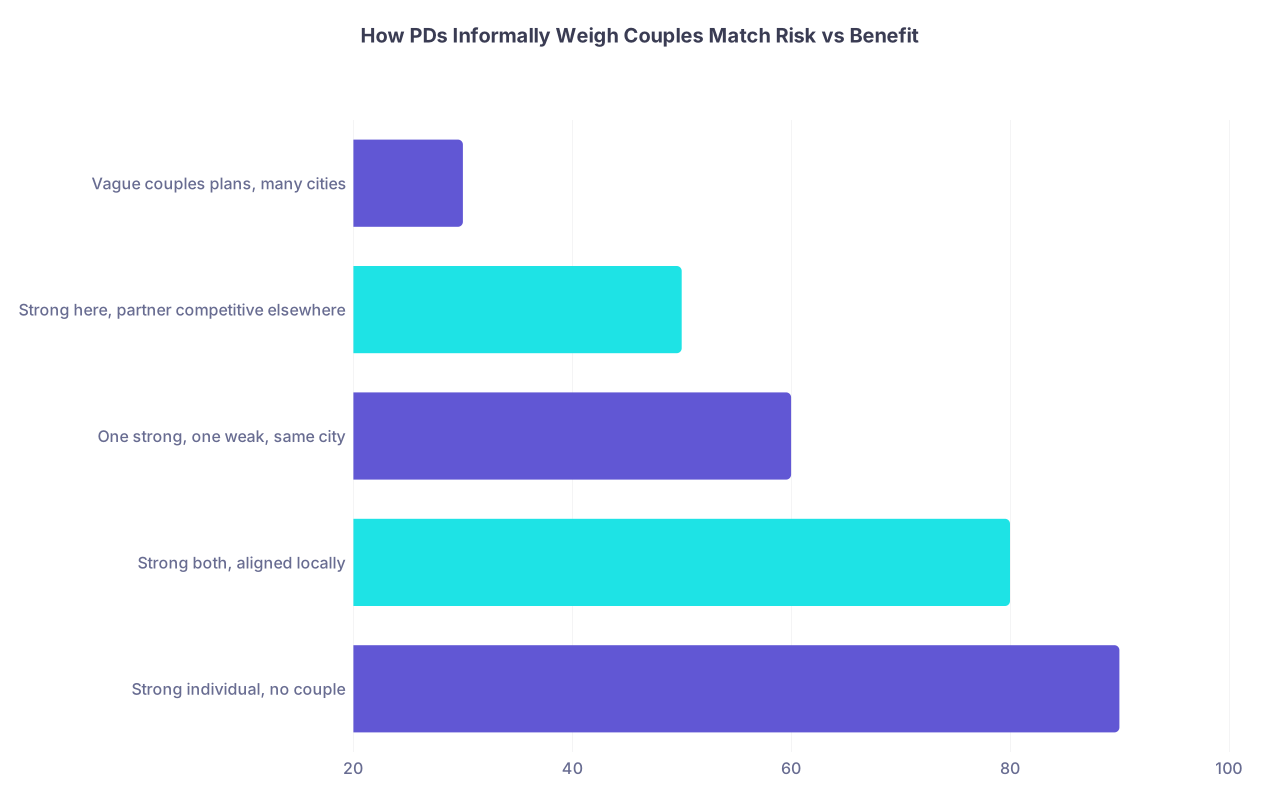
| Category | Value |
|---|---|
| Strong individual, no couple | 90 |
| Strong both, aligned locally | 80 |
| One strong, one weak, same city | 60 |
| Strong here, partner competitive elsewhere | 50 |
| Vague couples plans, many cities | 30 |
Interpretation, the way a PD would talk about this:
- Strong individual, no couple: almost pure upside.
- Strong both, same city: some risk, but high upside if they land both.
- One strong, one weak: moderate risk; might drag decision-making.
- Strong here, partner likely elsewhere: big risk of losing the one they want.
- Vague couples plans: lowest yield, easiest to drop lower.
Again, no one is drawing the above chart on a whiteboard in the room, but this is the mental calculus.
How to Play This Game Without Sabotaging Yourself
You can’t control the algorithm. You can’t sit in on the rank meeting. But you can control the way you’re perceived when couples status comes up.
Very specific, non-fluffy strategies:
Coordinate your narrative.
You and your partner need the same story about:- Priority region(s)
- How you’d feel about being in different programs in the same city
- How high this particular institution is on each of your lists
Inconsistency kills confidence.
Signal genuine interest independent of the couple.
Say explicitly: “If I weren’t in a couple, this would still be one of my top choices because…” and fill in specifics unique to that program.That line often gets quoted in the rank meeting.
Don’t overplay the drama.
Crying in interviews about how devastating it would be to be apart? That does not make programs more likely to take a risk on you. It makes them nervous about the downstream fallout.Keep your “backups” realistic.
Programs can sniff out pure fantasy: “We’re ranking all the big cities first and then we’ll see.” That tells them you haven’t really thought this through. Well-thought-out regional clusters sound safer.
FAQ – Couples Match Rank Meetings
1. Do programs see our actual couples rank list?
No. They never see your paired combinations. They only see your individual application and maybe that you’re in the couples match. The pairing magic happens entirely inside the NRMP algorithm after all programs have turned in their completely separate rank lists.
2. Can being in the couples match cause a program to rank me lower than they otherwise would?
Yes, absolutely. If you seem likely to leave for a better couple outcome, or your story sounds chaotic or unrealistic, some programs will quietly drop you a tier or not push you as high as your raw application might justify. They don’t announce this. But it happens.
3. How often do programs actively coordinate to match both people in a couple?
Less often than people think. True coordination—two departments deliberately nudging both of you up their lists—is usually reserved for couples where both are strong, both are clearly committed to that institution/region, and both departments like their respective applicant. Most of the time, “coordination” is one or two rank spots here and there, not a full reshuffle.
If you remember nothing else:
Programs don’t reorganize their world around your relationship; they weigh you as a slightly higher-risk, sometimes higher-upside candidate. Your job is to sound like someone they’d want even if the couple part vanished. And the more coherent and grounded your joint story is, the more likely your name gets the benefit of the doubt when it comes up in that rank room.


