

It’s 8:05 pm on a Tuesday. The interview day is over. The program director, a couple of associate PDs, and two residents are sitting around a conference table with a lukewarm pizza box in the middle. Laptops open. ERAS pulled up.
They’re going candidate by candidate.
Your name pops up. Your file has a bright yellow note: “Partner applying in same specialty, wants to be in same city. See supplemental response.”
Now the question that matters:
“Is this relationship a headache for us… or an asset?”
You think “relationship status” is a soft detail. Background color. The thing you throw in the “Personal” section to sound human.
It’s not.
In PD meetings, your relationship status—especially in a couples match scenario—gets talked about more than you’d like, and differently than you’d expect. Sometimes you’re gold. Sometimes you’re a walking scheduling crisis. Occasionally, you’re a giant red flag.
Let me walk you through what actually happens behind those doors.
What PDs Really Care About (And Where Your Relationship Fits)
First, strip away the romantic framing. From the program’s perspective, your relationship is operational risk or operational stability. That’s it.
They’re thinking:
- Will this person stay for all 3+ years, or are they a flight risk if the relationship implodes or the couples match fails?
- How hard is it going to be to make this work with call schedules, block structures, and our own match needs?
- Are we getting one good resident plus another good resident? Or one strong and one clearly weaker applicant we’re being “nudged” to accommodate?
- Is this person going to advocate for themselves… or are they going to blow up halfway through intern year because they resent their partner’s schedule?
Your relationship status gets filtered through those questions.
So you need to understand how you’re being labeled in that room: red flag, neutral, or asset.
And make no mistake: they do label you.
The Three Buckets PDs Put Couples Into
Most programs, whether they admit it out loud or not, are sorting couples match applicants into rough categories.
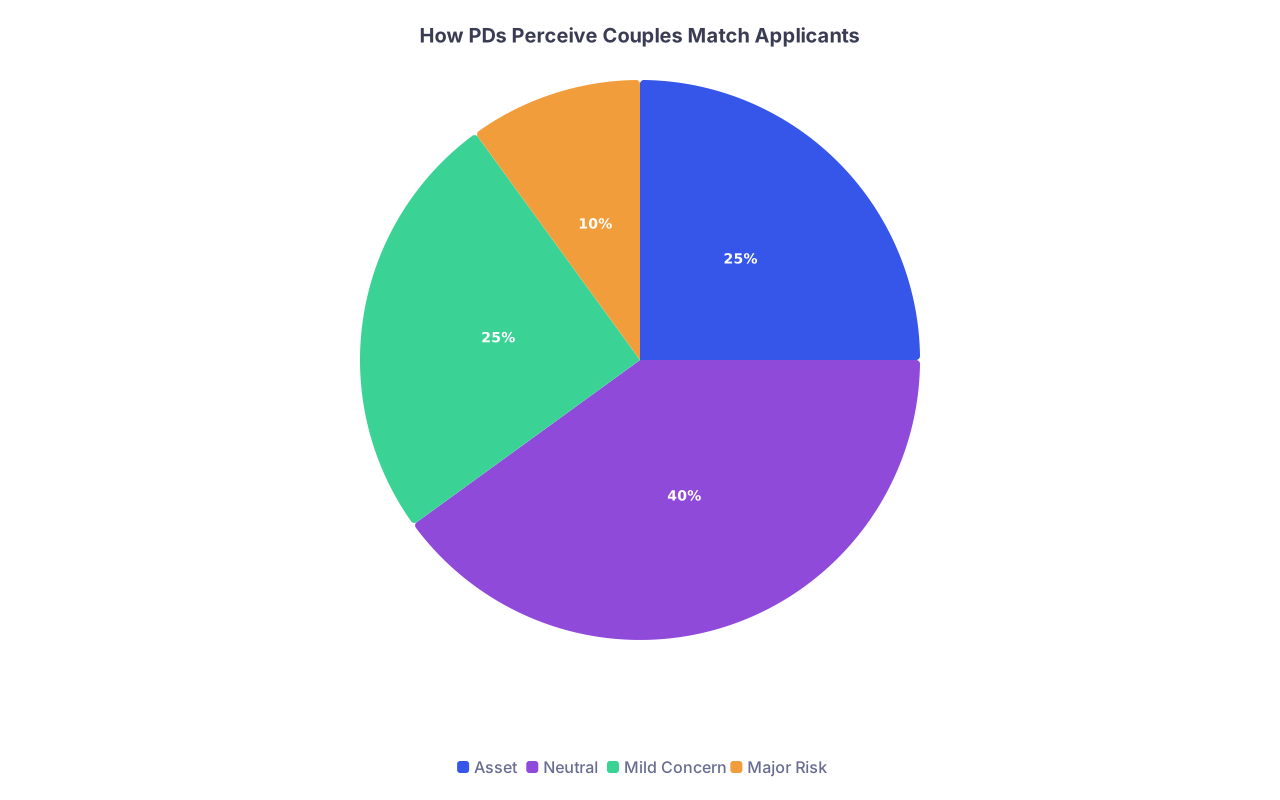
| Category | Value |
|---|---|
| Asset | 25 |
| Neutral | 40 |
| Mild Concern | 25 |
| Major Risk | 10 |
I’ve sat in rooms where the exact words were used:
“Good couple.”
“High maintenance couple.”
“This is a problem couple.”
Here’s how they decide which one you are.
1. The Asset Couple
This is the dream scenario from the PD side.
You and your partner are both strong on paper. Not clones, not perfect, but clearly above the program’s usual cutoff. You’re not asking for magic, just proximity and some reasonable consideration.
This is the couple where the PD says:
“If we can get both of them, that’s two high-yield residents who are much more likely to stay, be happy, and not jump ship.”
What makes you look like an asset:
- Both of you are independently rankable without “bending” standards.
- Your communication is clear and not demanding. You tell programs your priorities, not ultimatums.
- Your stories in interviews line up: similar geographic priorities, consistent explanations of how you’re thinking about the couples match.
- You’re realistic. You’re not two mid-tier applicants demanding a double match at a hyper-competitive academic mecca that’s already drowning in 260s.
Programs like to fill with asset couples because you come pre-packaged as stability. A happy couple integrated into the program often means fewer mid-year crises, fewer transfers, and a more predictable coverage picture.
When PDs see this type, they start to strategize how to help you land together in their city. Not because they’re romantics. Because it’s good business.
2. The Neutral Couple
This is the majority category.
You and your partner are fine. You’re not swinging the needle up or down much. The program will rank you if they like you. They’ll rank your partner if they like your partner. Your couple status is more of a scheduling puzzle than a deal-breaker.
In the PD meeting, this sounds like:
“We’ll rank them both where they fall. If it works out together, great. If it doesn’t, we’re not re-writing our list to force it.”
What keeps you in neutral territory:
- One of you is stronger, the other is borderline-but-acceptable.
- Or both of you are slightly above average but nothing special for that program.
- Your couples narrative is present, but not central to your whole pitch. You’re not making your relationship the main selling point.
PDs don’t hate neutral couples. They just aren’t going to re-engineer their entire rank list for you. They will let the algorithm and your couple rank strategy do most of the work.
3. The Problem Couple
This is where “relationship status” becomes a red flag.
There are a few classic red flag patterns:
- The rescue request: One strong candidate + one clearly weak candidate, and the strong one is openly or subtly asking the program to pull up the weaker partner. PDs hate this dynamic. They know exactly what they’re being asked: “Will you lower your bar for my partner so I don’t have to be apart from them?”
- The emotional hostage case: The candidate who is excessively dramatic about their relationship — “We absolutely cannot function in different cities,” “If we don’t match together we might have to quit,” that kind of talk. That sounds like risk.
- The inconsistent couple: PDs talk. If you tell one program you’re flexible about geography and another that you’re dead set on City X with your partner, it gets around. Residents compare notes too. Inconsistency smells like drama.
Behind closed doors, you’ll hear this:
“I love her as a candidate, but this partner situation is a mess.”
“This could become a monthly scheduling negotiation.”
“We’re not handcuffing ourselves to that.”
The harsh truth: if you present as a problem couple, your relationship absolutely hurts your individual ranking. Even if one of you is otherwise stellar.
How Your Relationship Status Is Actually Discussed in PD Meetings
Let me show you how this looks in real conversation, because it’s rarely as formal as applicants think.
Imagine this: mid-sized IM program, decent academic reputation, not Ivy, but not community either. They’re going candidate by candidate.
Candidate A: Single. Strong Step 2. Solid LORs. Done. 30 seconds.
Candidate B: Couples matching with general surgery at another local hospital. Good but not amazing file.
The PD turns to the APD who interviewed Candidate B.
“What’s their deal with the partner?”
APD: “They’re couples matching with Surgery down the road. They said their first priority is being in the same city, but they’re open to different institutions. They’re fine if their partner matches at Hospital X and they’re here.”
Resident rep: “I interviewed them too. They seemed pretty grounded about it. Talked more about our program than the relationship.”
PD: “Okay. Where would you put them? Independent of the couple.”
Then the program ranks Candidate B pretty much as if they were single. Relationship = neutral, maybe slight plus if they like the idea of partnering with the other hospital.
Now contrast that with Candidate C.
Candidate C: Very strong on paper. But in the interview, every answer came back to the partner. “My partner, my partner, our relationship, our plans, we can’t be apart, we’ve done long distance before and it was awful, we’re terrified…”.
In the PD meeting:
APD: “She’s great but I’m a little worried. She’s couples matching with EM. They only applied to 15 cities. She emphasized multiple times that she’d be devastated if they were separated.”
Resident rep: “Yeah, I got that too. She said being in the same place is more important than program type.”
PD pauses.
“Okay… rank her where she deserves academically, but be aware: if they don’t both end up in the same city, she may be a retention risk. We’re not going to chase the partner to make this work.”
What you do not see is some romantic, sweeping, “We must keep this couple together forever.” That’s the fantasy version applicants have in their heads.
The reality is: PDs are reading for stability, maturity, and how much extra work you’ll create for them.
When Your Relationship Is a Quiet Asset
Now, here’s the part almost nobody tells you: used correctly, your relationship status can absolutely help you in ways you don’t see.
Not because you’re “cute together.” Because you signal lower risk.
Programs worry a lot about early attrition and transfers. Losing a resident mid-year is a nightmare. More call coverage. More angry chiefs. More GME paperwork.
When they see:
- A dual-physician couple
- With coherent geographic priorities
- With realistic specialty expectations
- Who talk about building a life in X region, raising a family there, or having long-term ties
They see stickiness. Less chance you’re going to bail for “my partner matched across the country and I’m miserable here.”
I’ve seen PDs nudge couples up a little on the rank list for this reason alone. Not a huge leap, but enough to matter at the margins.
Example:
At one midwestern IM program, there was a couple—FM + IM—both solid but not spectacular. On paper, they were a little below what the program normally pulled in for IM. But they had deep ties to the region. Families nearby. Partner matching FM at a strong community program 10 minutes away.
PD in that room:
“They’re both going to stay. They’re both going to be solid workhorses. They’ll be happy. No relocation drama. I’d rather have them than a single 260 who leaves after PGY-1.”
They got bumped up a few slots. They matched there. Everyone was happy.
That’s how a relationship becomes an asset: you frame it as an anchor, not a demand.
Where Relationship Status Becomes a True Red Flag
Now let’s talk about the ugly side.
There are a few patterns that make PDs visibly tense when couples come up.
1. The “We Come as a Package” Threat
If you make it sound like you’re issuing a condition:
“We’re ranking programs almost entirely based on where we can both match together.”
or worse…
“We’re not going to rank places where we can’t guarantee matching together.”
Programs hear: We’re more loyal to each other than to any program, and we’re willing to bail if things don’t align perfectly.
They’re not going to fight for you in that scenario. The algorithm already handles couples matching. They’re not signing up for someone who might resent them from day one.
2. The Emotional Overshare
PDs are not your therapist.
When you talk about your relationship in interviews, there’s a line between human and unstable.
If you’re saying things like:
- “We really struggled as a couple during Step studying.”
- “We had a really hard time when I did away rotations; we almost broke up.”
- “I’m really anxious about being apart.”
That reads as volatility. They imagine you spiraling during a tough ICU month because your partner is on nights at another hospital.
They don’t want that risk.
3. The Hidden Relationship That Suddenly Becomes Central
Another red flag is the opposite: you hide the relationship entirely in your application and then suddenly drop it in a panicked email mid-season.
Example: you interview, don’t mention your partner once, then send this:
“Dear Dr. X, I wanted to update you that I’m actually couples matching with my fiancé at Hospital Y across town. Your program is our top choice if we could coordinate together. Is there any way you can adjust my position on the rank list?”
I’ve seen PDs react very badly to this. The message is: “I wasn’t transparent, and now I’m asking for special treatment late in the game.”
If your relationship is consequential to where you’ll train, hiding it until the end looks strategic and disingenuous.
How to Talk About Your Relationship So It Helps You
You cannot control what PDs say in that room, but you can control the frame you hand them.
Your goal: give them enough information to see your relationship as a stabilizing factor, not a burden, without turning your whole candidacy into a relationship story.
Here’s what consistently plays well:
Simple, calm facts.
“My partner and I are couples matching in Internal Medicine and Pediatrics. We’re primarily interested in being in the same city, and we’ve applied broadly within this region.”Priorities that still respect program quality.
“We care a lot about being close, but we’re also each independently ranking programs based on our fit, training, and long-term goals.”Zero ultimatums.
You never say: “We must be in the same hospital,” or “We won’t rank a place unless…”Mature framing.
You acknowledge reality:
“We understand the couples match algorithm can be unpredictable, so we’ve tried to be realistic and flexible with our lists.”
That’s the kind of language that, when re-told in a PD meeting, sounds like:
“They’re mature, they get it, they’re not going to be a nightmare if things don’t land perfectly.”
Specific Behind-the-Scenes Dynamics in Couples Match
There are a few extra layers you should be aware of that no one tells you in info sessions.
Cross-Program Whisper Networks
If you and your partner are applying to different programs within the same hospital, or different hospitals in the same city, conversations happen.
I’ve seen this:
IM PD emails EM PD across town:
“Hey, we like Candidate X. You guys going to rank Partner Y decently?”
Or vice versa:
“Saw you’ve got Candidate A couples matching with our Candidate B. What did you think of them?”
They are not re-building their lists around you, but they do calibrate. Especially in smaller cities where GME leadership is tight-knit.
Strong couple that both programs like? You might both creep a bit higher.
Messy couple with a big performance imbalance? Both programs get cautious.
The “We’ll Help, But Only So Much” Ceiling
Programs will sometimes do low-level accommodations:
- Being aware of your partner’s interview dates in the city so they can cluster yours.
- Slightly bumping you if they believe it helps land a pair they like.
- Coordinating with a sister program across town.
What they will not do is:
- Take someone clearly below their bar only to land the stronger partner.
- Destroy their rank strategy to engineer a perfect couples outcome.
There’s always a line where they stop and say, “We have to protect our own board scores / fellowship pipeline / reputation.”
And they’ll choose that over you. Always.
What If You’re the Stronger Partner?
This is the most uncomfortable truth in couples match, and it drives a lot of anxiety.
If you’re clearly the stronger candidate, PDs are looking at you and thinking:
“Are they going to be unhappy if we don’t rank their partner highly enough? Are we signing ourselves up for resentment?”
Here’s how you lower that concern:
- You must present as fully committed to your own specialty and training path, not just following your partner.
- You openly acknowledge your partner may end up at a different tier program or a different zip code and you’re prepared to handle that as adults.
- You never suggest, directly or indirectly, that you expect programs to pull your partner up.
I’ve seen strong candidates salvage this dynamic by being explicitly mature about it in the interview:
“I know our applications aren't carbon copies. We’ve both tried to build lists that make sense individually and together. We’re obviously hoping to end up nearby but we also understand we may not match at the exact same type of program, and we’re prepared for that.”
When that gets relayed in the PD meeting, what they hear is:
“They are not going to punish us if the partner doesn’t land perfectly.”
That keeps you rankable at your true level.
How Singles Are Viewed in Contrast
Let’s be honest: your competition is not other couples. It’s mostly single applicants or people whose relationships don’t influence geography.
PDs like straightforward. A single applicant with no big geographic constraint is simple.
- No couples algorithm constraints.
- No concern about a partner elsewhere pulling them away.
- No need for cross-program coordination.
So if you want your relationship not to hurt you, you have to be as simple, predictable, and low-drama as the single people. Or at least close.
You don’t have that built-in flexibility. Fine. Then you offset it with maturity, consistency, and clear communication.
The PD’s Mental Math: Your Relationship in One Sentence
By the end of the meeting, every PD has a one-sentence internal summary of you.
For a couples match applicant, it’s usually some version of:
“Strong IM applicant, couples with EM, wants Midwest, realistic and flexible, no red flags.”
or
“Good candidate but relationship-driven, big demands, might be trouble if separated.”
You want that sentence to sound boring. Almost dull. Because boring reads as safe.
If the summary in their head is complicated, emotional, or conditional… you’re losing ground to equally qualified singles.
Final Takeaways
Condensed to what actually matters:
- Programs see your relationship as either risk or stability, not romance. Your job is to frame it as an anchor, not a demand.
- The biggest red flags are desperation, ultimatums, and asking programs to rescue a weaker partner. Those will drop you on rank lists.
- Couples who are transparent, consistent, and clearly committed to their own training—while being flexible about logistics—quietly get nudged upward, because PDs bet on them to stay and function.
Play your relationship like an adult, not a storyline. That’s how you survive those 8 pm PD meetings.


